
My daughter-in-law left me five hundred zlotys in an envelope every month “for helping with the children.” I had never asked her for the money. For two years, I thought it was simply her way of showing her gratitude.
Until I got sick.
For two days, I lay in bed with a high fever and was unable even to walk down the stairs. When I felt better, I returned to taking care of my grandchildren as if nothing had happened.
Yesterday, Kinga brought another envelope.
Instead of five hundred zlotys, there were four hundred and fifty inside.
And beside the money was a small note.
“I deducted the two days you were absent. Proportional amount.”
I stared at those words for what must have been ten minutes.
And that was when I finally understood that for two years, she hadn’t been giving me a thank-you.
She had been paying me.
—
When I retired four years ago, I was afraid my life would suddenly become empty.
I had worked in accounting at a construction company in Częstochowa for thirty years. Every day had its own rhythm. Documents, phone calls, invoices, coffee at ten, lunch after I came home.
And then it all ended.
My husband, Henryk, had passed away the year before. The apartment that had once seemed so cozy suddenly felt enormous.
Silence can be very loud when you are left alone with it.
So when Grzegorz and Kinga asked whether I could sometimes help with Olek and Zusia, I was happy.
Not because I needed the money.
I needed people.
I needed to feel that someone needed me.
Every day at around half past two, I went to pick Olek up from school. Then I picked Zusia up from kindergarten. At home, I made the children sandwiches, helped them with their homework, cooked soup, and sometimes made pancakes.
If Kinga had to work overtime, I stayed until seven.
I never looked at the clock.
They were my grandchildren.
How could you count the hours you spend with your own grandchildren?
The first envelope appeared after about three months.
Kinga placed it on the kitchen counter.
White. No writing on it.
“This is for this month,” she said briefly.
“For what?”
“For helping with the children.”
I didn’t open it in front of her. I took the envelope home.
Only that evening did I look inside.
Five hundred zlotys.
I sat at the table and, for a moment, didn’t know what to do.
I felt strange.
As if someone were trying to pay me for loving my own grandchildren.
I called Grzegorz.
“Son, Kinga gave me money. I don’t need it.”
“Mom, don’t make a problem out of it,” he replied in a tired voice. “She thinks this is the right thing to do. You help us, so she wants to thank you. Take it.”
I took it.
And indeed, I stopped talking about it.
But every time another white envelope appeared on the kitchen counter, I felt a slight pang inside.
It wasn’t about the money.
It was about the fact that someone had placed a cash register between me and my grandchildren.
Kinga never said:
“It’s good that you’re here.”
She never said:
“Thank you for taking care of the children.”
But on the first day of every month, there was always an envelope.
Five hundred zlotys.
Like a subscription.
—
Two weeks ago, I got sick.
It wasn’t an ordinary cold or a mild illness.
I had a fever of almost forty degrees, every bone in my body hurt, and for two days I could barely get out of bed.
On Monday morning, I called Grzegorz.
“Son, I won’t be able to come and pick up the children today. I can barely stand.”
“Mom, don’t worry. Lie down and rest. We’ll manage somehow.”
On Tuesday, I still had a fever.
By Wednesday, I felt better, so I went to pick up my grandchildren.
When Olek saw me, he immediately threw his arms around me.
“Grandma, I missed you so much!”
I smiled.
And I thought that those few words were worth more than all the money I had ever received.
Yesterday, Kinga came to pick up the children.
Zusia was running around the room, while Olek was finishing a drawing at the table.
As usual, Kinga placed the envelope on the counter.
“For this month,” she said, fastening Zusia’s coat.
I didn’t even look at it.
I waited until they left.
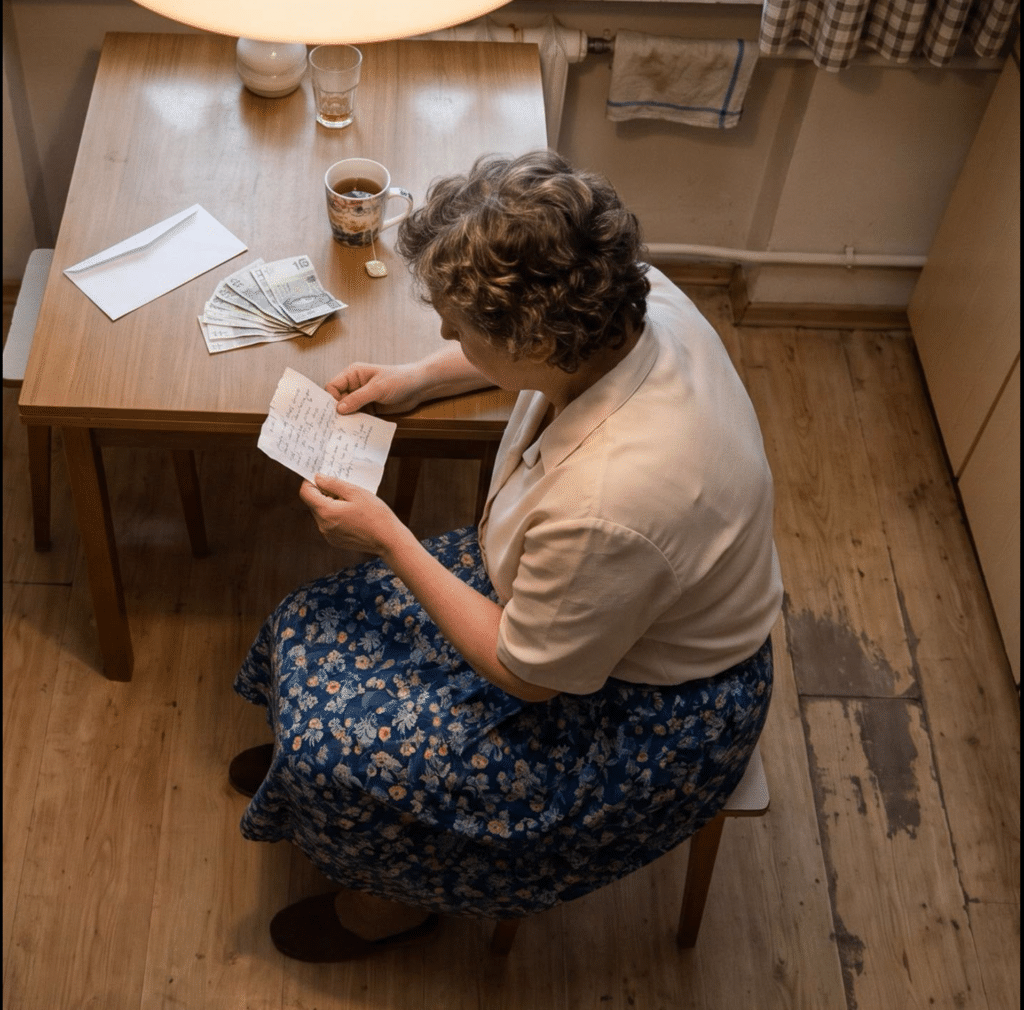
Only then did I open the envelope.
I took out the banknotes.
I counted them.
Four hundred and fifty.
I frowned.
At the bottom of the envelope, I found a note.
“I deducted the two days you were absent. Proportional amount.”
I read it once.
Then a second time.
And a third.
Suddenly, everything became clear.
It wasn’t gratitude.
It was accounting.
For two years, I had allowed myself to believe that the money was a gesture.
Meanwhile, someone had been keeping a record.
Two days of illness.
Minus fifty zlotys.
I sat at the table, staring at that note, while the tea beside me had long since gone cold.
One word hurt me more than anything.
“Absence.”
As if I were an employee who hadn’t shown up for work.
—
That evening, I called Grzegorz.
“Son, Kinga deducted money from me for those two days when I was sick.”
He was silent for a moment.
“Mom… you know what she’s like. She’s practical. Don’t take it personally.”
“Grzesiu.”
I said it exactly the way I used to when he was little.
“I had almost a forty-degree fever. I was lying in bed. And your wife deducted money because I didn’t come to look after the children.”
“Well, technically speaking, you were there two days less…”
Technically.
That one word stayed with me long after the conversation ended.
I barely slept that night.
I thought about Zusia, who threw herself into my arms every time she saw me.
About Olek, who showed me his drawings and asked whether his dragon looked scary enough.
About the soup simmering on the stove.
About the children’s laughter filling my apartment.
And about the white envelopes.
For two years, I had held them in my hands and thought: “This is a thank-you.”
But now I saw something completely different in them.
A price list.
—
The next morning, I went to King’s house.
I didn’t call beforehand.
I knocked around ten, when the children were already at school and kindergarten.
Kinga opened the door wearing sweatpants. She was holding a mug of coffee in one hand, and her hair was still wet.
“Kinga, I need to give you something back.”
I took the money from the last envelope out of my purse.
All five hundred zlotys.
I placed the money on the small table in the hallway.
Kinga looked at the banknotes, then at me.
“I don’t understand.”
“I didn’t understand either for two years.”
She fell silent.
“I thought you gave me this money because you wanted to thank me for what I did. But that note explained everything. You’re keeping accounts with me.”
“Teresa…”
“Like a service,” I finished calmly. “I wasn’t there for two days, so you deducted money from my pay. Except I’m not your employee, Kinga.”
I looked straight into her eyes.
“I’m the grandmother of your children.”
I expected anger.
Or a cold response.
Instead, King’s face suddenly changed.
“My mother…” she began.
She stopped.
She put her mug down on the cabinet.
“My mother always said that if you don’t pay someone, eventually they’ll hold it against you. That free help always ends in an argument. I thought this was the fair thing to do.”
I shook my head.
“Maybe that’s how it was with her.”
I sighed.
“But my grandmother never received a single penny from me. And she never expected money. Because not everything in life is a service.”
Kinga said nothing.
We stood there in that narrow hallway, between the coat rack and the shoe cabinet.
She didn’t say “I’m sorry.”
But for the first time in two years, she didn’t say anything about money either.
—
I took the bus home.
Częstochowa was slowly waking up. At the bus stop, an elderly woman was holding a bouquet of yellow tulips. Two women were talking about the price of butter. The driver braked suddenly, and everyone instinctively grabbed the handrail.
I looked through the dirty window at the apartment blocks, courtyards, and benches.
I thought about Kinga.
Maybe all her life she had been taught that every favor had to be paid for.
But I had been taught something completely different.
That there are things in life that cannot be measured in money.
Time.
Closeness.
Family.
Love.
Tomorrow, at half past two, Olek will come out of school.
As always, I will be waiting for him by the gate.
Only this time, I don’t know what I will find on the kitchen counter.
Maybe another white envelope.
Or maybe, for the first time in two years—a simple note.
No amount.
No deductions.
No word “proportional.”
Just:
“Thank you for being here, Grandma.”

