A thick silence filled the apartment, carrying the fading scent of incense and lilies. Mary sat quietly on the edge of the couch, still wearing the black dress she had worn to her grandmother Eleanor Thompson’s funeral. She had just buried the last person in the world she truly considered family.
Across the room sat her husband, Andrew.
Tomorrow, they were supposed to finalize their divorce.
Instead of offering Mary comfort, Andrew watched her with barely concealed irritation. He seemed annoyed that her grief was making the evening longer than he wanted.
After several minutes, he finally spoke.
“I’m sorry for your loss,” he said with a cold smile. “Although I suppose you should be celebrating. You’re a wealthy heiress now, aren’t you?”
Mary said nothing.
Andrew laughed.
“Or did your grandmother leave you something else? Oh, yes. That ancient Frigidaire.”
His words hurt, but Mary had already heard worse from him.
For years, Andrew had treated her grandmother with contempt. Eleanor had never trusted him. From the very beginning, she had warned Mary that Andrew was selfish and dishonest.
“He will leave you with nothing,” Eleanor had often said. “One day you’ll understand why I never trusted him.”
Andrew had always called Eleanor an old witch and laughed at her warnings.
Now Mary remembered those words with painful clarity.
Andrew stood and straightened his expensive jacket.
“And since we’re talking about your future,” he continued, “don’t bother coming to work tomorrow. I fired you this morning. The paperwork is already signed.”
Mary stared at him.
“You’re going to have nothing,” Andrew added cruelly. “Soon you’ll be searching through dumpsters. Maybe then you’ll remember me with gratitude.”
Something inside Mary finally broke.
Not her heart—there was almost nothing left of it where Andrew was concerned.
It was her last hope that he might show some humanity.
Without arguing, Mary went to the bedroom, picked up the bag she had already packed, took the key to her grandmother’s old apartment, and walked out.
The cold Chicago evening greeted her with a sharp wind.
She stood beneath a streetlamp with two heavy bags at her feet and looked at the gray apartment building where she had spent part of her childhood. Her parents had once lived there. After they died in a tragic car accident, Eleanor had sold her own home and moved into the apartment to raise Mary.
Mary had avoided the place for years because every room reminded her of loss.
Now it was the only home she had left.
Tears finally escaped the eyes she had kept dry all day.
Then a small voice interrupted her.
“Ma’am, do you need help?”
Mary turned.
A boy of about ten stood nearby. His jacket was too large, his sneakers were worn, and his cheeks were dirty. Yet his eyes were unusually clear and serious.
He pointed toward her bags.
“Those look heavy.”
Mary wiped her tears.
“I can manage.”
The boy studied her.
“Why are you crying?”
Mary was surprised by the direct question.
“Happy people don’t stand in the middle of the street with suitcases and cry,” he added.
For the first time that day, Mary almost smiled.
“My name is Sam,” the boy said.
“Mary.”
She looked at the bags.
“Okay, Sam. Help me.”
Sam grabbed one of them, and together they entered the dark apartment building.
Inside the old apartment, everything was covered with white sheets. Dust floated through the faint light coming from the street. The place smelled of old books, wood, and memories.
Sam looked around carefully.
“There’s a lot of work here,” he announced. “At least a week if we do it together.”
Mary smiled.
She immediately understood that Sam probably had nowhere safe to go. When she asked about his family, the boy explained that his parents had been alcoholics. A fire had destroyed their trailer, killing them both. Sam had survived and had been taken to a shelter, but he had run away.
“I don’t want to grow up in an orphanage,” he said quietly. “People say once you go there, you end up poor anyway. On the street, at least I’m my own boss.”
Mary shook her head.
“That’s not true. Your past doesn’t decide your future. What matters is what you choose to do with your life.”
That night, Mary gave Sam a warm meal and made him a bed on the old couch.
For the first time in a long time, the boy slept safely in a real home.
The next morning, Mary left a note saying she would return soon.
It was the day of her divorce.
The court proceedings were humiliating. Andrew portrayed Mary as dependent and ungrateful. He spoke as though she had contributed nothing to their marriage or his success.
Mary said almost nothing.
When she walked out of the courthouse with the divorce papers in her hand, she expected to feel free.
Instead, she felt empty.
As she returned to the apartment, Andrew’s mocking words about the old refrigerator came back to her.
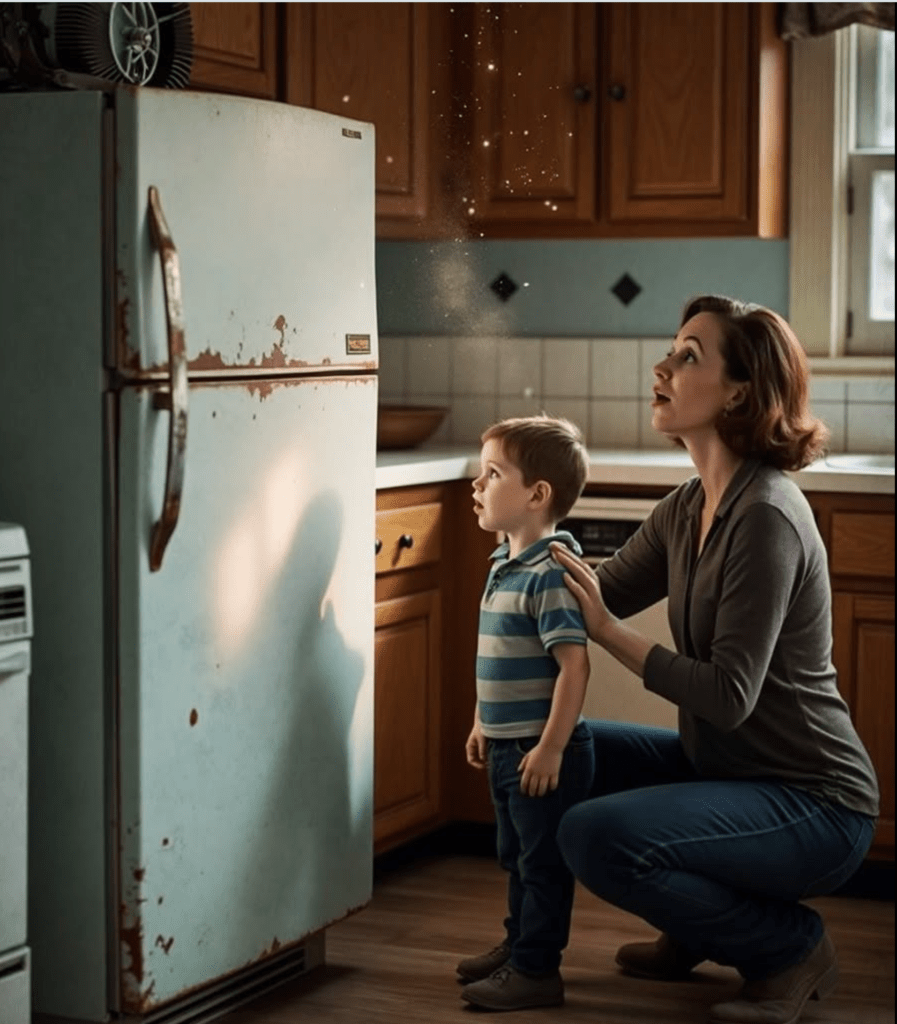
The enormous, scratched Frigidaire stood silently in the kitchen.
Sam walked around it curiously.
“Wow,” he said. “That thing is ancient.”
Mary laughed softly.
“It was my grandmother’s.”
“Does it even work?”
“No. It hasn’t worked in years.”
Sam continued examining it.
Then he stopped.
“Wait.”
He touched one side, then the other.
“This is strange.”
“What?”
“This wall is thicker than the other one.”
Mary came closer.
Sam tapped the refrigerator.
“Listen. This side sounds different.”
They examined the old appliance carefully and discovered a tiny crack hidden along the inside panel. Mary used a knife to pry it open.
The panel came away surprisingly easily.
Behind it was a hidden compartment.
Inside were bundles of cash.
Next to them were velvet boxes containing antique jewelry: a large emerald ring, a pearl necklace, and gold earrings decorated with diamonds.
Mary could barely breathe.
Everything suddenly made sense.
She remembered Eleanor’s old warnings.
“Never throw away old things, Mary. Sometimes they are worth more than you think.”
Her grandmother had lived through the Great Depression, war, and economic hardship. She had never trusted banks completely. She had hidden her savings and jewelry inside the old refrigerator because she believed nobody would ever think to look there.
The refrigerator Andrew had mocked was actually Eleanor’s final gift to Mary.
Eleanor had known that Andrew might leave her granddaughter with nothing.
She had prepared a way for Mary to survive.
Mary began to cry.
But these were no longer tears of despair.
They were tears of gratitude.
Then she looked at Sam.
The boy was staring at the treasure in disbelief.
“Sam,” Mary whispered, “everything is going to be different now.”
He looked at her.
“I can give you a home. I can adopt you. You can go to school. We can buy a place of our own.”
Sam’s eyes filled with tears.
“You really want to be my mom?”
Mary hugged him.
“Yes. I really do.”
And from that moment, their lives changed forever.
Mary officially adopted Sam. With part of Eleanor’s hidden fortune, they bought a beautiful apartment in a safe neighborhood. Sam finally had a stable home, proper schooling, and someone who believed in him.
He worked incredibly hard.
He caught up on the education he had missed, passed several grades, and eventually earned a scholarship to the prestigious University of Chicago’s Booth School of Business.
Mary also rebuilt herself.
She returned to school, earned another degree, and eventually founded a successful consulting agency.
The woman Andrew had predicted would be searching through dumpsters became an independent and successful businesswoman.
Nearly ten years passed.
Sam grew into a confident, intelligent young man.
On the morning of his graduation, he stood in front of the mirror wearing a perfectly tailored suit.
“Mom, how do I look?”
“Perfect,” Mary replied proudly. “Just don’t become arrogant.”
Sam smiled.
“I’m not arrogant. I’m simply stating a fact.”
Then he mentioned Leo Harris, their intelligent and kind neighbor, who had been quietly interested in Mary for years.
“You should give Leo a chance,” Sam teased.
Mary smiled.
“Today is about you.”
At the graduation ceremony, the auditorium was packed with professors, families, and representatives from major companies looking to recruit talented graduates.
Mary sat proudly in the fifth row.
Then she saw someone familiar.
Andrew.
He was now a successful businessman and the owner of a thriving financial company. He looked older, but the same confident smirk remained on his face.
Andrew stepped onto the stage and spoke proudly about his company.
“We want only the best,” he announced. “We are ready to open every door for talented young people.”
Then Sam was invited onto the stage as the university’s outstanding graduate.
He looked across the audience.
“I want to tell you how I got here,” he began.
He explained that he had once been a homeless boy living on the streets.
Then he told them about the woman who had taken him into her home on the very day her husband had thrown her out.
Sam never immediately said Andrew’s name.
But everyone understood who he was talking about.
“This man told her that she would end up begging in dumpsters,” Sam said.
Then he paused.
“And in a strange way, he was right.”
Andrew’s expression changed.
“She did find me on the streets. And because of that, we found each other.”
Sam looked directly at Andrew.
“So today, I want to thank him.”
The auditorium became completely silent.
“Thank you, Mr. Smith, for your cruelty. Thank you for throwing your wife out of your life. If you hadn’t done that, my mom and I might never have met. And I would never have become the person I am today.”
The audience erupted into applause.
Sam then made one final statement.
“I will never work for a company led by someone whose values I cannot respect. And I hope my classmates think carefully before choosing where they build their futures.”
He walked off the stage to thunderous applause.
Andrew stood humiliated as the image of the powerful businessman he had built for himself began to crumble in front of everyone.
Sam found Mary afterward and hugged her.
Then, with a mischievous smile, he said:
“Mom, call Leo Harris.”
Mary laughed.
She looked at the son she had once found on a cold Chicago street. He was now grown, successful, kind, and full of love.
For years, Mary had believed Andrew had destroyed her life.
She finally understood that he had only closed one chapter.
Eleanor had left her a hidden fortune.
Sam had given her a family.
And Mary had built the rest herself.
She took out her phone, smiled, and called Leo.
“Okay,” she said. “I agree to dinner.”