
At 30,000 feet above the ground, Colonel Elias Williams was thinking about anything except his family.
He was somewhere between Denver and Norfolk, surrounded by the steady hum of the aircraft and the quiet rhythm of a routine flight.
Then his phone vibrated.
One notification.
Then another.
Elias glanced at the screen.
IRONCLAD HOME SECURITY: Emergency Motion Detected.
Normally, he would have ignored it.
A delivery driver.
A neighbor.
A stray animal.
A branch moving in the wind.
There were a hundred harmless reasons his security system might send an alert.
But then the second notification appeared.
Audio detected: distress.
Elias froze.
Something in those two words made the years of military training inside him snap instantly into focus.
He opened the camera.
And his world changed.
On the screen stood his eight-year-old daughter, Matilda.
Barefoot.
Crying.
Still wearing her unicorn pajamas.
She was standing beneath the porch light, her tiny feet pressed against the cold driveway as she stared desperately at the front door.
She wasn’t throwing a tantrum.
She wasn’t misbehaving.
She wasn’t refusing to come inside.
She was begging to be allowed back into her own home.
Elias watched in silence.
Then he saw who was standing between her and the door.
Bonnie.
And behind her was Josephine—Elias’s wife.
Josephine wasn’t helping their daughter.
She was holding up her phone.
Recording.
Three of her sisters stood nearby.
Watching.
Laughing.
Elias’s jaw tightened.
He replayed the footage.
Once.
Twice.
A third time.
Not because he didn’t understand what he was seeing.
Because he wanted to be absolutely certain.
Every detail was burned into his mind.
Bonnie repeatedly blocked Matilda whenever the little girl tried to approach the door.
Matilda cried harder.
Josephine continued filming.
Her sisters laughed and encouraged the situation.
Nobody opened the door.
Nobody comforted the child.
Nobody seemed to notice that Matilda wasn’t angry anymore.
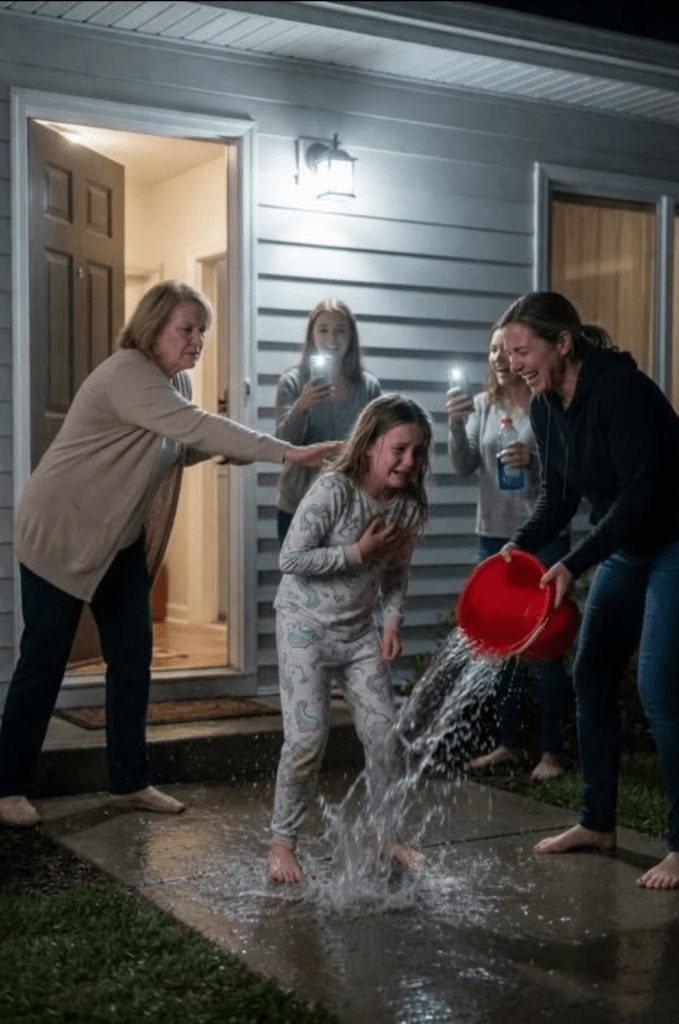
She was terrified.
Elias had spent years learning how to recognize danger.
A change in someone’s voice.
A pause before an answer.
A message sent at the wrong moment.
A person behaving differently than usual.
But nothing in his training had prepared him for this.
The threat wasn’t outside his home.
It was happening inside it.
And his daughter was standing alone on the other side of the door.
Elias looked at the flight attendant.
His voice was calm.
Almost frighteningly calm.
“Divert the flight.”
The people around him immediately understood.
Elias didn’t shout when he was angry.
He became quiet.
And when Elias became quiet, he was already making a plan.
Within minutes, the rerouting process had begun.
But Elias wasn’t going to sit helplessly in the sky.
He downloaded the footage.
Saved the audio.
Backed up the files.
Then he called Bevis Morgan, his former operations chief.
Bevis answered immediately.
“What’s happening?”
“My daughter is at home,” Elias said. “Something happened. I need you there before I arrive.”
There was no dramatic explanation.
No emotional speech.
Just facts.
Where he was.
Where Matilda was.
What the cameras had recorded.
And what needed to happen next.
While the aircraft changed course, Elias built a timeline.
The first security alert.
The second alert.
The video.
The voices.
Matilda’s attempts to get inside.
The people present.
The moment she was finally taken indoors.
Even the neighbor who had heard her crying.
He saved everything.
Because Elias had learned a long time ago that memories could be questioned.
Evidence was harder to erase.
When the plane finally landed, the night air hit him like a wall.
He stepped outside carrying the weight of several hours of fear and anger.
Bevis was waiting.
“They’re still inside,” he said.
Elias started toward the vehicle.
Then Bevis stopped him.
“Elias.”
Something in his voice made him turn.
Bevis held out a tablet.
“There’s something else.”
Elias looked at the screen.
Josephine’s social media page was open.
A video had been posted.
For one second, Elias assumed it was the same footage from the doorbell camera.
It wasn’t.
This was edited.
Carefully.
The video told a completely different story.
According to the caption, Matilda had been “acting out.”
She had supposedly refused to listen.
The family had supposedly been trying to teach her a lesson.
The adults in the video were presented as the victims.
Matilda was portrayed as the problem.
Elias stared at the screen.
And suddenly, something became even clearer.
They weren’t only trying to justify what they had done.
They were trying to rewrite what had happened.
But there was one problem.
The camera had already told the truth.
And the original footage was in Elias’s hands.
He looked at Bevis.
“Let’s go.”
When Elias entered the house, everyone expected an explosion.
They expected shouting.
Accusations.
A confrontation.
Instead, Elias walked straight past them.
He wasn’t there to win an argument.
He wasn’t there to punish anyone.
He was there for one person.
His daughter.
He found Matilda upstairs.
She was curled beneath a blanket, her small shoulders barely visible.
The moment she saw him, she jumped up and ran toward him.
Elias dropped to his knees.
Matilda wrapped her arms around him.
He held her tightly.
For several seconds, neither of them spoke.
Then Elias whispered the only question that mattered.
“Are you okay?”
Matilda nodded.
Then, almost immediately, she shook her head.
That tiny movement broke something inside him.
She was safe.
But she wasn’t okay.
And Elias realized that protecting a child wasn’t simply about stopping danger.
Sometimes it meant helping a child understand that what happened to them was wrong.
That they weren’t responsible.
That they didn’t deserve it.
And most importantly—
that they were still loved.
Over the following days, the family was forced to confront what had happened.
It became impossible to dismiss it as a joke.
Impossible to call it a misunderstanding.
Impossible to blame Matilda.
Several adults had watched a frightened eight-year-old girl cry outside her own home.
And instead of helping her, they had laughed.
That was the truth.
And no edited video could change it.
Eventually, Josephine admitted what she had been unwilling to say.
She believed Matilda needed to “learn a lesson.”
She believed Elias would always come home afterward and make everything better.
But she had failed to understand something fundamental.
Children remember how adults make them feel.
They remember the locked door.
The laughter.
The fear.
The feeling of being unwanted.
And sometimes, those memories stay long after the adults who caused them have forgotten the moment.
The hardest conversation Elias had wasn’t with Bonnie.
It was with Josephine.
Because anger toward an enemy is easy.
Anger toward the person you married is something else entirely.
There were no simple answers.
No single apology could erase what had happened.
Elias had to think about something bigger than the argument.
He had to think about Matilda’s future.
What kind of home would she grow up in?
Would she learn that love could disappear when she made a mistake?
Would she believe that adults could turn safety into a punishment?
Or would she learn something different?
That home meant security.
That love wasn’t conditional.
That when she was frightened, someone would come.
Elias chose the latter.
And he established one boundary that would never be crossed again.
Matilda would never again be placed in a situation where an adult could use the home, the doorway, or her sense of security to control her.
The driveway where she had once stood barefoot and terrified slowly became something else.
A place where she could run through sprinklers.
Ride her bicycle.
Draw with sidewalk chalk.
Come home.
Months passed.
One evening, Elias noticed something small.
Matilda’s shoes were sitting beside the front door.
Again.
He used to remind her to put them away.
Now he understood why she left them there.
She liked knowing that she could step outside—
and come right back in.
The door meant something different to her now.
It wasn’t simply an entrance.
It was proof that she belonged.
That she was safe.
That nobody could make her earn the right to come home.
One evening, Elias found Matilda sitting on the porch steps with a box of colored pencils beside her.
She looked up and smiled.
It wasn’t the cautious smile she sometimes gave when she was checking whether an adult was angry.
It was real.
Warm.
Carefree.
She held up a drawing.
Elias looked at it.
A simple house.
A driveway.
A front door.
And two pairs of shoes sitting beside it.
He stared at the picture for a long moment.
Then he understood.
Matilda hadn’t drawn the people who had laughed.
She hadn’t drawn the night she was locked outside.
She hadn’t drawn the fear.
She had drawn home.
Because when everything else became confusing, one thing had mattered most to her.
Someone came back.
Someone opened the door.
Someone made sure she knew she belonged.
And that was the truth no edited video, no family argument, and no rewritten story could ever erase.translate to hungarian

