
At the animal shelter, I asked for the oldest dog they had.
Baron was twelve years old, had a gray muzzle, and was deaf in his left ear — just like me.
When I walked out through the gate with him, the volunteer burst into tears.
— No one came for him for three years — she said. — No one even asked about him.
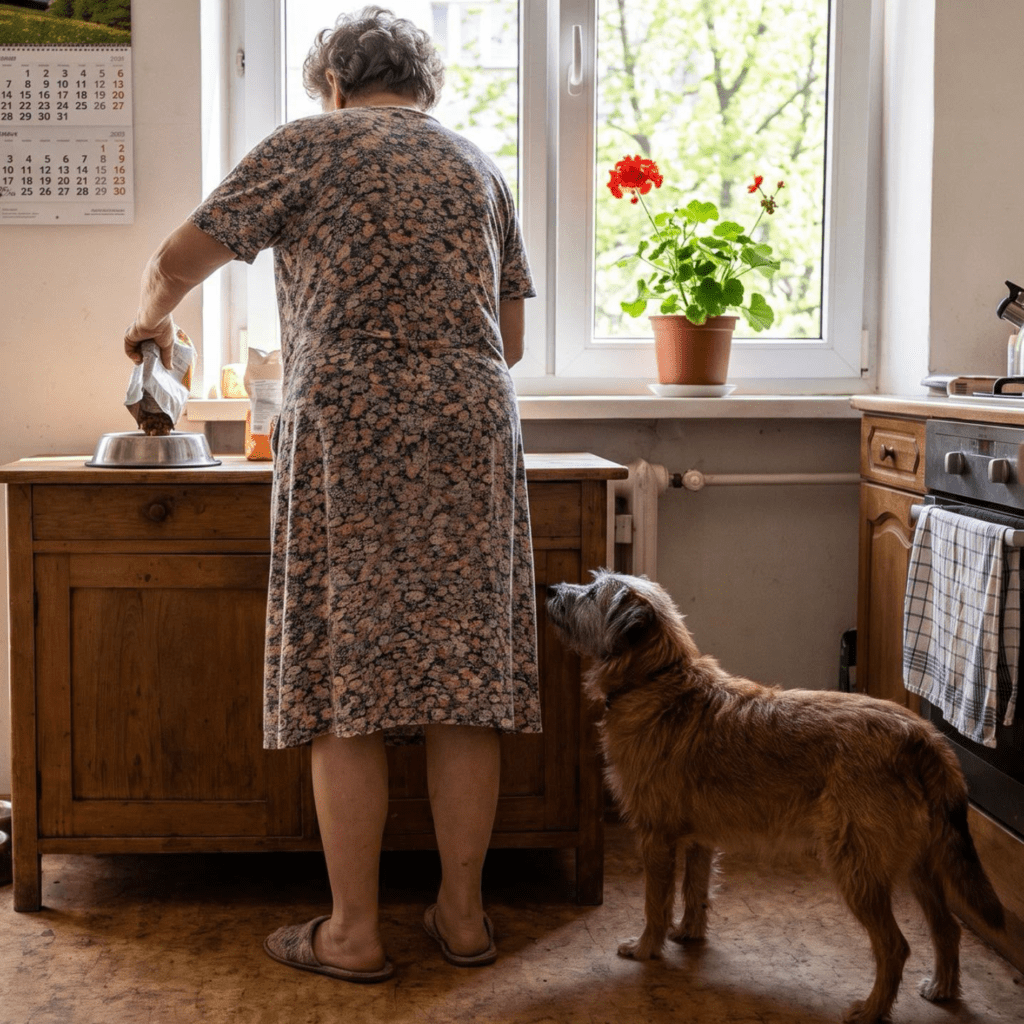
Now we both sleep until eight. We go out for bread together.
And for the first time in two years, the silence in my apartment doesn’t seem quite so frightening.
The alarm clock on my bedside table hasn’t rung in two years.
And yet Stanisław used to set it for 6:15 every day. Even on Saturdays. Even during holidays.
— Why do you need an alarm clock on vacation? — I would ask.
— So the day doesn’t get away from us — he would reply.
The alarm clock is still standing in the same place. There’s just no reason for it to ring anymore.
I still used to wake up at five.
Not because I was well rested. The silence woke me.
In an empty apartment, silence can be louder than the loudest alarm clock.
You can hear everything in it.
The ticking of the clock in the hallway. The hum of the refrigerator switching on every forty minutes. The quiet cracking of the radiator, even though the heating had been turned off long ago.
And my own footsteps.
It was only after Stanisław died that I discovered how loudly a person walks around their own apartment.
My name is Lucyna. I’m sixty-four years old, and for the past two years I’ve been living alone in a three-room apartment in the Północ district of Częstochowa.
Third floor. A balcony facing west. A view of the parking lot and the number two bus stop.
Once, this apartment was too small for the four of us.
Now it’s too big for one person.
Stanisław died suddenly.
A stroke in a store. Between the shelves of canned food and the checkout counter.
He was sixty-one. He had never been seriously ill. He hadn’t smoked for fifteen years. That morning, he had still joked that I would make him pancakes in the evening.
By evening, he was gone.
The paramedic said there was nothing they could have done.
To this day, I don’t know whether he said it to comfort me or to explain something I wasn’t capable of understanding anyway.
My daughter, Magda, flew in from Bristol for the funeral. She stayed for a week.
My son, Bartek, came from Kraków with his wife and their one-year-old son, Antoś.
For those few days, the apartment was full again.
Someone made coffee in the morning. Someone slammed a door. Antoś cried. The television played in the background. Conversations drifted in from the kitchen.
It was crowded.
It was noisy.
And it was wonderful.
Because for that one week, I didn’t have to listen to the silence.
Then everyone left.
Magda calls on Sunday evenings, always at roughly the same time. Bartek sends text messages twice a week. Short, practical ones.
“How are you feeling, Mom?”
“Have you been to the doctor?”
“Antoś is walking now.”
I love them.
I really do.
I don’t blame them.
They have their own lives.
It’s just that one day I realized that I no longer had one of my own.
I was in my fourth year of retirement.
For twenty-six years, I had worked behind the counter at a stationery shop in the Old Market Square. I knew the customers. Their children. Their favorite notebooks. I knew who bought birthday cards for their wives and who always came in for a pen five minutes before closing.
After retiring, I tried everything.
Swimming — my knee lasted two weeks.
Ceramics at the community center — three classes.
Then I quit.
Not because it was bad.
Precisely because it was good.
Because after spending an hour with people, I would return to my apartment, and the difference between “I was with someone” and “I’m alone again” hurt even more.
The animal shelter was on the street I walked along to get to the clinic for rehabilitation.
Three times a week, I passed its fence.
I could hear the barking.
I saw posters with dogs’ faces.
“ADOPT, DON’T SHOP.”
For months, I would quicken my pace there.
Maybe I was afraid of what I would see.
Or maybe I was afraid I would see myself.
Animals locked in kennels, waiting for someone to come for them.
One Thursday in March, it was cold, but the snow was just beginning to disappear from the sidewalks.
This time, I didn’t walk faster.
I stopped at the gate.
I stood there for several minutes, holding a pharmacy bag in one hand.
Finally, I thought:
“What have I got to lose?”
And I went inside.
It smelled of wet fur, dog food, and disinfectant.
A young woman in a green jacket approached me.
She was perhaps twenty-five, with her hair tied back and a tired but warm smile.
— Good morning. Can I help you?
— I’d like to see the dogs.
— Of course. Are you looking for a particular dog?
I shook my head.
— The oldest one.
The girl looked at me as if she wasn’t sure she had heard correctly.
— The oldest one?
— Yes.
I hesitated.
— The one no one comes for.
She was silent for a moment.
Then she said:
— Please, follow me.
Her name tag said “Ola.”
She led me to the very end of the corridor.
In the last kennel, lying on a gray blanket, was a reddish-brown dog.
His muzzle was gray.
His ears hung on either side of his head like two old, crumpled letters.
He didn’t get up when we approached.
He simply raised his head and looked at me with one eye.
The other was half closed.
A moment later, he laid his head back down on the blanket.
— This is Baron — Ola said.
— How old is he?
— Twelve.
I stared at him silently for a moment.
— Why did he end up here?
— His owner went into a nursing home. The family didn’t want the dog.
Ola lowered her voice.
— Baron has been here for three years.
Three years.
I thought about how much could happen in three years.
Children can finish school. People can change jobs. You can move to another city. You can meet someone, fall in love, lose someone.
And he had spent those three years waiting behind bars.
— He can’t hear with his left ear — Ola added.
I looked at her.
— Neither can I.
She laughed.
So did I.
And then we both fell silent.
The paperwork took almost an hour.
Identity card.
Documents.
Questions about the apartment.
Questions about the elevator.
Questions about how much time I would be able to devote to the dog.
Ola explained the vaccinations, diet, medication, and the problems that might arise with an older dog.
— You need to know that twelve years old is no longer a puppy — she said carefully. — There may be health problems.
I looked at her.
— I’m sixty-four and I have a bad knee.
I smiled.
— I know what it’s like to grow old. I’m not looking for a dog to go running with.
This time Ola didn’t laugh.
She just nodded.
When I left the shelter with Baron, he walked slowly beside me.
He didn’t pull on the leash even once.
He simply walked.
At my pace.
At the door, Ola stopped.
She watched us.
And suddenly tears began streaming down her face.
— What happened? — I asked.
She shook her head.
— Nothing.
She wiped her cheek with her sleeve.
— It’s just… three years.
— What about three years?
— He’s been here for three years. And during all that time, no one came for him.
Her voice broke.
— No one. Not even once.
I didn’t know what to say.
So I simply tightened my grip on the leash.
And walked out.
The first few days were strange.
Baron didn’t run around the apartment.
He didn’t jump.
He didn’t bark.
He wasn’t interested in toys.
He sniffed every corner very carefully, like someone inspecting an apartment they might possibly rent for the rest of their life.
After a few days, he chose a spot beside the radiator.
He put the gray blanket from the shelter there.
And stayed.
During the first week, we learned each other.
I didn’t know when he wanted to go outside.
He didn’t know that opening the cupboard didn’t always mean food.
After a few days, we found our own language.
When Baron wants to go outside, he sits by the door and sighs heavily.
When it’s time to eat, I start humming softly.
I don’t know when I started doing it.
But Baron knows.
When he hears me singing off-key, he looks at his bowl.
And then I know it’s time for dinner.
Now we both sleep until eight.
Baron sleeps on his blanket in the hallway.
I sleep in the bedroom.
I used to wake up at five because the silence wouldn’t let me sleep.
Now, at five, I hear Baron turning over onto his other side.
Sometimes he snores softly.
Sometimes he sighs in his sleep.
And that’s enough.
It’s not silence anymore.
It’s presence.
We go out for bread together.
The store is five minutes away.
Baron waits by the railing.
Mrs. Krysia comes out of the bakery with a little bread roll for him.
— Come here, old boy — she says.
Baron takes the roll with the dignity of a man who believes he deserves it.
And perhaps he really does.
Magda saw him recently during a video call.
— Mom… but he’s so old!
I looked at Baron.
Then at the screen.
— So am I.
Magda was silent for a moment.
Then she laughed.
Bartek sent me a text:
“Nice dog, Mom. Antoś is going to want pictures.”
I sent him three.
Baron was asleep in all of them.
Bartek replied with just:
❤️
The veterinarian said that for his age, Baron is in very good condition.
His joints are stiff.
His eyesight is weaker.
His left ear still can’t hear.
He was given medication and advised to take short, calm walks.
We take two walks a day.
In the morning — for bread.
In the evening — around the block.
Baron doesn’t pull on the leash.
He doesn’t chase cats.
He doesn’t bark at other dogs.
He walks beside me.
His nose close to the ground.
Slowly.
Exactly at my pace.
Ola calls every two weeks.
— How is Baron?
— Good.
— Is he eating?
— He is.
— Is he going for walks?
— He is.
— No problems?
— None.
I don’t tell her that since I got Baron, I’ve started eating more regularly myself.
That I leave the house twice a day.
That I talk to people in the neighborhood.
That Mrs. Krysia already knows what kind of bread I buy.
That my neighbor from the second floor sometimes stops me just to pet Baron.
I don’t tell her.
Because it would sound like I was thanking her.
And I don’t know how to thank someone for something I was the one who asked for.
Last night, I woke to a quiet whimper.
I got up.
Baron was lying on his blanket.
He was trembling in his sleep.
I knelt beside him and placed my hand on his side.
Under my fingers, I felt his ribs.
And beneath them — the calm, slow beating of his heart.
— It’s all right — I whispered.
Baron stopped trembling.
So did I.
I sat beside him for a few more minutes.
And then I thought about Stanisław.
About his alarm clock always set for 6:15.
About the way he used to go out for bread and always come home with something we didn’t need.
About the way he shouted during football matches.
About how I pretended it annoyed me.
It didn’t.
Those were the sounds of life.
Only after they disappeared did I understand how much they had meant.
Baron didn’t replace Stanisław.
He wasn’t supposed to.
He simply gave me different sounds.
Panting.
Quiet little grunts.
The tapping of his claws against the wooden floor.
A sigh by the door.
The rustle of his fur as he turned over on his blanket.
Different sounds.
But still life.
The alarm clock on my bedside table still doesn’t work.
And I still don’t set it.
But this morning, at exactly 6:30, the quiet tapping of claws on the wooden floor woke me.
Baron got up.
He stretched.
He walked over to his bowl.
He drank some water.
Then he stood at my bedroom door and looked at me.
— Already? — I asked sleepily.
He sighed.
As if answering:
“Already.”
I smiled.
I got out of bed.
Because for two years, emptiness was what woke me.
Now Baron wakes me.
I don’t have to set an alarm.
He knows when it’s time.
And I think, for the first time in a very long while, I know why I need to get up in the morning.

