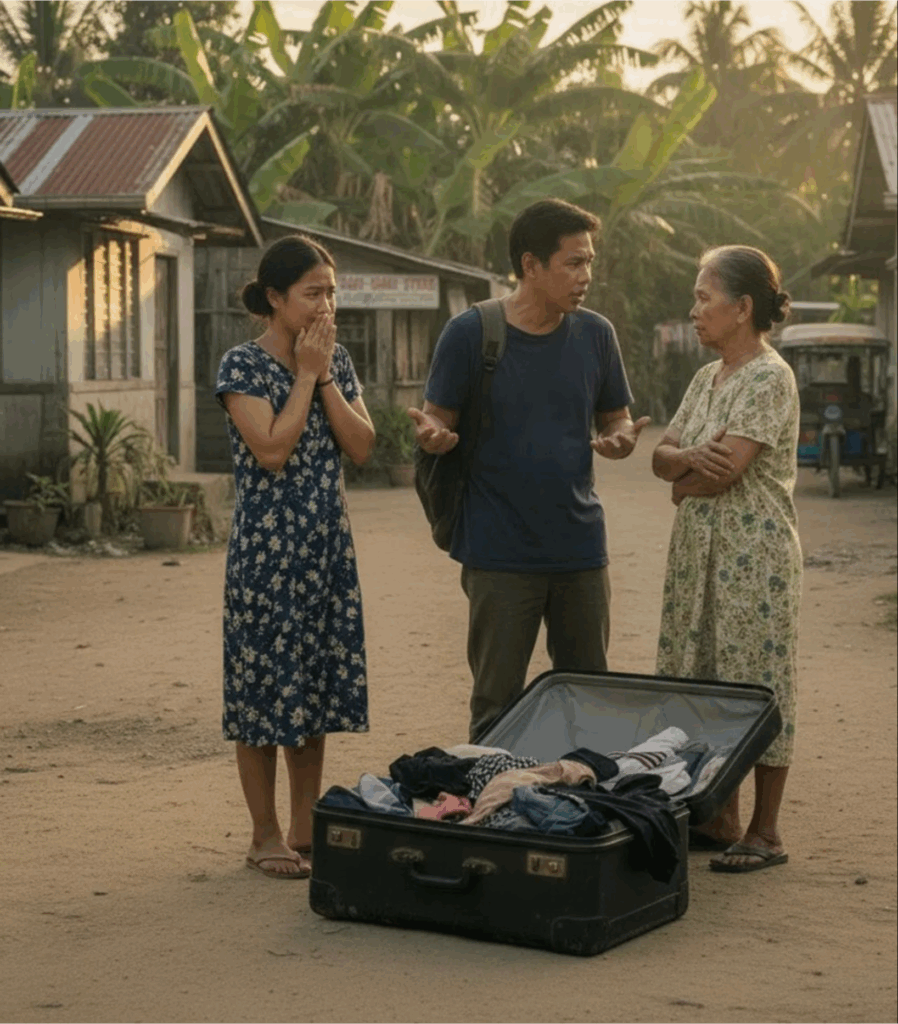
“Don’t start imagining things,” Denis said without looking up from his plate. “They’ll bring another chair.”
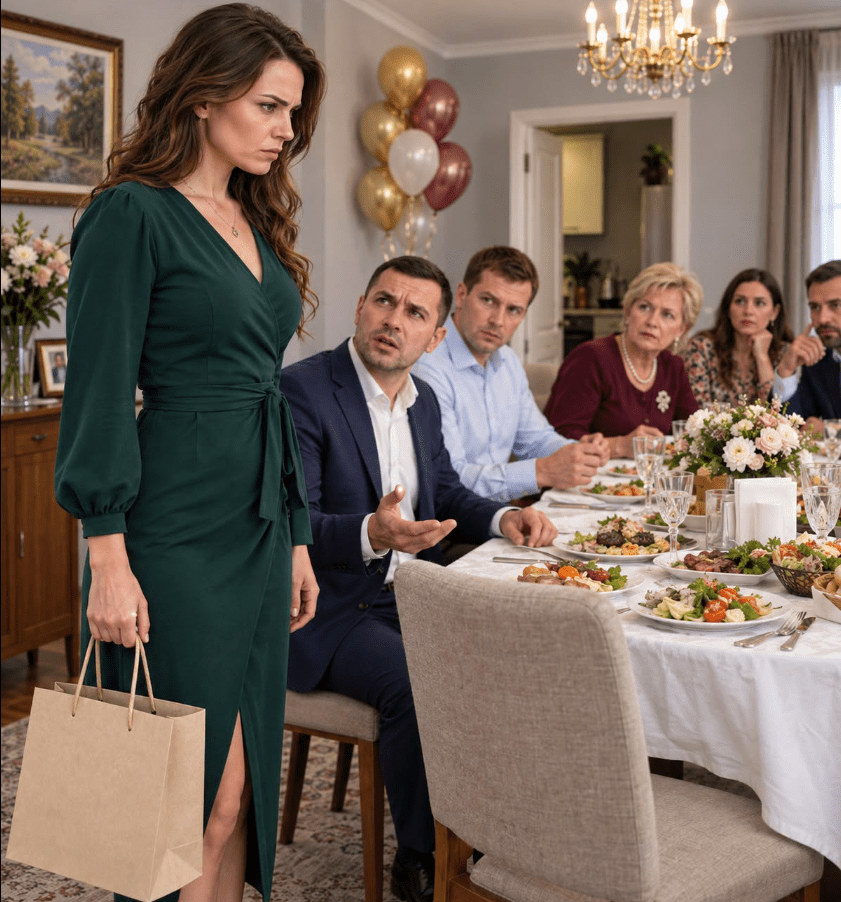
I was standing beside the long banquet table at Volzhsky Dvorik restaurant, clutching the gift bag I had brought for my mother-in-law, and counting the chairs for the third time.
Twenty-two.
There were also twenty-two name cards. My mother-in-law had spent the entire week writing them by hand with a blue marker.
Mine wasn’t there.
Above the table, two gold balloons floated in the air: a seven and a zero.
Nina Arkadyevna was sitting at the head of the table in a burgundy blouse with a large brooch pinned to her chest. Her hairstyle was flawless.
I had done it myself at eight that morning in her kitchen.
I had also curled Alena’s hair that morning.
Of course, I hadn’t charged either of them.
You don’t take money from family.
Except apparently, family doesn’t always consider you family.
Beside Denis sat a man I had never seen before, around forty years old, wearing a pale blue shirt.
He was sitting in my usual place.
The stranger gave me an awkward little nod and immediately looked away.
I walked around the table and leaned toward my mother-in-law.
“Nina Arkadyevna, where am I supposed to sit?”
“Oh, Ksenya…” She touched her temple, checking that her hairstyle was still perfect. “It turned out awkwardly. Lyuba suddenly came from Voronezh, and I wasn’t expecting her. The restaurant won’t give us any more chairs. Twenty-two places, that’s all. You’re young. They’ll bring you a little chair.”
Lyuba, my mother-in-law’s childhood friend, raised her glass and waved at me.
A few minutes later, a waiter brought a white plastic chair from the summer terrace and placed it in the corner beside the kitchen door.
The door swung open every minute as waiters carried trays in and out. The smell of fried onions and hot food poured into the room.
The chair was still wet from the evening rain.
The waiter apologized and wiped it down with a paper napkin.
“I’m not sitting by the kitchen door,” I whispered to Denis. “Either move over and sit with me, or ask that man to move.”
“Ksenya, it’s three hours. Don’t make a scene.”
“I’m not making a scene. I’m asking why I’m not on the seating list.”
“Don’t make things up. Nobody crossed you off. Mom got confused. She’s seventy.”
He spoke to me in the same calm tone people use when trying to convince a child to stop throwing a tantrum in a supermarket.
The man in the blue shirt suddenly became very interested in his napkin.
Alena, wearing the curls I had made that morning, began rummaging through her handbag.
I went back to my mother-in-law and placed the gift bag beside her chair.
Inside was a beautiful camel-wool shawl in a warm sand color.
I had spent two weeks choosing it.
I had even exchanged it twice before deciding on the right one.
“Happy birthday. I wish you good health.”
“Where are you going?” Nina Arkadyevna asked.
“Home.”
I didn’t wait for her answer.
As I walked down the stairs, I heard the host announce:
“And now, a few words from the birthday girl’s beloved son!”
I didn’t turn around.
When I got home, I unpacked my work case.
I cleaned the curling iron I had used on Alena that morning. I washed my brushes. I sorted my hair clips by color.
My hands needed something to do.
It was easier than sitting in the kitchen staring at the clock.
Denis came home at a quarter to midnight.
He put a plastic container with a piece of cake on the table, took off his jacket and carefully hung it on a hanger, smoothing the sleeves.
“Mom cried in the bathroom,” he finally said. “Lyuba asked what happened. Aunt Valya asked. Everyone asked. And you ruined her seventieth birthday over a chair.”
“Who was sitting beside you?”
“A guest.”
“Whose guest?”
He paused for a second too long.
“Some man my mother knows.”
“Who?”
“I don’t know. I didn’t ask.”
“Did you know beforehand that there wasn’t going to be a seat for me?”
“Don’t start,” he said, switching on the kettle even though neither of us was planning to drink tea. “Do you have any idea how that looked? Alena is grateful to you. Mom is grateful to you. And you get up and walk out in the middle of the celebration.”
He kept staring at the cake.
As if the crushed frosting were the most important problem in the world.
Alena was indeed grateful to me.
For the studio apartment.
Twenty-eight square meters in a new development across the river.
I had bought it eight years before I got married. I had taken out a mortgage, worked practically without weekends, and paid it off early.
When Alena divorced in the winter and was left with her nine-year-old son, Timosha, living in a rented room, I was the one who offered them the apartment.
“Move in. Just pay the utilities.”
They moved in in March.
I had still printed out a free-use agreement and made Alena sign it.
Denis had laughed.
“You’re seriously making your own sister sign paperwork?”
Alena had laughed too.
But she signed.
Denis fell asleep quickly, turning his back to me.
Around two in the morning, his phone lit up on the nightstand.
A message from Alena:
“Bro, thank you so much. Stas absolutely loved Mom.”
I had never heard of Stas.
Not once.
—
On Sunday morning, I drove to Bragino alone.
Denis was still asleep.
I didn’t wake him.
I had no interest in another conversation where he would stare at the floor and repeat, “Come on, enough, both of you.”
My mother-in-law didn’t open the door immediately.
When she finally did, she was wearing an old quilted robe.
Her hairstyle was still perfect.
Later, she admitted that she had slept on her back on a silk pillowcase so she wouldn’t ruin it.
For some reason, that detail made me uncomfortable.
There were flowers everywhere in her apartment.
In buckets.
In three-liter jars.
Even in the pot she usually used for making aspic.
The shawl I had given her was hanging neatly over a kitchen chair.
“Tea?” she asked, as if nothing had happened the night before.
“Yes. But first, I want you to answer one question honestly.”
She sat down.
“Did you forget to count me, or did you simply not want me there?”
Nina Arkadyevna was silent for a long time.
She slowly smoothed the tablecloth with her palm.
“I spent six months planning that table, Ksenya. Everyone had a place in my head. Lyuba, who has been my friend since first grade. Valya, whom I worked with for thirty years. My children. My grandson. Everyone I’ve shared my life with.”
“And me?”
She looked at me.
“You’ve been with us for four years.”
She didn’t say it angrily.
She sounded almost apologetic.
Somehow, that hurt more.
She looked toward the sideboard, where there was an old photograph of her late husband.
“I never even saw sixty,” she said quietly. “And now I’m seventy. Maybe this was the last time I’d have everyone together. I wanted things to be the way I wanted them. Just once.”
Her voice cracked.
Then she straightened.
“But you stood up and walked out. In front of Lyuba. In front of Valya. Everyone spent the rest of the evening asking what was wrong between my son and his wife.”
“I didn’t come here for an apology,” I said. “I came to tell you that I’m not going to sit beside the kitchen door. Not at your birthday. Not at New Year’s. Not at a christening. If you don’t consider me family, just say it. I’ll understand.”
“You are family,” she replied.
Then she took a sip of tea.
“As long as you’re with Denis.”
I never touched my cup.
—
On Wednesday, the management company called.
The water meters in the studio apartment were due for inspection.
A technician would come Thursday between ten and noon, and the owner needed to sign the paperwork.
Then the woman added:
“There’s also an outstanding utility balance. Three months. Eleven thousand four hundred rubles.”
According to our agreement, Alena was responsible for the utilities.
That evening I texted her:
“I’ll be there tomorrow at ten with the technician. Please check the bills. There’s an outstanding balance.”
She read the message.
She didn’t answer.
On Thursday, a man opened the door.
Gray socks.
Sweatpants.
A half-eaten sandwich in his hand.
It was the same man from the birthday party.
The one in the blue shirt.
“Hello,” he said awkwardly. “You’re Ksenya, right?”
“Yes.”
“I’m Stas. Alena’s partner. Come in. She’s at work.”
There were men’s work boots in the hallway.
On the wall where my mirror had hung, there was now a huge television.
My mirror was lying on the floor, leaning against the shoe cabinet.
Timosha’s desk had been shoved into the corner beside the radiator.
Men’s shirts were scattered across the sofa.
The blue one was on top.
The technician arrived on time, checked the meters and handed me the paperwork.
Stas stood awkwardly in the kitchen doorway the entire time.
After the technician left, I asked:
“How long have you been living here?”
“Since July.”
“Did Alena tell you I knew?”
“She said you did. Nina Arkadyevna said so too.”
Alena came running in half an hour later.
She was wearing a fitness-club uniform and carrying a pharmacy bag.
“What are you doing here?” she demanded. “Are you going to decide who I’m allowed to live with now?”
“I let you move in with Timosha. We never agreed that another adult would move in. It’s written in the agreement you signed.”
“Ksenya, seriously? The agreement?”
She dropped onto the sofa, right on top of the men’s shirts.
“I’m thirty-eight. I finally have a man who doesn’t drink, doesn’t scream, and actually helps me. He takes Timosha swimming. He helps him with math. I’ll pay the utilities from my salary. I’ve just been overwhelmed.”
“Then pay the debt.”
She looked at me.
“Mom has been taking heart medication since your birthday stunt. Could you just not start this again?”
Stas walked me to the elevator.
He was nervously twisting an empty bread bag in his hands.
“I’m sorry about Saturday,” he said finally. “It was awkward. I actually told Nina Arkadyevna a week before that I could sit somewhere else. But she said, ‘Sit here. You’re one of us now.’”
A week before.
While I was still running around stores looking for my mother-in-law’s birthday gift.
—
We had an old tablet in the kitchen.
We used it for recipes and watching shows.
Denis had once installed a messaging app on it to send football videos to his friends.
He had never logged out.
On Friday, he went to work the night shift at the water company.
I was searching for a video about a new hair-coloring technique when a notification appeared.
“Melnnikov Family.”
A group chat.
I had never been in it.
I stared at the screen for a long time.
I had always believed reading someone else’s private messages was wrong.
I still believed that.
Then I opened the chat.
I scrolled back to the end of August.
There was a photograph of a sheet of graph paper.
A seating plan.
A long rectangle with circles representing chairs.
Names written in my mother-in-law’s handwriting.
Lyuba was sitting next to Nina.
So she hadn’t suddenly arrived from Voronezh.
She had been expected.
My name was beside Denis’s.
But mine had been crossed out.
Above it, in block letters, was written:
“STAS.”
Under the photo, my mother-in-law had written:
“Denis, it’s important to Alena that Stas sits with us. He’s serious. Maybe things will finally work out for her. We’ll put Ksenya at the end. She’ll understand.”
Denis replied:
“Mom, just tell her there weren’t enough chairs. Otherwise she’ll start.”
Then Alena:
“What if she gets offended and takes the apartment back? Timosha starts school September first.”
Twelve minutes later, Denis replied:
“Don’t make things up. She’s not going anywhere. It’s Ksenya.”
My mother-in-law had reacted with a heart.
I put the tablet face down.
I switched on the kettle.
It boiled.
The kettle clicked off.
I didn’t move.
Half an hour later, I switched it on again.
It boiled again.
My cup remained empty.
“It’s Ksenya.”
The Ksenya who would come at eight in the morning and do their hair for free.
The Ksenya who had handed over her own apartment.
The Ksenya who never asked who was sleeping on her sofa.
The Ksenya who would apparently always be there.
They had decided everything a week before the party.
Calmly.
Casually.
With hearts.
I didn’t sleep that night.
I thought about Timosha.
About the drawing he had stuck to my refrigerator.
A picture of Aunt Ksenya with enormous scissors and bright yellow hair, even though my hair was dark.
He was nine.
He hadn’t read those messages.
He didn’t know what the adults had decided.
His school was only two blocks from the apartment.
He had finally made a friend there.
Maybe Denis was right.
Maybe I really was overreacting.
Maybe it really was just a chair.
Maybe I had turned a seating arrangement into a personal attack.
Maybe I was making a conspiracy out of a chat.
Maybe the heart reaction meant nothing.
At around three in the morning, I got out of bed.
I pulled the old shoebox from underneath it, where I kept important documents.
I found the agreement.
Two pages.
Two signatures.
“Term of use: indefinite.”
“User is responsible for utility payments.”
“Residence of third parties requires written consent of the owner.”
I read it twice.
Then I put it back.
I made one rule for myself:
I would never make important decisions in the middle of the night.
—
On Monday, during a coloring appointment, I casually asked one of my clients about a “friend’s” situation.
Her name was Rimma Sergeyevna.
She was a lawyer and had been coming to me every five weeks for six years.
While her hair color processed, she listened.
“An indefinite free-use agreement?” she said. “Either party can terminate it.”
“How?”
“In writing. Usually with one month’s notice if the agreement doesn’t specify another period.”
“And if they refuse to leave?”
“Then you can file a claim to have them evicted. But most cases don’t get that far.”
She paused.
“Is anyone registered at the apartment?”
“No.”
“Then they have somewhere else to go.”
She looked at me through the mirror.
“Ksenya, this isn’t a friend’s situation, is it?”
I said nothing.
On Tuesday morning, before work, I went to a copy shop near the market.
I wrote the notice.
It was only a few lines.
I was terminating the free-use agreement dated March 12 and requesting that the apartment be vacated and the keys returned within one month of receiving the notice.
I stared at the words “one month” for a long time.
I could have written until New Year’s.
I could have written until the end of the school year.
I could have given them six months.
But I wrote one month.
I printed it.
Signed it.
At the post office, the woman behind the counter adjusted her glasses.
“Registered?”
“Yes.”
“With an inventory and delivery confirmation?”
“Yes. Both.”
She stamped the forms.
“It should arrive in three or four days.”
My phone vibrated as I put the receipt into my wallet.
A message from Denis:
“Mom is inviting us for pies on Sunday. She wants to make peace. Come. And don’t make things up.”
The letter would arrive by Saturday.
—
On Sunday, there was a chair waiting for me in my mother-in-law’s kitchen.
All the other seats were simple kitchen stools covered in imitation leather.
This one had a high back.
She had clearly brought it from another room.
The cushion on it was embroidered with red poppies.
I remembered it from her sofa.
My mother-in-law was wearing the shawl I had given her.
Two trays of pies were cooling on the stove: cabbage and egg.
Denis was arranging them on plates and talking louder than usual.
Something about the neighbor’s dog.
Something about the heating pipes being dug up again.
Alena arrived last.
She walked straight into the kitchen without taking off her shoes.
Then she placed an envelope on the table.
It had a blue postal stamp.
“What is this?” she asked.
She wasn’t asking her mother.
She wasn’t asking Denis.
She was looking at me.
“The notice.”
Denis picked up the paper.
He read it.
Then read it again.
I could see him searching for another sentence.
Something that would reveal this was all a joke.
“You’re kicking my sister and her child out over a chair?”
“Not over the chair.”
I looked at him.
“Over ‘she’s not going anywhere.’”
His hand froze around the serving spoon.
My mother-in-law slowly lowered herself onto a stool.
The shawl slipped from one shoulder.
“The tablet is in the kitchen,” I said. “You never logged out.”
My mother-in-law’s face changed.
“You read our messages?”
“Yes.”
“There was a seating plan in your handwriting. Lyuba was already on it. She didn’t suddenly appear from Voronezh. And I saw the heart.”
“I have nowhere to go!” Alena suddenly cried.
“Timosha’s school is five minutes away! A rental apartment would take Stas’s entire salary!”
“Timosha is registered here. He has a home. You have one month.”
“You’re really doing this?”
“Yes.”
My mother-in-law didn’t scream.
She simply sat there, twisting the fringe of the shawl between her fingers.
“I only wanted the best,” she whispered. “I wanted Alena to finally have someone. I wanted Stas to see that she had a family behind her. That she belonged somewhere.”
For a moment, she didn’t look like my mother-in-law.
She looked like an old woman whose carefully planned life had suddenly stopped following the script she had written for it.
I felt sorry for her.
Truly sorry.
“I know, Nina Arkadyevna.”
I stood up.
“But you forgot something. I was the one standing behind Alena all this time. With the keys. With the apartment. Without asking for money. You simply didn’t count me.”
“Take the letter back,” Denis said. “Please. Don’t make things up.”
“It’s already been delivered.”
I took my coat from the hallway.
The chair with the poppy cushion remained beside the table.
Empty.
I got the keys back in the middle of October.
Denis brought them to me.
He silently placed them on the kitchen table and walked into the other room.
A small green clay dinosaur hung from the key ring.
It was crooked.
One eye was missing.
Timosha had made it at after-school care and attached it to the keys on the very first day they moved in.
The apartment was spotless.
Alena had washed the floors, cleaned the windowsills and even put my mirror back on the wall.
There was only one trace left.
A pale mark on the cabinet door where a soccer-player sticker had been.
Timosha must have tried to remove it before leaving.
He hadn’t managed to get it all off.
They were now living in Bragino.
All three of them in my mother-in-law’s two-bedroom apartment.
Stas had moved back in with his mother and visited on weekends.
Timosha woke up at six every morning and spent almost an hour getting to school by two buses.
Alena refused to transfer him again.
Denis still spoke to me.
About dinner.
About bills.
About the leaking faucet in the bathroom.
But he never once said, “Don’t make things up.”
And somehow, that hurt more than when he had.
At the end of October, he brought me an envelope from Bragino.
Photographs from the birthday party.
My mother-in-law had printed one for every guest.
She had told Denis to give one to me.
He didn’t know why.
In the photograph, the entire table was visible.
Twenty-two people.
The gold balloons.
Nina Arkadyevna in her burgundy blouse.
Stas in his blue shirt, sitting beside Denis.
And in the corner, beside the kitchen door…
the white plastic chair from the terrace.
Empty.
Nobody had moved it.
Denis stood beside me, looking at the photograph.
“I really thought you were making a big deal out of nothing,” he said.
I stayed silent.
“I thought it was just a chair.”
“And now?”
He looked down.
“Now Timosha keeps asking Mom why Aunt Ksenya is angry with him.”
Then he walked into the other room.
I remained in the kitchen, holding the photograph.
The apartment keys were lying on the table beside me.
A week later, I rented the studio to a young nurse from the regional hospital.
For money.
With a proper contract.
Exactly the way you rent a property to a stranger.
I never took the little dinosaur off the key ring.
Maybe because, despite everything, I had never wanted to punish Timosha for the choices the adults had made.
And even now, whenever I think about that birthday party, I remember the white plastic chair by the kitchen door.
Everyone thought it was just a chair.
It wasn’t.
The real problem was that the people who were supposed to love me had already decided that I would accept whatever place they left for me.
So what would you have done in my position?
Would you have let Alena and her son stay in the apartment until summer, swallowed the insult of the chair by the kitchen door and the words, “She’s not going anywhere”?
Or would you have given them exactly one month, just as the agreement allowed?