“Get out of here with that dying animal! This is a private clinic, not a shelter for filthy strays!”
The veterinarian angrily shoved the plastic carrier toward the door. It hit the tiled floor with a dull clatter.
Ten-year-old Nikita didn’t even flinch.
Three months earlier, his life had changed forever.
Their car had veered off the road near Zhytomyr. Nikita survived the crash, but something inside him seemed to have frozen that day.
For ninety days, he had not spoken a single word.
He spent his days staring blankly at the ceiling, as if he were no longer really there. Doctors at a Kyiv medical center could only shake their heads. They prescribed sedatives, recommended lengthy rehabilitation, and gently told his parents:
“Severe psychological trauma. Psychogenic mutism. It may take a long time. You have to be patient.”
But how could parents be patient while watching their own child slowly disappear before their eyes?
Nikita’s father picked up the battered plastic carrier.
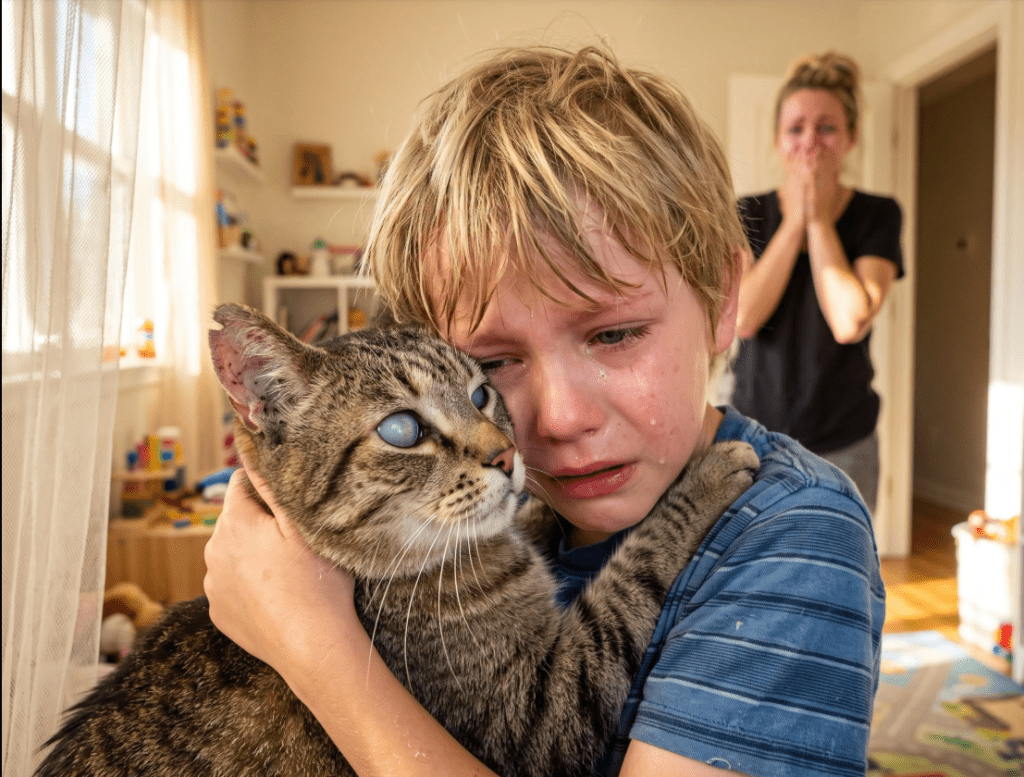
Inside, curled into a tiny ball, was a horribly injured cat.
Part of one ear was missing. Its side was covered with healing wounds, and its cloudy eyes had been damaged by untreated infections. The cat was almost completely blind.
“Why did we even bring him home?” Nikita’s mother whispered as she climbed into their old Lanos. “Isn’t everything we’re going through already enough? Our son is fading away, and you bring another problem into the house?”
She had no idea what had happened at the shelter just an hour earlier.
When Nikita was brought to the cages, he had barely looked at the animals. As always, his eyes had remained fixed somewhere in the distance.
A volunteer quietly explained:
“This one was just brought in… this one is recovering… and this one is blind. He was found in a basement. He was terribly sick, but we managed to save him.”
Then the injured cat slowly approached the bars.
A rough, painful sound came from its throat.
Nikita’s eyes moved.
For the first time in three months, he wasn’t staring into empty space.
He was looking at the cat.
Then he slowly raised his hand and touched the bars.
The cat didn’t pull away.
Instead, it pressed its dry little nose against the boy’s palm.
Nikita’s father made up his mind immediately.
“We’re not giving him back. That’s final. This cat was waiting for Nikita.”
At home, however, the tension quickly reached its breaking point.
Nikita’s mother was terrified of infections, dirt, and the extra expenses. She had spent three months living in constant fear, barely sleeping and worrying about her son’s future.
Finally, she imposed one strict rule:
“The cat stays in the hallway. He is not allowed anywhere else. And if Nikita gets sick because of him, we take him straight back.”
That night, Nikita’s father woke up to a faint scratching sound.
The hallway was completely dark.
The blind cat was slowly making its way forward. It used its whiskers to feel the walls, stumbled over the thresholds, then continued.
Straight toward Nikita’s bedroom.
Nobody had shown him the way.
He was simply following the sound of the boy’s uneven breathing.
Nikita’s father quietly got out of bed and looked through the half-open door.
What he saw left him frozen.
Nikita was sitting on the carpet with his face buried against his knees.
His shoulders were trembling.
He was crying.
For the first time in three months.
The blind cat slowly approached him, pressed its injured face against the boy’s sleeve, and began to purr.
Nikita stroked him for a long time.
Then something happened that the doctors had been waiting for.
“I hurt too…” the boy whispered hoarsely.
His father’s eyes filled with tears.
The voice was weak and unfamiliar.
But he was speaking.
“You hurt too, don’t you?” Nikita whispered. “You’re alone too, aren’t you?”
In the hallway, his mother covered her mouth with both hands.
She couldn’t stop the tears.
But their relief would not last long.
The next morning, someone knocked on the door.
A man in a leather jacket stood outside, holding a thick folder. A large, muscular man stood behind him in the hallway.
“Good morning,” the stranger said coldly. “I’m here about the cat you took from the shelter yesterday. That animal belongs to my breeding operation. It disappeared two months ago. Here are the documents. I’m taking him back.”
Nikita’s mother went pale.
She was terrified of a confrontation and even more terrified of getting involved in a legal dispute.
“Take him,” she said quickly. “If he really belongs to you, then take him. We don’t need any trouble.”
Then the bedroom door opened.
Nikita stood there.
The cat was pressed tightly against his chest.
“Give me the cat, son,” the man said. “He’s a valuable breed. He needs special care. You won’t be able to look after him properly.”
Nikita looked directly into the man’s eyes.
“No.”
The stranger stared at him.
The boy’s voice was quiet, but firm.
“He’s staying here.”
His mother panicked.
“Nikita, don’t be difficult! He isn’t ours!”
But the boy didn’t argue.
He simply turned around, carried the cat back into his room, and locked the door.
A few seconds later, they heard furniture scraping across the floor.
Nikita’s father immediately stepped in front of the doorway.
“The police will verify your documents. Now get out of this building.”
The stranger protested, but the father refused to move.
Eventually, the two men were forced to leave.
The parents rushed to Nikita’s room.
The door wouldn’t open.
The boy had pushed a heavy chair against it.
From inside came only the frightened cries of the cat.
“Nikita! Open the door!”
There was no answer.
His father threw his shoulder against the door until the latch finally broke.
What they saw made both parents freeze.
Nikita was sitting beside the open window.
His body was curled up, and he was staring down into the courtyard.
The blind cat was desperately wandering around the room, unable to find him.
Then it caught the draft from the open window.
It stumbled into the wall, turned around, and continued searching.
Finally, it reached Nikita.
The cat grabbed the boy’s jeans with its claws and began crying desperately.
Nikita lost his balance.
But instead of falling through the window, he slipped backward onto the carpet.
He immediately wrapped both arms around the cat.
“I’m here,” he whispered. “I won’t leave you.”
That was when they called the police.
The truth came out quickly.
The man at the door was not the cat’s owner.
He was an animal dealer who monitored shelters and online listings for valuable-looking or supposedly purebred animals. He intended to resell them or use them for illegal breeding.
His documents were fake.
The shelter volunteers confirmed that the cat had been found wandering the streets in a suburb. He had spent weeks alone before being rescued, and a severe untreated illness had eventually caused him to lose his sight.
Nikita’s mother sat silently in the kitchen.
Her eyes were lowered.
Her fear, exhaustion, and desperate desire to avoid yet another problem had almost taken away the one thing that had brought her son back from the darkness.
Six months passed.
Nikita returned to school.
He still spoke more quietly than before, but his smile had returned.
Every morning began the same way.
The blind cat, whom they had named Basalt, climbed onto Nikita’s bed, pressed his nose against the boy’s palm, and began to purr.
Nikita always smiled and stroked him.
Slowly, the boy was learning to trust the world again.
And he was doing it beside an animal that could no longer see the light, yet somehow seemed to understand human pain better than anyone else.
The relationship between Nikita and his mother, however, was still complicated.
She regretted what she had done.
But Nikita needed time to believe again that his mother would stand beside him even when she was afraid.
Perhaps that was the hardest lesson their family had learned.
You don’t protect the people you love by avoiding every problem.
You protect them by refusing to let go when things become difficult.
And sometimes, the one we initially see as a burden, a danger, or another problem is the very one who helps us find our way back to life.
What do you think?
Can a mother’s actions be forgiven when they are driven by fear, exhaustion, and the trauma of watching her child suffer?
Or are there some mistakes a parent simply should never make when it comes to their own child?