The moment I stepped into the greenhouse, the heavy, suffocating smell of crushed tomato vines hit me.
Just a few days earlier, the plants had been overflowing with fruit. Huge, glossy clusters of Bull’s Heart tomatoes hung from the vines, dark burgundy Black Moor tomatoes hid beneath the leaves, and golden peppers gleamed in the summer sunlight.
I had planned to spend the entire weekend preserving everything for winter.
But now…
I stood there staring at bare, battered plants.
Branches had been snapped off. Green tomatoes were scattered across the ground, some crushed beneath shoes, others tossed aside as if they were worthless.
And there were footprints everywhere.
Someone had been inside my greenhouse.
I stood frozen, unable to breathe, while a cold wave of anger slowly rose inside me.
Then I heard footsteps behind me.
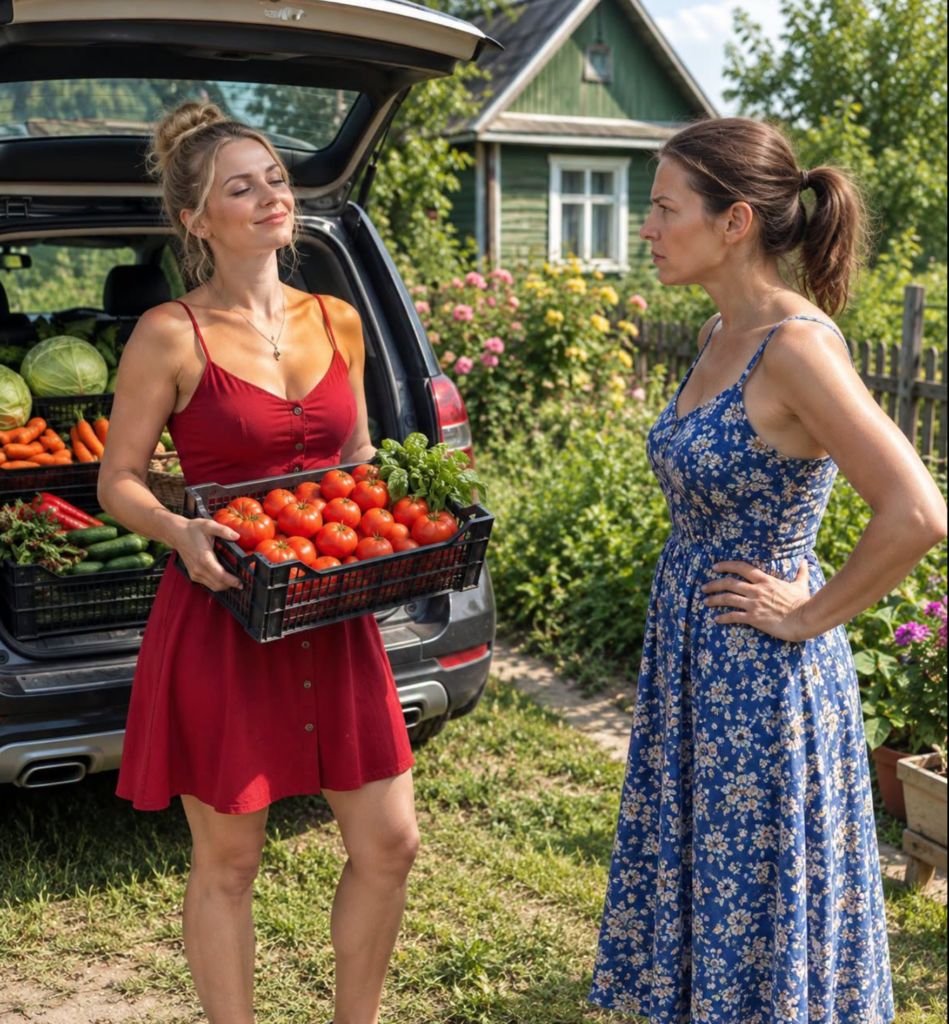
“Oh, Anna! You’re already here?” came my sister-in-law Rita’s cheerful voice.
I turned around.
She was standing at the entrance to the greenhouse, smiling brightly.
“We picked your harvest for ourselves,” she announced happily. “Come on, you and your husband could never eat all of this. It would just rot!”
She casually wiped her hands on my favorite kitchen towel.
I stared at her in disbelief.
Then I noticed her husband’s Nissan parked near the gate.
The trunk was wide open.
And it was packed.
Box after box. Plastic crates filled to the brim with my tomatoes, cucumbers, peppers and even the young garlic I had grown myself.
“What do you mean, you picked it for yourselves?” I finally asked.
Rita looked genuinely confused by my question.
“Anna, be reasonable. You two don’t have children. What would you do with all this? You couldn’t possibly eat it all.”
She pointed proudly toward the car.
“I have two growing boys. They need vitamins. And this is all natural! Igor already packed everything.”
Then she smiled.
“We left you some salad vegetables, though. There’s a small crate by the porch.”
I looked at my husband, Pavel.
He was standing beside the car, blinking in disbelief.
He clearly hadn’t expected this either.
But I knew exactly how this had happened.
Three years earlier, Pavel and I had bought this neglected piece of land outside Dmitrov.
It hadn’t been a spontaneous purchase.
We had saved for years.
The property was practically abandoned, with a crooked fence and soil so hard it felt like concrete.
During the first year, we removed old trees, dug out roots and hauled truckloads of fertile soil onto the property.
I still remembered the pain in my back from pushing those wheelbarrows.
Then we built the greenhouse.
It became my pride and joy.
I spent winter evenings studying different varieties of vegetables and ordering rare seeds from collectors.
In February, the windowsills of our city apartment were transformed into little nurseries.
I used grow lights, monitored the humidity, transplanted seedlings and carefully fertilized them.
Every single plant had been raised by my own hands.
For Pavel and me, the garden wasn’t simply a source of food.
It was something we had created together.
A place where we could escape from the noise and stress of city life.
Rita, however, saw it differently.
She was Pavel’s younger sister, and she had never been particularly shy about taking advantage of other people’s generosity.
She and her husband had two energetic boys.
They refused to get their own garden because, according to Rita, gardening was “something old people did.”
Yet somehow, they never refused an invitation to ours.
Every visit followed the same pattern.
They would arrive Friday evening with cheap sausages and a bottle of beer.
Rita would stretch out on a sun lounger.
The boys would run through the garden, trampling seedlings.
Igor would barbecue.
And I would prepare salads using the vegetables I had spent months growing.
Whenever I asked Rita to help weed even one garden bed or water the strawberries, she would look offended.
“We came here to relax, not to work,” she’d say.
“You wanted a garden. You deal with it.”
Pavel always tried to smooth things over.
“Anna, she’s my sister. Let the kids enjoy the fresh air.”
So I tolerated it.
For my husband.
For the sake of family peace.
But that summer, everything changed.
The weather had been unusually hot and sunny.
The vegetables were ripening incredibly fast.
My precious tomatoes were hanging from the vines in enormous, sugar-sweet clusters.
I had even taken Friday and Monday off work so I could spend four full days at the cottage.
I planned to make sauces, pickles, lecho and homemade tomato paste.
Then, on Wednesday evening, everything went wrong.
Our neighbor from the city called.
There was water pouring through our apartment.
We were being flooded from above.
We had no choice but to rush back to the city.
What we thought would take a few hours turned into two days.
Plumbers came.
Repairs had to be arranged.
And all the while, I worried about the garden.
The cucumbers could become oversized and bitter.
The tomatoes could split or break their branches.
When we finally finished dealing with everything on Friday afternoon, we immediately drove back.
And that’s when I found my greenhouse stripped bare.
“So you… picked it for yourselves?” I asked.
My voice was trembling.
Rita didn’t look even slightly embarrassed.
“Anna, look at this objectively,” she said calmly.
“You don’t have children. What are you going to do with all of it?”
She shrugged.
“My boys are growing. They need vitamins. It’s homemade and chemical-free!”
Then she gestured toward the Nissan.
“Igor packed the whole trunk.”
She smiled.
“You’re not selfish, are you?”
I looked at Pavel.
He opened his mouth to respond.
But before he could say anything, something inside my head clicked.
I could scream.
I could argue.
I could demand that they unload everything.
But I knew exactly what would happen.
Rita would start crying.
She would make me look like the unreasonable one.
Pavel would feel guilty.
And somehow, I’d still end up being the villain.
No.
I needed a different strategy.
I slowly inhaled.
Then I widened my eyes in horror.
“Rita…”
I took a step backward.
“Please tell me the children didn’t eat any of the tomatoes.”
Her smile disappeared.
“What?”
“Please tell me they didn’t eat any of it straight from the plants.”
Rita nervously shifted her weight.
“No… We put everything directly into the boxes.”
“Thank God.”
I grabbed my chest.
“Pavel!”
My husband looked at me.
He immediately realized something was happening and wisely said nothing.
“They picked the harvest!”
Rita’s expression changed.
“What do you mean?”
Igor appeared from behind the car, still eating an apple.
“What happened?”
I looked at both of them with complete horror.
“Why did you go into the greenhouse without asking me?”
Rita frowned.
“Anna, what’s wrong with you?”
I lowered my voice dramatically.
“Because I treated the entire greenhouse on Wednesday evening.”
Igor stopped chewing.
“With what?”
“Pesticide.”
Silence.
Rita’s face went pale.
“But you always said your vegetables were chemical-free!”
“They were.”
I sighed.
“Until I discovered spider mites and the first signs of blight.”
Igor swallowed.
“So… what does that mean?”
“It means the vegetables weren’t ready to be harvested.”
Rita stared at me.
“How long?”
“At least three weeks.”
The color drained from her face.
“Three weeks?”
I nodded.
Then I looked toward the Nissan.
“And you’ve already put everything in a closed trunk.”
Igor’s eyes widened.
“The kids were in the car!”
“Exactly.”
That was all it took.
The next few minutes were pure chaos.
Igor rushed to the trunk.
“Get everything out!”
Rita ran to the outdoor sink and started scrubbing her hands.
The boys were immediately pulled out of the car.
Igor carried crate after crate back to the porch, holding them away from himself as if they were radioactive.
Within fifteen minutes, every single vegetable had been returned.
The Nissan’s trunk was completely empty.
Igor wiped the sweat from his forehead.
“Anna… we’re sorry. We didn’t know.”
“We thought all that food was going to waste,” he muttered.
“We should probably go.”
They didn’t even come inside.
They jumped into the car and drove away so quickly that gravel flew from beneath the tires.
When the car disappeared down the road, Pavel and I were finally alone.
He looked at the mountain of vegetables stacked neatly on our porch.
Then he looked at me.
“Anna…”
“Yes?”
“We don’t actually have a disposal pit.”
I smiled.
“Of course we don’t.”
I picked up the biggest, ripest tomato from the top crate.
It was absolutely perfect.
I wiped it on my shirt sleeve and took a huge bite.
Sweet juice ran down my chin.
Pavel stared at me.
Then he slowly started smiling.
“There wasn’t any pesticide, was there?”
“No.”
“Any blight?”
“Nope.”
He burst out laughing.
“So you made the whole thing up?”
I took another bite of the tomato.
“I prefer to think of it as encouraging people to respect boundaries.”
Pavel laughed even harder.
Then I handed him a crate.
“Come on. We have jars to wash.”
He picked up another box, still laughing.
For the first time in years, our garden felt peaceful.
Rita and Igor never came back.
In fact, they eventually bought a weekend getaway of their own.
Apparently, they preferred relaxing somewhere far away from my “toxic” vegetables.
As for Pavel and me, we finally enjoyed our garden the way we always wanted to.
Quietly.
Peacefully.
Without anyone helping themselves to the fruits of our labor.
And I learned an important lesson that summer:
Sometimes keeping the peace doesn’t mean putting up with everything.
Sometimes people simply need to be reminded where the boundaries are.
In our case, apparently all it took was a little imagination… and one very convincing story about “toxic tomatoes.”