Anna adjusted the tablecloth for the third time.
The glasses were polished until they practically sparkled, the silverware was perfectly aligned, and a small vase of fresh flowers stood in the center of the table.
Everything was ready.
Still, Anna felt as though she were preparing for an exam.
That afternoon, her mother-in-law, Olga Pavlovna, was coming to their home for lunch for the first time since Anna and Vladimir had officially married. And Anna knew exactly what Olga intended to do.
She wasn’t simply coming to eat.
She was coming to inspect her.
To see how well her new daughter-in-law managed a household.
Vladimir wrapped his arms around Anna from behind.
“Relax. Everything will be fine. Mom loves good food, and you cook wonderfully.”
Anna smiled nervously and glanced at the table. There was rich homemade borscht, juicy meat cutlets made from fresh meat, and boiled potatoes sprinkled with herbs.
At exactly two o’clock, the doorbell rang.
Olga Pavlovna entered without being a minute late.
She looked around the hallway, inspected the living room, then studied the table setting with a critical expression.
She didn’t smile.
She simply nodded, like an inspector arriving at a building where she already expected to find problems.
Once seated, she took a spoonful of borscht, smelled it, and cautiously tasted it.
Her face immediately twisted.
“Something is wrong with this.”
Anna froze.
“Is it too salty?”
“No. It tastes like cheap cafeteria food. Just water with vegetables floating in it.”
Anna stood there holding the ladle.
Three hours at the stove.
Three hours.
And her mother-in-law had just called it vegetable water.
Vladimir quietly defended the soup.
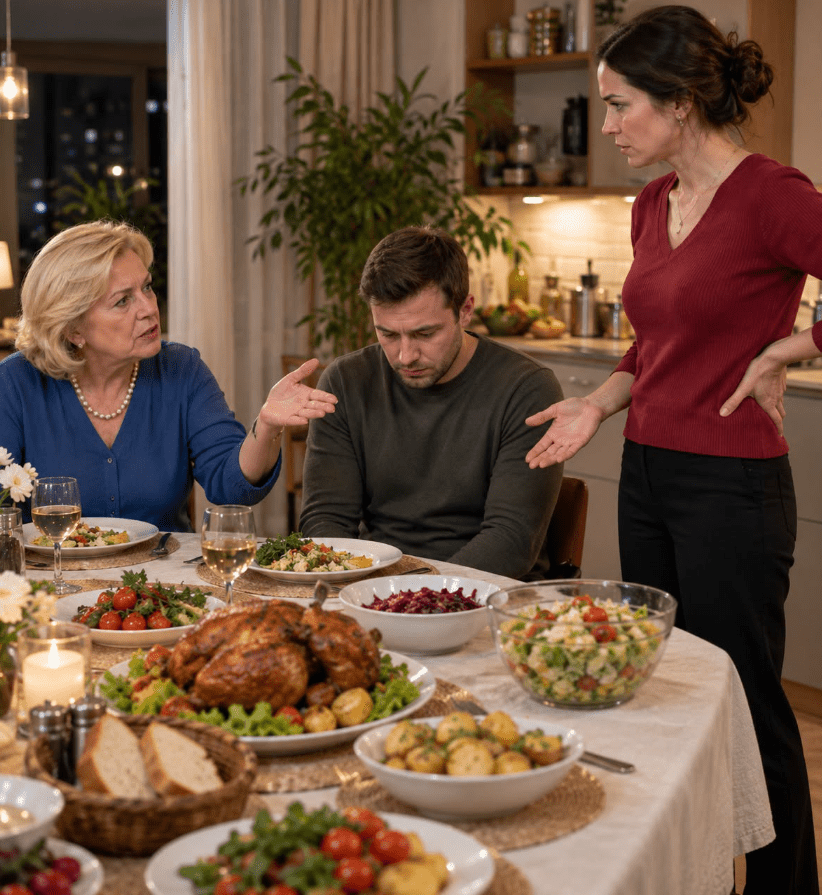
“I think it’s delicious.”
His mother immediately dismissed him.
“You only think that because you’ve gotten used to your wife’s cooking.”
The cutlets were too salty.
The potatoes were undercooked.
The salad was “bland.”
Before leaving, Olga Pavlovna delivered her final verdict.
“Don’t worry, Anna. I’ll teach you how to cook properly. You’re still young. You have practically no experience.”
Anna said nothing.
But the truth was, she had been cooking since she was fourteen. When her mother became seriously ill, Anna had taken care of the house and her younger brothers. At work, her colleagues constantly praised her homemade pastries.
Yet somehow, after listening to Olga, she began questioning herself.
Maybe she really wasn’t good enough.
That evening, Vladimir tried to reassure her.
“Mom is strict, but she’s fair. She’s been cooking for thirty-five years. You should listen to her.”
Anna remained silent.
She had no idea that those words would become the beginning of the end.
### Every Sunday, Another Judgment
Olga Pavlovna started visiting every Sunday.
And every Sunday brought another criticism.
The beef stew was too tough.
The carrots in the soup were cut too large.
The potatoes in the Olivier salad were overcooked.
The sausage was “the wrong kind.”
One day, Olga tasted Anna’s homemade pie, broke off a tiny piece, chewed it dramatically, and spat it into her napkin.
Anna tried everything.
She bought more expensive ingredients. She followed new recipes. She changed cooking times and measured everything carefully.
Nothing helped.
Freshly baked fish was called “rubber.”
Stewed cabbage was compared to garbage.
“I wouldn’t even give this to a dog,” Olga once announced.
Vladimir sat beside his mother and said nothing.
Sometimes he nodded.
Sometimes he looked away.
But he never defended Anna.
Slowly, Anna began feeling like a stranger in her own home.
Eventually, she stopped trying.
She started cooking simple meals: pasta, buckwheat, roasted chicken.
“You’ve completely given up,” Olga remarked one Sunday.
“I’m tired,” Anna replied. “Whatever I make, it’s never good enough for you.”
“That’s because you need to try harder. Not everyone has talent, but persistence can make up for it.”
Anna looked at Vladimir, hoping he would finally say something.
He simply continued eating.
### The Birthday That Changed Everything
On her twenty-eighth birthday, Anna decided she was done trying to impress her mother-in-law.
She invited her parents and prepared a beautiful celebration.
There was herb-roasted meat, elaborate salads, and a homemade berry pie.
Her parents arrived first.
Her mother admired the table.
Her father tasted the salad and smiled.
“Sweetheart, this is incredible!”
They praised everything.
They asked for the marinade recipe.
They loved the pie.
For the first time in months, Anna felt completely confident.
Her parents left around six.
Anna began clearing the table when the doorbell rang.
Olga Pavlovna had arrived.
She had been delayed at a friend’s house.
Anna swallowed her frustration, set the table again, and served her mother-in-law fresh portions.
Olga tasted the salad.
Her face tightened.
She cut a piece of meat.
She frowned.
Then she poked the pie with her fork and pushed the plate away.
“Anna, I tried to hold my tongue, but this is impossible.”
“What is wrong?” Anna asked.
“This isn’t a birthday dinner. It’s dog food.”
Anna stared at her.
“My parents loved it.”
“Your parents are simply being polite. Or perhaps they have no taste.”
Something inside Anna finally snapped.
“Enough.”
“You need to accept the truth. You can’t cook.”
Anna stood up.
“You will not speak to me like that in my own home.”
“I am your mother-in-law. I have every right to tell you the truth.”
“No,” Anna said quietly. “You have no right to humiliate me.”
Vladimir appeared in the doorway.
“Don’t raise your voice at my mother.”
Anna turned toward him in disbelief.
“She just called my birthday dinner dog food!”
“Mom is basically right,” Vladimir replied.
Anna stared at him.
“You’re serious? You ate two portions of that meat an hour ago and asked for seconds!”
“I didn’t want to ruin your mood. Mom is only trying to help.”
Anna gave a bitter laugh.
“She has humiliated me every Sunday for six months, and you’ve never once defended me.”
“You’re overreacting.”
Anna looked at Olga.
“Leave.”
Vladimir frowned.
“What?”
“Both of you. Leave my home.”
“This is ridiculous!”
“No. This apartment belonged to me before we were married. It was my inheritance.”
Olga grabbed her son’s arm.
“Vladimir, are you going to let her treat me like this?”
Anna picked up her phone.
“You have five minutes. If you’re not gone by then, I’m calling the police.”
Ten minutes later, Vladimir walked out carrying a bag.
Olga was already complaining in the hallway.
Anna closed the door.
Turned the lock.
And for the first time in months, the apartment was completely silent.
### Finally, She Understood
Anna returned to the kitchen.
She tasted the salad.
Fresh.
Balanced.
Delicious.
She tried the meat.
Tender, juicy, perfectly cooked.
Then she tasted the pie.
It was wonderful.
Anna smiled.
Suddenly, everything became clear.
Her cooking had never been the problem.
Olga hadn’t been trying to teach her how to cook.
She had been trying to break her confidence and maintain control over her son.
And Vladimir had allowed it.
The next morning, he called demanding an apology.
“Mom’s blood pressure went up because of you!”
“I won’t apologize,” Anna said calmly.
“You’re destroying our marriage over one comment about food?”
“No. I’m ending it because I finally realized I was married to a man who would rather watch his wife be humiliated than stand up to his mother.”
Then Anna blocked both their numbers.
The divorce was finalized quickly.
There were no children and no complicated shared assets.
When Anna walked out of the courthouse, she stopped on the steps and took a deep breath.
For the first time in a long time, she felt free.
That evening, she went home, baked fish with vegetables, made a light salad, and set the table beautifully.
For one person.
She lit a candle and sat down.
The food was delicious.
But that wasn’t the important part.
No one was sitting across from her telling her that she wasn’t good enough.
Anna finally understood something simple:
Her home was not an examination room.
Her kitchen was not a courtroom.
And she did not have to spend the rest of her life proving her worth to anyone.
For the first time, she could cook in peace.
Eat in peace.
Live in peace.
And no one would ever again be allowed to tell her how little she was worth.