When my son said, “Mom, we’re taking you to the allotment. You’ll get some rest. The fresh air will get you back on your feet,” I truly believed him.
I had no idea yet that waiting for me there were two buckets of green paint, three paintbrushes, and a fence that apparently had been dreaming of a new life for a very long time.
I only realized it when I saw it beneath the gazebo.
But by then, it was already too late.
Marcin rarely called me. Usually, he would send me a short text: “How are you feeling?”, “How are things?”, sometimes, “We’ll come on Sunday.”
So when I saw his number on my screen on Tuesday evening, I immediately felt uneasy.
“Mom, it’s a long weekend. We’re taking you to the allotment,” he said instead of saying hello. “You’ll rest. The fresh air will get you back on your feet. Agnieszka says you’ve looked pale lately.”
I smiled into the phone.
Maybe I really did need some rest.
I was sixty-three years old and had been retired for two years. For thirty years, I had worked behind the counter at a stationery store in Radom. All my life, I had been used to work, people, and constant rushing around.
And now?
My knees hurt, sometimes my spine bothered me, and the only walks I had been taking lately were from my apartment building to Biedronka.
So I packed as if I were going on a real vacation.
A book. Night cream. Slippers. A light sweater for the evening.
I even baked a yeast cake with crumble topping.
Because, after all, it wouldn’t be proper to visit my son empty-handed.
On Friday morning, Marcin came to pick me up.
Agnieszka was sitting in the front. I sat in the back, between three-year-old Zosia’s car seat and a huge beach bag.
“It’s going to be great, Mom,” Marcin said. “You’ll see. You’ll get some rest.”
The allotment really was beautiful.
A new gazebo, freshly mowed grass, beds full of tomatoes, and young raspberry bushes planted along the fence.
Only the fence…
The fence looked as if it remembered the days of my childhood.
The wooden boards were gray, cracked, and peeling in large flakes.
And beneath the gazebo stood two buckets of green paint and three paintbrushes.
I looked at them.
Then at Marcin.
“Dad left them,” he said casually. “He was supposed to paint it, but he didn’t get around to it.”
“Dad,” meaning Zdzisław—my ex-husband, who had transferred the allotment to Marcin two years earlier and had only come here once every few months since then, just to check whether the tomatoes were still alive.
“Then we’ll paint it together,” I said.
Marcin nodded.
“Sure.”
Agnieszka looked up at the sky.
“But the sun is terribly strong today. Zosia needs some shade.”
Twenty minutes later, all three of them were already by the car.
A blanket.
A picnic basket.
An inflatable flamingo.
Sunscreen.
The lake.
“Mom, relax. Tomorrow we’ll tackle the fence together,” Marcin called as he closed the gate.
I waved goodbye.
I sat down in the gazebo.
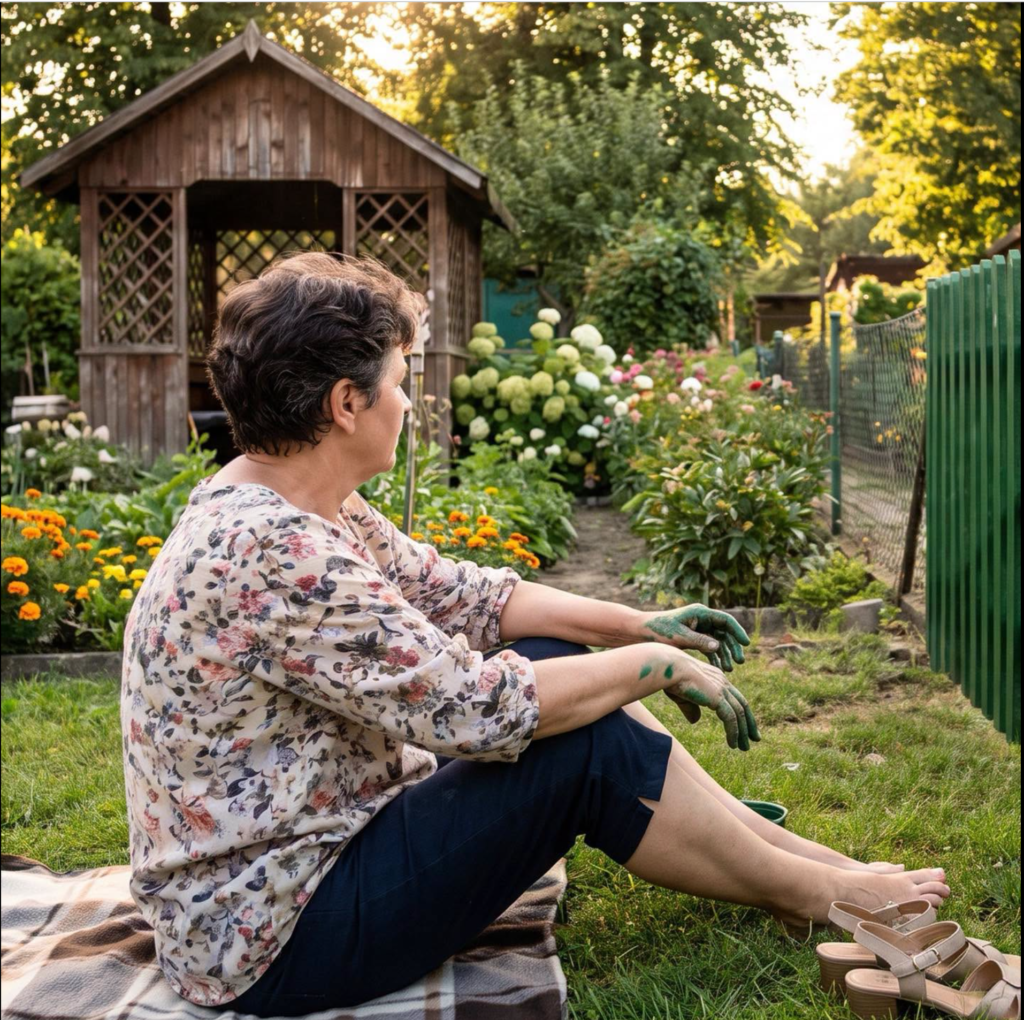
Made myself a cup of tea.
Opened my book.
Read two pages.
Then I looked at the fence.
The fence looked back at me.
At noon, I stood up.
I picked up a paintbrush.
“I’ll just paint a little bit,” I thought.
Just a little bit.
I painted until four o’clock.
The sun was merciless. The paint stuck to my fingers, sweat ran down my back, and every half hour my spine reminded me that I wasn’t twenty anymore.
When Marcin returned from the lake, his face was tanned and he smelled of sunscreen.
He looked at the fence.
Then at me.
“Mom… why did you do this? You were supposed to be resting!”
“I was resting, sweetheart,” I replied. “I was just getting a little bored.”
He laughed.
Just like that.
As if it were some funny little anecdote.
That evening, I made chicken soup from the chicken I had found in the refrigerator. Agnieszka set the table, which I have to give her credit for—she helped.
Marcin talked about his plans.
A new barbecue.
Better lighting.
Raspberries.
Maybe even a small terrace beside the gazebo.
Nobody said:
“Mom, thank you for painting the fence.”
Saturday morning was exactly the same.
Them—the lake.
Zosia in her little hat.
Agnieszka with the picnic basket.
Marcin with a towel draped over his shoulder.
And me?
A paintbrush.
The third side.
Then the fourth.
My knees began to swell, my hands hurt from holding the brush, but there was less and less paint left in the buckets.
They returned around lunchtime.
They ate the pork cutlets I had prepared that morning.
Then they went down for a nap.
I sat in the gazebo.
And then I remembered my mother.
My mother used to do exactly the same thing.
She would come to our house to “rest,” and after a few hours she would be scrubbing the kitchen, washing the curtains, sewing buttons back on, and ironing everything she could find.
When I was young, I thought she simply liked keeping busy.
I thought an older person couldn’t just sit around doing nothing.
Only then, with a paintbrush in one hand and a painkiller in the other, did I understand something I had never been able to see before.
Mom didn’t do those things because she enjoyed them.
She did them because she couldn’t say no.
And I had never been able to ask:
“Mom, aren’t you tired?”
On Sunday, I woke up before everyone else.
Everything hurt.
My back.
My knees.
My wrists.
I could barely straighten my fingers.
There was only one last section left to paint—several boards facing the road.
I sat down for a moment.
Then I picked up the paintbrush again.
I painted slowly.
Centimeter by centimeter.
Just as my grandmother used to paint Easter eggs.
When I finished, I stepped back a few paces.
The fence was even.
Green.
Really beautiful.
I sat down on the grass and simply looked at it for a while.
At ten o’clock, Marcin came outside.
He was holding a cup of coffee in one hand.
He looked at the fence and his face lit up.
“Oh, Mom! You finished it! It looks great!”
He was genuinely delighted.
Like a child who had received an A for homework he hadn’t done himself.
“See? I told you the fresh air would do you good. You already have more color in your face!”
I looked at my hands.
They were completely green.
My skin was cracked.
There were marks on my fingers from the paintbrush.
“Yes,” I said quietly. “I certainly have some color.”
Marcin laughed.
I didn’t.
“Marcin.”
“What?”
“Next time, if you need someone to paint the fence, just tell me.”
He frowned.
“What are you talking about?”
“You don’t have to call work ‘rest.’”
For a moment, he stared at me without saying anything.
“Mom, I didn’t ask you to do anything. You started it yourself.”
And then I understood what was most painful about the whole thing.
He really believed that.
He genuinely believed the paint standing beneath the gazebo had been there by accident.
That I had picked up the brush on my own.
That a woman in her sixties could come for a weekend, work for three days, cook, clean, and paint a fence…
…and do all of it because she enjoyed it.
Because, after all, “Mom likes feeling needed.”
On the drive home, Zosia was asleep.
Agnieszka was scrolling through her phone.
Marcin was talking about his plans for the fall.
“In September, we’ll still need to varnish the gazebo,” he said. “Will you come, Mom? It did you good here.”
I didn’t answer.
I watched the fields rushing past the window.
I thought about my mother.
About how she used to come home from our house after every one of her “rests.”
With a sore back.
Exhausted.
But always smiling.
Mom passed away three years ago.
And suddenly I realized that I had never thanked her.
Not for the curtains.
Not for the buttons.
Not for the spotless kitchen.
But for doing more for us throughout her entire life than she had the strength to do.
I had never asked her either:
“Mom, does anything hurt?”
When Marcin stopped the car outside my apartment building, he got out and took my bag from the trunk.
He kissed me on the cheek.
“Thank you, Mom. You look great.”
I smiled.
“You too, sweetheart.”
I went inside my apartment.
Closed the door.
Put down my bag.
I went to the bathroom and turned on the tap.
I began washing the paint from my hands.
The soap didn’t help.
The green had worked its way deep beneath my fingernails, into the lines of my palms, into every wrinkle.
The shampoo didn’t help either.
I scrubbed my hands harder and harder.
And then I thought about my mother.
About her hands.
About how many times she had come home with similar traces of our everyday lives on them.
And for the first time in my life, I understood that some marks don’t disappear right away.
Not because they are difficult to wash away.
But because for years, no one had tried to notice them.