My son came on Sunday with a friend who, according to him, “just happened to be in the area.”
The friend looked through all three rooms, went down into the basement, stopped by the kitchen window, and spent a surprisingly long time studying the courtyard. Then he nodded approvingly and remarked on how “well laid out” the apartment was.
That was when I recognized him.
I knew that face far too well.
For three years, it had been staring at me from a huge real estate advertisement near the roundabout.
If I hadn’t passed that billboard every morning on my way to buy bread, I probably would have shaken his hand, made him a cup of tea, and never thought twice about why Tomek had brought a complete stranger into my home on a Sunday afternoon.
But I did pass it.
Every single day.
For three years.
Ever since the real estate agency rented the advertising board at the roundabout on Lipowa Street, I had seen that same smiling face almost every morning. Elegant suit. Perfectly styled hair. Dark-rimmed glasses. And that polished professional smile that seemed to say he could sell you an apartment before you even realized you had decided to buy one.
Under his face was the slogan:
“Your property in good hands.”
I knew that face better than I knew the faces of half the people in my apartment building.
So when I suddenly saw it standing in my own hallway, something cold and uneasy tightened in my chest.
I just didn’t know why yet.
But somewhere deep inside, a little voice was already telling me that this Sunday was not going to end like an ordinary Sunday.
—
Tomek called on Thursday.
The fact that he called on a Thursday was strange enough.
My son had his Sundays.
Every Sunday, precisely at four in the afternoon, my phone would ring in the kitchen.
“Hi, Mom. How are you?”
A few minutes of conversation. He would ask how I was feeling, whether I needed anything, whether everything at home was all right.
Then came the usual:
“Okay, Mom. Talk to you next Sunday.”
As if our conversations were simply another item on his weekly calendar.
But this time, he called on Thursday.
“I’ll come over this weekend,” he announced. “With a friend.”
“With a friend?”
“Yeah. He’ll be in Lublin for business, so we thought we’d stop by.”
“We thought we’d stop by.”
At the time, I didn’t think anything of it.
I was simply happy that my son was coming.
I had been retired for three years. After thirty-two years working behind the counter at a pharmacy on Głęboka Street, I had suddenly discovered how long a day could feel when nobody was expecting you anywhere.
Especially Sundays.
Sometimes, from morning until evening, the only sounds in the apartment were the ticking of the clock and the distant hum of cars outside.
So I was genuinely looking forward to seeing Tomek.
On Saturday, I pulled my old cheesecake pan from the cupboard.
It had belonged to my mother.
The enamel around the rim was scratched in several places, and there were dark marks on the bottom from years of baking.
I went to the market and bought good farmer’s cheese.
I wiped down the kitchen table.
Cleaned the windows.
Even went down into the basement and organized a few things because Tomek had mentioned several times that he wanted to take his father’s old bicycle.
I had no idea then that I was actually preparing my home for a man who had come to determine how much it was worth.
—
They arrived before noon.
Tomek came in first.
“Hi, Mom.”
He kissed my cheek and placed a box of chocolates on the table.
The kind wrapped in gold paper that you could buy at practically any gas station.
Then the other man stepped inside.
He was tall.
Slim.
He wore a pale shirt buttoned all the way to the collar, despite the fact that it was nearly ninety degrees outside.
He held out his hand.
“Bartek. Nice to meet you.”
I smiled politely.
“Danuta.”
I looked at him for a few seconds longer than was probably appropriate.
His face seemed familiar.
But where had I seen him?
I couldn’t place it.
“Come into the kitchen,” I said.
I put the cheesecake on the table, made tea, and tried to behave as though everything were perfectly normal.
Tomek ate quickly, the way he always did when he was eating homemade food. Bartek, on the other hand, took small, careful bites.
“This is very good,” he said. “Homemade?”
“My mother’s recipe.”
“You can tell you have a talent for this.”
I smiled.
For a moment, everything felt completely ordinary.
Then Bartek asked:
“Would it be all right if I used the bathroom?”
“Of course. First door on the left.”
A few minutes later, I heard his footsteps.
Then silence.
I glanced toward the hallway.
Bartek was coming back.
Except instead of returning to the kitchen, he opened the bedroom door.
He looked inside.
“Oh,” he said. “Very bright room.”
He looked toward the window.
“South-facing?”
I froze.
Nobody normal says “south-facing” when they’re coming back from the bathroom.
Nobody.
—
Tomek cleared his throat.
“Mom, we’ll show Bartek the apartment. He’s interested in older buildings.”
I didn’t answer.
I simply followed them.
First, the living room.
Bartek tilted his head back and studied the ceiling for several seconds.
Then he moved into the hallway.
He knocked on the wall with his knuckles.
Once.
Then again.
As if he were checking what was underneath the plaster.
In the kitchen, he stood by the window and stared at the courtyard for a long moment.
“Large courtyard,” he murmured.
Tomek nodded.
“Yeah.”
“Quiet neighborhood.”
“Very.”
Then we went down to the basement.
Bartek looked around.
Old shelves.
Jars.
Boxes.
My husband’s old bicycle leaning against the wall.
“Quite a practical space,” he said.
And that was when something inside me clicked.
“Practical.”
That word.
The way he was looking at everything.
Those glasses.
That jawline.
That smile.
Suddenly, everything fell into place.
I remembered the huge billboard near the roundabout.
The face I passed every morning.
The name of the real estate agency.
And suddenly I felt cold, even though it was thirty degrees outside.
He wasn’t Tomek’s friend.
He was a real estate agent.
A man who, for the past several minutes, hadn’t been looking at my home as a guest.
He had been looking at it as a property.
—
I went back upstairs.
I sat at the kitchen table.
I said nothing.
I waited.
A few minutes later, they came back.
Tomek looked unusually animated.
He was talking quickly.
About apartment prices.
About the housing market.
About how much property values had increased in this part of the city.
Bartek kept nodding.
It was starting to feel less like a family visit and more like a professional consultation.
That was when I spoke.
“Tomek.”
My son looked at me.
“Your friend is the real estate agent from the agency by the roundabout.”
Silence.
Bartek slowly put down his cup.
Tomek’s neck turned red.
All the way up to his ears.
Exactly the way his father’s used to when he was trying to lie to me.
“Mom…”
“Isn’t that right?”
He didn’t answer.
“Then what is it, Tomek?”
My voice was calm.
Far too calm.
“You bring a man into my home whose job is to value properties. You tell me he’s your friend. And you honestly thought I wouldn’t recognize the man whose face I’ve been looking at every morning for three years?”
Bartek stood up.
“Mrs. Danuta, I’m sorry. I didn’t mean to mislead you.”
“But that is exactly what you did.”
He lowered his eyes.
“I’m sorry.”
Then he walked out.
I heard his quick footsteps on the stairs.
Then the front door slammed.
Tomek stayed.
He sat across from me at the table where, as a little boy, he had eaten tomato soup, done his homework, and once announced that he was getting married.
Now he was playing with his teaspoon.
He looked like a little boy who had just been caught lying.
“Mom, nobody is taking anything away from you.”
“Really?”
“I just wanted to know how much the apartment was worth.”
“For what?”
“Just to know.”
“For you? Or for someone else?”
He fell silent.
Then he mentioned the name he didn’t really need to mention.
“Sylwia says…”
He stopped.
He didn’t have to finish.
For two years, Sylwia had been saying that their apartment in Czuby was too small for them and their two children.
That they needed something bigger.
That I had an entire apartment all to myself.
That I could move somewhere smaller.
That it would be more “reasonable.”
That it would be better for everyone.
Everyone.
Except somehow, nobody had ever asked me what would be better for me.
I looked at my son.
“Do you know what the worst part is?”
He raised his eyes.
“It isn’t that you want my apartment.”
I paused.
“The worst part is that you didn’t have the courage to tell me to my face.”
Tomek lowered his head.
For several seconds, the only sound in the kitchen was the ticking of the clock.
“Your father died in this apartment,” I said quietly.
Tomek shifted in his chair.
“In that bedroom your friend was examining so carefully. The bedroom he described as south-facing.”
I looked directly at him.
“Five years ago. In that bed.”
“Mom…”
“Do you remember?”
He said nothing.
“Do you remember or not?”
He nodded.
—
I stood up.
I gathered the cups.
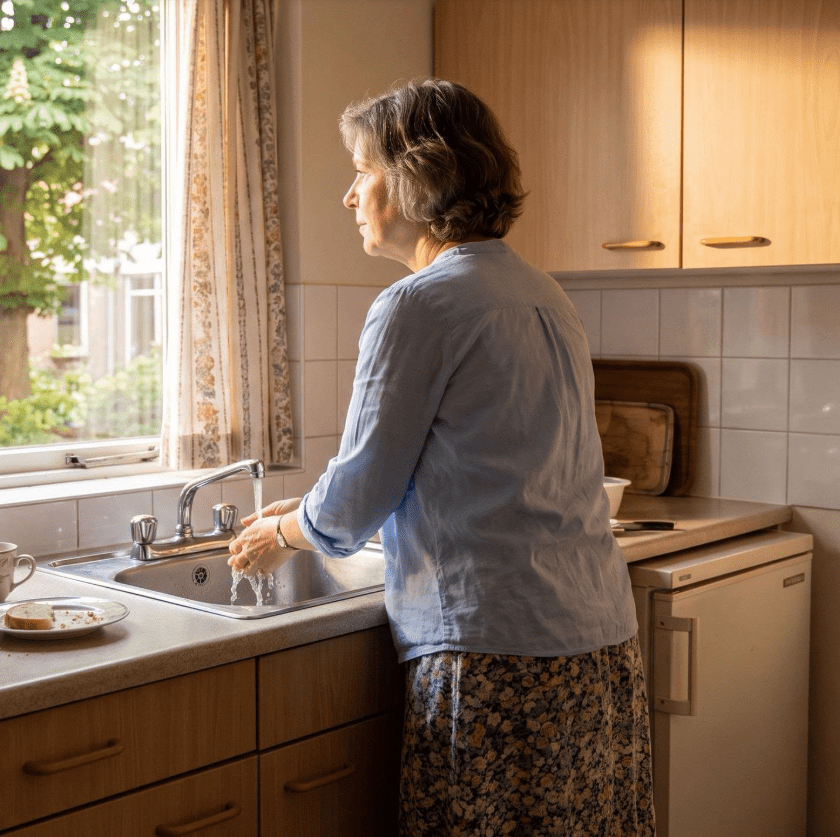
In the kitchen, I turned on the faucet and stood there for a moment with my hands beneath the running water.
Through the window, I could see the courtyard.
The same courtyard I had looked at for thirty-five years.
The old chestnut tree.
The bench.
The place where a sandbox used to stand.
Children had grown up.
People had left.
Apartments had changed hands.
But the view from my kitchen window had remained the same.
“Go home, Tomek,” I said.
I didn’t turn around.
“Take the cheesecake with you.”
There was a moment of silence.
“Sylwia likes it.”
I heard him pick up the box.
Then the front door slammed.
Footsteps on the stairs.
The sound of the car starting.
And finally, silence.
—
That evening, I washed the cheesecake pan.
I dried it carefully and put it on the highest shelf, where I could no longer reach it without a step stool.
For thirty years, I had baked in that pan for my children.
For birthdays.
For name days.
For Christmas.
For ordinary Sundays, when everyone still came without calling first and nobody calculated how much the walls around us were worth.
Maybe one day I would take it down again.
Maybe I wouldn’t.
The next morning, I went out to buy bread.
I walked past the roundabout.
And there he was.
Bartek.
Smiling from the billboard exactly as he had every other morning.
Elegant suit.
Glasses.
Professional smile.
And beneath him, the same slogan:
“Your property in good hands.”
But this time, I looked at him differently.
I quickened my pace.
Not because I was afraid of him.
But because, for the first time in a long time, I truly understood something.
My home was not simply an apartment.
It was not square footage.
It was not a “good layout.”
It was not a number someone could write on a property valuation form.
It was thirty-five years of my life.
My memories.
My husband’s final days.
My son’s childhood.
Our family’s history.
And as long as I was the one holding the keys in my hand, I was the one who decided who crossed my threshold.