At 10:03 that Friday night, I drove away from my mother’s house with my two children in the back seat, tears burning my eyes so badly that the road ahead looked blurry.
I wasn’t crying because Mom had given our bedroom to my sister.
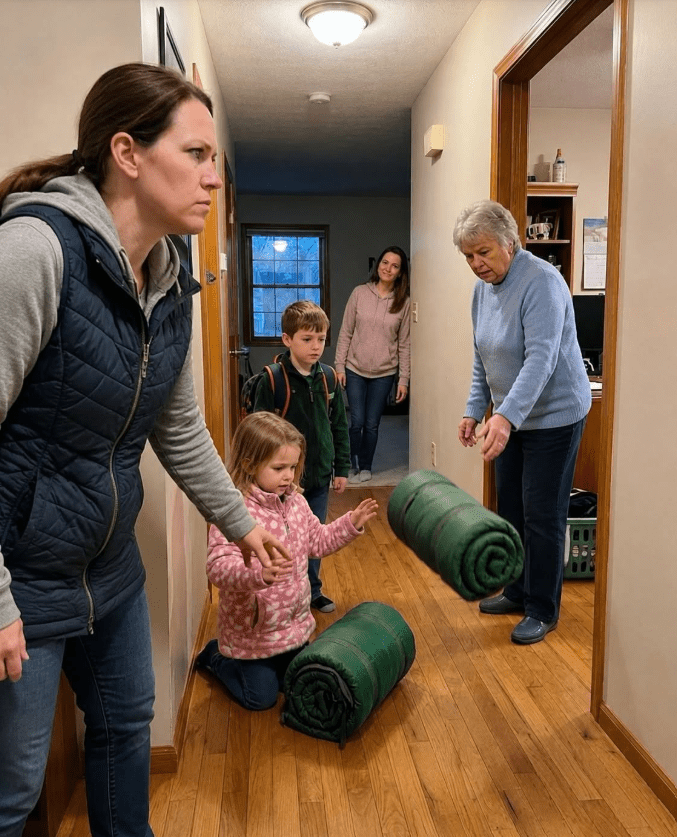
I wasn’t crying because Amanda had laughed when she handed us two sleeping bags.
I wasn’t even crying because my mother had stood there and watched it happen.
I was crying because my five-year-old daughter, Lily, had stared at the sleeping bag on the cold floor and whispered:
“Mommy… did Grandma not want us here?”
My hands tightened around the steering wheel.
“No, sweetheart.”
I forced the words out.
“Of course Grandma wants you here.”
It was a lie.
Or maybe it was the answer a mother gives when the truth is too cruel for a five-year-old to understand.
Because that night, I finally realized something I had spent years refusing to admit.
My family didn’t value me.
They valued what I did for them.
And there is a painful difference between the two.
Three weeks earlier, everything had seemed completely different.
Mom had called me on a Tuesday evening, practically begging.
“Claire, please,” she said. “It’s the first Thanksgiving since Grandpa died. I don’t want everyone scattered. I want the whole family together.”
I didn’t hesitate.
“Okay, Mom. I’ll organize it.”
Of course I would.
I always did.
I was the daughter who remembered everyone’s birthdays.
The daughter who booked restaurants.
The daughter who arranged transportation.
The daughter who made sure the children had activities.
The daughter who paid the deposit when everyone else said, “Don’t worry. We’ll figure it out later.”
So when Mom suggested renting a beautiful lodge in Hocking Hills for the entire Thanksgiving weekend, I took care of everything.
Eleven bedrooms.
A private dining room.
Catering.
Family activities.
Transportation.
A professional photographer.
Even a little Thanksgiving craft table for the children.
It was going to be perfect.
At least, I thought it was.
I paid the deposits because the lodge required immediate confirmation.
“Everyone will reimburse you,” Mom promised.
“Of course,” I said.
Nobody did.
Not one person.
But I didn’t complain.
Because it was Thanksgiving.
Because Grandpa had just died.
Because we were family.
And somewhere deep inside me, despite years of disappointments, I still believed my mother loved all her children equally.
Friday night destroyed that illusion.
When we arrived at Mom’s house, Amanda and her husband were already there with their teenagers.
Mom pulled me aside.
“There’s been a little change.”
I should have known.
“What kind of change?”
She smiled awkwardly.
“Amanda’s family needs the guest room you were supposed to have.”
I stared at her.
“So where are we sleeping?”
Mom pointed toward the hallway.
“You and the kids can use the living room.”
I thought she was joking.
She wasn’t.
Amanda appeared behind her, already laughing.
“Come on, Claire. It’s only for one night.”
Then she looked at the sleeping bags.
“You’ve got two of those. The kids can sleep on the floor.”
My daughter looked at me.
I looked at Mom.
Not one person said, “That’s not okay.”
Not one.
I packed our things.
I didn’t argue.
I didn’t scream.
I simply took my children by the hand and walked out.
And that was the moment everything changed.
—
Nearly an hour later, I pulled into a small roadside hotel.
It wasn’t luxurious.
The lobby smelled faintly of coffee and disinfectant.
The carpet had seen better days.
But the room had two beds.
There were clean blankets.
And most importantly, my children were treated like they belonged.
Lily climbed into bed and was asleep within minutes.
Nine-year-old Noah stayed awake.
“Mom?”
“Yeah?”
“Are we still going to Thanksgiving tomorrow?”
I looked at him through the rearview mirror.
“I don’t know.”
He thought about it.
Then he shrugged.
“That’s okay.”
Two words.
That was all.
But they crushed me.
My nine-year-old son was already learning how to swallow disappointment so nobody else would feel guilty.
I checked us into the room, ordered room service, and helped both children get ready for bed.
When they were finally asleep, I sat beside the window with my phone in my hand.
It wouldn’t stop vibrating.
Mom.
Amanda.
Mom.
Amanda.
Mom again.
I ignored every call.
At 11:26 p.m., a message appeared from Mom.
You’re being ridiculous. Come back tomorrow.
I stared at the screen for a long time.
Then I opened my email.
Three messages waited for me from the lodge.
The first confirmed our Thanksgiving reservation.
The second confirmed the catering.
The third reminded me that the cancellation deadline was approaching.
I opened the reservation.
The total stared back at me.
It was a lot of money.
For a moment, I hesitated.
Then I thought about Lily’s voice.
Did Grandma not want us here?
Something inside me went completely still.
For years, I had confused keeping the peace with keeping my family together.
That night, I finally understood they were not the same thing.
Saturday morning, at exactly 7:41, I called the lodge.
“Good morning. I need to cancel a reservation.”
The woman on the phone sounded surprised.
“Certainly. May I have the reservation name?”
“Claire Morgan.”
She pulled up the booking.
“Your Thanksgiving weekend?”
“Yes.”
“Are you sure?”
I looked across the room.
Lily was coloring a turkey at the little hotel breakfast table.
Noah was eating pancakes.
Neither child looked miserable anymore.
“Yes,” I said.
“I’m sure.”
She explained the cancellation policy.
Because I was still within the cancellation period, most of the deposits would be refunded.
The catering company could return most of its payment.
The photographer could release the date.
The transportation company could cancel the vans.
I slowly realized something.
I hadn’t ruined Thanksgiving.
I had simply stopped paying for a celebration where my children had been treated like unwanted guests.
—
At 8:12, Mom called.
This time, I answered.
“Where are you?”
“At a hotel.”
“Claire, this has gone far enough.”
I said nothing.
“You embarrassed me last night.”
I almost laughed.
“Mom, you gave the room you promised us to Amanda.”
“She has four people!”
“I have two children.”
“They’re five and nine! They don’t need an entire bedroom.”
I stared out the window.
“Neither do Amanda’s teenagers.”
Silence.
Then Mom asked sharply:
“So are you coming back or not?”
“No.”
“Fine.”
Her voice turned icy.
“Then don’t expect everyone to wait around for you.”
“I won’t.”
I hung up.
Five minutes later, Amanda texted.
You seriously canceled Thanksgiving because of a sleeping arrangement?
I ignored it.
Another message arrived.
Mom says you’re being selfish.
Then:
Everyone is furious.
I turned my phone face down.
For the first time in years, I didn’t feel responsible for everyone else’s emotions.
And strangely enough…
I felt free.
—
That afternoon, Noah and Lily and I went to a small Thanksgiving festival in town.
There were lights strung across the square.
Music played from a little outdoor stage.
Food trucks lined the street.
Children ran between games while volunteers decorated a giant Christmas tree.
Lily wore a red scarf and carried a cup of hot chocolate.
Noah carried her stuffed rabbit because she had forgotten it in the hotel room.
We took pictures.
We laughed.
We ate far too much pie.
And for several hours, I forgot about my family.
Then Sunday morning came.
My phone lit up.
83 MISSED CALLS.
I stared at the screen.
Mom.
Amanda.
Uncle Robert.
Aunt Linda.
Even cousins I hadn’t spoken to in months.
My stomach tightened.
Something had happened.
I called Mom.
She answered before the first ring finished.
“Claire!”
Her voice was completely different.
No anger.
No accusations.
Panic.
“Where are you?”
“Still in Ohio.”
“Why didn’t you tell me?”
“Tell you what?”
There was a long silence.
Then she whispered:
“The lodge.”
I sat down on the edge of the bed.
“What about it?”
“You canceled it.”
“Yes.”
“You canceled everything?”
“Yes.”
“But everyone is here!”
I closed my eyes.
Sunday morning.
Exactly as planned.
The entire family had apparently gathered at Mom’s house Saturday night, expecting to leave for the lodge that morning.
Nobody had checked the reservation.
Nobody had asked me.
Nobody had even bothered to confirm that the person who had paid for everything was still willing to do it.
Mom’s voice began trembling.
“The vans aren’t coming.”
“I canceled them.”
“The caterer isn’t coming.”
“I canceled them too.”
“The photographer?”
“Canceled.”
Silence.
Then Mom asked the question I had been waiting for.
“Why?”
I looked toward my children.
They were watching cartoons on the bed.
I lowered my voice.
“Because you told my children they could sleep on the floor while Amanda’s family got the bedroom you promised us.”
“Claire…”
“No, Mom.”
For once, I didn’t soften my words.
“I didn’t cancel Thanksgiving because of a bedroom.”
I took a breath.
“I canceled because I finally realized I was the only person treating this family like it mattered.”
Mom said nothing.
Then, quietly:
“I didn’t know you paid for all of it.”
I almost smiled.
Of course she didn’t.
She had never asked.
“Who did you think paid for the lodge?”
“I thought everyone was contributing.”
“Did anyone?”
Silence.
“No.”
I looked down at my hands.
Then Mom whispered:
“I thought you were okay with it.”
That hurt more than anything else she had said.
“Mom, I was okay with helping.”
I paused.
“I wasn’t okay with being taken for granted.”
—
That afternoon, Mom asked to meet me.
I almost said no.
But I agreed.
We met at a quiet café.
When she walked through the door, she looked exhausted.
For the first time, I didn’t see the woman who had always been my mother.
I saw an aging woman who had finally realized she might have pushed her daughter too far.
She sat across from me.
“I owe you an apology.”
I didn’t answer.
She continued.
“I treated you like you’d always be there.”
I looked down.
“Because I always was.”
She nodded.
“I know.”
Her eyes filled with tears.
“I kept thinking you were the strong one. The dependable one. The one who could handle things.”
I swallowed.
“Being strong doesn’t mean I don’t get hurt.”
Mom looked away.
“I know that now.”
Then she admitted something I had suspected for years.
She had favored Amanda.
Not because she loved Amanda more, she said.
But because Amanda demanded more attention.
She complained more.
She needed more.
And I had always seemed capable of handling everything alone.
I finally told her what I had never had the courage to say.
“You didn’t make me strong, Mom.”
She looked at me.
“I became strong because I couldn’t count on anyone else to be.”
She began crying.
And for once, I didn’t rush to comfort her.
I let her feel it.
Because I had spent years feeling it.
—
Then came Amanda.
She arrived twenty minutes later.
She sat down with her arms crossed.
“You really canceled everything?”
“Yes.”
“You could have just told Mom you were upset.”
“I did.”
“You embarrassed all of us.”
I looked directly at her.
“No, Amanda.”
My voice was calm.
“I stopped covering for all of you.”
She looked away.
Neither of us spoke for several seconds.
Then she finally said:
“I thought Mom always chose you.”
I blinked.
“What?”
“You were the responsible one. The successful one. The one she called whenever something needed fixing.”
She laughed bitterly.
“I thought you liked being the favorite.”
I shook my head.
“I was never the favorite.”
I looked at her.
“I was the convenient one.”
Amanda went completely still.
And suddenly, I saw something in her expression I had never seen before.
Recognition.
Maybe she finally understood that we had both been trapped in roles.
She demanded.
I accommodated.
Mom relied on both patterns because they were familiar.
And somehow, all three of us had mistaken those roles for love.
—
A week later, Mom called.
“I have an idea.”
I immediately became cautious.
“What kind of idea?”
“Thanksgiving.”
I laughed.
“Mom, Thanksgiving is over.”
“I know.”
She laughed too.
“I mean next year.”
I listened.
“Same lodge,” she said.
“But this time, everyone pays their own share.”
I smiled.
“Everyone helps with planning.”
I nodded.
“And nobody gets treated like a guest in their own family.”
She paused.
“And Claire?”
“Yeah?”
“If anyone ever makes your children feel unwanted again…”
Her voice became firm.
“They won’t be invited.”
I laughed softly.
“That sounds fair.”
Then she said something that made my throat tighten.
“I want you to come because you’re my daughter.”
She took a breath.
“Not because you’re useful.”
That was the moment I finally forgave her.
Not because what she had done was okay.
It wasn’t.
But because she had finally understood what I had been trying to say for years.
—
The following Thanksgiving, we rented the same lodge.
But everything was different.
Everyone paid their share.
Everyone helped.
Amanda brought dessert.
Mom handled breakfast.
I organized the children’s activities.
No one expected me to do everything.
And when Lily walked into the guest room, she froze.
A little basket sat on the bed.
Inside was a soft blanket with a tiny stuffed rabbit stitched into the corner.
On top was a handwritten note.
For Lily. So you always know Grandma wants you here.
Lily ran downstairs.
“Grandma!”
She threw her arms around Mom.
Mom burst into tears.
So did I.
Noah stood beside me, smiling.
Later that evening, everyone gathered around the long dinner table.
Mom stood up and raised her glass.
“I want to say something.”
The room became quiet.
She looked at me.
“Last year, I thought Claire ruined Thanksgiving.”
A few people laughed nervously.
Mom smiled.
“But she didn’t.”
She took a breath.
“She saved our family from becoming something none of us wanted.”
I looked down at my plate.
I hadn’t expected that.
Mom lifted her glass.
“To family.”
I raised mine.
“To family.”
But this time, the words meant something different.
Because family isn’t the person who gets the biggest bedroom.
It isn’t the person who demands the most.
It isn’t the person who pays every bill, plans every holiday, solves every problem, and quietly absorbs every disappointment.
Family is the people who notice when they’ve hurt you.
The people who are willing to change.
The people who can look you in the eye and say, “I’m sorry,” and actually mean it.
And most importantly…
Family should never make a five-year-old child wonder whether she is wanted.
That night, Lily fell asleep upstairs surrounded by cousins, blankets, laughter, and the warm chaos of a family that was finally learning how to treat one another.
There was no sleeping bag on a cold floor.
No feeling like an inconvenience.
No whispered question about whether Grandma wanted her there.
She knew she belonged.
I stood in the hallway for a moment, listening to everyone laughing downstairs.
And I thought about that Friday night.
The tears.
The sleeping bags.
The drive into the darkness.
The decision to walk away.
For years, I had believed that loving my family meant giving more.
More time.
More money.
More patience.
More forgiveness.
More of myself.
But that night taught me something I wish I had learned much earlier.
Sometimes walking away isn’t abandoning your family.
Sometimes it’s the only way to make them realize what they were about to lose.
Sometimes the most loving thing you can do isn’t to keep giving.
It’s to draw a line.
And step back.
Because when you finally stop allowing people to treat you like you’re disposable, you give them a choice:
They can lose you.
Or they can learn how to love you properly.
Thankfully, my family chose to learn.