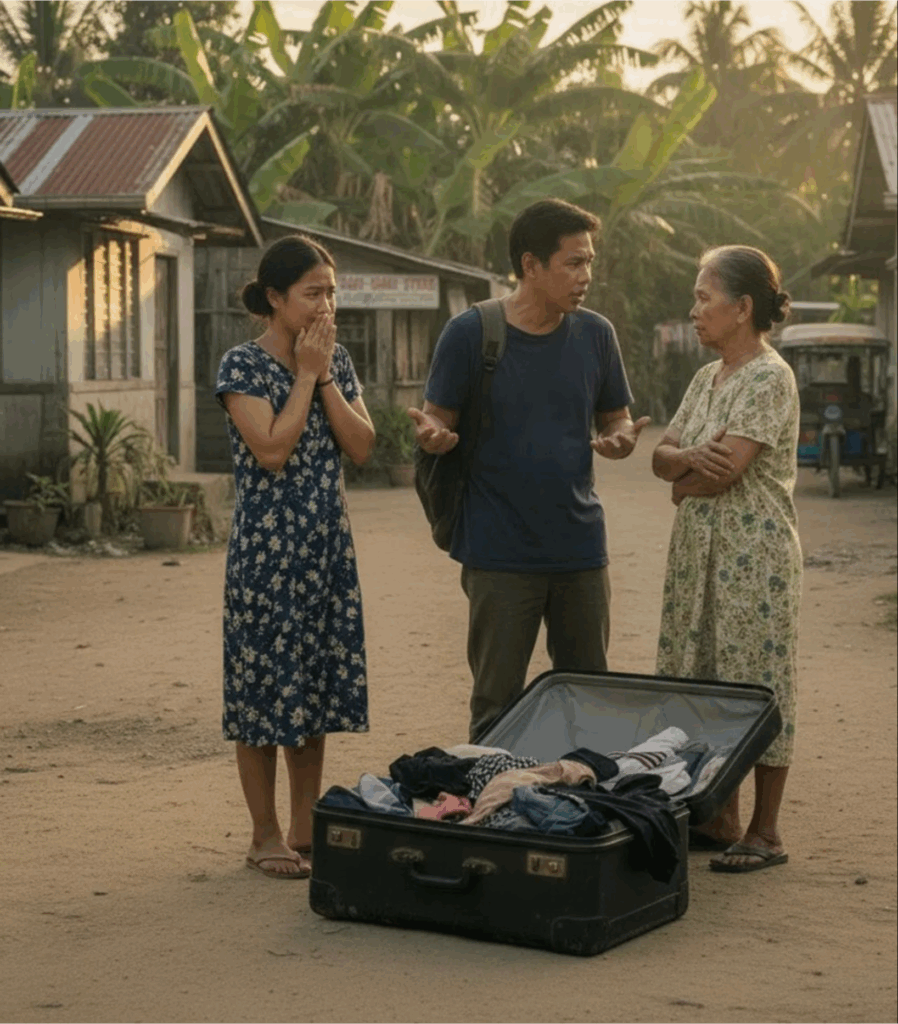
— Denis, turn it more slowly! You’ll break the lock.
— It won’t go in, Olya. It doesn’t turn at all. It’s as if it doesn’t belong to this door.
— What do you mean it doesn’t belong? Which key did you lock it with this morning?
— This one. I’ve never had another key.
Neither of us understood what was happening yet.
I had just finished a twelve-hour shift in the treatment room at the local clinic. My legs were throbbing, my lower back ached, and my fingers could barely feel the handles of the grocery bag stuffed with potatoes, bread, and a pack of cottage cheese. The thin plastic strips had cut deeply into my palms.
Denis tried turning the key again. Nothing.
— Damn it…
Then he pushed down on the handle, swore under his breath, and slammed his shoulder against the heavy, leather-covered door.
Nothing.
The lock didn’t budge.
Then we heard quiet, shuffling footsteps from inside.
The inner bolt clicked.
The chain rattled.
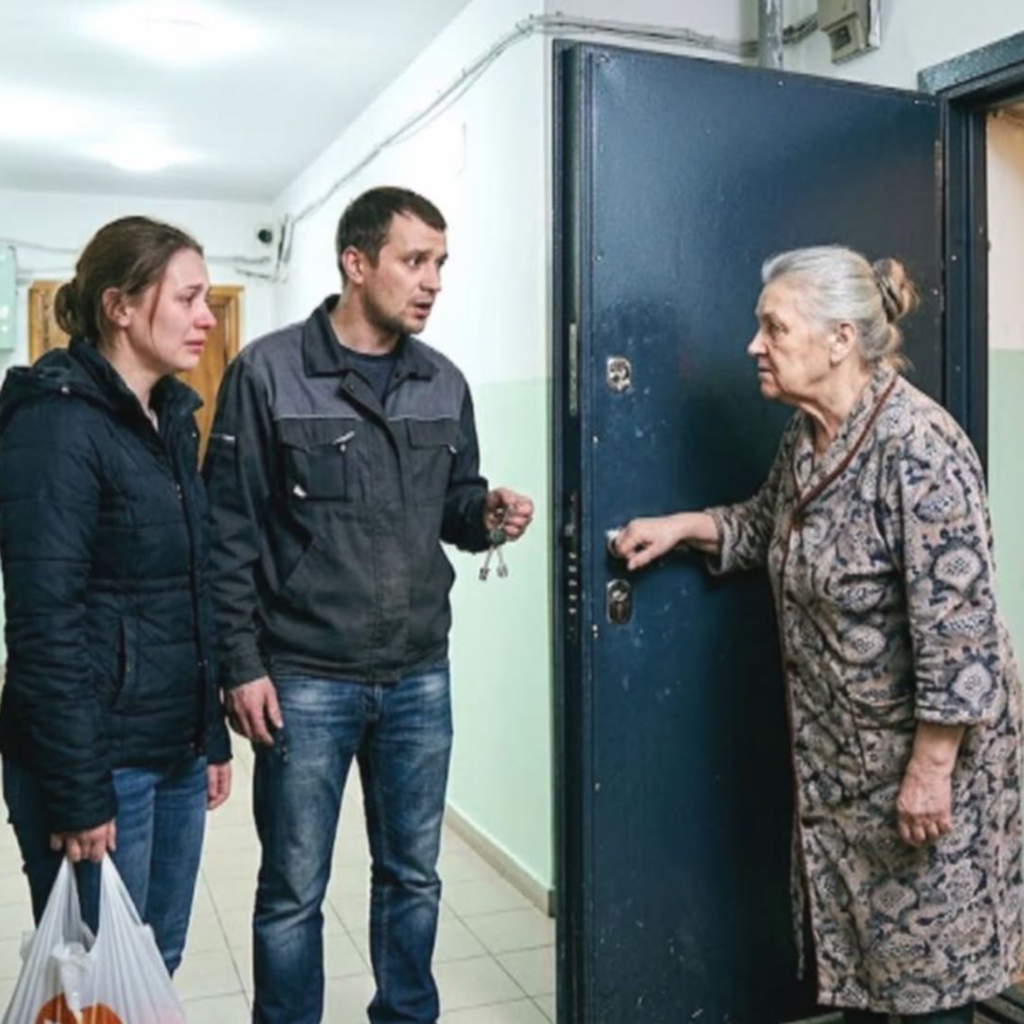
And the door slowly opened exactly ten centimeters.
Tamara Ivanovna, my mother-in-law, appeared in the gap.
She was wearing a faded robe with a tiny floral pattern. Her hair was pulled into a tight bun, and she looked at us calmly over the top of her glasses, as if she had been waiting all day for us to arrive.
She wasn’t surprised.
Not in the slightest.
— That’s an unfamiliar key, Denis — she said calmly. — Don’t force it. The locksmith changed the lock at two this afternoon.
Denis froze.
— Mom?
The key was still between his oil-stained fingers. He worked at an auto repair shop from morning until evening, repairing the suspension systems of old foreign cars. Usually, he was patient even when everyone else had already lost their temper.
But now he simply stared at his mother.
— What do you mean, you had the lock changed?
Tamara Ivanovna shrugged.
— Exactly what I said. You’ve lived here long enough. Move out. My younger son needs the apartment.
The words fell between us like a bucket of ice water.
For a moment, I thought I had misheard her.
Cold October air drifted through the stairwell on the fifth floor of the apartment building. Somewhere below, a door slammed. A dog began to howl. Outside the window, rain tapped monotonously against the glass.
Finally, Denis spoke.
— Mom, open the door.
— Why?
— Let’s talk about this.
— There’s nothing to talk about.
— Our things are inside.
— I packed them.
— What?!
Tamara Ivanovna’s voice remained just as calm.
— Pasha is getting married on Saturday. Svetochka is having a baby. They’re young and they need an apartment. You’ve already lived here for four years.
— Four years? — Denis asked incredulously.
— Yes. It’s time for you to move on.
I felt something inside me snap.
— Tamara Ivanovna, are you serious?
— Completely.
— “Move on”? When we moved in, this apartment looked like an abandoned warehouse! The floor was rotten, the pipes were rusted, and the walls were covered in mold. We flooded the neighbors three floors below! Denis spent six months repairing the electrical wiring after work at night. We replaced the windows. We bought a bathtub. We tiled the bathroom.
— Who owns the apartment? — she asked coldly.
I fell silent.
— I do — she continued. — My grandmother left it to me. Not to you.
— We put more money into this apartment over four years than we would have spent on rent!
— I didn’t ask you to renovate it.
— But we lived there!
— Exactly. You used it. You lived there in comfort. You used the utilities. I think we’re even.
Denis rested his forehead against the door.
— Mom, at least let us inside. We’ll take our clothes, our documents, the laptop…
— I packed everything.
— Where?
— In bags.
— What kind of bags?
Tamara Ivanovna opened the door.
And then we saw them.
Seven enormous blue garbage bags were lined up in the hallway.
Our life.
Stuffed into plastic bags.
The sleeve of my favorite knitted cardigan poked out of one. The corner of Denis’s toolbox stuck out of another. Two travel bags stood against the wall, while our winter boots lay in a heap on the floor.
Four years of our lives reduced to a few blue bags.
— The refrigerator and washing machine are staying — Tamara Ivanovna announced.
Denis slowly looked up.
— Why?
— Pasha will need them.
— I bought the refrigerator.
— It stays here anyway.
— I bought it on installments!
— So?
— I paid for it for two years!
His voice grew louder.
— I worked double shifts for that refrigerator! I worked weekends too! And now you’re simply telling me to leave it here?
— Pasha needs it.
— Pasha needs everything! An apartment, a refrigerator, a washing machine, money… But when is he going to work?
Tamara Ivanovna’s face hardened.
— Don’t you dare talk about your brother like that!
— He’s twenty-four, Mom!
— He’s sensitive.
— He was kicked out of two universities!
— He was going through a difficult period.
— He worked as a security guard for one month and quit. He delivered packages for a week, then suddenly his leg started hurting!
— He’s starting a family now.
— He got a girl pregnant!
— Exactly! That’s why he needs the apartment!
Denis laughed bitterly.
— And what about me?
— You’re strong.
— What?
— You always manage somehow. You’re the older one. You have to give in.
Something changed in Denis’s face.
As if he finally understood.
It wasn’t that his mother had chosen Pasha for the first time.
She had been choosing him his entire life.
One son always received.
The other was always expected to understand.
One always needed help.
The other was expected to provide it.
Suddenly, Tamara Ivanovna kicked one of the bags.
The seam split open.
My books spilled onto the floor.
My pediatric medicine notes scattered across the hallway.
And our wedding photograph slipped out of its cracked frame.
Denis bent down and picked it up.
For a long moment, he simply stared at it.
Then he said very quietly:
— Olya, get the documents.
— And the appliances?
— Leave them.
— But…
— Leave them.
He looked at me.
— We’ll buy new ones.
— The washing machine too?
— Everything.
Then he looked at his mother.
— But we’re never coming back here.
Tamara Ivanovna snorted mockingly.
— Look at you. You’ve suddenly become such a big man.
Denis didn’t answer.
He simply picked up the two heaviest bags and started down the stairs.
I gathered the documents, the cracked picture frame, and the torn grocery bag.
The door slammed shut behind us.
The brand-new lock turned twice.
Outside, the rain was pouring.
Our old station wagon stood beneath a wet maple tree in front of the building.
One by one, we loaded the bags into the trunk.
Our clothes.
My books.
Denis’s tools.
Our photographs.
Four years of memories.
When everything was finally packed, we got into the car.
Water dripped from our clothes.
The windows fogged up.
Denis turned the key. The engine sputtered to life with a rough, hoarse growl.
— Where are we going? — I asked.
He didn’t answer.
He simply lowered his forehead onto the steering wheel.
His shoulders trembled.
Then again.
He didn’t cry.
Denis never cried.
But at that moment, I understood that something much deeper than his pride had broken inside him.
His childhood belief.
The belief that you must always forgive your mother.
I took his hand.
— Denis, look at me.
Slowly, he looked up.
— You know what? — I said. — Maybe we’ve just lost an apartment.
— Yes.
— But maybe we’ve just gotten our life back.
He was silent for a long time.
Then he smiled.
— She didn’t even give us the kettle.
I laughed through my tears.
— We’ll buy another one.
— One that whistles.
— A whistling one.
That evening, with the help of a friend, we found a tiny one-room apartment on the outskirts of the city. It wasn’t beautiful. The wallpaper was faded, the sofa creaked every time you moved, and the kitchen was so small that the two of us could barely stand in it together.
But it was warm.
It was dry.
And the key was in our hands.
During the first week, we pulled our clothes out of black garbage bags. Denis worked from morning until night, then spent his nights repairing cars in a garage at an ambulance station.
Sometimes he slept only four hours.
But every evening, when he came home, he looked at me and said:
— This is our life now.
Three months later, he put a bank statement in front of me.
— We have the down payment.
— For what?
— An apartment.
I picked up the paper.
— Seriously?
— It’ll be small.
— I don’t care.
— A studio.
— I don’t care.
— But it’ll be ours.
He looked into my eyes.
— No one will ever be able to change the lock on it.
Six months later, we bought our own little apartment in a new residential neighborhood.
There was no expensive furniture.
There was no large kitchen.
There was no panoramic balcony view.
But when we locked the door behind us for the first time, Denis took out the key, stared at it for a long moment, then closed his fist around it.
— No one can take this away from us.
I thought that was the end.
It wasn’t.
One March evening, six months after Tamara Ivanovna had thrown us out onto the street, we were sitting in our kitchen.
We were drinking simple tea.
The phone rang.
One word appeared on the screen:
Mom.
Denis stared at it for a long time.
Then he answered.
— Hello?
Tamara Ivanovna’s voice sounded completely different now.
Not commanding.
Not offended.
Terrified.
— Denis! Finally! Something terrible has happened!
— What happened?
— The washing machine broke!
Denis said nothing.
— Water is everywhere! We flooded the neighbors downstairs! Pasha tried to shut it off, but he broke the valve! Hot water is pouring everywhere! Come immediately! You have tools!
Denis listened in silence.
— And the refrigerator broke too — his mother continued. — It isn’t cooling! All the food has gone bad. Svetochka has nothing to feed the baby!
Still no answer.
— Denis, are you listening?!
— Yes.
— Then come!
— Why?
— Because you’re his older brother!
— And?
His mother’s voice rose.
— You won’t even help your own mother?!
Denis looked at me.
I said nothing.
I didn’t need to.
— At least give me ten thousand rubles for the repairs — his mother begged. — Pasha is having such a hard time right now. He lost his job again.
Denis slowly leaned back.
— Mom.
— Yes?
— Who owns the apartment?
There was silence on the other end.
— Why are you asking?
— Just answer me.
— I do.
— Then deal with it yourself.
— Denis!
— You said the apartment was yours. You said you could do whatever you wanted with it.
— But you’re my son!
— Yes.
His voice remained calm.
— And six months ago, you showed me exactly what that means to you.
— You don’t understand. We’re in trouble now!
— You’re there.
— Denis!
— We’re not.
His mother said something else, but Denis didn’t wait to hear it.
He pressed the red button.
Silence filled the kitchen.
The old kettle began to boil.
Denis stood up, poured me a cup of tea, then sat back down across from me.
He took a cookie from the plate.
He broke it in half.
He gave one half to me.
— Drink, Olya.
— What about you?
He smiled.
— I already had some.
— Had what?
— Freedom.
Then he laughed.
I laughed too.
And in that moment, I realized something.
That evening, when our life had been thrown out onto the street in seven blue garbage bags, I thought we had lost everything.
But in reality, that was when the first life began in which we never had to prove to anyone that we deserved our own home.
And ever since then, whenever Denis locks the front door behind us, he always checks the lock.
Once.
Twice.
Then he looks at me and smiles.
— This is our key.
And I always answer:
— I know.
But that evening, after we put down our tea cups, Denis went back to the hallway one more time.
He took hold of the handle.
He turned it.
The lock clicked softly.
Then he took out the key and placed it in my palm.
— Keep it.
— Why?
— Because now I know what a key is worth.
I looked at him.
— What?
He smiled.
— It’s not about who lets you in.
He paused for a moment.
— It’s about who can never lock you out again.
And then we locked the door.
Not against someone else.
But finally, for ourselves.