The Day My Family Called Me a Maid — and Discovered Who Really Owned the Store
I should have known something was wrong when my daughter-in-law, Meadow, suddenly decided she wanted to come grocery shopping with us.
Meadow rarely did anything unless there was something in it for her.
That morning, however, she looked as though she were heading to a business meeting rather than a supermarket. Her blonde hair was twisted into a flawless bun, her designer handbag rested neatly against her arm, and not a single strand was out of place.
My twelve-year-old grandson, Jud, leaned over the back seat and grinned at me.
“Come on, Grandma Bessie. We’re getting ice cream afterward!”
That smile warmed my heart.
At seventy, I still treasured every moment Jud wanted me around. Those moments had become painfully rare.
I climbed into the SUV beside him, moving carefully because of my arthritis.
Meadow glanced at me through the mirror.
“Try not to embarrass us in there.”
I looked at her.
She turned away before I could respond.
My son, Blaine, didn’t hear her.
Or perhaps he simply didn’t care.
I said nothing.
Silence had become my way of surviving in that house.
Whenever I defended myself against Meadow, Blaine accused me of creating tension. If I complained, I was “too sensitive.” If I stood up for myself, I was “making everything about me.”
So I learned to swallow my words.
I didn’t realize then that every insult I swallowed was slowly teaching them they could give me another one.
The Grocery Store
We arrived at Morrison’s Market, the grocery store where I’d been shopping for more than thirty years.
The moment we walked through the doors, Meadow took control.
She pushed the cart ahead of us, marching through the aisles as though she owned the place.
Ironically, she didn’t know how close she was to the truth.
I stopped briefly near the baking aisle to look at a new brand of flour.
Meadow snapped her fingers.
“Bessie. Keep up.”
I looked at her hand.
Then at her face.
Jud glanced at me.
He said nothing.
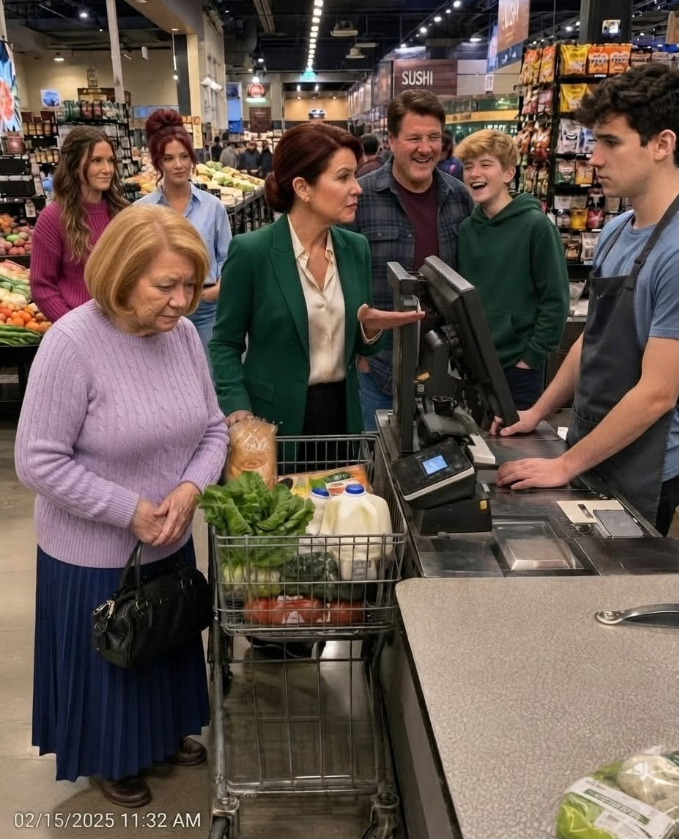
At checkout, a young cashier greeted me with a friendly smile.
“Good morning, ma’am. How are you today?”
I opened my mouth.
I never got the chance to answer.
Meadow stepped between us.
“This old woman is the maid. Don’t bother talking to her.”
For a second, I couldn’t breathe.
The cashier’s smile disappeared.
Heat rushed into my face.
But the words themselves weren’t what hurt most.
It was the laughter.
Blaine laughed.
My own son.
The boy I had raised alone after his father walked out on us.
He threw his head back as if Meadow had just delivered the funniest joke he’d ever heard.
Then Jud laughed too.
“Yeah,” he said. “Grandma’s basically our servant.”
Something inside me went completely still.
I looked at my grandson.
Then at my son.
Then at Meadow.
The cashier suddenly looked embarrassed for me and dropped her eyes.
I picked up the grocery bags.
Nobody offered to help.
As we walked out, Meadow slipped her arm through Blaine’s.
They were laughing together.
And I carried the bags.
That was the moment I finally understood what I had become in their eyes.
I wasn’t their mother.
I wasn’t their grandmother.
I wasn’t even family anymore.
I was free labor.
The Woman I Had Become
That evening, I cooked dinner.
Then I washed the dishes.
Then I cleaned the kitchen.
When the house finally became quiet, I went upstairs to the tiny bedroom Meadow had assigned to me five years earlier.
It was the smallest room in the house.
When Meadow first moved in, she had smiled sweetly and explained that she and Blaine needed the master bedroom because they “needed more space.”
I had agreed.
I always agreed.
Little by little, I had surrendered everything.
The bedroom.
The kitchen.
My privacy.
My business.
My voice.
Years earlier, before Meadow became part of our family, I had run a successful catering business from my own kitchen.
People booked my meals months in advance.
Every Thanksgiving, customers begged to get on the waiting list for my apple pies.
I loved that business.
It gave me independence.
It gave me purpose.
Then Meadow began complaining.
Customers coming to the house were inconvenient.
The kitchen was too busy.
There was too much noise.
It was embarrassing.
Blaine agreed with her.
Within a year, I closed the business.
After that, I became their cook.
Their cleaner.
Their babysitter.
Their convenient extra pair of hands.
And I convinced myself that this was what family meant.
That night, I sat on the edge of my bed and stared at my reflection.
For a long time, I didn’t recognize the woman looking back at me.
Then I remembered something.
I stood up.
Walked to the closet.
Moved several old coats aside.
And opened the safe hidden behind them.
Inside were documents my family had never seen.
Bank statements.
Investment records.
Property deeds.
Corporate agreements.
For decades, I had kept those papers private.
Not because I was ashamed.
Because I had learned a long time ago that people treat money very differently from the way they treat a person.
After my husband, Frank, abandoned Blaine and me, I made myself a promise.
I would never again depend on someone else for my survival.
So I saved.
I invested.
I bought property.
And I kept quiet.
The documents told a very different story about the “poor old woman” Meadow thought she was controlling.
I owned three rental properties.
I had a substantial investment portfolio.
And I owned forty percent of Morrison’s Market.
The very grocery store where my daughter-in-law had just called me a maid.
Years earlier, Bill Morrison had needed investors to expand the business.
I had supplied the capital.
In return, I became a silent partner.
For fifteen years, I had collected returns while allowing Bill to run the operation.
I had never told Blaine.
I had certainly never told Meadow.
Whenever Meadow discovered I had extra money, she immediately found a reason I should spend it on her family.
So eventually, I let them believe I had nothing.
That night, I looked at those documents again.
And for the first time in years, I remembered who I was.
Independent.
Capable.
Strong.
The woman in the mirror wasn’t helpless.
She had simply been pretending.
And suddenly, I knew the performance was over.
What I Heard Upstairs
Three days later, I came home from my afternoon walk and heard voices coming from the living room.
Meadow had friends over.
I was about to go upstairs when I heard my name.
I stopped.
“I honestly don’t know how much longer I can stand having her here,” Meadow complained.
One of her friends asked what she meant.
“She walks around like a ghost. She’s always in the way.”
Another woman laughed.
“Why don’t you put her in a nursing home?”
Meadow laughed too.
“I’ve looked into it. Blaine gets sentimental.”
Then her voice became quieter.
“Besides, we’re waiting to see what inheritance she leaves.”
I froze.
Her friend asked, “Does she have money?”
“Blaine thinks she might have savings. Maybe life insurance. It would be stupid to move her out before we know.”
Someone asked how long they might have to wait.
Meadow sighed.
“She’s seventy. Unfortunately, she’s healthier than she looks. She could live another ten years.”
My hand tightened around the banister.
For years, I had wondered whether my family simply took me for granted.
Now I knew.
They weren’t waiting for me to get better.
They weren’t waiting for me to find happiness.
They were waiting for me to die.
They had already started counting what they thought would be theirs.
I quietly walked upstairs.
That night, Meadow complained about dinner.
“This chicken is a little dry.”
It wasn’t.
I knew it wasn’t.
But I smiled.
Then Blaine casually told me they were planning to repaint the house.
“You’ll need to move downstairs for a while, Mom.”
Meadow added, “You can sleep on the couch.”
The basement couch had a broken spring.
I smiled again.
“Of course.”
But something inside me had changed.
The next morning, while everyone was still asleep, I put on my coat and walked downtown.
The First Call
My first stop was Morrison’s Market.
Bill Morrison looked surprised when he saw me.
“Bessie? What brings you here?”
I looked around the store.
“I think I’ve been a silent partner long enough.”
His eyebrows rose.
“I’ve been waiting for you to say that.”
I smiled.
“I want to become more involved.”
“Then we’re going to have a lot to talk about.”
Before I left, I asked him for the name of a good estate attorney.
He gave me one.
That afternoon, I sat across from Sarah Mitchell.
I told her everything.
The humiliation.
The years of being used.
What I’d overheard.
The inheritance they were already counting on.
When I finished, Sarah looked at me calmly.
“What do you want changed in your will?”
I didn’t hesitate.
“My son gets nothing.”
She looked up.
“And your grandson?”
“Jud gets a trust when he turns twenty-five.”
She waited.
“Provided he builds a relationship with me based on respect, not money.”
“And the remainder?”
“Mostly charity.”
Sarah nodded.
Then I leaned forward.
“One more thing.”
“Yes?”
“My family must know nothing until everything is finalized.”
For the first time in years, I wasn’t enduring my life.
I was taking it back.
Two Weeks Later
For the next two weeks, I watched my family differently.
Every command.
Every insult.
Every assumption.
They no longer made me feel small.
They simply confirmed that I was making the right decision.
Then, one morning at precisely ten o’clock, someone knocked on the front door.
I opened it.
Sarah Mitchell stood there with a leather briefcase.
Beside her stood James Morrison, Bill’s son and the attorney handling the company’s legal affairs.
Meadow appeared behind me almost instantly.
“Who are they?”
“My attorneys.”
Her expression changed.
Sarah handed me a thick envelope.
“The documents have been completed and filed.”
Meadow stared at the envelope.
“What documents?”
“Perhaps everyone should sit down,” Sarah said.
Blaine came in from the kitchen.
“What is going on?”
I remained standing.
They sat together on the couch.
I looked at them.
“Three weeks ago, Meadow called me a maid in a grocery store.”
Blaine shifted.
“You laughed.”
“Mom—”
I raised my hand.
“And last week, I heard Meadow discussing how long I might live and how much money she expected to inherit.”
Meadow’s face turned red.
“You were listening to a private conversation?”
“In my house.”
I opened the envelope.
“I have removed both of you from my will.”
Blaine stared at me.
“You can’t be serious.”
“I am.”
“What about Jud?”
“Jud will receive a trust when he turns twenty-five, provided he earns it through the choices he makes. Most of the rest of my estate will go to charity.”
Blaine looked devastated.
“But we’re your family.”
I looked straight at him.
“Family doesn’t treat someone the way you’ve treated me.”
Then I turned to James.
“Tell them about Morrison’s.”
James opened his briefcase.
“Mrs. Harrison owns forty percent of Morrison’s Market. She has been a silent partner for fifteen years and has recently assumed an active management role.”
Meadow stared at me.
“That’s impossible.”
James continued.
“She also owns several rental properties, significant investments, and interests in additional grocery operations and commercial real estate.”
The room fell silent.
Blaine swallowed.
“How much money do you have?”
Sarah answered.
“Based on the current valuation of her investments, businesses, properties, and liquid assets, approximately forty-seven million dollars.”
Meadow’s hand flew to her mouth.
“Forty-seven million?”
I looked at her.
“Yes.”
“While you had me sleeping in the smallest bedroom.”
Nobody spoke.
“While you forced me to close the business I loved because it embarrassed you.”
Blaine suddenly stood.
“Why didn’t you tell us?”
I almost laughed.
“Why should I have?”
“We would have treated you differently if we’d known.”
Meadow said it before she could stop herself.
Silence.
I looked at her.
“Exactly.”
Her face changed.
She finally understood what she’d just admitted.
“You would have treated me better because I had money.”
I shook my head.
“Not because I deserved respect.”
Nobody had anything to say.
Sarah placed another document on the table.
“There is one more matter.”
She slid it toward Blaine.
“Mrs. Harrison’s company has acquired the mortgage on this property.”
Meadow went pale.
“What does that mean?”
I answered.
“It means I now control the house.”
She stared at me.
“This house?”
“Yes.”
I looked at both of them.
“You have thirty days to find somewhere else to live.”
Meadow jumped to her feet.
“You can’t throw us out! Jud lives here!”
“This was my home for twenty-two years before you arrived.”
“You can’t do this!”
I looked at her calmly.
“You spent five years telling me I was in the way.”
I paused.
“Consider this my solution.”
One Suitcase
I told them I would stay in a downtown hotel while everything was finalized.
As I went upstairs to pack, Blaine followed me.
“Mom, please.”
I kept packing.
“We can fix this.”
I folded a sweater.
“We’ll change.”
I placed it inside the suitcase.
“Mom, please listen to me.”
I stopped at the staircase.
For one painful second, I wanted to turn around.
I wanted to see the little boy whose scraped knees I had bandaged.
The boy whose college applications I had proofread after working double shifts.
The boy I had raised when his father walked away.
But that little boy wasn’t standing behind me.
The man standing there had laughed while his wife called his mother a servant.
So I kept facing forward.
“I’m seventy years old, Blaine.”
My voice was quiet.
“I don’t have enough years left to wait for you to learn how to love me properly.”
Then I walked upstairs.
One suitcase.
That’s all it took.
One suitcase to remove my belongings from a house where I had lived for twenty-two years.
Strangely, carrying it out felt lighter than staying.
Six Months Later
Six months later, I sat on the terrace of my villa overlooking Lake Como.
The mountains glowed beneath the morning sun.
I sipped espresso from a porcelain cup.
And for the first time in decades, nobody expected me to make breakfast.
Nobody snapped their fingers.
Nobody criticized my cooking.
Nobody treated me like a servant.
I had hired a wonderful housekeeper named Elena.
The first time she caught me washing dishes, she nearly had a heart attack.
Eventually, we reached a compromise.
I cook every Sunday.
Because I love cooking.
The rest of the week, Elena refuses to let me work.
After I left Blaine’s house, Sarah’s team conducted a complete audit of my finances.
The final number surprised even me.
Nearly fifty million dollars.
Fifty years of careful decisions had quietly become a fortune.
But I didn’t want my money sitting in accounts while people around me struggled.
I helped arrange a generous employee buyout for the grocery stores.
At one staff meeting, the young cashier from that humiliating morning approached me.
He looked nervous.
“I’m sorry,” he said. “I should have said something that day.”
I smiled.
“You don’t need to apologize.”
“I should have defended you.”
“You were caught off guard. You believed someone who spoke with confidence.”
He nodded.
Then he smiled.
“I’m glad you’re back.”
So was I.
I placed my rental properties under professional management and instructed them to keep rents reasonable for working families.
Then I finally did something I had postponed for half a century.
I chose a life simply because I wanted it.
Italy.
A comfortable villa near Lake Como.
Three bedrooms.
A library.
Gardens stretching toward the water.
And, most importantly, a kitchen where I cooked because I wanted to—not because someone ordered me to.
The Phone Call
One morning, Elena brought me my phone.
“There’s a young man named Jud calling from America.”
My grandson had been calling every week.
At first, he had been angry.
Then confused.
Eventually, he started asking questions.
I answered.
“Grandma?”
“Hello, sweetheart.”
There was a long pause.
Then he said:
“Mom and Dad are getting divorced.”
I wasn’t surprised.
“How are you doing?”
“I’m okay.”
Another pause.
“Dad wants to talk to you.”
“And what do you think?”
Jud was silent.
Then he said something that surprised me.
“I think Dad knows he messed up.”
He hesitated.
“But I also think he’s extra sorry because he found out how much money you have.”
I smiled sadly.
At thirteen, Jud was beginning to understand something his parents never had.
So I asked him a harder question.
“What about you?”
“What?”
“Are you sorry because of the money?”
“No.”
His voice became quiet.
“I’m sorry because I laughed at you in the store.”
My throat tightened.
“I knew it was wrong. I just wanted Mom and Dad to think I was funny.”
I closed my eyes.
“Thank you for telling me the truth.”
Then he asked:
“Could I visit you someday?”
“Of course.”
“Not because you’re rich.”
His voice cracked slightly.
“I just miss you.”
I looked across the lake.
“When you’re old enough to travel, sweetheart, I’d love that.”
There was still hope for Jud.
He had made a terrible mistake.
But unlike his parents, he was learning from it.
Blaine’s Calls
Blaine called too.
Again.
And again.
I never answered.
His messages always said the same things.
He was sorry.
He had changed.
He wanted another chance.
Maybe someday I would believe him.
But I wasn’t ready.
Then one morning, a letter arrived from Meadow.
Three pages.
I read every word.
She blamed me for destroying the family.
She demanded money for her divorce attorney.
She threatened to keep Jud from visiting me.
And she promised that she would change if I reconsidered my will.
There was only one thing missing.
An apology.
Not once did she say she was sorry for humiliating me.
Not once did she admit that she had treated me like a servant.
Not once did she acknowledge what she had done.
Every sentence was about what my money could do for her.
I folded the letter.
Walked to the fireplace.
And watched it burn.
Some bridges deserve rebuilding.
Others were never bridges at all.
They were toll booths.
The Life I Chose
Eventually, I created a foundation for elderly people experiencing neglect, exploitation, or financial manipulation by their own families.
I also funded scholarships for single mothers trying to build businesses.
Women standing where I had once stood.
Women working two or three jobs.
Women raising children alone.
Women who believed they had to sacrifice everything to prove they were good mothers.
I wanted them to have something I had nearly forgotten was possible.
A choice.
For the first time, my money reflected who I actually was.
That evening, I stood on my terrace and watched the sun disappear behind the mountains.
I raised my glass.
“To second chances.”
I smiled.
“To independence that arrives late—but still matters.”
Then I looked out over the lake.
“And to finally understanding that choosing yourself isn’t selfish.”
For decades, I had believed that being a good mother meant giving everything away.
My time.
My money.
My dreams.
My dignity.
I thought love meant enduring whatever my family asked of me.
I was wrong.
Love without respect becomes exploitation.
And sacrifice without boundaries becomes permission.
I am seventy years old.
Six months ago, my own family laughed while someone called me their maid.
Today, I wake up in a home filled with peace.
I am surrounded by people who treat me with kindness without knowing—or caring—how much money I have.
And that is the greatest luxury of all.
For decades, I thought my life was almost over.
I couldn’t have been more wrong.
It wasn’t over.
It was waiting for me to finally begin.