“Put It Back Where It Belongs” — The Mother-in-Law Who Thought Her Daughter-in-Law’s Home Was Hers for Years
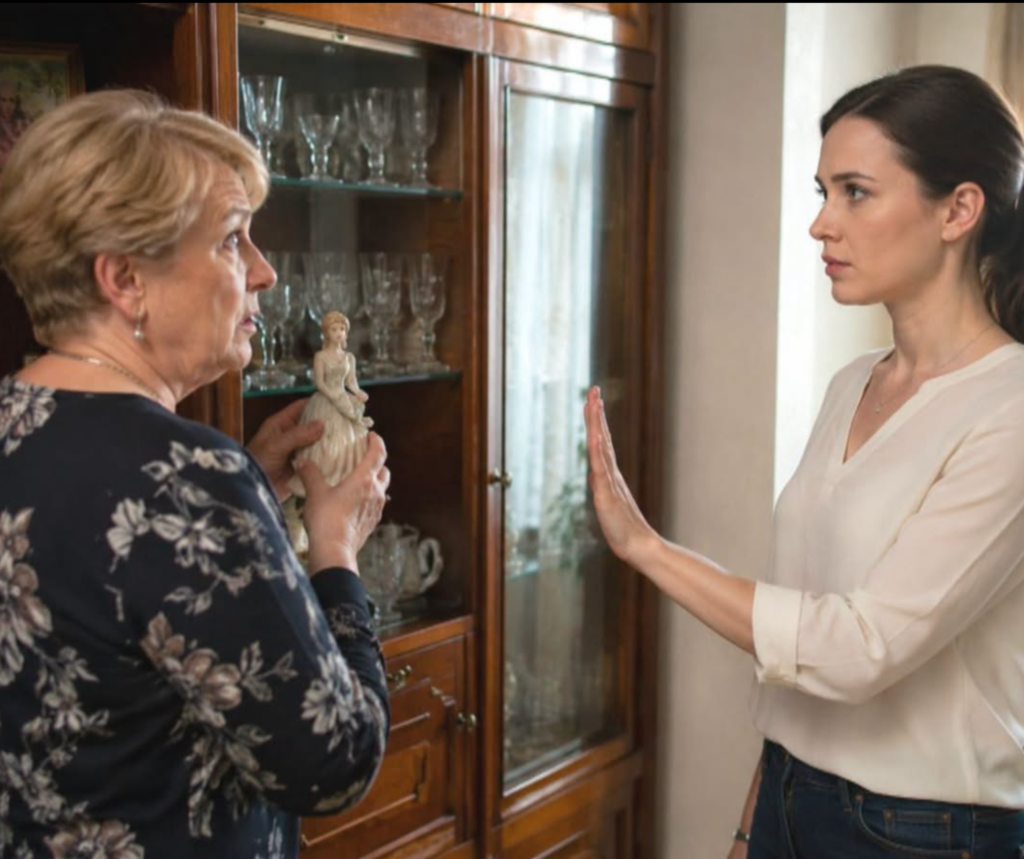
— Tamara Petrovna, put it back where it belongs. That item is not yours — Alina said so calmly that the air in the room seemed to freeze.
In her mother-in-law’s hands was a small, dark wooden jewelry box.
Through its open lid, silver forks, knives, and spoons gleamed in the lamplight.
— Oh, come on, Alina! — Tamara Petrovna waved her hand dismissively. — I’m just taking it to the anniversary celebration. Just for one evening.
— No.
— I’ll bring it back afterward.
— Then why did you tell Katya that you might give it to her too?
Katya looked awkwardly toward the door.
— Mom, I didn’t ask for anything.
Alina wasn’t looking at her sister-in-law. She was watching the box.
The silverware had belonged to her grandmother.
And at that exact moment, Alina realized that this had stopped being about a coffee pot, a baking pan, or a few cups a long time ago.
It was about someone who had been acting for years as though she had the right to decide what belonged to whom in Alina’s home.
Five years earlier, Alina had lived alone in her apartment.
She had bought the spacious two-room home years before meeting Maksim. She had paid the mortgage for years, given up many things, and slowly and carefully furnished the apartment.
She never bought things unnecessarily.
If she needed a kitchen utensil, she would spend days comparing prices and quality. If she chose a piece of furniture, she would first think carefully about whether she really needed it.
Everything had its place.
And every object had a story.
The porcelain cups, for example, had been bought after her first major purchase. She treasured her grandmother’s silverware as though she had been given a piece of the past back.
Maksim moved in later.
They dated for eight months before he moved in with a few boxes, his clothes, work equipment, and computer.
Maksim had never acted as though the apartment belonged to him.
At least not at first.
Then they got married.
And the problems began when Tamara Petrovna received a spare key.
Maksim had given it to her when they went away for a few days. His mother was supposed to water the plants and check a recently repaired faucet.
But the key was never returned.
Alina only found out weeks later.
— Why does she still have it? — she asked.
— Mom probably forgot to give it back.
— Then ask her for it.
— Sure. Later.
That “later” lasted for months.
At first, Tamara Petrovna called before coming over.
Then she simply announced that she was visiting them.
Later, she would just open the door.
— I knew you were home — she would say.
Sometimes nobody was home.
But even that wasn’t an obstacle.
Alina increasingly discovered that someone had rearranged the cupboards, taken something from the pantry, or moved food around in the refrigerator.
Then one day, the baking pan disappeared.
— Mom took it — Maksim said.
— When?
— I don’t know.
— And why?
— She needed it.
Alina called Tamara Petrovna.
— When will you bring it back?
— When we go to the country house.
— I need it now.
— Use another one.
— I don’t have another one.
— Then buy one. It’s not a big deal.
That sentence would be repeated many more times later.
It’s not a big deal.
When she finally got the baking pan back almost a month later, it was scratched and covered with baked-on grease stains.
Tamara Petrovna didn’t even apologize.
— Things are meant to be used — she said.
Alina stayed silent then.
Then four porcelain cups disappeared.
— Katya has them — Maksim said.
— Why?
— Mom gave them to her.
— My cups?
— Alina, please. It’s just four cups.
One of the cups later cracked.
A piece also chipped off one of the saucers.
That was when Alina said for the first time:
— Never take anything from this apartment without my permission again.
Tamara Petrovna nodded.
— Fine.
A week later, the hand mixer disappeared.
— I needed it to make cream — she explained.
— You have a mixer too.
— Mine is broken.
— When are you bringing it back?
— When I have time.
— Today.
— Don’t order me around!
— Then don’t take my things.
The mixer was returned that evening.
And, of course, Maksim felt sorry for his mother again.
— She’s offended.
Alina simply looked at him.
— And I was offended when I needed something and couldn’t find it.
The months passed.
And the objects continued to migrate.
A folding table ended up at Tamara Petrovna’s sister’s house.
A clothes steamer went to Katya.
A new saucepan went to her mother-in-law.
A set of towels went to a distant relative.
A small table lamp also disappeared.
Eventually, Alina took out a notebook.
Not because she wanted to keep track of every spoon.
She wrote everything down because whenever she brought up what was happening, Maksim always said the same thing:
— It’s just a little thing.
So Alina started writing down the “little things.”
Date.
Item.
Who took it.
Where it went.
Whether it was returned.
By the middle of August, the list was two full pages long.
And then came the silverware.
Maksim organized a family dinner.
Alina didn’t object.
Let his parents, Katya, and the relatives come.
Maybe this time everything would be fine.
The guests arrived at six.
They laughed, talked, and had dinner.
Tamara Petrovna, of course, criticized the food, the plates, and even the timing of when the meat should have been served.
Alina didn’t argue this time either.
After dinner, she gathered the leftovers and went into the kitchen.
When she returned, Tamara Petrovna was gone.
Katya wasn’t at the table either.
The bedroom door was slightly open.
Alina walked over.
And stopped.
Tamara Petrovna was standing in front of the wardrobe.
In her hands was Alina’s grandmother’s silverware.
— It would look wonderful at the anniversary celebration — her mother-in-law said. — I don’t have anything this beautiful. Maybe I’ll give it to Katya afterward too.
Katya went pale.
— Mom, put it back.
Tamara Petrovna turned around.
And Alina stepped inside.
— Tamara Petrovna, put it back where it belongs.
Her mother-in-law laughed.
— Oh, don’t start this again!
— Put it back.
— I’m only taking it for one evening.
— No.
— I’ll bring it back.
— You’ve already decided to give it to Katya.
— Why are you acting as though I’ve done something terrible?
Alina looked her in the eye.
— Because you took my grandmother’s silverware from our bedroom without permission and put it in your bag.
Maksim appeared at the door.
— What’s going on?
Tamara Petrovna immediately spoke up.
— Your wife is making a scene over a set of silverware.
Maksim looked at Alina.
— Couldn’t you discuss this later?
Alina didn’t answer.
She opened the other wardrobe door.
— Look.
Maksim stepped closer.
Empty shelves.
— The porcelain set was here — Alina said. — Four cups disappeared. Two came back damaged.
She pointed to another shelf.
— The baking pan was here.
Then another.
— The clothes steamer.
She pointed to the empty space beside the wall.
— The folding table was here.
Maksim slowly began to understand.
— And this?
Alina took out the notebook.
— Everything is written down.
Maksim opened it.
He began reading.
The first page.
Then the second.
By the end, he said nothing.
Tamara Petrovna sighed nervously.
— This is getting ridiculous.
But Alina only said:
— One object by itself may be insignificant. But when someone repeatedly takes other people’s belongings without permission, it stops being about the objects.
Silence filled the room.
Finally, Maksim looked at his mother.
— Mom. Put it back.
Tamara Petrovna stared at him in disbelief.
— You’re taking her side too?
— I’m not against you. But this doesn’t belong to you.
His mother slowly put the box back on the shelf.
Alina closed the wardrobe.
Then she held out her hand.
— I want the key too.
Tamara Petrovna froze.
— What key?
— The apartment key.
— Maksim gave it to me!
— And now I’m asking for it back.
— I’m your son’s mother!
— And I am the owner of this apartment. Being a relative does not mean you have permission to enter.
Everyone looked at Maksim.
The man sighed deeply.
— Mom, give her the key.
Tamara Petrovna’s face turned red.
But she took it out.
She tossed the key onto the dresser.
Alina picked it up.
The next day, they had a new lock installed.
Maksim helped.
— I won’t give Mom a key again — he said.
— No one gets one without my consent — Alina replied.
Maksim nodded.
Over the next few days, things slowly began coming back.
Katya brought back the clothes steamer, three cups, and two saucers.
The fourth cup was broken.
— I’m sorry — she said. — I really thought Mom had permission.
Later, the folding table came back.
The coffee pot.
The saucepan.
The towels.
Almost everything.
Anything that didn’t come back was replaced by Tamara Petrovna.
Not because she had suddenly changed her mind.
But because she finally understood that Alina would no longer stay silent.
A few days later, Tamara Petrovna stood outside the building.
She called.
— Alina? Can I come up?
Alina looked at the clock.
— It’s still early. We agreed on seven o’clock.
— All right. I’ll wait.
Alina remained silent for a few seconds.
In the past, Tamara Petrovna would simply have opened the door.
Now she waited.
At seven, Alina let her in.
Her mother-in-law handed over the towels she had brought back.
Then she asked:
— I need a large baking tray next Saturday. Could I borrow yours?
Alina nodded.
— Yes. I’ll give it to you myself.
Tamara Petrovna didn’t open a single cupboard.
She didn’t go into the bedroom.
She didn’t look for anything herself.
She simply thanked Alina and left.
After the door closed, Maksim smiled.
— Looks like she finally understood.
Alina put the towels back in their place.
— She didn’t understand now.
— Then when?
— This is the first time there have been consequences for not understanding before.
In the autumn, Alina took out her grandmother’s silverware.
Her aunt was coming over for dinner.
Alina slowly set the table.
The old silver spoons were placed beside the plates.
She carefully put every piece in its proper place.
That evening, no one opened the wardrobe without permission.
And Alina realized something.
Setting boundaries didn’t mean she didn’t love her family.
It didn’t mean she was selfish.
And it didn’t mean she wanted conflict over everything.
It simply meant that she no longer expected herself to stay silent so that other people could feel comfortable.
Sometimes one sentence is enough.
Not loud.
Not insulting.
Not threatening.
Just clear:
— Put it back where it belongs. That item is not yours.