When a teenage boy knocked on my door and asked if he could mow my lawn for the summer, I assumed he was just another kid looking for some extra spending money.
I had no idea he was coming to my house for a reason he was too afraid to tell me.
I signed the papers for my new house on a Thursday.
By Saturday morning, I was already wondering whether I had made a terrible mistake.
The grass was nearly ankle-high. Weeds had swallowed the flower beds, and the previous owner apparently hadn’t touched the yard in weeks.
I had just carried another moving box inside when someone knocked on the door.
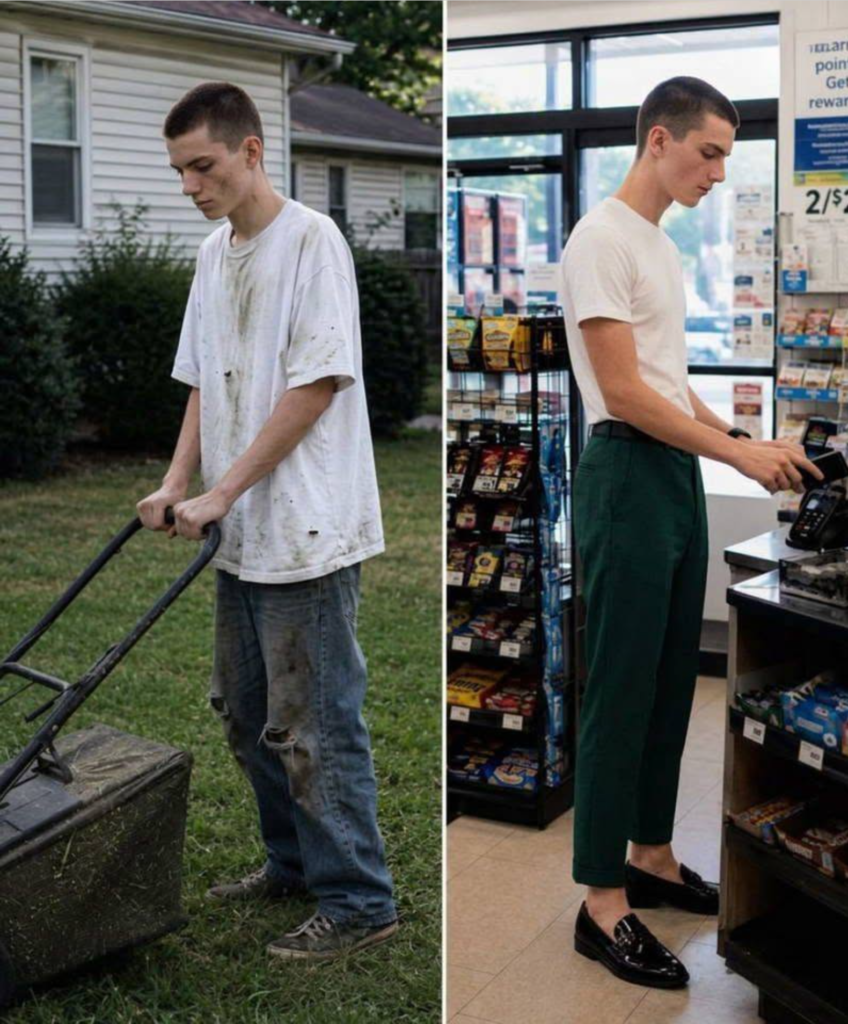
Standing on my porch was a boy who looked about fifteen. He wore a faded baseball cap, patched sneakers, and jeans that had clearly seen better days. Beside him sat an old red push mower that looked like it had been passed down through three generations.
“You the new owner?” he asked.
“I am.”
Instead of introducing himself, he looked past me.
His eyes traveled from the porch to the upstairs windows, then toward the backyard.
But when he saw the detached garage, he stopped.
He stared at it for several seconds.
Then, almost imperceptibly, he smiled.
“Good.”
I frowned.
“Good?”
He seemed embarrassed.
“I was hoping somebody would finally move in.”
“What do you mean?”
He shrugged.
“Nothing. Empty houses just make me sad sometimes.”
Then he nudged the mower with his shoe.
“Anyway, I’m Chase. I live with my mom over at Cedar Creek Trailer Park. I’m trying to make some money before school starts. You need your lawn mowed?”
“How much?”
“Twenty-five dollars.”
That was less than half of what a landscaping company would have charged.
“I’ll give you fifty if you do a good job.”
His eyes widened.
“Seriously?”
“Seriously.”
He grinned.
And then he got to work.
For the next hour, I unpacked boxes while the steady roar of the mower drifted through the open windows.
Every time I looked outside, Chase was still working.
No phone.
No earbuds.
No disappearing for twenty-minute breaks.
Just work.
When he finished, the yard looked completely different.
I handed him fifty dollars.
“You don’t have to pay me this much,” he said. “I said twenty-five.”
“And I said fifty.”
He stared at the bills for a moment.
“Thank you.”
As he pushed his mower toward the street, something bothered me.
His face looked familiar.
I couldn’t figure out why.
But the feeling stayed with me.
The following Saturday, Chase returned at exactly eight in the morning.
Again, he went straight to work.
About an hour later, I brought him a bottle of water.
“You’ve earned a break.”
“Thanks, Mr. Rick.”
He took a drink.
Then his eyes drifted toward the garage.
“You ever been inside there?”
“Not yet.”
He looked surprised.
“Really?”
“I’m still unpacking.”
He nodded.
But something about his expression had changed.
The next week, I caught him standing beside the garage before he’d even started mowing.
His fingertips were resting lightly against the old wooden siding.
“Everything okay?” I asked.
He jerked his hand away.
“Yeah.”
“What were you looking at?”
“The garage.”
“What about it?”
He hesitated.
Then he walked back toward his mower.
That became our routine.
Every Saturday, Chase arrived, mowed the lawn perfectly, and argued whenever I tried to pay him extra.
And the more time I spent around him, the more certain I became that I had seen his face somewhere before.
Then, about a month after I hired him, my boss canceled an afternoon meeting.
I arrived home hours earlier than usual.
The mower was sitting in the backyard with the engine still running.
One strip of grass remained unfinished.
“Chase?”
No answer.
I walked around the side of the house.
“Chase?”
Still nothing.
Then I saw the garage.
The door was open.
I stopped dead.
That couldn’t be right.
I’d never used the garage.
And its only key was hanging on a hook beside my kitchen door.
A few seconds later, Chase came jogging out.
The moment he saw me, he froze.
“I didn’t hear your truck.”
“I can tell.”
I looked past him.
“How did you get in there?”
“The door was open.”
“No, it wasn’t.”
“It was when I got here.”
I pulled the key from my pocket.
“I’ve had this with me all day.”
His eyes flicked toward the garage.
“It was hot. I just wanted somewhere cool to sit.”
The explanation was suspicious enough.
But then he made things much worse.
“You keep it locked now?”
My stomach tightened.
I had never told Chase the garage had ever been unlocked.
“What did you just say?”
His face went pale.
“I…”
“You asked if I keep it locked now. How would you know it wasn’t always locked?”
He lowered his eyes.
“I should go.”
“Chase.”
He stopped.
“If you don’t tell me what’s going on, don’t come back.”
For several seconds, he stood perfectly still.
Then he whispered:
“I’m sorry.”
He shut off the mower, lowered the handle, and pushed it down the driveway.
He didn’t even ask for his money.
The next Saturday came.
No Chase.
The Saturday after that?
Still nothing.
Then, three days later, I saw him outside a grocery store.
He was climbing into a brand-new black SUV.
At first, I thought I had the wrong kid.
The faded baseball cap was gone.
So were the patched jeans and worn sneakers.
Chase was wearing a designer polo shirt, spotless shoes, and an expensive-looking watch.
Then he looked directly at me.
It was definitely him.
The SUV pulled away before I could call his name.
And suddenly, I wondered whether everything he’d ever told me had been a lie.
The following Saturday, someone knocked on my door.
It was Chase.
He was standing there with the same old red mower.
He looked exhausted.
“I know you told me not to come back.”
“I did.”
“I want to explain.”
I stepped aside.
“Then explain.”
He entered the living room but refused to sit.
Instead, he twisted his baseball cap between his hands.
“The man driving the SUV was my dad.”
I waited.
“I live with my mom. The court says I have to stay with him every other weekend.”
“So the expensive clothes?”
“They stay at his house.”
He gave a tired little shrug.
“I call them my weekend clothes.”
I didn’t know what to say.
“My dad likes people to think he takes care of me.”
“Does he?”
Chase stared down at his cap.
“He buys expensive things.”
He paused.
“But I’d trade all of it for him showing up to one baseball game.”
The room fell silent.
Then I asked the question that had been bothering me for weeks.
“Why were you mowing my lawn?”
Chase closed his eyes.
“Because I wanted to be here.”
When he opened them again, his eyes were wet.
Everything suddenly clicked.
“The garage.”
He nodded.
“My grandfather built the workbench inside. He taught me how to fix bikes there. I learned to ride on that concrete floor.”
His voice cracked.
“When it rained, we’d sit inside and listen to the water hitting the roof.”
He swallowed hard.
“After Grandpa died, everything fell apart. Mom couldn’t keep up with the mortgage. We lost the house.”
“When?”
“Three years ago.”
“And your father?”
“He wasn’t around.”
I thought about the black SUV.
“He had money?”
“He always had money.”
Chase looked away.
“He just fought Mom about helping us. By the time the court ordered child support, we’d already packed everything.”
He took a shaky breath.
“I used to ride my bike past here after we moved. Then I saw the For Sale sign.”
He looked toward the backyard.
“When you finally bought the house, I thought…”
He paused.
“…if I couldn’t live here anymore, maybe I could still take care of it.”
“You didn’t really need a mowing job.”
He shook his head.
“That wasn’t the real reason.”
“What were you looking for?”
His answer was barely a whisper.
“Home.”
That single word hit me harder than I expected.
I looked toward the garage.
“You weren’t stealing anything?”
“I wasn’t trying to.”
He quickly added, “I just sat at Grandpa’s workbench. I remembered where his tools used to hang. Where our bikes stood.”
His eyes dropped.
“When I found the garage open that afternoon, I went inside.”
He hesitated.
“No. That’s not completely true.”
He looked up at me.
“I found a way in because I knew the old latch.”
Then he gave a sad smile.
“And when I was inside, I forgot for a few minutes that it wasn’t ours anymore.”
I didn’t know what to say.
“I forgot it wasn’t ours anymore.”
“You should’ve told me.”
“I was afraid you’d tell me I couldn’t come back.”
“I probably would’ve.”
“I know.”
For the first time, we both laughed.
The tension in the room finally broke.
“Go mow the lawn,” I said.
Chase blinked.
“You still want me to?”
“I have a feeling you’re the only person who actually cares whether every row is perfectly straight.”
He smiled.
As he reached the door, he stopped.
“Mr. Rick?”
“Yeah?”
“If my dad wanted to see the garage… would you let him?”
“Why?”
“I finally told him why I keep coming here.”
I waited.
“He didn’t know this house meant more to me than everything he’s ever bought.”
Chase looked down.
“I think he wants to understand.”
“If he really wants to understand, he can come.”
Over the next month, our Saturday routine returned.
After Chase finished mowing, we’d sit beside the garage with cold sodas while he told me stories about his grandfather.
How he’d repaired bicycles for neighborhood kids.
How they built birdhouses every Christmas.
How Grandpa insisted every scratch on the garage floor had a story behind it.
One afternoon, I asked, “Did you ever tell your dad these stories?”
“I used to.”
“What happened?”
“He always said we’d make new memories.”
Chase stared at the concrete floor.
“But he was never around long enough to make them.”
The following Saturday, the black SUV pulled into my driveway.
A man climbed out.
“I’m Christian. Chase’s father.”
“I figured.”
He looked toward the garage.
“Chase said I should see it. He thinks I’ll understand if I do.”
“Will you?”
Christian gave a tired smile.
“I don’t know.”
“Maybe not. But showing up is a start.”
He nodded.
Then he thanked me for giving Chase work.
“He talks about this place constantly. I didn’t understand how important it was.”
Christian stared at the garage.
“I honestly thought I was doing enough.”
“The money?”
“The support payments. Clothes. Weekends.”
I folded my arms.
“Were you?”
He didn’t answer.
Finally, he shook his head.
“Probably not.”
For the first time, I didn’t see him as some rich villain who didn’t care about his son.
I saw a father who had confused providing money with being present.
“They’re not the same thing,” I said.
“I know.”
His shoulders dropped.
“I just wish I’d figured that out sooner.”
That afternoon, Christian and Chase sat together in my backyard for nearly an hour.
I stayed inside.
Whatever needed to be said belonged to them.
When Christian finally drove away, Chase knocked on my back door.
“He apologized.”
“How’d that go?”
“I don’t know yet.”
He shrugged.
“But it was the first conversation we’ve had in years that wasn’t about school, grades, schedules, or money.”
“That’s something.”
“I think so.”
A few days later, I decided it was finally time to clean the garage.
Boxes left behind by the previous owner lined one wall. Cobwebs stretched across the rafters, and years of dust covered the floor.
I was sweeping behind an old stack of storage bins when my broom hit something on the wall.
At first, I thought they were scratches.
Then I looked closer.
They were pencil marks.
Names.
Dates.
Heights.
CHASE — AGE 8
CHASE — AGE 10
CHASE — AGE 12
Higher up were older marks belonging to his mother.
And above them all was another name.
GRANDPA
I crouched there, staring at an entire family’s history written directly onto the garage wall.
Then I moved another storage bin.
Something slipped out and landed on the concrete.
A small framed photograph.
The glass was cracked, but the picture was still clear.
An older man stood beside a young boy holding a bicycle.
I recognized the boy instantly.
Chase.
And suddenly, I knew why his face had looked familiar from the very first day.
I’d seen that photograph before.
It had been hanging in the hallway during the open house when I first toured the property.
By the time I moved in, the realtor had removed it along with everything else.
The following Saturday, Chase arrived with his mower.
I didn’t explain anything.
I simply opened the garage door.
“Come here.”
He stepped inside.
Then he saw the wall.
Chase froze.
I held out the photograph.
“That’s why you looked familiar.”
He took it carefully with both hands.
For several seconds, he couldn’t speak.
“I thought we’d lost this.”
His thumb moved across the cracked glass.
“Grandpa loved this picture.”
Then he walked toward the wall and gently traced one of the pencil marks.
“I thought these were gone too.”
His eyes filled with tears.
“Grandpa always joked that one day we’d need a taller wall.”
I looked toward the paint cans in the corner.
I’d planned to repaint the garage that weekend.
The roller was already sitting beside them.
Instead, I picked it up, carried it back to the shelf, and closed the paint can.
Chase looked at me.
“What are you doing?”
“I’m not painting over these.”
“You don’t have to keep them.”
“I know.”
I looked at the names and dates covering the wall.
“But some things deserve to stay exactly where they are.”
Chase nodded slowly.
Then we stood together in that old garage, staring at the pencil marks his family had left behind.
Technically, the house belonged to me now.
The garage belonged to me.
The lawn Chase had been mowing every Saturday belonged to me.
But standing there beside him, I finally understood.
He had never been coming back because he wanted my property.
He wasn’t trying to steal anything.
He was searching for proof that the happiest part of his childhood still existed somewhere.
A workbench his grandfather had built.
A concrete floor where he’d learned to ride a bicycle.
A wall that still remembered how tall he’d been at eight, ten, and twelve.
And a cracked photograph of a man he’d loved.
Over time, even his father began showing up more often.
I didn’t know whether Christian could repair every mistake he’d made.
Neither did Chase.
But at least he’d finally stopped trying to replace memories with expensive things.
He had started making the effort to be present.
As for Chase, he continued mowing my lawn every Saturday.
And I continued paying him.
Not because he needed an excuse to come back anymore.
But because by then, the arrangement had become something that belonged to both of us.
Sometimes, after he finished, we’d sit outside the garage with cold drinks.
Sometimes Christian joined us.
Other times, Chase would simply stand inside for a few quiet minutes, looking at the old workbench or tracing the pencil marks on the wall.
I never repainted them.
Because houses don’t actually remember the families who lived inside them.
Walls don’t miss people.
Garages don’t grieve when children grow up and leave.
But sometimes, a home holds onto evidence that someone was loved there.
A photograph.
A scratched floor.
A worn workbench.
A child’s name written in pencil.
And sometimes, when someone feels as though they’ve lost everything, those little pieces are enough to remind them that home isn’t always something you have to own.
Sometimes, home is simply the place where a piece of your heart is still waiting to be found.
And sometimes, all it takes is one person willing to leave the door open.
For Chase, it wasn’t the house he had been trying to reclaim.
It was the childhood he thought he had lost forever.
And that Saturday, as the old red mower disappeared into the afternoon sunlight, I realized something too.
I hadn’t just hired a boy to mow my lawn.
Somehow, without realizing it, I had helped a kid find his way back home.