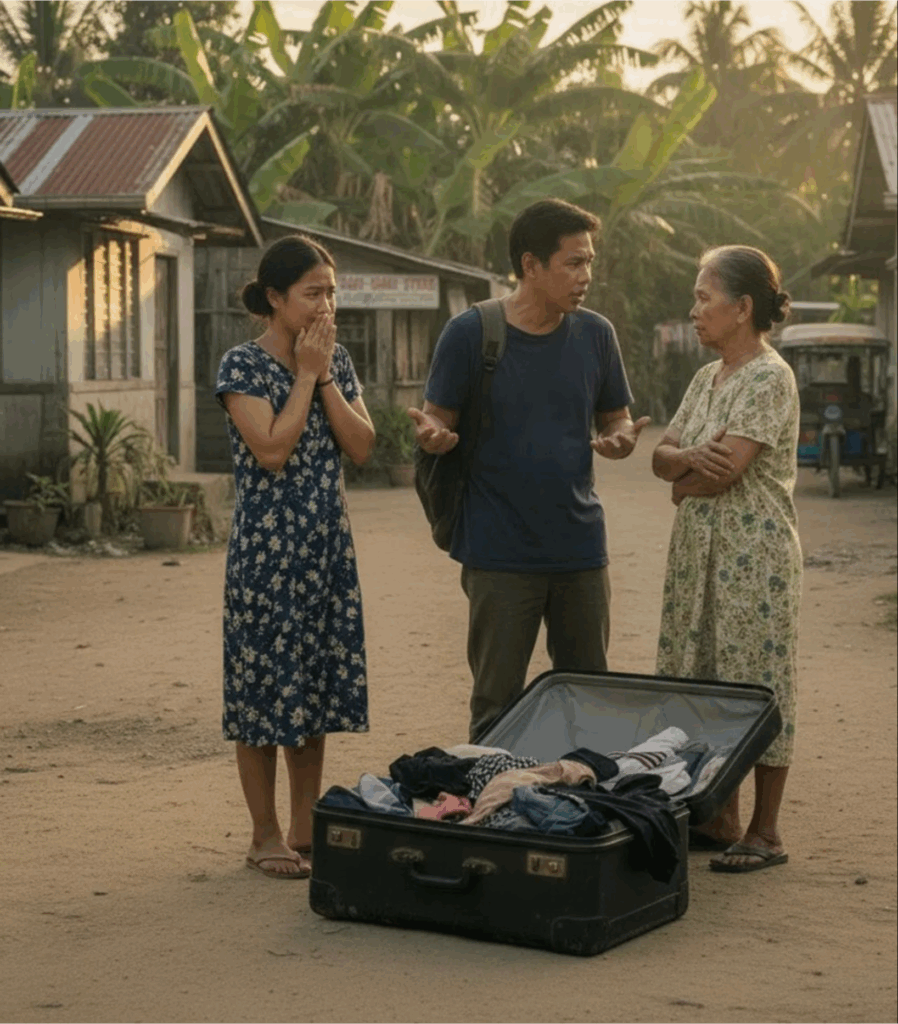
“Take your hand away, Mom. I’ll drop the screwdriver.”
Valentina pulled her hand back.
The screw went in crooked, and Vitaly muttered a curse under his breath.
“Vitaly… Where am I supposed to go?”
“Mom, please. Don’t start again. We’ll figure something out. It’s not like we’re going to throw you into the street.”
The smell of wet straw and wood smoke drifted in from the fields.
The house was fifty-two years old.
Valentina and her husband, Tikhon, had built it themselves. After every shift at work, they would come home and lay three rows of bricks before dark. They mixed the mortar in an old trough beside the bathhouse.
Now the house was listed for 1.9 million rubles.
A buyer had already come twice, carrying a measuring tape and bringing his son along the second time.
Valentina returned to the little outbuilding behind the house and sat down on the narrow bed.
Tikhon had built the place in 1978.
One tiny room. A stove. One window overlooking the garden. A simple roof.
In summer, they used it to cook jam in huge basins and dry onions on sheets of newspaper.
In winter, it had never been heated.
There had been no reason to.
Now Valentina had been living there since May 20.
The door no longer closed properly. The wind from the fields kept forcing it open.
So she used an old brass one-kilogram weight to hold it shut.
She had been given that weight when she retired from the grain collection point.
For thirty-one years, it had sat on the scales there.
Valentina picked it up and weighed it in her palm, just as she had weighed thousands of things throughout her life.
Then she placed it beside the door.
In her son’s house, the lights were on.
Behind the new plastic window, Zhanna walked around in a terry-cloth robe, stirring something in a pot while talking on the phone.
Valentina put her blue enamel kettle on the little hot plate.
Then she remembered.
The electricity had been disconnected on Wednesday.
Again.
“All right,” she murmured. “I’ll have to go to Klavdiya’s.”
She picked up the kettle and crossed the yard.
It was blue, with a whistle on the spout and a small chip on its nose.
She hurried across the street, hoping no one would see her from the window.
Vitaly watched her from the hallway.
He thought his mother could at least stop embarrassing herself in front of the neighbors.
The electricity had not been cut to punish her.
The wiring really was old.
One spark and the whole house could burn down.
Besides, they would move her to the district center in the spring.
There would be doctors, shops, other elderly women to talk to.
She would be better off there.
At least, that was what Vitaly kept telling himself.
But then why did seeing his mother carrying that kettle across the street make him feel so uneasy?
THE DAUGHTER CAME HOME EARLY
Larisa arrived on Friday, a full day earlier than she had promised.
She walked through the gate with a travel bag in her hand and immediately saw the sign.
FOR SALE.
She stood there for several seconds.
Then she opened the gate and walked not toward the main house, but toward the light coming from the little outbuilding.
“Mom.”
Valentina did not turn around immediately.
First, she put the kettle down.
Then she wiped her hands on her apron.
Only after that did she face her daughter, as though she needed a few seconds to prepare her expression.
“Larochka. Why didn’t you call?”
“Mom… What is that sign on the gate?”
“Oh, that? Vitalik put it there. Take off your coat. I’ll make you some tea.”
They had dinner in the main house.
Larisa barely recognized it.
The wall between the old sitting room and dining room had been knocked down, creating one huge space.
A new corner sofa stood in the middle of it.
The old chest of drawers that had belonged to her mother was gone.
On the wall remained a pale rectangle where it had once stood.
Zhanna put a plate in front of Larisa and sat down opposite her.
“Sorry about the mess. We’re almost finished. We’re just waiting for the curtains.”
“How much did all this cost?”
“You don’t want to know. Vitalik took out a loan. Eight hundred thousand.”
Valentina ate at the very edge of the table.
In the corner where the salt shaker used to sit.
She barely spoke.
She took her bread quickly, kept her eyes down, and ate as though she was afraid of taking up too much space.
“Mom, why are you rushing? Sit with us.”
“I’ve eaten. I still need to feed the chickens.”
The door closed behind her.
Vitaly pushed his plate away and looked directly at his sister.
“This is my house, Larisa. It has been mine for five years. Mom transferred it to me herself.”
“I know.”
“Then why are you looking at me like that?”
“You know why.”
“I put eight hundred thousand into this place. When I sell it, I’ll buy her a small apartment in the district center. She’ll have other elderly women around her. The clinic will be nearby. What’s wrong with that?”
Zhanna immediately nodded.
“We’ve supported her for five years, Larisa. Five years. You come once a year and start teaching us how to live.”
Larisa said nothing.
Because there was truth in what they were saying.
And for five years, they had built their entire argument on that truth.
THAT NIGHT
Later that night, Larisa went outside.
A light was glowing inside the little outbuilding.
Her mother was sitting on the bed with a coat thrown over her shoulders, mending a sock.
“Mom. Come home with me. We’ll pack tomorrow and leave.”
“I’m not leaving.”
“But this isn’t your house anymore.”
Valentina slowly looked up.
There were no tears in her eyes.
No anger.
That calmness frightened Larisa more than tears ever could.
“No,” her mother said quietly. “It isn’t.”
Then she lowered her head and continued sewing.
“I DON’T NEED ANYTHING FROM YOU”
The next morning, Larisa placed an envelope on the stool.
“There’s forty thousand rubles. For firewood, coal, whatever you need.”
Valentina looked at the envelope.
She did not touch it.
“Take it away.”
“Mom…”
“Take it away, Larochka. I don’t need anything from you.”
“You’ll freeze.”
“I’ll manage.”
“At least take the heater. I brought an oil heater. It’s in the car.”
“Take that away too.”
Larisa sat down on the bed and began to cry.
Not loudly.
Just helplessly.
Her mother sat beside her and gently stroked her back with a dry hand.
But she never touched the envelope.
Later that afternoon, Larisa went to see their neighbor, Klavdiya Mironovna.
The woman knew more about what was happening in that yard than anyone else.
“She comes to me all the time,” Klavdiya said. “She heats her kettle here, sits and talks. I told her, ‘Valya, take the money your daughter offers you.’ But she refuses. She’s always been proud.”
“How often?”
“Every other day since spring.”
“And the electricity?”
“Sometimes it’s on, sometimes it isn’t. Vitalik says the wiring is dangerous.”
When Larisa returned home, she found her mother polishing the old brass weight with a piece of cloth and ash.
She was rubbing it until it shone.
“Mom, why are you polishing that?”
“I like things to be clean.”
“What do you need that old weight for?”
Valentina placed it carefully on the windowsill.
“For thirty-one years, they checked my work with this.”
Larisa frowned.
“How?”
“When the inspector came, he put the certified weight on the scales and watched the needle. Not once did my scale lie.”
She ran her fingers over the brass.
“The grain I weighed belonged to other people. Not me.”
She smiled faintly.
“When you weigh what belongs to someone else, you have to be even more precise than when you weigh your own.”
Larisa did not understand what she meant.
Not yet.
THE HOUSE THAT WASN’T REALLY HIS
The buyer’s name was Nikolai Pavlovich.
He came on Wednesday in a white car with his son and a measuring tape.
They measured everything.
The yard.
The walls.
The attic.
They even tapped the wall beneath the window.
Valentina stood near the little outbuilding and watched.
“Does the old woman come with the house?” Nikolai asked.
“My mother,” Vitaly replied. “She’ll move to the district center by spring.”
“It’s settled,” he added confidently.
The buyer had already paid a deposit.
One hundred thousand rubles.
The money was being held by Vitaly’s godfather, Pyotr.
Valentina waited until the white car disappeared down the road.
Then she walked into the house to get some salt.
“December thirty-first,” she said quietly.
“What?”
“That’s when I’m supposed to leave, isn’t it?”
“Mom, go rest.”
“I’m asking you. December thirty-first?”
“Yes. December thirty-first. Why are you acting like a child?”
That same week, Vitaly installed a latch on the outside of the door to her little outbuilding.
“So the wind doesn’t slam it,” he explained.
The latch was on the outside.
That evening, Valentina took a screwdriver and moved it to the inside.
The next morning, Vitaly moved it back.
Neither of them mentioned it again.
Then twelve-year-old Egor sent a message to his aunt.
It was short and full of spelling mistakes.
“Aunt Lar, Dad didn’t chop Grandma enough firewood. She’s collecting wood chips in the shed. Dad said she can manage until New Year.”
A twelve-year-old boy had understood what the adults refused to see.
THE BRASS WEIGHT ON THE TABLE
In early November, the curtains finally arrived.
Zhanna invited everyone over.
The table was covered with food.
The new ceiling gleamed under the lights.
Klavdiya and her husband came.
Pyotr and his wife came.
Zhanna’s mother came from the district center.
Several of Vitaly’s coworkers came.
Even Nikolai Pavlovich was invited to celebrate the deal, although the sale had not yet been finalized.
Larisa arrived that morning.
She barely spoke all day.
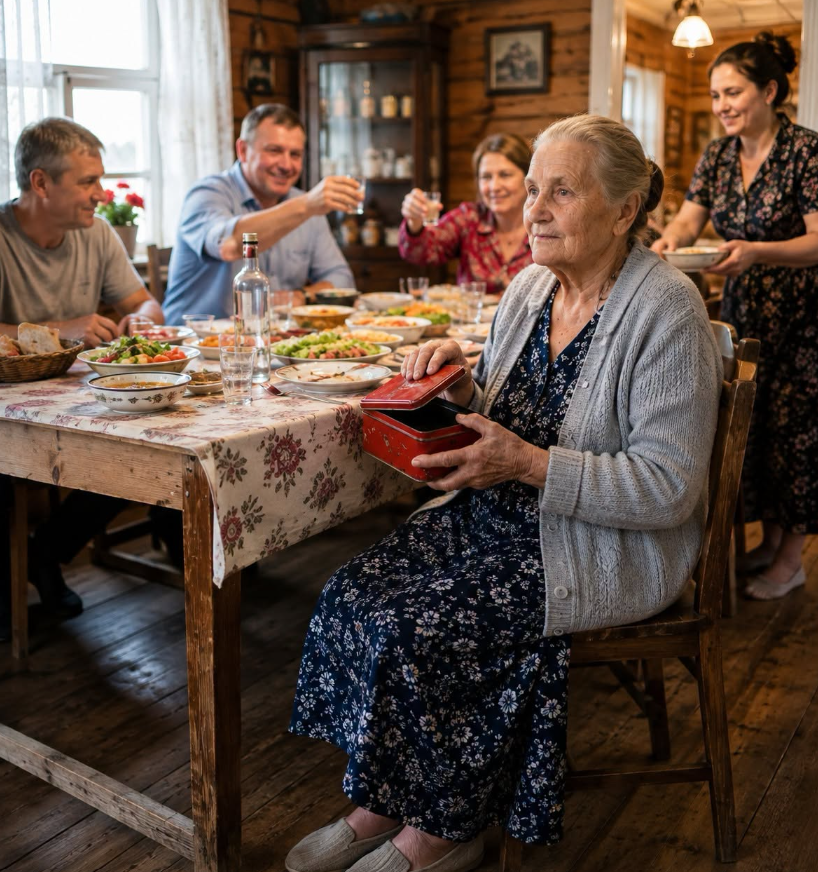
Valentina was seated at the end of the table, near the doorway.
She wore a dark dress—the same one she had worn to school meetings years ago.
She kept her apron on.
When everyone had glasses in their hands, Vitaly stood.
“Well, since everyone is here…”
He smiled.
“Zhanna and I have decided everything. We rebuilt this house, invested a fortune into it, and now it’s worth much more. The deposit has been paid. Nikolai Pavlovich can confirm that.”
People nodded.
“So in the spring, we’ll sell the house. Mom will move to the district center. She’ll have company there and the clinic will be close.”
“Exactly,” Pyotr said. “What’s an old woman supposed to do out here alone?”
Zhanna’s mother nodded enthusiastically.
“She’ll be happier with people her own age.”
Valentina slowly pushed her plate away.
Then she reached inside her apron.
She took out the brass weight.
And placed it in the middle of the table.
The table trembled.
Forks rattled against plates.
The conversation died instantly.
“Vitaly,” Valentina said quietly.
“You won’t be able to sell this house.”
Vitaly laughed.
But no one laughed with him.
“Mom. Please. Not in front of everyone.”
“In front of everyone,” she replied.
“They’re all family here.”
She reached beneath her apron again and pulled out a folded document.
She unfolded it slowly.
Smoothed the paper with her palm.
Then turned it so everyone could see.
A blue official seal stood beneath the new chandelier.
“This says exactly what you agreed to when you received the house,” she said.
Vitaly stared at the document.
“What are you talking about?”
“You didn’t receive the house for nothing.”
She pointed to the page.
“You agreed to provide me with food, heat, care and a place to live until the end of my life.”
She looked directly at him.
“And you cannot sell the house without my consent.”
Nikolai Pavlovich put on his glasses and leaned closer.
“This is a lifetime support agreement?”
“Yes.”
“Is it registered?”
“Yes.”
“When?”
“August fifth, 2020.”
Vitaly’s face went pale.
“You knew?”
“For five years.”
“Why didn’t you tell me?”
Valentina looked at him calmly.
“Because I wanted to see what you would do.”
No one moved.
No one spoke.
Then Valentina turned to Klavdiya.
“Tell them. How often did I come to your house?”
Klavdiya stared at the tablecloth.
“Every other day since spring.”
“And where did I get my firewood?”
“From Kolya. Two thousand rubles. I was there when you paid him.”
Valentina placed one hand on the brass weight.
“The electricity was cut off. My hot plate was disconnected. The latch on my door was moved outside. My furniture was taken from my room.”
She looked at her son.
“That is not care, Vitaly.”
“It’s not neglect.”
“It is.”
“Mom, I didn’t mean any harm.”
“I know.”
“I thought you would be happier in the district center.”
“I know you did.”
She paused.
“That’s what makes it worse.”
Zhanna suddenly stood up.
“Valentina! Do you understand what you’re doing? We spent six months renovating this house!”
“In my house,” Valentina replied.
“I never asked you to knock down my walls.”
“Vitalik!”
Zhanna turned toward her husband.
“Say something!”
Vitaly said nothing.
He sat there, red-faced, holding his glass so tightly that it trembled in his hand.
Then Egor tugged at his father’s sleeve.
“Dad…”
Vitaly looked at him.
“Grandma really does collect wood chips in the shed.”
The room went silent again.
THE THIRTY-DAY DEADLINE
Nikolai Pavlovich left that evening without finishing his dinner.
On Monday, he sent his son to collect the deposit.
Pyotr brought the money outside in the same sugar bag.
He stood beside the car for a long time, trying to explain that he had not known anything and that he had been misled too.
Valentina looked at him over the fence.
“Pyotr, don’t count your commission before you’ve earned it.”
He swallowed.
“Count it afterward.”
Zhanna started packing on Tuesday.
The huge coffee-colored sofa would not fit through the door.
Not sideways.
Not upright.
They ended up cutting it apart in the yard.
Half the street watched.
Zhanna shouted at the movers.
Vitaly began coming to see his mother every day.
He would sit on the little stool inside the outbuilding.
“Mom. What am I supposed to do about the loan?”
“Work.”
“You know I didn’t do it out of spite.”
“I know.”
“I thought this would be better for you.”
“I know what you thought.”
He stared at the floor.
Then he took the screwdriver from his pocket.
Without another word, he went outside.
He removed the latch from her door.
Filled the screw holes with white putty.
Then wiped his finger on his pants.
The cancellation was signed on December 23 in an office above the savings bank.
Valentina signed her name carefully, with the same neat handwriting she had used for thirty-one years at the grain station.
Vitaly signed too.
Then he sat there staring at the desk until someone finally called his name.
The renovations remained with the house.
The plastic windows.
The new floor.
The ceiling.
Everything.
“Well,” Valentina said to Larisa, “at least my grandson will have it someday.”
On December 31, Valentina slept in the main house for the first time in seven months.
She lit the stove herself.
Went to bed shortly before midnight.
And for the first time in seven months, she slept until eight in the morning.
TWO CUPS OF TEA
Six months passed.
In May, Larisa came home for the weekend.
The FOR SALE sign was gone from the gate.
Only two small screw holes remained.
Valentina had filled them with tree sap.
The brass weight stood on the windowsill in the large room.
It gleamed in the sunlight.
Beside it were little packets of seeds labeled in pencil:
“Carrots.”
“Asters — from Klavdiya.”
Egor now visited his grandmother every Saturday.
He came by himself, taking the 9:15 bus.
Vitaly came too.
Not every Saturday.
But more often than before.
In February, he had quietly cleared the snow from the porch to the road and left without coming inside.
In April, he repaired the northern section of the fence.
He refused payment.
That May morning, Valentina saw her son through the window.
He was chopping wood beside the fence.
She put the blue kettle with the chipped spout on the stove.
Then she took two cups from the cupboard.
The kettle began to whistle.
Valentina turned off the stove and looked outside.
Vitaly was stacking the firewood.
Neatly.
Log against log.
Exactly the way his father had taught him.
Valentina smiled.
She had not taken anything away from her son.
She had not destroyed his life.
She had not punished him.
She had simply taken back what had slowly, quietly been taken from her.
Her home.
Her dignity.
Her voice.
And most of all, her rightful place at her own table.
The brass weight remained on the windowsill.
Heavy.
Silent.
Precise.
It weighed exactly one kilogram.
Just as the truth weighed exactly what it needed to.