
“Are You Really That Stingy That You Won’t Give My Mother a Piece of Meat?!” My Husband Shouted When I Stopped His Mother from Taking Food from Our Fridge. That Evening, I Saw My Groceries on My Sister-in-Law’s Party Table.
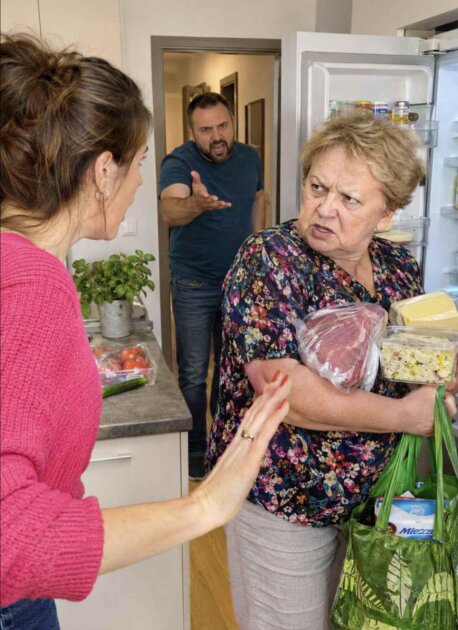
My mother-in-law was standing in front of our open refrigerator, putting a kilogram of pork loin, two packages of cheese, and a container of homemade salad into her shopping bag.
She was doing it so casually that anyone would have thought she was standing in her own kitchen.
“Mrs. Irena, please leave those things. I bought that meat for tomorrow’s lunch.”
She turned toward me with an irritated expression.
“Surely you can buy some more.”
“I’ve just come back from the supermarket. I’m not going shopping again.”
My husband, Marcin, heard our conversation and immediately walked into the kitchen.
“What’s going on now?”
“Your mother is taking our groceries.”
He looked at me as though I had said something outrageous.
“Are you really that stingy that you won’t give my mother a piece of meat?!”
It had already been an exhausting week. I worked ten-hour days at an accounting office in Katowice, and the following morning I was supposed to visit my father, who was recovering from surgery.
I had planned to prepare several homemade meals for him so he wouldn’t have to worry about cooking.
“I bought that meat for my father, too,” I explained.
Irena let out an exaggerated sigh.
“Fine, fine. I won’t beg. I’ve never encountered such unfriendliness in my life.”
She put the pork back, but left the other groceries inside her bag.
Marcin gave me an accusing look.
“Did you really have to humiliate her?”
I didn’t answer. I went to the bathroom to change.
When I returned to the kitchen, my mother-in-law had already left. Marcin was sitting on the sofa, watching television.
I opened the refrigerator.
The pork was gone.
“Where’s the meat?”
“I gave it to Mom. I’m not going to let her go hungry.”
His mother received a pension, lived in her own apartment, and had never mentioned having financial difficulties or being unable to afford groceries.
Nevertheless, for several months, she had regularly been taking things from our kitchen.
Sometimes it was eggs, sometimes butter, coffee, fruit, or entire containers of meals I had prepared myself.
Marcin always insisted that he was simply helping an older woman.
That day, I decided I wasn’t going to waste my energy on another pointless argument.
That evening, I sat down with a cup of tea and started scrolling through my phone.
A new post appeared on my sister-in-law Monika’s social media profile.
She was hosting a family celebration to mark the completion of her apartment renovation.
The table looked beautiful. There were candles, fresh flowers, elegant serving dishes, and several beautifully prepared meals. A few smartly dressed guests were sitting around it.
I swiped to the next photograph.
And froze.
There was the roasted pork loin.
Beside it stood my glass salad bowl, recognizable by the small chip on its edge.
I also recognized the herb-covered cheese I had purchased that very morning from a little neighborhood grocery store.
Under the photograph, Monika had written:
“I love spoiling my guests! Everything prepared with my own hands!”
I felt my face grow hot.
I called Marcin.
“Apparently, your mother really was starving.”
I showed him the photographs.
He stared at the screen for a moment.
“Looks like she took some things to Monika.”
“Looks like?”
“So what?”
“So you shouted at me because I supposedly begrudged your mother some food. Meanwhile, our groceries ended up at your sister’s party.”
“Monika wanted to make a good impression on her friends.”
“With my money?”
Marcin put down his phone.
“Can’t you just be happy that you helped someone?”
I stood up and went into the bedroom.
I wasn’t going to answer a question designed to make me feel guilty for someone else’s behavior.
The following morning, I bought fresh groceries for my father. This time, I drove straight to his house without stopping at home.
We spent several hours together.
When I returned, Marcin was sitting at the empty dining table.
“What’s for lunch today?”
“I don’t know. What are you planning to cook?”
He looked at me in disbelief.
“I thought you’d done the shopping.”
“I did. For my father.”
“And what about us?”
“You can go to the supermarket.”
For the first time in a long while, he had to take responsibility for preparing his own Sunday lunch.
On Monday morning, while getting ready for work, I noticed a piece of paper lying near the refrigerator.
It was written in Irena’s handwriting.
At first, I thought it was an ordinary shopping list.
But when I looked closer, I noticed dates and several people’s names written beside the items.
Next to the upcoming Friday, someone had written:
“Monika – eight guests. Ania will prepare the meat, salads, and cake.”
Ania was me.
There was another gathering scheduled for the following week.
At the very bottom of the page, I noticed a sentence that made absolutely no sense to me.
“Photos must be taken before the guests arrive.”
I took a photograph of the list and slipped the paper into my handbag.
That evening, I asked Marcin what the notes meant.
“Mom is helping Monika organize her gatherings.”
“Then why am I expected to prepare the food?”
“She probably just wrote it down.”
“Without asking me?”
“Ania, you don’t have to do everything on that list.”
“Wonderful. Because I won’t be doing anything.”
Marcin became visibly irritated.
“Monika has important guests coming on Friday. You could at least bake a cheesecake.”
“No.”
“Just one cheesecake!”
“No.”
This time, he didn’t push the subject.
But on Wednesday, my sister-in-law called me.
“Ania, Mom told me you’re making a cheesecake for Friday. Could you prepare two? One with raspberries and one traditional.”
“I’m not making any cheesecake.”
“What do you mean?”
“Nobody asked me, and I haven’t promised anything.”
Monika sighed.
“But I’ve already told my guests what will be on the table!”
“Then you can order cakes from a bakery.”
“Do you know how much that costs?”
“Yes. Ingredients aren’t free either.”
She hung up without saying goodbye.
That same evening, my mother-in-law arrived at our apartment carrying an empty shopping bag.
When she noticed that our refrigerator contained only enough food for the next couple of days, she looked disappointed.
“You haven’t bought anything decent?”
“I bought what we need.”
“What about butter? Eggs? Cream?”
“They’re all available at the supermarket.”
Irena turned toward Marcin.
“What has gotten into her lately?”
My husband shrugged.
“She has decided to be offended by everyone.”
I didn’t correct him.
On Friday, after work, I went swimming. Afterwards, I met a friend and had dinner at a small restaurant.
When I finally got home, I found nine missed calls from Monika.
I called her back.
“Where are you?!” she demanded.
“At home.”
“Mom said you might still bring the cake.”
“I told you clearly that I wasn’t preparing anything.”
“I had to spend almost three hundred zlotys on ready-made food!”
“I hope your guests enjoyed it.”
I wasn’t trying to be sarcastic. I simply refused to apologize for something I had never promised to do.
A few days later, I ran into Justyna, an old friend of Monika’s, in our neighborhood.
We chatted briefly about work and family. Then she suddenly said:
“Your sister-in-law is doing wonderfully. You must be proud of her.”
“Why?”
“Those gatherings she organizes. I attended one two weeks ago. She talks so convincingly about running a household and saving money.”
I became curious.
“What gatherings?”
Justyna took out her phone.
She showed me a social media profile belonging to Monika that I had never seen before.
There were photographs of elegant dinners, beautifully decorated interiors, and homemade desserts.
Monika described herself as a woman who helped others run their households without spending a fortune.
She organized small paid workshops where she taught women about budgeting, cooking, meal planning, and entertaining guests.
I scrolled through the photographs.
Then I recognized something.
My Christmas dumplings.
My poppy seed cake.
My homemade preserves.
Even the porcelain jug I had inherited from my grandmother, which had been missing from our apartment for several weeks.
In one video, Monika explained that with the right organization, anyone could prepare an impressive dinner without spending much money.
Suddenly, everything made sense.
She wasn’t paying for the groceries.
She wasn’t spending hours cooking.
She was using my work while earning money by teaching other women how to manage their homes.
“How much does it cost to attend one of these workshops?” I asked Justyna.
“One hundred and twenty zlotys per person. Refreshments are included.”
I thanked her and went home.
Marcin was sitting at his computer.
“Did you know your sister organizes paid workshops?”
“She mentioned something about them.”
“And she uses my food for them?”
“Mom just wanted to help her a little.”
“And you?”
“Ania, she’s only getting her business started.”
“Since when?”
“For a few months.”
I sat down on the edge of the sofa.
“So for several months, you’ve been making me feel guilty for supposedly begrudging food to a pensioner, while knowing your sister was using our groceries for her business?”
Marcin said nothing.
“How many times did you ask me to prepare extra portions of dinner, telling me your mother needed food?”
“I don’t remember.”
“I do.”
I left the room.
The following day, I sent Monika a message stating clearly that I did not consent to her continuing to use my meals, photographs, or personal belongings for her business.
I also asked her to return all the dishes she had borrowed.
She replied that I was exaggerating and that I was simply jealous of her success.
I didn’t argue.
For the next two weeks, I bought only the groceries we actually needed. Whenever I prepared meals, I took them to work or delivered them directly to my father.
Marcin had to buy groceries for his mother and sister himself.
I quickly noticed that his generosity was beginning to disappear.
One afternoon, he returned from the supermarket holding a receipt.
“Almost four hundred zlotys for Mom’s groceries!”
“I understand.”
“Everything has become ridiculously expensive.”
“I’ve been saying that for ages.”
He sat at the table and began calculating the expenses.
Suddenly, his phone rang.
“Monika, I can’t keep buying everything for you every week! You earn money yourself!”
I couldn’t hear her response, but Marcin soon walked into another room to continue the conversation.
That evening, my mother-in-law invited us over for a family discussion.
When we arrived, Monika was already there.
A notebook filled with handwritten figures lay on the table.
“We need to decide how we’re going to help Monika from now on,” Irena announced.
“We don’t need to decide anything,” I replied. “It’s her business.”
My sister-in-law pressed her lips together.
“You don’t understand how much I’ve spent getting everything started!”
“On what?”
“Renovating the apartment, furnishing the kitchen, advertising, decorations…”
“But you organize your workshops in your own home.”
“Exactly! That’s why I had to prepare everything properly!”
Irena opened the notebook.
“If everyone contributes a little, Monika will be able to develop her business without worrying so much about money.”
I looked at the figures.
Beside Marcin’s name was an amount:
12,000 zlotys.
“What is that?”
My husband immediately closed the notebook.
“Nothing important.”
“Twelve thousand zlotys is nothing important?”
Monika looked away.
Irena sighed.
“Marcin helped his sister with the renovation.”
At that moment, I remembered the money we had saved six months earlier for a holiday by the sea.
Marcin had told me that his car needed an expensive repair, so we would have to postpone our vacation.
“Was that our savings?” I asked quietly.
He didn’t answer immediately.
Eventually, he admitted that he had given his sister the money without discussing it with me.
I felt as though someone had suddenly opened a door into a completely different life, one I had never known I was living.
“Why?”
“Monika promised she’d pay everything back once she started earning money.”
“Then why are we still supporting her?”
Irena looked at her daughter.
“Because she still can’t afford all the expenses herself.”
I stood up.
“Then she can’t afford to run this business in its current form.”
Monika started crying.
“You want to destroy everything I’ve worked for!”
“No. I want to stop financing something I never agreed to.”
I left and returned home alone.
For the next several days, Marcin tried to convince me that I was being too harsh about his decisions.
But the problem was no longer about groceries.
I had finally understood something much more painful.
For months, my husband had been willing to portray me as a selfish, unkind woman simply to hide his own financial decisions and his sister’s exploitation of my work.
We needed to have a serious conversation about the future of our marriage.
We agreed on new rules for managing our shared finances and began attending marriage counseling.
Monika, meanwhile, had to start buying the ingredients for her workshops herself.
Within a month, she raised the prices of her classes.
Later, she reduced the number of gatherings.
Eventually, she changed the format of her business and began holding workshops without elaborate dinners.
I thought that was the end of the story.
But one Saturday in November, Justyna called me.
“Ania, there’s something I really need to show you.”
We met at a café.
She brought a printed booklet that participants had received at one of Monika’s first workshops.
The cover featured a title about traditional family recipes and authentic Silesian cooking.
I opened it.
On the third page, I found my mother’s recipe for beef roulades.
On the next page was her method for preparing red cabbage.
Then came the cheesecake recipe she and I had baked together every Christmas for years.
Even the unusual instruction about adding lemon zest had been copied almost word for word.
My mother had died four years earlier.
I had kept her handwritten recipe notebook in a kitchen drawer.
Irena must have taken it or photographed its pages at some point.
But what hurt me most was the dedication on the last page.
“To my mother, Irena, who passed down all our family’s culinary secrets to me.”
I stared at those words for a long time.
This time, I didn’t call Marcin.
I went straight to my father’s house.
I showed him the booklet.
He turned the pages silently until he reached the cheesecake recipe.
Suddenly, he smiled.
“Your mother added lemon zest because she knew how much I loved it.”
I wiped away my tears.
“Dad, they’ve even taken her recipes and claimed them as their own.”
My father closed the booklet.
“They can copy the recipes, Ania. But they never lived through a single one of those days with her. We remember those days. They don’t.”
A few weeks later, I had one final serious conversation with Monika.
I asked her to stop distributing materials that presented my mother’s recipes as part of her own family tradition.
This time, she didn’t argue.
She also returned all the dishes she had borrowed.
Before Christmas, I decided to prepare a small gift for my father.
I gathered my mother’s recipes, our family photographs, and memories connected to each dish.
I printed several copies of a little family cookbook for our closest relatives.
On the first page, I placed a photograph of my mother standing beside the kitchen table.
Underneath it, I wrote her name.
Jadwiga.
When Dad opened the gift on Christmas Eve, he didn’t say anything for a long moment.
Then he hugged me and whispered:
“Now she’s with us again.”
Marcin was sitting across the table.
I could see tears in his eyes.
That evening, he prepared dinner himself and drove to his mother’s apartment with some groceries.
He didn’t take anything without asking.
And when he returned, he asked whether he could have a slice of cheesecake.
I gave him a plate.
Because I had never begrudged anyone food.
What I regretted was that the people I had cared for over so many years had so easily mistaken my kindness for an obligation.
And it took me stopping the flow of food to their tables for them to understand whose hands had been preparing their feasts all along.

