
“I’ve already sent it, Lar. To my mother. At lunchtime.”
I stood frozen in the hallway, holding one sneaker in my hand. The other was still on my foot, its shoelace untied. It had come undone at the bus stop, and I had walked the entire way home curling my toes to keep the shoe from slipping off.
“What did you send?”
“The refund. For the plane tickets. It came through today, so I transferred the money straight away. Their boiler was sealed off, remember?”
I remembered the boiler. Of course I did.
A week earlier, the gas inspectors had visited my in-laws’ house outside Danilov. They had examined the old heating unit, declared it unsafe, and attached an official seal. Before winter arrived, the entire boiler had to be replaced. Vadim had spent the rest of that evening pacing around our kitchen, calculating how much money he could borrow and from whom.
What I didn’t remember was agreeing to give him our vacation refund.
The airline had canceled our flight to Kaliningrad twelve days before departure. They had offered passengers two options: choose another date or request a refund. Vadim and I had agreed to reschedule.
I had found another flight for the following Tuesday, called the hotel in Zelenogradsk, and arranged to move our reservation. All that remained was to confirm the changes in the airline’s app.
The account belonged to Vadim. We had booked the tickets through his profile because he collected travel reward points with every flight. He was surprisingly proud of those points.
I had no idea he had requested a refund instead.
“We agreed to change the dates,” I reminded him. “I sent you the new flight yesterday.”
“Come on, Lar. They’re old people.” He didn’t even turn around. He was standing at the stove, stirring buckwheat. “They need to get through the winter. Dad can barely carry a bucket to the bathhouse anymore, and you’re talking about going to the seaside.”
“Vadim, that was my mother’s money.”
I had transferred forty-six thousand rubles to him in May from the savings account my mother had left me.
She had died two years earlier. Since then, I hadn’t touched that money. Not for renovations, not for dental treatment, not even when we had unexpected expenses. It had felt wrong to spend something she had worked so hard to save.
The trip to Zelenogradsk was the first thing I had ever wanted to use it for.
I couldn’t remember whether my daughter, Katya, or I had first suggested the idea. What I remembered was looking at photographs of the Baltic Sea late at night, studying the sand dunes and imagining myself walking along the shore.
I was fifty-two years old and had never seen the Baltic Sea.
It might sound ridiculous, but that trip meant more to me than Vadim understood.
“Your mother would have told you to give it to them,” he said. “She respected my father.”
“My mother would have told you to ask your wife before spending her inheritance. At least return half. Now.”
“How am I supposed to return anything? The money is already in their account. Alla is calling the technician tomorrow.”
I took off my second sneaker and placed both shoes neatly on the hallway shelf, their toes facing the wall.
On top of the wardrobe sat a shopping bag. Inside was a straw hat with a wide brim and a blue ribbon. I had bought it in July for fifteen hundred rubles. Sometimes, when Vadim wasn’t home, I tried it on in front of the mirror and imagined myself wearing it beside the sea.
I left the bag untouched and went to wash my hands.
The following morning, I was arranging chrysanthemums in the flower stall near the market when I called the hotel.
The receptionist explained politely that because the cancellation was so close to the arrival date, they would keep the cost of the first night.
Seven thousand rubles.
“What if I move the reservation to October?”
“Unfortunately, we’re closed in October for exterior renovations. We can only offer dates in the spring.”
I canceled the reservation.
Zoya Pavlovna, the woman who owned the flower stall, was sixty-one. She had heard the entire conversation, although she pretended to be counting ribbons.
“I’m not canceling your holiday,” she said without looking up. “You’ve worked six Sundays in a row to earn it. You can stay home or go to your country house if you want. But I don’t want to see you here on September first.”
For florists, September first was practically Christmas. Years earlier, I had agreed to work every summer Sunday in exchange for time off at the beginning of autumn. Those Sundays were usually slow, hot, and exhausting. The flowers wilted before lunchtime, and the market seemed to bake under the sun.
Zoya had agreed on one condition: I couldn’t take a single day off before autumn.
I had kept my promise.
That afternoon, one of our regular customers came to the counter. He was around seventy and usually bought a single orange gerbera every Friday. He never told me who it was for.
It was Wednesday, and he bought two flowers.
For some reason, I still remember that.
During my lunch break, I called Vadim.
“Let’s settle this properly. I’m not against replacing the boiler. Your parents need heat. But you have to repay me. A little from every paycheck. And there’s the hotel money they kept because you didn’t tell me what you were doing.”
“Don’t start, Lar. I’m at work.”
“I’m not starting anything. I’m asking when you’ll return it.”
“I have a production line waiting. We’ll talk tonight.”
He came home late and went straight to bed.
I was still sitting in the kitchen when my phone sounded with a reminder:
September fifth: automatic payment, 10,000 rubles, recipient Nina Fyodorovna K.
I had been sending my mother-in-law ten thousand rubles every month for her blood pressure medication.
It had started in January, eight months earlier.
Vadim had explained that his car loan was taking most of his salary, so I could transfer the money for his mother’s prescriptions while he covered the household utility bills.
I had agreed without giving it much thought.
Looking at that reminder, I wondered for the first time whether I should have been keeping track of everything.
### The Repayment Agreement He Refused to Sign
On Sunday, I placed a sheet of paper from one of Katya’s old school notebooks in front of Vadim.
I had written a simple statement by hand, without complicated legal language:
“I acknowledge receiving money from my wife’s mother’s savings account and agree to repay it in equal monthly installments before spring.”
I had calculated a monthly amount that was less than what he spent on cigarettes and driving to the garage.
“I’m not asking you to return everything at once,” I said. “I’m not asking you to take the boiler away from your parents. Just sign this, and we’ll put the matter behind us.”
Vadim read the paper twice, moving his lips as he followed the words.
“I’m not signing IOUs for my own wife. Are you my wife or a bank?”
“I’m your wife. The one you took money from without asking.”
“Without asking?” He gave a short laugh. “You could disappear from that flower stall for two weeks, and nobody would even notice. Someone else would sort out the flowers. Meanwhile, my father has a heart condition, and winter is coming.”
I thought about those six Sundays.
The heat, the buckets of water I carried every half hour, and the painful blister on my thumb from using the pruning shears.
Someone else could sort out the flowers.
Vadim placed his tea mug directly on my handwritten agreement. I don’t think he did it deliberately. The kitchen table was small, and the paper happened to be lying near his elbow.
I pulled it out from under the mug.
A wet circle had spread across the page, blurring the letter in the word “repay.”
“Vadim, you just put your tea on my mother’s money.”
He stared at the stain for a long time.
Then he rubbed his face with both hands until his cheeks turned red.
“Lar, I’m fifty-five years old,” he finally said. “My father spent my whole life telling me I was a man, the breadwinner, the person responsible for everyone. When I was in ninth grade, he built me a bicycle out of parts he collected from a scrapyard. Now he calls me asking how much a new boiler costs, and I don’t even know what to tell him because I have nine thousand rubles left in my account until payday.”
His voice cracked.
“I couldn’t ask you for money. Do you understand? I just couldn’t.”
“But you could take it.”
He lowered his head.
“Yes. I could take it.”
Then he went into the bedroom.
I folded the paper into four and put it in my handbag. By evening, the wet circle had dried, but the damaged letter was still visible.
My mother had kept her savings in an old metal tea tin decorated with an elephant. I had taken it home after her funeral. It still sat on top of my refrigerator, empty, with the faint smell of tea lingering inside.
She used to say that money was easier to understand when you could see it in a tin rather than on a bank statement.
But that wasn’t the point anymore.
Katya came over on Wednesday.
She was twenty-five and rented a small one-bedroom apartment with a friend. Their washing machine, she often complained, only worked properly on the quick-wash setting, so she regularly came to our house to do her laundry.
I hadn’t told her anything about the money.
But apparently Vadim had.
She loaded the washing machine, sat across from me, and began carefully choosing her words.
“Mum, I don’t want to interfere, but…”
“You always say that right before interfering.”
“All right. I am interfering.” She took a grape from the bowl. “Dad was completely wrong not to tell you. There’s no question about that. But Grandma and Grandpa are alone out there. Aunt Alla lives just across the fence, but she’s not exactly taking care of everything. They really needed the boiler.”
“I never said they didn’t.”
“Right. You said you should have been asked.”
I nodded.
Katya seemed satisfied that she had understood me.
“Grandma keeps telling all the neighbors what a wonderful son she has. She says Vadim paid for the boiler and sends her money for medication every month. Aunt Alla even shows her the transfers on her phone because Grandma doesn’t have a banking app.”
I slowly put the kitchen towel down.
“Katya, I’m the one who sends the money for her medication.”
My daughter stopped chewing.
“What?”
“Every month since January. Ten thousand rubles. It comes directly from my account.”
Katya put the grape down.
“So Grandma doesn’t know?”
Apparently not.
“She told me last Sunday that Dad was such a wonderful provider,” Katya said quietly. “She said she wouldn’t have survived without him.”
“Who shows her the transfers?”
“Aunt Alla. I saw it myself during the summer. Grandma handed her the phone and asked whether the money had arrived. Alla looked through the transactions and said, ‘Yes, Mum. Vadik sent it.’ I thought Dad was being generous.”
Katya looked genuinely confused.
“Mum, could there have been some mistake?”
“Maybe,” I answered.
But I already knew there hadn’t been one.
The washing machine moved into its spin cycle. For a while, neither of us spoke. We just listened to it rattling in the bathroom.
I had never expected anyone to thank me.
It was enough to know that my mother-in-law could buy her medication and avoid ending up in the hospital.
But every bank transfer displayed the sender’s name.
Anyone looking at her transaction history could see it.
And Alla was the person who checked that history.
### The Fifth of the Month
On September fourth, the day before the next automatic payment, I decided I couldn’t wait any longer.
I called my mother-in-law myself. It was the first time I had spoken to her all summer.
Nina Fyodorovna was seventy-seven. She had a loud voice and always sounded as though she were calling to someone at the far end of a vegetable garden.
“Larochka! We finally have the new boiler! It’s white and enormous. The gas technician says it should last twenty years. Our Vadik is such a wonderful provider. The boiler, my medicine, everything. Every month, right on time. Alla shows me the transfers.”
“That’s wonderful, Nina Fyodorovna. Is Alla there?”
“She is. She’s making pickles. Alla!”
My sister-in-law took the phone.
She was forty-eight, seven years younger than Vadim, and worked at the post office in Danilov. She lived right across the fence from her parents.
“Lar, why are you calling Mum? You know she shouldn’t get upset.”
“Alla, will the medication money arrive tomorrow?”
“Well, of course. It’s the fifth. Mum has to go to the pharmacy on Thursday to collect her prescription.”
“How do you know it always arrives on the fifth?”
There was a small noise on the other end. Perhaps she had put down a jar lid.
“Because it has been coming that way since winter. I’m not blind.”
“And you’ve seen my name on the transfers all this time. Larisa Viktorovna K. Yet you’ve been telling Mum the money comes from Vadik.”
There was a long silence.
I could hear my mother-in-law asking who was on the phone.
“Lar, come on. You understand how things are,” Alla finally said. “Vadik asked me to do it. Back in the winter. Dad would have been embarrassed to know his son was taking money from his wife. He’s already ashamed about the car loan. What did you expect me to do? Tell them the truth and upset them? I don’t interfere in your marriage.”
“You’ve already interfered, Alla. You’ve gone much further than you think.”
“What about the boiler? Did you know where that money came from?”
“I know nothing about the boiler. Vadik told me he received a bonus. I was happy for him.”
I couldn’t tell whether she was lying.
Her voice was perfectly calm, like a postal worker explaining a delivery schedule.
I ended the call.
My mother-in-law tried calling twice afterward. I didn’t answer.
It wasn’t because I was angry with her. I simply couldn’t think of anything honest to say that wouldn’t frighten a seventy-seven-year-old woman who already had problems with her blood pressure.
That night, I did the calculations.
I used the back of the same notebook paper, the one with the blurred letter.
Forty-six thousand rubles from my mother’s savings, spent on the boiler without my permission.
Seven thousand rubles lost because the hotel had charged us for the canceled reservation.
Eight monthly payments of ten thousand rubles for my mother-in-law’s medication. Eighty thousand rubles that everyone believed had come from Vadim.
The total was 133,000 rubles.
One hundred and thirty-three thousand rubles for a family in which I seemed to exist only when someone needed money.
I sat at the kitchen table until three in the morning.
Then I got up, went to the hallway wardrobe, and took out the shopping bag.
I put on the straw hat.
In the dark mirror, I saw a middle-aged woman wearing a ridiculous summer hat in the middle of the night.
And suddenly, I wondered whether I was being petty.
The old people hadn’t done anything wrong. It wasn’t their fault their son was too proud to admit he was struggling.
My mother-in-law had sewn yellow kitchen curtains for us during the first year of our marriage. They had little roosters on them. I had thrown them away years ago, but I still remembered how carefully she had stitched every seam.
What would the truth accomplish now?
Would it make a seventy-seven-year-old woman feel better to discover that the son she admired had been taking credit for his wife’s generosity?
Perhaps I would feel better.
But was that enough reason to hurt her?
For a moment, I decided to leave everything as it was.
Let the payments continue. Let them thank Vadim. Let the new boiler keep their house warm.
I took off the hat and went to bed.
I could hear Vadim moving around in the bedroom next door. He wasn’t sleeping either.
I wanted to go to him and say that we should forget everything and carry on as before.
I even sat up and reached for my slippers.
But at six in the morning, I picked up my phone, opened my banking app, and canceled the automatic payment.
Regular payments.
Nina Fyodorovna K.
Delete.
The application asked whether I was sure.
I pressed yes.
I hadn’t waited this long because I was afraid.
I had waited because I wanted proof.
My mother-in-law didn’t trust things she saw on a phone. She trusted official documents, stamps, and signatures.
So, during my lunch break, I went to the bank and requested a complete statement for my account from January through September. I also requested a separate statement showing the May transfer from my mother’s savings, including the payment description: “Zelenogradsk tickets.”
The woman at the counter asked which organization needed the documents.
“My mother-in-law,” I replied.
She raised an eyebrow but promised to put the bank stamp on every page.
The documents would be ready the next day.
While I waited, a little boy of about four kept dropping a toy dump truck beneath the security guard’s chair. The guard picked it up every time.
At least six times.
That evening, Vadim came home furious.
Alla had called him.
“You didn’t send Mum the money?”
“No.”
“Lar. It’s for her medication. Do you understand what you’re doing?”
“I understand perfectly. We’ll talk on Saturday.”
“What does Saturday have to do with anything?”
“You said you were going to visit your parents and show them the new boiler. I’ll come with you.”
He looked at me in a way that made it clear he had no intention of speaking to me again before Saturday.
### The New Boiler in the Old Kitchen
The boiler really was enormous and white.
It hung on the kitchen wall beside an old pharmacy calendar from three years earlier. Someone had circled a date in March, and nobody had bothered to turn the page.
Nina Fyodorovna brought out cabbage pies. Lev Arkadyevich, my eighty-year-old father-in-law, sat by the window leaning on his walking stick.
Alla stood near the stove, carefully avoiding eye contact with me.
Vadim had been silent throughout the two-and-a-half-hour drive from Yaroslavl, but once we entered his parents’ kitchen, he suddenly became animated.
He showed his father how to adjust the temperature and explained the different settings.
“Vadik, my wonderful provider,” Nina Fyodorovna said, gently stroking his sleeve. “If it weren’t for you, how would Lev and I have survived this winter?”
“Nina Fyodorovna,” I said.
I reached into my handbag and took out the bank statements.
Two pages, each bearing the official bank stamp in the lower-right corner.
I placed them on the plastic tablecloth between the cabbage pies and the sugar bowl.
“I want to explain something, and I’d rather say it directly.”
Everyone went quiet.
“The boiler was paid for with money from my mother’s savings account. I had been keeping that inheritance for years because I wanted to take one special trip. I finally used some of it in May to buy our plane tickets. When the airline canceled the flight, Vadim requested a refund and transferred the money to you without asking me.”
I pointed to the first statement.
“And these are the medication payments. I’ve been sending ten thousand rubles every month since January. Every transfer came from my account. Vadim asked Alla to let you believe the money was coming from him.”
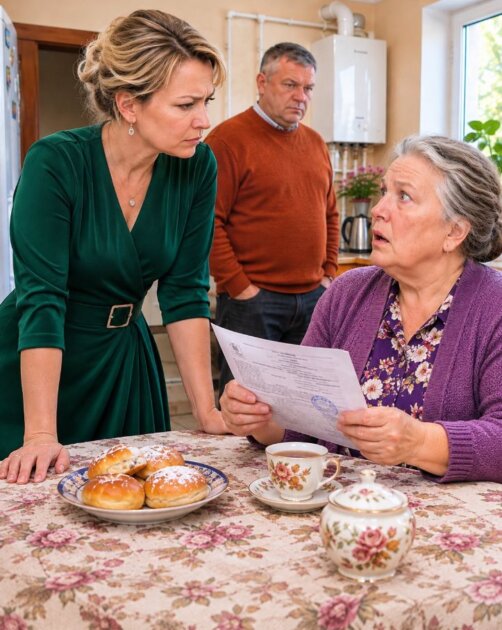
Nina Fyodorovna picked up the papers.
She put on the glasses hanging around her neck and began reading. Her finger moved slowly down the lines.
Vadim stood beside the boiler.
His face had turned an unnatural shade of gray.
“Vadik,” his father said quietly. “Is this true?”
Vadim didn’t answer.
He walked out onto the porch and slammed the door so hard that a glass jar of dill on the windowsill rattled.
“Lar, what have you done?” Alla whispered angrily. “Your father-in-law has high blood pressure!”
I ignored her and looked directly at Nina Fyodorovna.
“From this month onward, the medication money will come from Vadim’s salary. I’m not transferring it anymore. I’m not asking you to return the boiler. Let it keep your house warm. But from now on, please thank the person who actually paid for it.”
My mother-in-law folded the bank statements in half.
Then she folded them again.
Finally, she took off her glasses.
“I thought it was him,” she said quietly, speaking to nobody in particular. “I’ve been telling everyone it was him.”
“Sit down, Nina,” Lev Arkadyevich said, although she hadn’t even stood up.
Alla turned toward the stove and began moving the cabbage pies from one plate to another, even though they had already been arranged on a serving dish.
I went outside.
Vadim was sitting on the bottom step, smoking a cigarette. He had quit smoking three years earlier.
“You could have told me at home,” he said without turning around.
“I did tell you at home. You put your tea mug on my agreement.”
“How am I supposed to look my mother in the eyes now?”
“The same way I’ve been looking you in the eyes all week. You’ll learn.”
He crushed the cigarette against the step and said nothing.
A dog barked once or twice behind Alla’s fence, then fell silent.
I returned to Yaroslavl alone, taking the bus from Danilov.
Vadim stayed with his parents until Monday.
The bus smelled of apples. Someone must have had an entire bag of them.
The journey took two and a half hours. I spent the entire time staring out of the window without really seeing anything.
What Happened After I Finally Told the Truth
By the time the Feast of the Intercession arrived in October, things had settled into a new routine.
Vadim had started working Saturdays at the bakery, taking additional shifts to make sure he could send his mother money for her medication.
He made the transfers himself, although naturally, they still went through Alla.
At home, he spoke to me only about practical matters: utility bills, groceries, and whether we needed more washing powder.
A couple of times, I heard him talking to his father on the balcony. Their conversations lasted half an hour, sometimes longer. They spoke quietly, and I never asked what they discussed.
He now sleeps in the room that used to belong to Katya.
His mother used to call me every Sunday. She would tell me about her blood pressure, the neighbors, and the goat that kept getting into someone’s vegetable garden.
She hasn’t called once since that Saturday.
Katya visits less frequently, too.
The last time she came over to do her laundry, she stayed for half an hour and told me that Grandma hadn’t spoken to anyone for an entire week after our visit.
Then she left without waiting for my answer.
She forgot her jeans in the washing machine. I hung them up to dry.
The hotel in Zelenogradsk once emailed me, saying they might refund the difference for an additional breakfast charge. I wrote back twice, but I still haven’t received a response.
Honestly, I no longer know whether they owe me that money or not.
A week ago, Alla sent me a message.
It was short and didn’t even begin with a greeting.
“You humiliated your elderly father in front of the entire family. All because of your stupid seaside vacation. Are you happy now?”
The straw hat now hangs on a nail above the cash register in the flower stall.
Zoya Pavlovna uses it to collect leftover pieces of satin ribbon. Customers sometimes ask whether it’s for sale.
I never answer.
Sometimes, when I look at it, I remember the woman who stood in front of the mirror imagining herself walking beside the Baltic Sea.
I still haven’t seen that sea.
But I have learned something about the people closest to me.
A person can spend years helping a family, paying bills, buying medicine, and sacrificing the things they have quietly dreamed about. And somehow, everyone can become accustomed to the help without ever wondering who is making those sacrifices.
I never wanted praise or public recognition. I only wanted my husband to respect me enough to ask before spending my inheritance.
And I wanted my mother-in-law to know that the medication keeping her healthy hadn’t magically appeared in her bank account every month.
Perhaps I should have handled everything privately. Perhaps I should have confronted Vadim at home, demanded repayment, and allowed his parents to continue believing that their son was their sole provider.
But then I think about those eight months of transfers, my mother’s forty-six thousand rubles, and the vacation I had worked six Sundays to earn.
And I wonder how long I would have continued pretending that none of it mattered.
So I want to ask you something.
Was I right to reveal the truth at my mother-in-law’s kitchen table, in front of my husband and father-in-law, or should I have settled everything privately with Vadim and allowed his elderly parents to keep believing in their wonderful, generous son?

