“I Only Set the Table for People Who Belong Here,” My Sister-in-Law Told My Seven-Year-Old Son on Christmas Day. I Took My Family and Left—But By Dinner, Half the Family Had Followed Us.
PART 1: THE BOY WHO HAD NO PLACE
“I only set the table for people who actually belong here.”
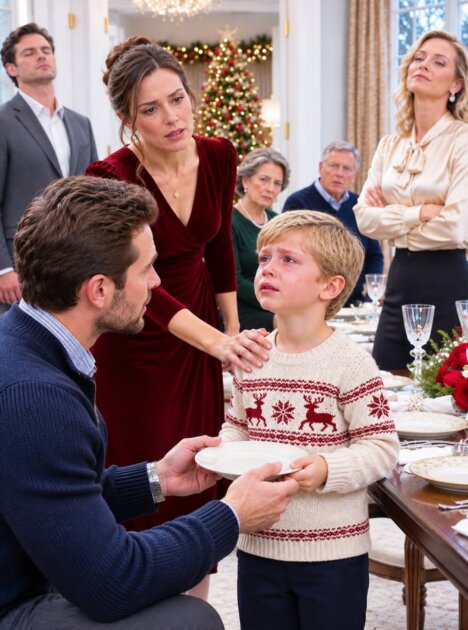
My sister-in-law, Susette, delivered those words directly to my seven-year-old son, Caleb, as he stood beside her beautifully decorated Christmas table, holding an empty dinner plate.
He had walked around the table twice, carefully searching the handwritten place cards for his name.
There was none.
Not for him. Not for his four-year-old sister, Lily. Not for my wife, Nadia. And not for me.
Fourteen chairs surrounded Susette’s enormous mahogany table. Fourteen perfectly arranged place settings, complete with matching silverware, folded linen napkins, and personalized cards.
Yet somehow, there wasn’t a single place for our family.
The room fell silent.
My mother stared down at her napkin. Uncle Pete stopped halfway through unfolding his. My older brother, Garrett—Susette’s husband—closed his eyes as though he desperately wished he were somewhere else.
But what I remember most clearly was Caleb’s face.
He wasn’t angry. He wasn’t even crying.
He simply looked confused.
“Daddy?”
I walked over and crouched beside him.
“What’s wrong, buddy?”
He held up his plate.
“Where am I supposed to sit?”
I looked at the table, then at Susette.
After six consecutive Christmases of being treated like unwanted guests, I finally understood that this wasn’t an oversight.
It was deliberate.
And this time, I wasn’t going to pretend otherwise.
My name is Wesley Bennett. I’m thirty-four years old, married to Nadia, and the proud father of Caleb, seven, and Lily, four. I own a small catering company in northern New Jersey, so I know a thing or two about preparing meals, organizing seating arrangements, and making sure nobody is left without a place.
I also know the difference between an honest mistake and a deliberate insult.
For six years, my sister-in-law had found increasingly creative ways to remind my family that we weren’t quite as welcome as everyone else.
And for six years, I’d allowed it to happen because I didn’t want to create problems between my brother and me.
I told myself she was difficult. That hosting Christmas was stressful. That family members sometimes had to compromise.
But I had forgotten one important thing.
My children were watching.
And they were learning that being part of a family sometimes meant accepting humiliation just to keep the peace.
It had started with one missing chair.
Growing up in Fair Lawn, New Jersey, Christmas had always been the happiest day of the year.
Our house wasn’t particularly large. My mother, Marilyn, somehow managed to prepare enough food for an army, while my father, Richard, usually fell asleep halfway through the football game.
My brother Garrett and I fought over the turkey drumstick, and our Uncle Pete complained about my mother’s mashed potatoes every single year, despite always asking for a second helping.
We never had enough chairs.
But that was never a problem.
Someone would bring a folding chair from the garage. Someone else would sit on the kitchen stool. Sometimes we’d squeeze another small table into the living room.
My mother had one rule she repeated whenever an unexpected guest arrived.
“If there’s food in the kitchen, there’s room at the table.”
I grew up believing those words.
Then Garrett married Susette.
She was elegant, organized, and extremely concerned with appearances. Her home always looked as though it belonged in a holiday magazine. Every decoration was perfectly positioned, every cushion matched, and every dinner party followed a carefully prepared plan.
At first, I admired her attention to detail.
When Garrett and Susette bought a spacious colonial house in Ridgewood, she volunteered to host Christmas.
Mom was delighted.
After decades of cooking for everyone, she finally had an opportunity to enjoy the holiday without spending the entire morning in the kitchen.
That first Christmas at Susette’s house was wonderful.
The staircase was wrapped in evergreen garlands, candles glowed in the windows, and every guest—including the children—had a personalized place card.
Nadia and I went home that evening thinking we’d found a lovely new family tradition.
The following year, however, things began to change.
Susette had prepared twelve place settings instead of fourteen.
“Oh, my goodness, Wesley!” she exclaimed when we arrived. “I must have miscounted!”
She disappeared into the garage and returned with two folding chairs.
Our seats were positioned beside the kitchen doorway, far from everyone else. We were also given paper napkins while the other guests used matching linen ones.
“I am so embarrassed,” she said with a smile.
I accepted her apology.
Mistakes happen.
The following Christmas, Caleb was still a toddler when Susette announced that she’d arranged a separate table in the living room for us.
“The dining room simply can’t accommodate everyone,” she explained.
Yet I noticed two empty chairs at the main table, each with a complete place setting.
When I asked about them, she smiled.
“Oh, those seats have already been assigned.”
“To whom?”
“Let’s not complicate things, Wesley.”
I should have recognized the warning.
Instead, I stayed quiet.
Mom even pulled me aside and whispered, “Don’t upset her. She’s worked very hard.”
So we sat in the living room.
The next year, our little table somehow ended up in the hallway.
Caleb kept asking why he couldn’t eat with his cousins. Nadia tried to turn it into a game, telling him we had our own special adventure table.
But I could see the disappointment in her eyes.
By the fifth Christmas, Lily had joined our family.
Susette reserved one chair at the main table for me, then suggested Nadia eat in the den with the baby.
“She’ll be much more comfortable somewhere quiet,” she explained.
Nadia didn’t argue.
She carried her plate into the den and ate beside a television she never even turned on.
I brought her a fresh drink and apologized.
She simply smiled.
“It’s fine.”
But it wasn’t.
The sixth Christmas was worse than all the others.
Susette seated our entire family in the unheated sunroom.
Outside, the New Jersey temperature had dropped below freezing. Our children kept their coats on throughout dinner while a small portable heater struggled to warm the room.
Through the glass doors, I could see sixteen place settings in the dining room.
Only fourteen people were eating.
I confronted Garrett.
“Why are my kids sitting out here?”
He barely looked at me.
“Susette gets overwhelmed, Wes.”
“Your children are warm, Garrett.”
He sighed.
“Don’t start.”
“Caleb and Lily are eating Christmas dinner in their coats.”
“I’ll talk to her.”
He never did.
Later, as we helped our exhausted children into the car, Nadia finally broke down.
“How many more Christmases are we going to put up with this?”
I had no answer.
For the first time, I realized the problem wasn’t a shortage of chairs.
It was that we kept accepting a place in a family that seemed determined to make us feel unwelcome.
The following November, Nadia showed me Susette’s Christmas invitation.
“I can’t do another year of this, Wesley.”
“I know.”
“No, I don’t think you do.”
She looked toward our children, who were playing together on the living room floor.
“Caleb thinks it’s normal to eat in another room while his cousins sit together. He’s starting to believe that’s where he belongs.”
Her words hit harder than any argument we’d ever had.
Nadia took my hand.
“If we go this year and she pulls another stunt, we’re leaving. No arguments. No excuses. No pretending everything is fine because Garrett might get upset.”
I looked at her.
“I promise.”
She squeezed my hand.
“Your family isn’t just the people waiting at Susette’s house.”
I didn’t realize how important those words would become.
Because that Christmas, everything was about to change.
Christmas morning began beautifully.
Caleb woke us before six, practically jumping on the bed, while Lily came running into our bedroom clutching her favorite stuffed reindeer.
The Christmas tree was glowing, cinnamon rolls were baking in the oven, and Nadia was making coffee.
For a few wonderful hours, the children were completely absorbed in their presents.
Then Nadia’s phone buzzed.
It was Susette.
Everyone was expected at noon. Dinner would be served promptly at one. Late arrivals would not be accommodated.
Nadia read the message twice.
“She makes Christmas sound like a restaurant reservation.”
I laughed, although neither of us found it particularly funny.
At eleven-thirty, we got dressed.
Caleb wore his navy sweater with tiny white snowflakes. Lily wore a red velvet dress, and Nadia looked beautiful in a dark green outfit.
Before we left, she gave me a meaningful look.
“Remember our agreement.”
“I remember.”
As we drove through Ridgewood, Caleb recognized the familiar Christmas decorations.
“Daddy! Do you think Aunt Susette has the giant snowman again?”
“Probably.”
“Can we see him?”
“Of course.”
He smiled excitedly.
I would remember that smile for a long time.
Susette’s house looked magnificent. A wreath hung on the front door, evergreen garlands decorated the windows, and an enormous inflatable snowman stood beside the driveway.
Garrett opened the door and greeted us warmly.
He hugged me, picked up Lily, and asked Caleb about his Christmas presents.
For a moment, he seemed like the brother I remembered.
Then Susette appeared.
She wore a cream-colored dress beneath a perfectly tied red apron, her hair styled beautifully.
“Merry Christmas, everyone!”
She greeted Nadia with a smile and kissed the children’s cheeks.
It was almost impossible to believe what would happen less than an hour later.
The children hurried downstairs to play with their cousins. Nadia joined my mother in the kitchen, and I walked into the dining room.
After six years, checking the seating arrangements had become almost automatic.
The mahogany table was covered with a white runner, silver candlesticks, fresh roses, and carefully arranged evergreen branches.
Fourteen matching place settings surrounded it.
I began reading the cards.
Garrett.
Susette.
Marilyn.
Richard.
Uncle Pete.
Aunt Diane.
Then the cousins, their spouses, and Garrett’s children.
Everyone had a place.
Except us.
I checked again, convinced I’d somehow overlooked something.
There were no additional chairs. No children’s table. No extra place settings.
Nothing.
Susette had prepared Christmas dinner for everyone except my wife and children.
Garrett entered carrying a bottle of sparkling cider.
“Everything okay?”
I pointed toward the table.
“Where are we sitting?”
His smile disappeared.
“Susette handles the seating.”
“Where are Nadia and the kids sitting, Garrett?”
“Maybe there’s another table.”
I looked around.
“There isn’t.”
He glanced toward the hallway.
“Let me ask her.”
I stopped him.
“Did you know?”
He frowned.
“Know what?”
“That your wife didn’t prepare places for us.”
“Wes, come on.”
“Did you know?”
He looked uncomfortable.
“I don’t inspect the table before dinner.”
“You live here, Garrett.”
“Don’t make this a thing.”
That was when something finally clicked.
For years, I’d mistaken his embarrassment for disagreement. I’d believed he was uncomfortable with Susette’s behavior but simply didn’t know how to confront her.
Now I realized that avoiding the problem had become his preferred solution.
And my family had paid the price.
“Your children have places,” I said quietly.
“Of course they do.”
“Mine don’t.”
Before he could answer, Susette called everyone to dinner.
I was about to find Nadia and leave.
Then Caleb appeared in the doorway, carrying a small plate he’d picked up in the kitchen.
“Look, Dad! I’m helping!”
“Buddy, wait a second.”
He was already walking toward the dining table.
He carefully examined the place cards.
“Grandma… Grandpa… Uncle Pete…”
Then he walked around the table again.
He looked under the centerpiece, checked the opposite side, and finally turned toward Susette.
“Aunt Susette?”
“Yes, sweetheart?”
“Where do I sit?”
She glanced at the table.
Then she smiled.
“Oh, sweetie, I only set the table for people who actually belong here.”
The words echoed through the room.
“Ask your dad where you’re sitting.”
Silence fell.
Caleb turned toward me.
“Daddy?”
I approached him and gently took the plate from his hands.
“What’s wrong, buddy?”
His little face crumpled.
“Do I not belong here?”
For a moment, I couldn’t speak.
Then I crouched in front of him and looked directly into his eyes.
“You listen to me, Caleb. You belong with us. You belong anywhere your mom and dad are. And nobody gets to tell you otherwise.”
Behind me, Susette sighed impatiently.
“Wesley, don’t be dramatic.”
I slowly stood.
For six years, I’d swallowed my anger, accepted excuses, and pretended that my family wasn’t being deliberately excluded.
Not anymore.
“Nadia,” I called.
She appeared in the doorway, took one look at Caleb, and understood immediately.
“Kids, get your coats.”
Susette stared at us.
“Excuse me?”
“We’re leaving.”
She gave a dismissive laugh.
“Oh, for heaven’s sake. Are we really going to do this?”
Garrett stepped forward.
“Wes, don’t overreact.”
I turned toward him.
“Your wife just told my seven-year-old son he doesn’t belong at her Christmas table.”
“She didn’t mean it that way.”
“Then what did she mean?”
Susette folded her arms.
“I didn’t say he doesn’t belong in the house. I said I only prepared places for the people who belong at the table.”
I stared at her.
The distinction was so ridiculous that I almost laughed.
“And you think that makes it better?”
She rolled her eyes.
“If everyone wants to twist my words, that’s their problem.”
Nadia took Caleb’s hand while Lily approached us holding a plastic candy cane.
“Are we going home?”
“Yes, sweetheart,” Nadia answered.
“But what about dinner?”
“We’ll have dinner at home.”
Susette shook her head.
“You’re teaching your children to make scenes over nothing.”
I picked up Lily’s coat.
“No. I’m teaching them that they never have to beg for a place where they’re not wanted.”
Mom finally stood.
“Wesley, please. Let’s not ruin Christmas.”
I looked at her.
“Mom, whose Christmas?”
She blinked.
“Because Caleb’s Christmas has already been ruined.”
Her eyes filled with tears.
But she still didn’t say anything.
I wished she had.
I wished she’d remembered the words she’d repeated throughout my childhood.
If there’s food in the kitchen, there’s room at the table.
But I couldn’t wait for another person to defend my children.
Nadia and I gathered our things and walked out.
No shouting.
No slammed doors.
No dramatic argument.
We simply left.
Outside, Caleb glanced sadly at the enormous inflatable snowman.
“Daddy?”
“Yeah, buddy?”
“Can we still have Christmas?”
I crouched beside him.
“Absolutely. And we’re going to have a wonderful one.”
Just then, my phone buzzed.
A message from Uncle Pete appeared on the screen.
“Don’t start eating without me.”
I stared at it for a moment.
Then, for the first time that afternoon, I smiled.
Because I had a feeling Christmas wasn’t over yet.