My Mother-in-Law Spat Out the Food I Had Spent Hours Preparing in Front of Everyone, Then Declared That Her Son Was Starving Because of Me. She Had No Idea Why I Was Cooking Completely Salt-Free Meals. When My Husband Finally Spoke Up, the Silence Around the Table Was So Complete That You Could Even Hear the Children Breathing…
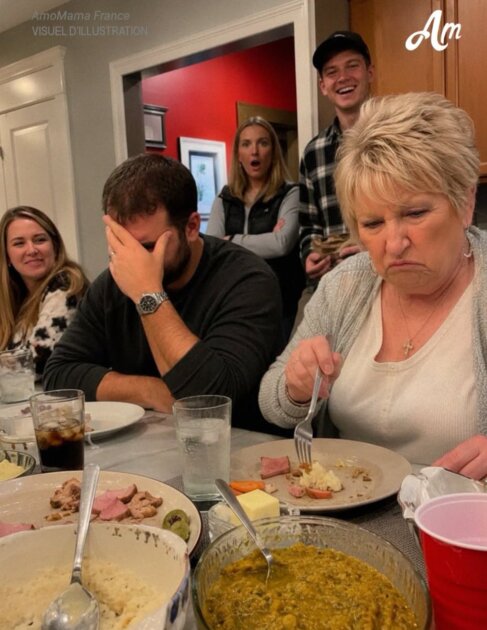
“It’s no wonder my son looks like he’s starving to death. Even a dog wouldn’t eat this food!”
My mother-in-law, Sally, made sure her voice echoed throughout the dining room.
The next moment, she spat the bite in her mouth back onto her plate.
There were thirteen of us sitting around the table. Just a moment earlier, everyone had been chatting happily, but now the room had fallen so silent it was as if someone had switched off the world.
My husband’s cousins lowered their eyes. His sister, Diane, covered her mouth with her hand. Our ten-year-old daughter, Ellie, stared at me in horror.
I stood frozen, the serving spoon still in my hand.
I had spent three hours preparing that dinner. I had measured every ingredient separately, checked the labels, calculated the sodium content, and tasted everything several times to make sure it was just right.
Of course, Sally knew nothing about any of that.
“It’s bitter, tasteless, absolutely disgusting!” she continued, pushing her plate away. “Mark, do you really eat things like this every night? No wonder you’ve lost so much weight!”
A few guests laughed awkwardly.
My face burned. Beside me, my husband, Mark, was gripping the edge of the table so tightly that his knuckles had turned white.
Sally only became more worked up.
“Just look at him! He’s pale, skinny, and miserable. A man needs proper food, not these awful diet meals. Claire, I honestly don’t know how you can bring yourself to cook this stuff every day.”
I didn’t answer.
I couldn’t tell her why there was no salt in the food. I couldn’t explain why I used lemon, garlic, parsley, and special spice blends instead of our usual seasonings.
I couldn’t tell her that every meal I prepared for Mark followed his doctor’s and dietitian’s instructions.
Because six months earlier, I had promised my husband I would keep his condition a secret.
But Sally wasn’t finished yet.
She leaned closer to Mark.
“At least don’t pretend you like it just to avoid hurting your wife’s feelings!”
That was when Mark slowly stood up.
His chair scraped sharply against the floor.
“That’s enough!”
His mother blinked in surprise.
“Excuse me? Are you seriously defending her now?”
“I said that’s enough, Mom!”
I had been Mark’s wife for twelve years. I had seen him angry, nervous, and exhausted, but I had never heard him speak to his mother with such determination.
Sally let out an uneasy laugh.
“Oh, come on! I’m just saying what everyone else is thinking!”
“No, Mom. This is what you always do. You humiliate my wife, criticize everything she does, and then defend yourself by claiming you’re only looking out for me.”
“Mark, I’m your mother!”
“And Claire is my wife. And you are never going to treat her like this again.”
Everyone around the table fell silent.
Mark placed both hands on the table. I could see that he was struggling to breathe steadily, but he continued.
“Claire cooks this way because my doctor prescribed it. I have heart failure, Mom. My heart isn’t functioning properly, so I have to follow a strict diet.”
The spoon slipped from our daughter’s hand.
Our seven-year-old son, Ben, looked up at his father.
“Dad, what does that mean?”
My heart tightened.
This was exactly what Mark and I had feared. We hadn’t wanted the children to discover the truth unexpectedly in the middle of an argument.
Mark immediately turned toward our son.
“Sweetheart, I’m sick, but the doctors are treating me. I’m taking medication, and I have to be careful about what I eat. You don’t need to be frightened right now.”
Ellie’s eyes filled with tears.
“Daddy, are you going to die?”
Mark’s face crumpled.
He knelt beside his daughter and pulled her into his arms.
“No, sweetheart. We’re doing everything we can to help me get better. And from now on, we’ll always tell you what’s happening.”
I stepped closer, wrapping my arms around Ben.
Meanwhile, Sally sat frozen in her chair, as though she had suddenly forgotten how to speak.
Mark straightened up and looked at his mother.
“Claire has spent months doing everything she can to help me get better. She plans every meal, checks my medication, accompanies me to appointments, and even wakes up during the night whenever I cough. She’s also learned how to prepare delicious meals without putting my health at risk.”
His voice cracked.
“And you come here every Sunday and humiliate her for taking care of me.”
Sally turned pale.
“I… I didn’t know.”
“You didn’t know I was sick. But you knew perfectly well that you were hurting her.”
And then Mark said something I never expected to hear:
“Mom, I want you to leave. Right now.”
Our Sunday family dinners had been a tradition for years.
After Mark’s father passed away, Sally insisted that the entire family get together every week. She said it was the only way to make sure nobody drifted apart.
At first, I enjoyed those evenings too.
But gradually, Sally began taking control of everything.
It started with little comments.
She didn’t like my curtains. She thought I set the table incorrectly. Once, she rearranged all my kitchen cupboards without even asking because, according to her, I didn’t know how to keep things properly organized.
When Ellie was born, she said I held her too much.
When Ben arrived, she complained that I wasn’t giving him enough attention.
But her favorite subject was always my cooking.
If I made pasta, the sauce was too watery. If I roasted chicken, it was too dry. If Mark complimented dinner, Sally would simply smile.
“My son has always been easy to please.”
I would laugh awkwardly, while Mark squeezed my hand under the table.
“Don’t let it bother you,” he whispered.
Later, he would always apologize on her behalf.
“You know what she’s like. She’s never going to change.”
Eventually, I grew to hate that sentence.
Sally didn’t behave that way because she was incapable of acting differently. She did it because everyone allowed her to.
And for years, I stayed silent.
But six months earlier, everything changed.
One evening, Mark was carrying the laundry upstairs when he suddenly became dizzy and nearly collapsed.
He had been unusually tired for weeks. At first, we blamed his workload. Then I noticed that his ankles were swollen and that he became breathless after climbing just a few steps.
I rushed him to the hospital.
After the examinations, the doctor explained that Mark’s heart wasn’t pumping blood as effectively as it should. He was diagnosed with cardiomyopathy, which had led to heart failure.
He was only thirty-seven years old.
He exercised regularly, didn’t smoke, and rarely drank alcohol. We had never imagined that he would face such a serious heart condition at such a young age.
The doctor explained that the condition could have several possible causes and that further tests would be necessary.
I remember Mark lying in his hospital bed, staring at the ceiling for several minutes.
“My father died when he was fifty-eight,” he finally said.
“You’re not your father. Your condition is different, and you’re receiving treatment now.”
“What are we going to tell the children?”
“We’ll explain it to them as much as they need to know.”
“Not yet, Claire. Please. I want to understand my chances first.”
I agreed.
We also decided not to tell Sally for the time being.
Ever since Mark’s father had died, she had reacted to every health problem with panic. Mark was afraid she would call him every hour, inform every relative, and turn his illness into the family’s only topic of conversation.
“I don’t have the strength to spend my time reassuring her too,” he said.
I understood.
And then our new life began.
The cardiologist and dietitian prescribed a strict low-sodium diet. I had to learn to cook in a completely different way.
I checked the labels on every product. I learned which spices were suitable, how to replace salt, and how to prepare meals that Mark could still enjoy eating.
Some of his weight loss was due to the treatment reducing the excess fluid that had accumulated in his body. He was also paying much closer attention to his diet.
Naturally, Sally noticed.
“Claire is making you waste away!” she remarked one Sunday.
On another occasion, she brought a huge bowl of salty food and insisted that Mark eat at least two servings.
I told her we would have some the following day.
The next day, I threw it away.
More and more often, I asked Mark whether it wouldn’t be better to finally tell his mother the truth.
He always gave me the same answer:
“Not yet. Please. I have enough to deal with because of my illness. I don’t want every conversation we have to revolve around it.”
So I stayed silent.
And I continued putting up with Sally’s comments.
Until that Sunday.
That evening, after Mark asked his mother to leave, the rest of dinner passed in almost complete silence.
My husband explained his condition to the children in simple terms and promised them that from then on, we wouldn’t keep important things from them.
Before leaving, Diane, Mark’s sister, came over to me.
“Claire, I’m sorry. I should have stepped in years ago. We all saw how she treated you, but it was easier for us to stay quiet.”
One of the cousins also apologized for laughing at Sally’s earlier remark.
That evening, after the children had fallen asleep, Mark and I sat on the edge of our bed.
“I’m sorry,” he said.
I didn’t answer.
“Not just for tonight. For everything.”
He looked down at his hands.
“I kept telling myself that I was protecting our privacy. But deep down, I knew that as long as you couldn’t explain the truth, Mom would continue blaming you.”
“Yes,” I replied quietly.
He seemed surprised that I wasn’t trying to reassure him.
“I should have defended you years ago. I shouldn’t have waited until I became ill to finally stand up for you.”
“Do you know what hurt the most?” I asked. “It wasn’t that your mother criticized me. It was that every single time, I had to face her alone, while you comforted me in private afterward.”
Mark lowered his head.
“You’re right.”
This time, he didn’t make excuses.
The next morning, at eight o’clock, someone knocked on the door.
Sally was standing outside. She was holding a covered food container.
At first, I assumed she had brought another homemade dish.
“It’s not for Mark,” she said quickly. “It’s just fruit.”
I didn’t immediately invite her in.
Her eyes were red, and she looked exhausted.
“Claire, I’d like to apologize.”
“Mark is resting.”
“I know. But I need to talk to you first.”
She gripped the food container more tightly.
“After I left yesterday, Diane called me. Then Michael did too, along with a few of the cousins. They all told me that what I did was unacceptable.”
“Is that why you came?”
“No. Well… that also made me realize something.”
She lowered her eyes.
“For years, I’ve been telling myself that I was only joking with you. That it was my responsibility to protect my son. But yesterday, Mark was right. I wasn’t protecting him. I was simply hurting you.”
I said nothing.
Sally continued:
“I didn’t know he was sick. But I knew that I hurt you every Sunday. I saw your face whenever I made those comments. And I still didn’t stop.”
A tear rolled down her cheek.
“I’m sorry I spat out your food. I’m sorry I humiliated you in front of your children. And I’m sorry I behaved in your home as though I had more right to be there than you did.”
It was the first time I had ever heard a genuine apology from her.
There was no “but.”
She wasn’t trying to justify her behavior.
Mark appeared behind me.
“Mom, if we’re going to repair our relationship, a few things need to change.”
Sally immediately nodded.
“You can no longer criticize Claire’s cooking, her parenting, her home, or our marriage. You can’t rearrange our belongings, and you can’t show up without calling first. And you must not tell anyone about my illness without our permission.”
“I understand,” she replied quietly.
“If you can’t respect these boundaries, you won’t be invited to our home anymore.”
Sally remained silent for a few seconds before nodding.
We didn’t forgive her in a single moment. But we gave her the opportunity to prove that she genuinely understood what she had done.
She also apologized to the children for frightening them.
Then she left when Mark told her he needed to rest.
Over the following weeks, we put our Sunday family dinners on hold.
When we eventually started gathering again, Sally behaved quite differently.
She asked before bringing food. She no longer touched my kitchen cupboards or made comments about how I raised the children.
Our relationship didn’t become perfect, but at least we began treating each other with respect.
Mark’s treatment continued. His next follow-up examination showed a slight improvement in his heart function. The doctor was cautiously optimistic but warned us that recovery could be a long process.
The children gradually adjusted too.
Ellie often helped me read food labels. Ben, meanwhile, proudly told everyone:
“Daddy’s heart is going to get stronger because Mommy makes him special soup!”
A month after everything happened, Sally arrived early one Sunday.
“Can I help with anything?” she asked from the kitchen doorway.
I almost told her that I didn’t need any help.
But then I handed her a cutting board.
She chopped vegetables while I measured the spices.
For several minutes, neither of us said a word.
Finally, Sally broke the silence.
“You know, Claire, for years I thought nobody could take care of Mark as well as I could.”
I looked up at her.
“Then I realized I hadn’t even noticed how much you do for him every single day.”
I didn’t answer immediately.
Her words couldn’t erase the years of humiliation. I hadn’t forgotten how many times I had stood in the kitchen with tears in my eyes after everyone had gone home.
But perhaps this really was the first step toward a new relationship.
Sally had spent years justifying her cruelty by claiming how much she loved her son.
Mark, meanwhile, had excused his silence by saying he wanted to preserve family peace.
They had both been wrong.
And I had spent far too long believing that peace meant I had to tolerate everything.
That Sunday, when Sally spat out the food onto her plate, everyone finally saw the truth.
Mark’s illness didn’t just change our lives. It also revealed who truly stood beside us when we needed them most.
The apology was important.
But even more important was that Mark finally understood that respecting his wife was not something he could compromise on whenever his mother pleased.
And from that day forward, nobody in our family ever had to guess where the boundaries stood.
What do you think? Did Sally genuinely regret her behavior, or did she only change when the rest of the family turned against her? And do you think Mark should have stood up for Claire years earlier?