# “If You Want to Go to a Concert, Go Alone, Spiro! I’m No Longer Willing to Pretend We Have a Happy Marriage!” — My Mother Said These Words After Forty Years of Marriage. We Thought My Father Had Done Something Terrible. But the Next Day, He Took Out an Old Wooden Box, and We Discovered a Secret None of Us Had Ever Imagined…
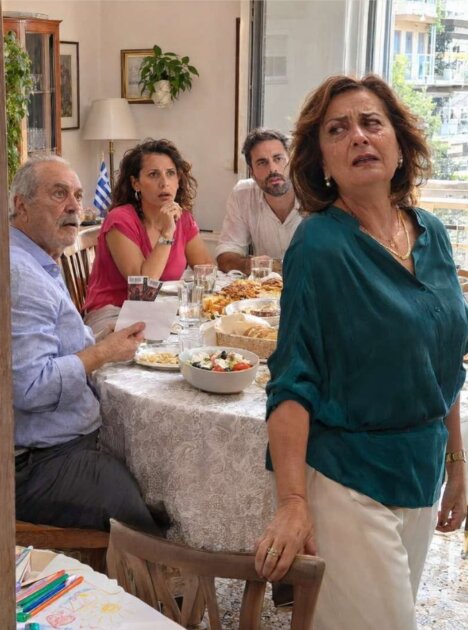
My mother’s words cut through the silence of Sunday lunch as if someone had suddenly shattered the carefully preserved peace of our family.
“If you want to go to a concert, go alone, Spiro! I’m no longer willing to play the role of a happy wife!”
My father had just taken a small white envelope out of his jacket pocket. He held it in his hand and stared at my mother in disbelief.
It was Sunday at noon. Our family had gathered at my parents’ home in Katerini, a quiet town near Thessaloniki. My mother had prepared beef in tomato sauce with homemade pasta. My eight-year-old daughter was drawing at the corner of the kitchen table, while my younger brother, Nikos, was slicing bread.
Everything was just as it always was.
Until that moment.
My father froze, the envelope still in his hand.
“Irini, what are you talking about?”
“Exactly what you heard.”
“But today is our anniversary!”
“I know.”
“We’ve been married for forty years!”
My mother slowly put down the napkin that had slipped from her lap and looked him straight in the eyes.
“We’ve been married for forty years, Spiro. But that doesn’t mean we’ve been happy for forty years.”
My brother stopped chewing. I felt as though someone had poured ice-cold water down my back.
I had never heard my mother speak to my father in that tone before.
Of course, they had their arguments. They disagreed about money, the holiday house in Halkidiki, the old car, or whether they really needed new furniture. But those had always seemed like ordinary disagreements.
At least, that was what we thought.
“Mom, has something happened?” I asked carefully.
She looked at me. Her eyes were red, but she wasn’t crying.
“No, Marina. Nothing happened today. That’s exactly the problem. This all began many, many years ago. Nobody simply wanted to face it.”
My father lowered his head.
My mother stood up, walked into the bedroom, and closed the door behind her a few seconds later.
The three of us remained around the table.
My father slowly opened the envelope. Inside were three tickets to a November concert at the Thessaloniki Concert Hall. The seats were next to one another, just as they had been every year.
Only this time, nobody was smiling.
My name is Marina. I’m thirty-eight years old and work as a pharmacist. I’m married and have an eight-year-old daughter. My younger brother, Nikos, is thirty-four and lives in Athens.
We had always thought of our parents as one of those couples who were simply impossible to imagine apart.
My father, Spiro, had worked as a mathematics teacher at a public high school. My mother, Irini, had worked in an accounting office until her retirement.
They met in 1983 at a musical evening organized by a cultural association in the old town of Thessaloniki.
My father always told the story this way: he saw my mother laughing with a friend, and in that instant, he knew he wanted to hear that laughter again.
My mother would always interrupt him.
“Don’t believe him! The first thing he asked was whether the chair next to me was free. Then he spent half an hour talking about the weather!”
We always laughed at that story.
They got married the following year.
But they had one unusual tradition. Every November, around the anniversary of the day they met, they went to a concert together. Sometimes they listened to classical music, while other years they bought tickets for popular performances or concerts by smaller bands.
It was their special evening.
And every single time, my father bought three tickets.
When I was a child, I often asked him why.
“So we’ll have somewhere to put our coats,” he would joke.
Later, he said he simply didn’t like having a stranger sitting right next to them, talking throughout the evening.
We considered it one of my father’s harmless little quirks.
We never really thought about it.
Not until that Sunday.
***
When we left our parents’ house, Nikos walked me all the way to my car.
“Do you think they’re going to get divorced?” he asked.
“I have no idea.”
“Did Dad do something?”
“Maybe.”
“Mom wouldn’t talk like that for no reason.”
I had to agree with him.
That evening, I called my mother, but she didn’t answer. I sent her a message instead:
“Mom, if you want to talk, I’ll always be here to listen.”
Two hours later, she replied:
“I love you, sweetheart. But this is something your father and I have to resolve ourselves.”
The next day, my father called Nikos and asked us to come over. Just the two of us, without our spouses or children.
“There’s something I need to show you,” he said.
His voice was trembling.
When we arrived, my mother wasn’t home. My father was sitting in the living room in front of an old wooden box. I had never seen that box before.
When he opened it, we saw old concert programs, photographs, and a bundle of faded tickets tied together with a ribbon.
On top lay two identical concert tickets issued in November 2006.
The same date. The same performance. Seats next to each other.
My father placed them side by side on the table.
“That year, your mother discovered something that could have destroyed our entire marriage,” he began.
Nikos crossed his arms.
“Was there another woman?”
My father looked at us.
“Yes.”
I felt the blood drain from my face.
“Who was she?” I asked, barely able to speak.
My father closed his eyes.
“The woman I’ve been buying the third ticket for every year.”
“What?” Nikos exclaimed.
My father took a deep breath.
“Her name is Anna. She’s fifty-two now.”
I quickly did the math. My father was seventy. That meant the woman was eighteen years younger than him.
“Was she your mistress?” I asked.
“No.”
“Then who was she?”
My father took an old photograph out of the box. It showed a young woman standing outside a music school, holding a violin. On the back of the photograph was a name:
Anna Konstantinou.
My father stared at the picture for a long time before saying something none of us was prepared to hear.
“She’s my daughter.”
Nikos jumped up from the sofa as if someone had struck him.
“What?!”
“Anna is my daughter. She was born from a relationship I had before I met your mother.”
I looked at the photograph again. The woman’s dark eyes, the shape of her face, and the tiny dimple on her left cheek all seemed familiar. She had the same features I recognized in my father and my brother.
“Why have you never told us?” I asked.
My father rubbed his forehead.
“Because I was a coward.”
He explained that when he was seventeen, he had been in a relationship with a girl named Despina. They were both very young. When she became pregnant, their families strongly opposed the relationship.
Despina moved to Athens with her parents.
For many years, my father knew nothing about her. He had been told that the baby had been given up for adoption.
“And you never tried to find her?” I asked.
His answer made me even angrier.
“But she was your own child!”
“I know,” he said, lowering his head. “And I’ve never been able to forgive myself for that.”
In 2004, Anna contacted her father.
Her mother had died by then, and while going through her personal belongings, Anna discovered some old letters. Among them were letters Spiro had written many years earlier. Despina had kept every single one but had never replied to any of them.
With the help of an old family acquaintance, Anna managed to find my father and wrote him a letter.
My father opened the envelope one afternoon while my mother was out shopping.
“At first, I thought someone was playing a cruel joke on me,” he explained. “But Anna sent photographs, dates, and details that a stranger could never have known.”
Eventually, they met in Athens.
My father traveled there secretly, telling my mother he was attending a teachers’ training course.
“So you lied to her,” Nikos interrupted.
“Yes,” my father replied, without trying to make excuses.
Anna was working as a music teacher at the time. She also played the violin in a small orchestra and loved going to concerts.
When my father told her about his family’s annual concert tradition, Anna smiled.
“I’d love to go to a concert with you sometime,” she said.
That’s why, in 2005, my father bought three tickets.
Anna traveled to Thessaloniki. My mother, however, knew nothing about her.
My father chose the seats so that Anna could sit two places away from them. During the concert, they barely exchanged a word. They simply sat in the same hall.
“And you thought that was normal?” I asked in disbelief.
My father shook his head.
“No. But at the time, I felt that at least I could be close to her without having to face the consequences of telling the truth.”
In 2006, Anna came again.
This time, however, my mother noticed something.
She hadn’t seen them kissing. She hadn’t overheard secret phone conversations or discovered a love letter.
She had simply seen my father approach Anna during the concert interval and hand her a small paper bag.
Inside was a book about music.
My mother noticed the way the young woman looked at my father. There was a natural closeness and familiarity in her expression that couldn’t easily be explained away as an old acquaintance.
That evening, my mother asked my father who the woman was.
At first, he lied and said she was the daughter of an old friend. But when my mother kept asking questions, he finally admitted the truth.
“And did he tell her everything?” Nikos asked.
My father hesitated.
“Not immediately. At first, I only told her about our relationship. Then I explained that Anna was my daughter.”
I looked at the two concert tickets.
“Why are you showing us this now?”
My father turned the tickets over.
On the back of one was a telephone number. On the other was a short handwritten sentence:
“I don’t want to spend the rest of my life being a seat you secretly reserve for me.”
The handwriting was feminine.
“Anna wrote that,” my father said.
“And what did you tell her?” I asked.
“I told her I needed time.”
Nikos let out a bitter laugh.
“Twenty years?”
My father didn’t answer.
A long silence settled over the room.
Finally, I asked:
“What did Mom do when she found out?”
“She was furious. Not because I had a daughter before I met her. But because I had hidden something so important from her.”
My mother wanted to meet Anna. But my father said his daughter wasn’t ready for that yet.
Anna eventually cut off contact with him for a while. It was painful for her to realize that her father could still only make room for her in his life through secret meetings.
Later, they began speaking again.
My mother didn’t try to stop them. In fact, she told my father that it was finally time for him to acknowledge his daughter openly.
She had only one condition: he had to tell us the truth, too.
“But you still didn’t do it,” I whispered.
“No.”
“Why?”
My father remained silent for a long time.
“I was afraid I would lose your respect.”
Nikos stood up and walked over to the window.
“Instead, you took away our chance to get to know our own sister.”
My father didn’t argue.
And that was when I finally understood what had been the most painful part of the entire story.
It wasn’t simply that there had been a secret family relationship.
It was that my mother had known the truth for almost twenty years, while every November she had to watch my father buy that particular third ticket.
Sometimes Anna attended the concert. Other times, she didn’t.
But every year, my mother asked the same question:
“Will you finally tell the children this year?”
And my father always gave her the same answer:
“After the concert.”
But when the concert was over, he always found another excuse.
“Did Mom really know all this?” I asked.
“Yes.”
“Then why didn’t she tell us herself?”
My father sighed.
“Because she said it was my responsibility. She didn’t want to be the one to tell my children a truth I hadn’t had the courage to admit myself.”
I was angry. Angry at my father, angry at the secrets, and angry that everything I had believed about our family had changed in an instant.
I thought about all the Sunday lunches, Christmas celebrations, birthdays, and family photographs.
Somewhere out there, there was a woman who was my sister.
And I had known nothing about her for thirty-eight years.
“Where is Anna now?” I asked.
My father raised his eyes.
“In Thessaloniki.”
“What?!”
“She moved here six months ago. She got a job at a music school.”
Nikos stared at him in disbelief.
“And you didn’t tell us that either?”
“I was going to…”
“When?” I interrupted. “On your eightieth birthday?”
My father’s eyes filled with tears. For the first time in my life, I saw him cry without even trying to hide his feelings.
“You’re right,” he said.
But this time, I couldn’t bring myself to feel sorry for him. I couldn’t hug him either.
I simply stood up and walked away.
***
The next day, I visited my mother.
I found her on the balcony, watering her flowers. It was cold, yet she was wearing nothing but a thin cardigan.
“Mom, we know everything,” I said.
She put down the watering can.
“He spoke to you?”
“Yes.”
She nodded slowly.
“It took him long enough.”
I sat down beside her.
“Why did you stay with him?”
My mother looked at me.
“Because I loved him. And because his mistake wasn’t that he had a daughter before he met me. His mistake was that he was so ashamed of his own past that he couldn’t even openly acknowledge his child.”
“But he lied to you.”
“Yes.”
“And you could live with that?”
My mother lowered her eyes.
“Not always, Marina. There were years when I was terribly angry with him. Other times, I was disappointed. Then I would hope again that he might finally find the courage to do the right thing.”
She fell silent for a moment.
“But recently, I realized something. For twenty years, I had been waiting for the ending of a story I hadn’t even started.”
“And what do you want now?”
She gave me a sad smile.
“Now I no longer want to go to our concerts pretending everything is fine. I don’t want to keep smiling when I feel something completely different inside.”
I hugged her.
“Do you want to divorce Dad?”
“I don’t know, sweetheart. For now, I only know that I don’t want to continue living the way we have been.”
***
Three days later, Nikos called me.
“I spoke to Anna,” he said.
I froze.
“How?”
“Dad gave me her phone number. I called her.”
“And what did she say?”
“She wants to meet us.”
I didn’t know what to feel.
I was curious about her, but I was also angry. I was afraid of meeting her, and somewhere deep down, I even felt a little jealous of all the years we had never been able to share.
Eventually, I agreed.
We arranged to meet at a small café near the Rotunda.
Anna arrived first. She was a dark-haired woman with calm eyes and a reserved smile. The moment I saw her, I immediately recognized my father’s features in her face.
When she noticed us, she stood up, but she looked visibly nervous.
“I don’t even know if I’m allowed to hug you,” she said.
Nikos answered honestly.
“We don’t know that ourselves yet.”
We all laughed.
It was an awkward, uncomfortable laugh, but somehow it broke the ice.
We talked for three hours.
Anna told us she had a nineteen-year-old son who was studying music in Athens. She had divorced years earlier, loved old bookstores, and enjoyed traveling by train.
She also told us that she had never wanted to destroy our family.
“I never wanted to take anyone’s place,” she said quietly. “I simply wanted to know who my father was. That was all.”
I asked her what it had felt like to sit in that third seat at the concerts.
She lowered her eyes.
“At first, I went because I thought that one day he would introduce me to his family.”
“And later?”
“Later, I stopped waiting.”
She took an old concert program out of her bag. It was from a performance in 2011.
“This was the last time I sat in the third seat.”
Nikos frowned.
“But Dad kept buying the tickets afterward.”
Anna nodded.
“I know. Every year, he sent me a photograph of the third ticket. He always wrote that my place would be there.”
Her eyes filled with tears.
“But I didn’t need a seat in the concert hall. I needed a place in his life.”
I didn’t know what to say.
In that moment, I finally understood just how much pain the whole situation had caused her.
My father had believed that buying the third ticket would keep his relationship with his daughter alive. But in reality, every year he made the same promise to her all over again, a promise he never dared to fulfill.
***
A few days later, the evening of the concert finally arrived.
My mother didn’t go.
My father sat alone in the concert hall.
But this time, he didn’t take his usual seat.
He sent us a message:
“I bought three tickets, but tonight I am not reserving any of those seats as a way of continuing to run away from the truth.”
The following day, he asked the entire family to meet.
My mother agreed. Anna came, too.
For the first time in our lives, we all sat around the same table.
It wasn’t easy.
My father struggled for a long time to find the right words. Finally, he stood up.
“I owe all of you an apology,” he began. “Not because Anna exists, but because I deprived you of the chance to get to know one another.”
Then he turned toward Anna.
“And I owe you even more than that. You deserved a father who didn’t have to hide you from the world.”
Anna wiped her eyes.
“We can’t get back the years we’ve lost.”
“I know.”
“But we can still decide what to do with the time we have left.”
My mother looked at my father.
“That’s exactly what I’ve been trying to tell you for all these years, Spiro.”
My father nodded.
“And it took me far too long to finally listen.”
We didn’t throw our arms around one another as if a single conversation could solve every problem. That wouldn’t have been honest.
But at least there were no more secrets between us.
Over the following months, we slowly began getting to know one another.
Anna came over to my house for coffee. My daughter asked her if she would teach her to play the violin. Nikos visited her at the music school.
And my mother, to my surprise, invited Anna to Sunday lunch one day.
When I asked her why she had done it, she simply said:
“This child isn’t responsible for the mistakes the adults made.”
Meanwhile, my father slowly learned that forgiveness cannot be demanded.
It has to be earned.
My mother didn’t return to her old life overnight, either. She started going to the theater alone, reconnected with old friends, and finally began doing things she had always postponed.
At first, my father found this difficult to accept. But eventually, he stopped asking when everything would go back to the way it used to be.
Instead, he began asking:
“What do you need from me now?”
***
Almost a year passed.
One afternoon, my mother called me.
“Marina, I want to ask you something.”
“Go ahead, Mom.”
“Do you know if there are still tickets available for the December concert?”
I smiled.
“Why are you asking?”
“I’m thinking about going.”
“With Dad?”
She was silent for a moment.
“Perhaps.”
Then she added:
“But this time, I don’t want to go simply because it’s what we’ve done for forty years. I want to go because I genuinely feel like it.”
A few days later, my father bought two tickets.
Just two.
When my mother found out, she smiled.
“Finally, he understands that he doesn’t have to buy a third seat every year to prove to someone that they have a place in his life.”
But the story didn’t end there.
On the day of the concert, Anna sent us a photograph from the music school. She was standing beside her nineteen-year-old son, holding her violin.
Under the photograph, she had written:
“Tonight we’re performing for parents and their children. If you’d like, you should all come next time!”
My father stared at the message for a long time. Then he showed it to my mother.
She smiled.
“We’ll go next time,” she said.
My father turned toward her in surprise.
“All of us?”
“All of us, Spiro. But this time, nobody will have to sit secretly in the concert hall.”
When they later told me about that conversation, I felt something unusual.
It wasn’t simply relief, nor was it pure happiness.
It was more like the feeling of watching a door that had remained slightly open for twenty years finally swing wide.
My parents are still together today.
Not because they have forgotten what happened. And not because every lie automatically deserves forgiveness after forty years of marriage.
They are together because they decided to get to know each other again. They are no longer searching for the people they were forty years ago. Instead, they are trying to build a life together with the people they have become over the years.
And Anna has become part of our family.
Not out of obligation, but because we discovered that we have far more in common than we ever imagined.
A few days ago, I found my father sitting beside the old wooden box. He was quietly looking through the old concert tickets.
“Why do you still keep these?” I asked.
He gave me a sad smile.
“So I never forget how much it can cost a person when they don’t have the courage to tell the truth.”
I took an old ticket out of the box.
It was nothing more than a small piece of paper. A date, the name of a performance, and a seat number.
And yet, it held twenty years of silence, pain, and missed opportunities.
“Dad,” I said, “you can’t change those evenings anymore.”
“I know.”
“But you don’t have to lose the ones that are still ahead of you.”
He looked at me and slowly nodded.
The following Sunday, we gathered again at my parents’ house.
My father, my mother, Nikos, Anna, me, and all our children were there.
We no longer fit around the old kitchen table. We even had to bring in two extra chairs from the balcony.
When everyone had finally found a seat, my mother looked around and burst out laughing.
“Who would have thought that, after forty years, we’d need a bigger table?”
We all laughed.
My father took my mother’s hand.
He didn’t say anything.
He didn’t need to.
That was when I finally understood what my mother had meant that particular Sunday when she announced that she no longer wanted to pretend to be happy.
She hadn’t wanted to pretend anymore.
She had wanted a real reason to be happy.
Because sometimes, for a family to find happiness again, it must first face everything that has caused it pain.
Love isn’t proven by how many years we spend beside one another.
It’s proven by whether we have the courage to be honest, even when the truth has the power to change everything.
And do you know what the most valuable ticket in this entire story was?
It wasn’t the one my father bought every November.
It was the opportunity we were all finally given: the chance to sit together at the same table, truly as a family.
With no secret seats.
No hidden truths.
And no one having to pretend they belonged.