
# He Was About to Say Goodbye to His Pregnant Wife Before Her Cremation When He Noticed Something Moving Beneath Her Stomach—What Doctors Discovered Next Exposed a Horrifying Family Secret
Marcos Almeida was standing beside his pregnant wife’s coffin, preparing to say goodbye to the woman he had loved for eight years, when something caught his eye.
At first, he thought grief was playing tricks on him.
Then he saw it again.
A faint movement beneath the fabric covering her swollen stomach.
His heart stopped.
“Wait! Don’t close the coffin!” he shouted.
The crematorium employees turned toward him, startled. One of them tried to calm him, explaining that everything had already been arranged and that the medical examination had confirmed his wife’s death.
But Marcos refused to listen.
“Something moved! Please, open it again!”
What happened next would turn a funeral into a desperate medical emergency. And the shocking discovery made at the hospital would eventually expose a terrible secret involving someone Ana Clara had trusted with her life.
Just twenty-four hours earlier, Marcos had believed his greatest tragedy was losing his wife.
He had no idea he was about to discover that their unborn son was still alive.
And he certainly didn’t know that Ana Clara’s death might not have been an accident at all.
The day everything fell apart
The rain had been falling over São Paulo since early morning.
Marcos remembered the sound of water hitting the windows of their apartment. He remembered the unfinished nursery, the tiny blue clothes folded neatly inside a drawer, and the baby crib he had promised to assemble before the weekend.
Most of all, he remembered the phone call.
Ana Clara had left home that afternoon to run a few errands. She was seven months pregnant and had insisted on buying some final things for their little boy.
Before leaving, she had kissed Marcos and smiled.
“Don’t forget the crib this time,” she had joked.
He had laughed and promised.
Those were the last words she ever said to him.
A few hours later, his phone rang.
The unfamiliar voice on the other end informed him that there had been a serious accident on Rodovia dos Imigrantes. Ana Clara’s vehicle had reportedly lost control on the rain-soaked road and collided with another car.
She had been taken to the hospital.
Then came the words that shattered his world.
“I’m very sorry, sir. Your wife did not survive.”
Marcos couldn’t remember what he said afterward.
He couldn’t remember how he ended the call or how long he stood motionless in the kitchen.
He only remembered looking toward the nursery.
The crib was still unfinished.
Their son’s clothes were waiting.
And Ana Clara was never coming home.
Marcos and Ana Clara had been together for eight years. They met by chance in a bank, where he watched her defend an elderly woman who was being treated disrespectfully by an impatient employee.
She had a warm smile, a generous heart, and a stubborn determination to stand up for what she believed was right.
Marcos fell in love with those qualities.
Their wedding had been modest, surrounded by family and close friends. They never had much money, but they had built a happy life together.
When Ana Clara discovered she was pregnant, Marcos felt as though the world had given him everything he had ever wanted.
They chose the name Miguel.
Ana Clara saved every ultrasound photograph, every medical document, and every little note about the pregnancy. She even kept a blue folder containing a list of everything they needed before their son’s arrival.
She was careful about everything.
Especially medication.
She never took anything without consulting her obstetrician.
That detail would become extremely important later.
A brother who seemed strangely nervous
Ana Clara’s younger brother, Gustavo, was a frequent visitor at their apartment.
He was charming when he wanted to be, but he was also constantly struggling with money.
He borrowed from relatives, made promises he rarely kept, and always seemed to have another financial emergency.
Marcos had never been particularly comfortable with him.
Still, Ana Clara defended her brother.
“He’s family, Marcos. He just needs a little help.”
And Marcos usually gave in because he didn’t want arguments to come between them.
On the afternoon of the accident, Gustavo called Marcos twice.
The first time, he asked whether Ana Clara had returned home.
The second time, he sounded unusually anxious.
“Have you heard anything from her?” he asked.
“No. Why?”
“Nothing. I was just wondering.”
Marcos was too distracted to question him.
At that moment, he was desperately trying to reach the police and find out where his wife had been taken.
He didn’t know that those two calls would later become an important part of the investigation.
The final goodbye
The following afternoon, Marcos arrived at Vila Alpina Crematorium in eastern São Paulo.
Everything seemed unreal.
White flowers surrounded the polished wooden coffin. Relatives whispered prayers. Ana Clara’s mother held her rosary so tightly that her fingers had turned pale.
Marcos approached the coffin slowly.
His wife looked peaceful, almost as though she were sleeping.
But he knew she would never open her eyes again.
Her pregnant stomach was visible beneath the fabric covering her body.
Seeing it made the pain even worse.
Their little boy was supposed to be born in a few weeks. They were supposed to bring him home together. Ana Clara was supposed to hold him, kiss his forehead, and complain that Marcos was changing too many diapers.
Instead, he was standing at her funeral.
Her brother Gustavo remained near the wall, his arms crossed. His eyes were red, and he occasionally lowered his head.
He looked like a grieving man.
But Marcos would later remember something strange about him: Gustavo seemed more interested in watching the crematorium employees than looking at his sister.
Eventually, an employee approached Marcos with the final documents.
“Sir, we are ready to proceed. We just need your authorization.”
Marcos stared at the papers.
He couldn’t pick up the pen.
“Can I see her one more time?” he whispered.
The employee hesitated.
“We’re about to close the coffin.”
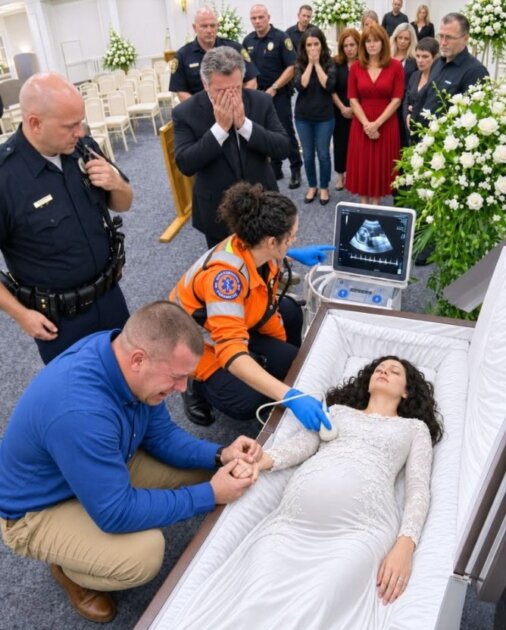
“Please. Just one last time.”
After a brief discussion, the staff agreed to open it.
Marcos stepped forward.
He leaned over Ana Clara, gently touched her hand, and tried to find the words he had been unable to say since receiving the terrible news.
“I’m sorry, my love,” he whispered. “I should have been with you. I should have protected you.”
His voice broke.
He lowered his head.
Then he noticed something.
The fabric covering Ana Clara’s stomach had moved.
Marcos froze.
He stared at the spot.
Nothing.
Perhaps it had been a fold in the fabric. Perhaps the movement had come from his own trembling hands.
Then it happened again.
A tiny, unmistakable flutter.
He stepped backward.
“STOP!”
Everyone turned.
“What is it?” Ana Clara’s mother asked.
Marcos pointed toward his wife’s stomach.
“Something moved!”
One of the employees tried to reassure him, suggesting that it might be a natural physical reaction.
But Marcos shook his head.
“No! I saw it. There was movement!”
He leaned closer.
And then he saw it a third time.
His face went pale.
“The baby,” he whispered.
He looked around desperately.
“MY SON IS ALIVE!”
The heartbeat that changed everything
Someone immediately called emergency services.
Within minutes, paramedics from SAMU arrived at the crematorium.
The employees moved away from the coffin while the medical team began examining Ana Clara.
Marcos stood nearby, unable to breathe normally.
One paramedic checked the situation while another prepared medical equipment.
The room became completely silent.
Then a faint sound came from the monitor.
A rapid, fragile heartbeat.
The paramedic looked at his colleague.
“There’s fetal cardiac activity.”
Marcos grabbed the edge of the coffin.
“What does that mean? Is my baby alive?”
The paramedic looked at him.
“Yes. We need to get him to a hospital immediately.”
Ana Clara’s mother collapsed into tears.
Marcos covered his face with both hands.
His wife was gone, but somehow, impossibly, their son was still fighting.
The cremation was immediately suspended.
An ambulance was prepared for an emergency transfer to Hospital das Clínicas.
Before leaving, one of the officers who had been notified about the unusual discovery examined the medical documents accompanying Ana Clara’s body.
Something caught his attention.
The recorded medical timeline didn’t appear to match the preliminary information about the accident.
It was only an inconsistency, not proof of wrongdoing.
But it raised an important question.
Had Ana Clara’s condition been properly investigated before her body was released?
Marcos climbed into the ambulance and held his wife’s cold hand.
“Please, Miguel,” he whispered. “Don’t give up. Your father is here.”
The siren echoed through the streets of São Paulo.
A tiny cry behind the operating room doors
At the hospital, an obstetric emergency team was already waiting.
Ana Clara was rushed into the operating room.
Marcos tried to follow, but a nurse stopped him.
“Sir, we need you to wait here.”
“That’s my son in there! Please!”
“We’re doing everything we can.”
The doors closed.
Marcos sat in the corridor, still wearing the dark suit he had chosen for his wife’s funeral.
He couldn’t stop looking at the clock.
Every minute felt like an eternity.
He thought about the nursery. The unfinished crib. The little clothes Ana Clara had carefully arranged.
He thought about the future they had planned.
Then, at 6:32 p.m., a doctor briefly emerged.
A few minutes later, another nurse hurried past him.
At 6:49, Marcos was still waiting.
And then he heard something.
A faint cry.
He stood up immediately.
The sound came again.
A nurse appeared, carrying a tiny baby wrapped in a white blanket.
“Mr. Almeida?”
Marcos couldn’t speak.
The nurse smiled gently.
“Congratulations. Your son is alive.”
Marcos dropped to his knees.
Miguel had survived.
He was premature and extremely fragile. His breathing required medical assistance, and doctors immediately transferred him to the neonatal intensive care unit.
But he was alive.
For a few precious seconds, Marcos was allowed to see him.
The baby’s tiny fingers moved beneath the blanket.
Marcos gently touched his hand.
“I’m your daddy,” he whispered through tears. “I’ve been waiting for you.”
He had lost the love of his life.
But their son had survived against all odds.
What Marcos didn’t yet know was that the hospital had already discovered something deeply troubling.
And it would change everything he thought he knew about Ana Clara’s final hours.
The first disturbing discovery
During the emergency medical procedure, doctors noticed an unusual mark on Ana Clara’s body.
Its location did not appear consistent with the injuries described in the initial accident report.
They also documented an unexplained reaction on her skin.
Because of the unusual circumstances surrounding the delivery, the medical team preserved the relevant findings and notified the authorities.
The planned cremation was formally suspended.
Investigators requested additional forensic examinations, including toxicology testing and a detailed inspection of the damaged vehicle.
Meanwhile, Marcos was asked to provide information about his wife’s final movements.
He mentioned the two phone calls from Gustavo.
The investigators immediately requested the relevant phone records.
They also began reconstructing Ana Clara’s journey using surveillance cameras from businesses along Rodovia dos Imigrantes.
One recording would prove particularly important.
A security camera at a gas station had captured Ana Clara’s car stopping shortly before the accident.
And standing beside the driver’s door was Gustavo.
Ana Clara’s own brother.
The footage showed the two arguing in the pouring rain.
Gustavo appeared agitated, repeatedly gesturing toward the car.
Ana Clara seemed upset and tried to end the conversation.
A few minutes later, she drove away.
The accident happened shortly afterward.
When investigators questioned Gustavo, he claimed that he had simply stopped to discuss a family matter.
He said his sister had been nervous and distracted.
He insisted that their conversation had been completely ordinary.
But the investigators weren’t convinced.
The secret hidden in the toxicology report
Several days later, the toxicology results arrived.
The examination had detected a sedative in Ana Clara’s system.
The substance was not part of her prescribed medical routine.
More importantly, its presence raised serious concerns because Ana Clara was pregnant.
Marcos was horrified.
His wife had been extremely careful throughout her pregnancy. She had refused even ordinary medication without speaking to her doctor.
Why would she suddenly have a sedative in her system?
And who could have given it to her?
Investigators returned to the surveillance footage.
They examined Gustavo’s phone records and recovered deleted messages from Ana Clara’s phone.
The conversations revealed a growing conflict between the siblings.
Ana Clara had repeatedly demanded that Gustavo stop asking for money.
She accused him of lying to Marcos and exploiting their family’s generosity.
In one message, she told him that she had discovered the truth about his debts.
She also made it clear that she intended to tell their mother everything after Miguel was born.
Gustavo had apparently been hiding serious financial problems from the family.
Ana Clara had discovered the extent of his deception and refused to help him anymore.
But there was something even more disturbing.
In one of the recovered conversations, Gustavo had begged his sister not to reveal what she knew.
She had refused.
Her final message was short:
“I’m done protecting you. You need to take responsibility for what you’ve done.”
Investigators began to suspect that the argument at the gas station had been about those hidden debts.
They compared the messages with Gustavo’s statements, the toxicology report, and the medical findings.
Piece by piece, the evidence began pointing in the same direction.
The truth about the accident
The investigation eventually established that Gustavo had confronted Ana Clara during the storm and had been involved in exposing her to a substance that impaired her ability to drive safely.
The sedative, the confrontation, the suspicious timeline, and the circumstances of the collision formed the basis of a criminal case.
What had initially been treated as a tragic highway accident was now being investigated as a deliberate criminal act.
When Marcos learned the details, he felt physically sick.
He remembered every time Ana Clara had defended her brother.
Every time she had lent him money.
Every time she had told Marcos to be patient because Gustavo was going through a difficult period.
She had trusted him.
She had never imagined that the person she had spent years trying to help could become a danger to her.
When Gustavo was finally arrested, Marcos was informed by the police.
He didn’t celebrate.
He didn’t feel victorious.
He simply remembered the crematorium.
He remembered Gustavo standing near the exit when the paramedics discovered the baby’s heartbeat.
And he remembered the strange expression on his brother-in-law’s face.
At the time, Marcos had believed it was shock.
Now he understood that there might have been something much darker behind it.
Gustavo was eventually convicted for his role in the events that led to Ana Clara’s death and endangered her unborn child.
The court considered the forensic evidence, toxicology findings, surveillance recordings, recovered messages, and contradictions in his statements.
Justice had finally been served.
But for Marcos, no sentence could undo what had happened.
The boy who carried his mother’s memory
While the investigation and court proceedings continued, Miguel remained in neonatal intensive care.
His first weeks were difficult.
He needed constant monitoring, medical assistance, and specialized feeding.
Marcos practically lived at the hospital.
He learned the names of the machines, the meaning of the monitor readings, and the complicated routines that kept his son alive.
Every small improvement became a reason to hope.
A little more weight.
A stronger cry.
A successful feeding.
One day, a nurse told him that Miguel was making encouraging progress.
Marcos cried with relief.
The first time he was allowed to hold his son’s tiny hand without protective gloves, he whispered:
“You have no idea how much your mother loved you.”
Ana Clara’s mother visited whenever she could.
She and Marcos often sat together beside the incubator without saying anything.
She had lost her daughter and nearly lost her grandson.
She was also struggling with the unimaginable reality that her own son had been convicted in connection with Ana Clara’s death.
There were no words that could make such pain disappear.
But they had Miguel.
And for both of them, he became a reason to keep moving forward.
Months later, Miguel was finally strong enough to leave the hospital.
Marcos brought him home.
The nursery was still waiting.
The crib had been assembled, the little clothes were ready, and Ana Clara’s favorite blanket was folded inside the drawer.
For the first time, Marcos placed his son in the room they had prepared together.
He stood there for a long time, holding back tears.
Ana Clara should have been beside him.
She should have been the one placing Miguel in his crib.
But Marcos promised himself that his son would grow up knowing exactly who his mother had been.
The folder he could never throw away
Years passed.
Miguel grew into a happy, healthy little boy.
He learned to walk, talk, laugh, and ask endless questions.
Marcos told him stories about Ana Clara.
He told him how she had defended strangers, how she loved handwritten letters, and how she could never walk past a shop without looking at baby clothes.
He told him how excited she had been about his arrival.
And he told him that, even before Miguel was born, his mother had loved him more than words could describe.
Marcos kept the blue folder Ana Clara had prepared during her pregnancy.
Inside were her ultrasound photographs, hospital records, appointment notes, and Miguel’s first hospital bracelet.
He rarely opened it.
But he could never bring himself to throw it away.
Sometimes, late at night, after Miguel had fallen asleep, Marcos remembered the afternoon at Vila Alpina Crematorium.
The flowers.
The cold lights.
The coffin.
And that tiny movement beneath the fabric.
Everyone in the room had believed that Ana Clara’s story was over.
The documents had been signed.
The cremation was about to begin.
The final goodbye was only moments away.
But Marcos had asked to see his wife one last time.
And because he refused to ignore what he had seen, his son was given a chance to live.
He had entered the crematorium believing he was about to lose everything.
He left knowing that Miguel had survived—and that the truth about Ana Clara’s death would no longer remain hidden.
Sometimes, the smallest detail can change the course of an entire life.
For Marcos, it was one faint movement beneath a piece of fabric.
One moment of doubt.
One desperate refusal to say goodbye.
And one tiny heartbeat that deserved to be heard.
THE END.

