PART 2
My phone buzzed again before I had even finished putting away the last of the Thanksgiving leftovers.
“What do you mean you’re not cooking Christmas dinner? Is something wrong?”
I stood motionless in the kitchen, holding my phone in one hand. The refrigerator hummed softly behind me, and the little green light on the printer blinked in the otherwise quiet room. Outside, the November wind rattled the nearly bare branches against the window.
I read Cassandra’s question several times.
There had been a time when a message like that would have sent me into a frantic explanation. I would have apologized for upsetting everyone, assured her that nothing was wrong, and immediately started suggesting alternative menus, shopping arrangements, and ways to make sure the family celebration went ahead without a hitch.
I would have taken responsibility for everybody’s disappointment before anyone had even expressed it.
But that evening, I felt strangely calm.
I typed a short response.
“I’m making other plans this year. We can talk tomorrow.”
I pressed send, placed the phone facedown on the counter, and stood there for another moment. Then I switched off the kitchen light and slowly climbed the stairs.
Sleep was almost impossible.
I lay beneath the covers, listening to the old house settle around me. Every little sound seemed unusually loud: the ticking clock on the bedside table, the occasional gust of wind outside, the faint creaking of the wooden floor whenever the heating came on.
Around three in the morning, I opened my eyes and stared at the ceiling.
Had I made a terrible mistake?
Was eight weeks in Portugal too ambitious for a woman my age? Was I being selfish? Had I allowed one thoughtless remark at Thanksgiving to turn into something much bigger than it needed to be?
I even considered whether I should call Derek in the morning and tell him I’d changed my mind.
Then I pictured him sitting across from me at that beautifully decorated dining table, his eyes fixed on his plate while his wife turned my life into a joke for the entertainment of her guests.
I remembered the uncomfortable laughter.
I remembered the way nobody had bothered to change the subject until someone else finally did.
And most of all, I remembered how familiar that feeling had become.
It wasn’t one remark. It was eight years of small humiliations, unspoken expectations, and the assumption that I would always swallow my feelings because keeping the family comfortable mattered more than my own happiness.
By the time the first pale morning light crept through my curtains, I had made up my mind.
Portugal was still happening.
Derek called shortly after nine.
I was standing at the kitchen counter, making toast and watching steam rise from my freshly brewed coffee when his name appeared on the screen.
“Mom, what’s going on?” he asked without even saying hello. “Cassie says you’re upset about something she said yesterday.”
I spread butter across my toast and took a breath.
“She made a joke about my entire personality being cooking and cleaning,” I answered. “I didn’t find it particularly funny.”
Derek let out a long, impatient sigh.
“Mom, you know how Cassie is. She sometimes says things without thinking.”
“I know,” I replied quietly. “I’ve been listening to her do it for eight years.”
“She didn’t mean anything by it.”
I put the butter knife down.
“Then why didn’t you say something?”
There was a brief silence.
“What was I supposed to say?”
I turned toward the window.
Outside stood the old dogwood tree Leonard had planted beside our first home. Its branches were bare now, but I could still remember the spring when he had brought it home in the back of his truck. He had spent an entire Saturday digging the hole while the children ran around the garden, getting dirt on their shoes.
Leonard had a saying he repeated whenever we discussed raising children.
“You can tell a lot about someone’s character by what they do when nobody expects anything from them.”
I had never forgotten those words.
“You could have reminded everyone that I’m more than the woman who cooks your dinners,” I said.
Derek sighed again.
“Mom, you’re making this bigger than it needs to be.”
I looked down at my untouched toast.
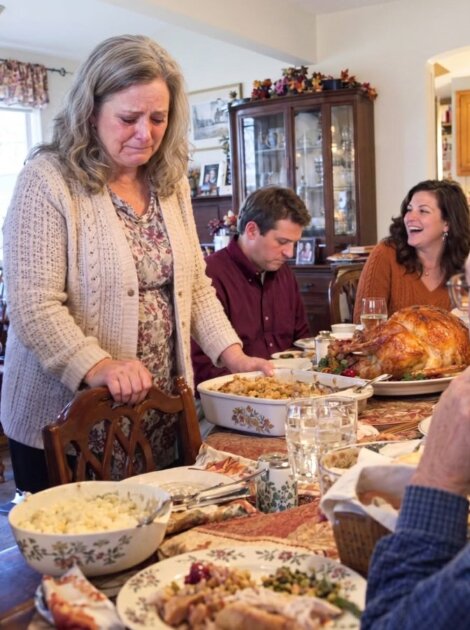
“Maybe I’ve been making it smaller than it is for far too long.”
He didn’t answer.
For a few seconds, all I could hear was the faint crackling of the phone connection.
Then he asked the question I had been expecting.
“So who’s supposed to handle Christmas?”
I closed my eyes.
There it was.
Not an apology. Not even a question about how I was feeling.
Just Christmas dinner.
“Derek,” I said, keeping my voice steady, “you’re forty years old. You have a wife, a kitchen, and a grocery store ten minutes from your house. I’m sure you’ll figure something out.”
He sounded surprised, almost offended.
“Fine. I’ll call you later.”
The call ended.
I lowered the phone and noticed that my fingers were trembling. I sat down at the kitchen table, looking at the toast on my plate as the butter slowly disappeared into the bread.
Why did saying no feel so much harder than arranging an eight-week trip across the Atlantic?
I had spent decades making decisions for my family, solving problems, stretching money, and finding ways to keep everyone happy. Yet the moment I tried to make one decision for myself, I felt guilty.
That realization hurt more than I expected.
That afternoon, I called Joanna.
My daughter lived in Durham and worked as a physical therapist. At thirty-seven, she was practical, independent, and considerably less likely than her brother to assume that I could solve every problem simply because I had spent most of my life doing exactly that.
She answered on the second ring.
“Hi, Mom! Everything okay?”
I settled into Leonard’s old armchair near the living-room window and told her what had happened at Thanksgiving.
I described Cassandra’s joke, the awkward laughter around the table, and Derek’s silence. I expected Joanna to interrupt with an angry comment, but instead she listened quietly until I had finished.
“Mom,” she finally said, “I wish you’d told me things had gotten this bad.”
“I didn’t want to cause trouble between you and your brother.”
“Being unhappy doesn’t mean you’re causing trouble. You’re allowed to have feelings, you know.”
I smiled faintly.
Then I told her about Portugal.
For a moment, there was complete silence on the other end of the line.
Then Joanna practically shouted.
“Wait! You actually booked it?”
“I did.”
“Mom! That’s amazing!”
Her excitement was so genuine that I had to pull the phone away from my ear because she was laughing so loudly.
“You’re not worried about me traveling alone?” I asked.
“Worried? You went to New Zealand by yourself! You know how to get on an airplane, book a hotel, and find your way around.”
She paused.
Then her voice softened.
“Besides, you spent my entire childhood telling me I could do things even when they scared me. You always told me not to let fear decide what kind of life I would have. Maybe it’s time you started listening to your own advice.”
My eyes filled with tears.
I turned toward the window, pretending to examine the garden.
It wasn’t that Joanna had said anything particularly extraordinary. It was the way she said it. She wasn’t asking who would prepare Christmas dinner or wondering how my absence would affect everybody’s plans.
She was simply happy that her mother had finally chosen something for herself.
And I hadn’t realized how much I needed to hear that.
Over the next several days, I began reviewing the financial arrangements I’d gradually made with Derek and Cassandra.
I wasn’t interested in punishing them. I didn’t want to make their lives difficult or leave them unable to pay their bills. But I had finally reached the point where I needed to understand exactly how much of my retirement income had quietly become part of another household’s monthly budget.
I started with my bank statements.
The first expense I noticed was the storage unit. Three years earlier, when Derek and Cassandra had moved into their current house, I’d offered to cover the rental temporarily while they sorted out their belongings.
Temporary.
I actually laughed when I saw how long the payments had continued.
Thirty-six months.
Then there were two streaming subscriptions I’d agreed to pay for because Derek had mentioned that their monthly expenses were adding up. There was also a regular transfer into his account, originally intended to help during a particularly difficult financial period.
And there were the smaller expenses.
A delivery I’d paid for here, an unexpected bill there, a few hundred dollars when something needed repairing, and occasional grocery purchases whenever Cassandra mentioned that things were tight.
None of those payments had seemed particularly significant when I agreed to them.
But when I added them together, I sat back in my chair and stared at the calculator.
The total was considerably higher than I had imagined.
I walked to the living-room bookshelf and picked up an old photograph of Leonard and me taken shortly before he retired. We were standing outside our house, smiling at the camera, with his arm wrapped around my shoulders.
We had worked hard for that retirement.
We skipped restaurant dinners, wore winter coats for years longer than we probably should have, postponed replacing furniture, and transferred money into our savings account every payday.
Leonard used to joke that our savings account was the only member of the household that never needed reminding to do its job.
We had made those sacrifices because we wanted to enjoy the years ahead.
We hadn’t saved so carefully just to discover that my retirement had become an extension of Derek and Cassandra’s household budget.
I returned to the computer and opened a new email.
I listed the recurring payments one by one, explained that I would cover the current billing cycle for the services I’d agreed to, and made it clear that beginning in January, Derek and Cassandra would need to take responsibility for those expenses themselves.
I included the necessary account information and asked Derek to confirm once everything had been transferred.
I read the email twice before sending it.
There was no anger in it, no accusations, and no mention of Thanksgiving.
Just facts.
Still, pressing the send button made my stomach tighten.
His response arrived that evening.
“Mom, why are you suddenly doing all this?”
I stared at the message, wondering how to explain something that had taken me years to understand myself.
Finally, I typed:
“Because I need to start managing my retirement around my own plans.”
I sent it and closed the laptop.
He didn’t answer.
Two days later, Cassandra sent me a message containing a detailed Christmas menu.
I opened it while sitting in my favorite chair, a cup of tea balanced on the small table beside me.
She had already invited sixteen people.
The list included a whole roasted turkey, glazed ham, mashed potatoes, homemade stuffing, roasted vegetables, fresh rolls, cranberry sauce, and three different desserts.
There were even little notes beside several dishes.
My name appeared next to the turkey, stuffing, vegetables, and pumpkin pie.
At the bottom, Cassandra had written:
“Let me know if you need anything picked up.”
I read that sentence twice.
Then I looked at the menu again.
Apparently, despite everything I had said, she had already assigned me half the kitchen.
For a moment, I could almost picture the scene she expected: me arriving early, carrying bags of groceries, tying my apron around my waist, and spending the next six hours moving between the oven and the sink while everyone else enjoyed their holiday.
I imagined the familiar questions.
“Diane, how long until the turkey is ready?”
“Could you warm up the rolls?”
“Do you need help with anything?”
And, of course, the inevitable disappearance of anyone who actually offered to help.
I slowly placed my teacup on the table.
Then I picked up my phone and began typing.
This time, I wasn’t going to apologize, make excuses, or offer to prepare just one dish.
I had spent enough Christmases proving how much I could do for everyone else.
It was time they learned how to manage without me.