“Get out of the way, Mommy’s precious treasure!” my husband shouted, shoving me away from the bank vault as if I had no right to be there. But when the lock clicked open, both he and his mother recoiled in horror, as though they had seen a ghost.
“Put your passport on the edge of the counter, and stop fidgeting,” Denis snapped, pressing my leather handbag against the bank counter with his palm. “Don’t sign anything on your own. Do you hear me? I’m the only direct heir.”
“I’ve been listening to you for three hours, Denis,” I replied, pulling my bag strap out from under his fingers. “The authorization is issued to both of us. They won’t unlock the safety deposit box without my signature.”
“Oh, here we go again with your penny-pinching!” Marina Sergeyevna sighed loudly behind me, straightening the collar of her cropped beaver-fur coat. “Rita, you turn every little thing into a tragedy. Men handle financial matters. My late husband, Viktor Nikolayevich, never even took me to the bank. He brought everything he earned home to his family.”
“Your late husband left three million rubles in unpaid utility bills on his garages,” I reminded her quietly. “And I’m the one who paid for this safety deposit box. With my own bank card.”
“Because Denis’s accounts were frozen by mistake!” my mother-in-law snapped, glancing nervously at the security guard standing near the entrance gates. “It was a tax authority error! Don’t you dare embarrass your husband in front of strangers!”
Behind the glass partition, the bank clerk looked up at me. Her badge read “Albina, Senior Specialist.” She pressed her lips together and slid an electronic signature pad across the counter.
“Ms. Margarita Sergeyevna, please confirm your consent to joint access to the vault. Our records show a payment of 7,800 rubles for the rental fee, made in your name. Would you like to extend the agreement for another six months?”
“I confirm,” I said, picking up the stylus.
“Can you hurry up?” Denis demanded. He pulled a thick black zippered folder from his jacket pocket. “People are waiting for us. Security downstairs counts every minute. Mom, did you take your heart medication?”
“I did, sweetheart, I did,” Marina Sergeyevna murmured, clutching her suede handbag to her chest. “My heart is pounding so hard. Before your father was taken to the hospital, he whispered to me, ‘Marina, everything is in box forty-four. Gold. For a rainy day, so you’ll never be left with nothing.’ He collected imperial gold coins for decades. I remember those two velvet boxes myself.”
“Then I’ll finally get back on my feet,” Denis grinned, drumming his fingers on the counter. “No more loans, no more rented garages! I’ll buy the workshop on Nagornaya Street, hire two decent mechanics, and sell Rita’s old junk once and for all.”
“We are not selling my car,” I said, returning the stylus to Albina. “I bought it with my own bonus money before we got married.”
“Are you living in a family or a dormitory?” Denis leaned close to my ear, his breath sour with cheap tobacco. “What’s mine is yours, and what’s yours is ours. Stop hoarding everything! Are you really begrudging my mother the chance to move out of that miserable old apartment?”
“I’m not begrudging her anything,” I replied, staring at the terminal’s smooth white surface. “I’m just curious why you haven’t asked once in six months how much it costs to maintain this box.”
Albina placed a magnetic-stripe access card and two long metal keys on the counter. A round brass tag engraved with the number forty-four connected them.
“Please familiarize yourselves with the vault access regulations,” Albina said quietly. “Entry is permitted individually or as a pair with the appropriate authorization. Photography and video recording are prohibited. The bank accepts no responsibility for the contents of individual safety deposit boxes.”
“We know your regulations,” Denis snapped, snatching up the keys. The brass tag clinked against the countertop. “Let’s go, Mom. We’ve wasted enough time talking.”
As Albina returned my passport, she briefly held my hand.
“Ms. Margarita Sergeyevna, if you need assistance from security or would like a separate record of the box opening, simply press the blue button beside the vault entrance.”
“Why would she need security?” Denis snarled. “What are you implying, miss? We’re family! We’re here to collect a perfectly legal inheritance!”
“This is standard bank procedure,” Albina replied without blinking.
Then she looked at me. There was such quiet sympathy in her eyes that my stomach tightened.
At the time, I didn’t understand why she looked at me that way.
Soon, I would.
Other People’s Debts Behind a Locked Door
“Why are you standing there like a statue?” Denis yanked my sleeve in front of the heavy armored door leading to the basement. “Move your feet! My mother can barely breathe, and you’re standing there pulling faces!”
“I’m coming,” I said, shifting my handbag to my other shoulder. “Stop grabbing my coat.”
“Then stop acting like a queen!” Marina Sergeyevna hissed behind me, leaning heavily on the chrome railing. “You think that because you spend your days calculating bridge construction budgets, you’re smarter than everyone else? Denis would be the family’s sole breadwinner if it weren’t for this cursed economic crisis. Instead of supporting him, you count every single ruble! You begrudged him the 300,000 rubles he needed to get back on his feet!”
“I didn’t begrudge him anything, Marina Sergeyevna. I withdrew that money from my savings three months ago. Have you forgotten?”
“And now you throw it in our faces every day!” Denis cut in, wiping his sweaty forehead with his jacket sleeve. “I used it to buy a shipment of tires! How was I supposed to know the warehouse would be sealed?”
“You knew,” I said quietly. “You received a notice terminating the sublease two weeks earlier. You never told me. You simply took the cash from the drawer.”
“I was saving our business!” he shouted, nervously turning the keys in his hand. “Our business! My mother spent three years caring for my bedridden father while you sat at work until eleven at night, buried in bridge construction plans! She sacrificed her health and her strength for that inheritance! Doesn’t she deserve to live peacefully in her old age? Answer me!”
I looked down at the stairs. A dark shoeprint ran along the dirty tiles beside the wall.
For a moment, I couldn’t answer.
Because there was an uncomfortable truth buried in his words.
Marina Sergeyevna really had spent years caring for her paralyzed husband. She had turned him in bed, changed his sheets, fed him by the spoonful, and administered his medication. Meanwhile, I often worked late and rarely visited them. Whenever Denis asked for money for medicine or adult diapers, I handed over half my salary without a word.
I had given him the 300,000 rubles for the workshop, too.
Not because I believed in his business, but because I was exhausted by the endless family arguments. I wanted peace. I wanted them to stop treating me like the villain who never did enough.
I had paid the money myself. I had kept quiet.
And now I was standing there while the same people explained that I had no right to anything I had helped maintain with my own money.
“Yes,” I finally said. “Your mother deserves peace.”
“Exactly!” Marina Sergeyevna straightened triumphantly, clutching her handbag against her chest. “That’s why your father’s gold will buy us a proper three-bedroom apartment on the avenue. And we’ll get Denis a decent SUV. I’m sick of watching him drive around in that embarrassing little tin can of yours with its manual transmission!”
“And why are you buying an apartment only for yourselves?” I asked.
Denis stepped toward me in a single stride, forcing me back against the cold wall beside the armored door.
“Because my father saved that money for my mother! The day before he fell into a coma, he told me, ‘Denis, look after your mother. Don’t let strangers take what belongs to her.’ You’re a stranger here, understand? You’re my wife today, and tomorrow you might walk away. But I only have one mother!”
“Denis, stop shouting in the hallway,” I said, trying to free my arm.
“I’m not shouting. I’m explaining how things are going to work,” he said, his face blotching red. “We go in, we sign the papers, Albina opens the box, and I transfer everything into the bag. You stand by the exit and keep your mouth shut. When we get home, you’ll sign a waiver giving up your share in favor of my mother. I’ve already arranged an appointment with the notary for four o’clock.”
“You’ve already booked a notary?”
“Of course! Did you think I was stupid? Did you think I’d spend my entire life under your thumb? ‘Denis, where’s the receipt?’ ‘Denis, why haven’t you paid the rent?’ Well, that’s over, sweetheart! Now my father will settle every debt from beyond the grave!”
The security guard behind the armored glass pressed the intercom button.
“Visitors for the opening of box forty-four. Please prepare your access cards and switch off your mobile phones.”
Denis grinned with satisfaction.
But something inside me was beginning to feel terribly wrong.
Behind the Heavy Door
The steel vault door swung open with a low hydraulic groan. The air inside was cold, carrying the smell of ozone, old paper, and polished metal. Rows of gray safety deposit boxes stretched from floor to ceiling along a long, narrow room.
There were no windows. Only frosted fluorescent lights illuminated the room, while cameras watched us from above.
Albina walked ahead of us, her shoes clicking sharply against the stone floor.
“Section B, lower row. Box forty-four,” she announced, stopping in front of a metal compartment.
“Denis, hold me,” Marina Sergeyevna whispered, suddenly grabbing her son’s arm. “I feel dizzy. It’s as though Viktor is watching us. He always said, ‘Marina, I’ve put something aside for the bad days. You’ll never go without.’”
“We won’t, Mom,” Denis assured her.
He licked his dry lips and gripped the black folder so tightly that his knuckles turned pale. The zipper had split open in the middle, revealing the corner of a thick sheet of paper marked with a diagonal red stripe.
I recognized it immediately.
In my line of work, I had seen hundreds of similar documents when contractors failed to meet their obligations and faced financial claims.
“Denis, what’s in that folder?” I asked.
“None of your damn business!” he snapped, pressing it against his side with his elbow. “Bank paperwork. Documents for the transfer.”
“Banks don’t print contracts on forms like that. That’s a debt collection notice. Where did you get it?”
“Rita, shut your mouth!” my mother-in-law turned on me, her eyes flashing with hatred. “You can’t stand to see anyone happy! He’s here to preserve his father’s memory, and you’re pestering us with receipts and bills! You’re a heartless woman!”
Albina stopped in front of the metal cabinet and inserted the master key into the lower lock of box number forty-four.
“The master key is in place. Now the client’s key,” she said.
She stepped back and stood beside me. Her shoulder nearly touched mine. I noticed how tense she was. She wasn’t looking at Denis but at the security monitor on the wall.
“Give it here!” Denis snatched the second key. His fingers trembled as he inserted it into the lock. “Mom, hold the bag open! The gold bars should be in their original packaging, and the coins should be in boxes. Forty imperial gold coins, if I remember correctly.”
“Dear God, please help us,” Marina Sergeyevna whispered, opening her handbag and holding it beneath the compartment like a bucket beneath a running tap. “At last, we’ll live like normal people…”
I stepped forward.
“Denis, wait. We should make an inventory first. According to the regulations, Albina needs to record—”
He spun around so abruptly that his shoulder struck mine. His heavy hand, encased in a rough suede jacket, slammed into my chest.
I stumbled backward two steps and hit the opposite wall of safety deposit boxes.
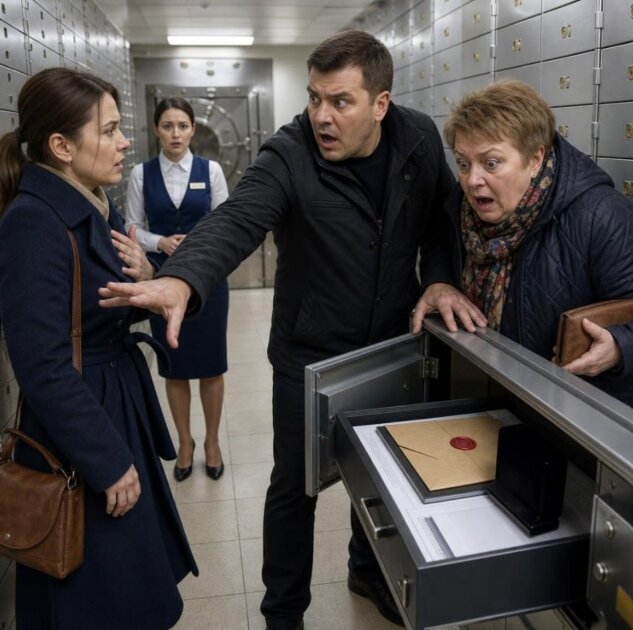
“Get out of the way, Mommy’s precious treasure!” Denis roared, his voice echoing through the vaulted room. “Don’t you dare touch it! You have absolutely no right to that gold! You won’t get a single ruble from it, do you understand? My mother sacrificed her entire life for this family! This is her share, her blood! Get away from the box!”
My back struck the cold steel. My handbag slipped off my shoulder, but I caught the strap before it hit the floor.
A heavy silence fell over the vault.
The security guard near the entrance took a step forward, his hand moving toward his belt. Albina gave him a subtle shake of her head, signaling him to wait, then moved closer to me, placing herself between Denis and me.
“Mr. Denis Sergeyevich, you must comply with the bank’s security regulations,” she said in a sharp, metallic voice. “Continuous audio and video recording is in progress. Any physical aggression will result in immediate intervention.”
“What aggression?” Denis laughed nervously as he turned the key in the lock. “It’s a family argument! My wife is jealous of other people’s property, so I had to put her in her place. Mom, look!”
Then he turned the key.
Two dry clicks sounded in the silence.
The lock released.
With a triumphant grin, Denis pulled the brass handle and swung open the narrow metal door of box forty-four.
Marina Sergeyevna practically shoved her face inside. Her mouth fell open, and she stretched out her hands, ready to receive the old velvet boxes.
But there was no velvet inside.
No imperial gold coins.
No gold bars sealed in plastic.
No bundles of dollar bills held together with bank bands.
Instead, on the narrow metal shelf, beneath a thin layer of gray vault dust, lay a thick stack of white papers tied together with twine. Beside it sat a transparent plastic envelope containing official documents.
The top sheet bore a blue official seal and a bold heading:
“DEMAND FOR VOLUNTARY REPAYMENT OF DEBT.”
Marina Sergeyevna froze. Her brown-gloved hands remained suspended in the air.
“What… what is this?” she stammered. “Denis, sweetheart… where are the boxes? Where is your father’s gold?”
Denis stood motionless, his mouth hanging open. One hand still rested on the compartment door.
Slowly, he pulled out the stack of papers. The twine snapped, scattering documents across the narrow shelf.
“What is this, Denis?” I asked.
My voice sounded strangely calm, exactly as it did when I reviewed a faulty financial report at work.
For once, nobody tried to push me aside.
I picked up the top sheet.
It was a consumer loan agreement for 1.2 million rubles, taken out in Denis Sergeyevich’s name eighteen months earlier.
On the third page, under the heading “Guarantor,” were Marina Sergeyevna’s passport details.
Below them was her signature: the same broad, uneven handwriting, with the distinctive long tail on the letter M.
The next document was an 800,000-ruble car loan secured against equipment that apparently did not exist.
Once again, Marina Sergeyevna was listed as guarantor.
The third paper was a private loan agreement for 500,000 rubles. The collateral listed was the old apartment where Denis’s parents lived.
“Denis…” Marina Sergeyevna’s knees buckled. She slowly sank onto the cold tiled floor, grabbing the edge of the lower compartment for support. “Why is my signature on these papers?”
“Mom, get up!” Denis stammered, backing away as if the documents might burn him. “These are old debts. I’ve paid almost everything back…”
“You haven’t paid anything back,” I said, turning over the sheet marked with the red stripe.
The date was from the previous Thursday.
“With penalties and interest, the total debt is 3.4 million rubles. Enforcement proceedings began three weeks ago. The deadline for voluntary repayment expired yesterday.”
“Denis!” Marina Sergeyevna screamed so loudly that the metal cabinets seemed to vibrate. “What enforcement proceedings? Why is my signature on these papers? You told me we were borrowing the money to pay for your father’s operation! You said you were paying everything yourself!”
“I was paying!” Denis shouted, pressing his back against the wall. His eyes filled with a desperate, animal fear. “I was paying until the workshop went under! I thought Dad really had gold in that damned box! He talked about those imperial coins inherited from his grandfather for twenty years! I took out loans because I thought the gold would cover everything! I thought we could settle all the debts today!”
“You knew there was nothing in the box,” I said. “The notary told you a month ago that your father’s bank accounts were empty.”
“They weren’t empty!” Denis lunged toward me, then stopped when the security guard approached. “My father hid the money! He couldn’t have lost everything! He couldn’t have left my mother with nothing!”
Then he turned back to me.
“Rita… wait. Rita, please.”
His arrogance disappeared in an instant. The man who had been ordering everyone around moments earlier now looked small and defeated, with sagging cheeks and sweat running down his forehead.
“You have a car,” he whispered, reaching toward me with trembling hands. “And savings through your employer. You could take out a loan against your apartment. We only need three million to stop the bailiffs from seizing Mom’s home! We’re family, Rita! Mom didn’t do anything wrong. I dragged her into this by accident. I was trying to help her! I wanted to build a better life for us!”
Marina Sergeyevna sat on the floor, her mascara streaking down her cheeks. She stared at her son as though she were seeing him for the first time.
“Son…” she whispered. “They can take my apartment? My pension is only thirteen thousand rubles. Where will I go?”
“Rita!” Denis grabbed the hem of my coat. “Tell her something! You’re smart. You understand money! Tell us we can fix this! Refinance everything! I’ll go work at a construction site, even if it’s far away. I’ll pay back every single ruble!”
I looked down at the brass key tag lying on the floor.
Number forty-four.
I had personally paid the 7,800-ruble rental fee so this moment could finally happen.
I gently removed Denis’s fingers from my coat.
His hands were cold and clammy.
“No,” I said.
“What do you mean, no?”
“I mean I will not take out a single loan. I will not sell my car. And you will no longer live in my apartment.”
“Have you lost your mind?” Denis shouted, but the authority had drained from his voice. Only desperation remained. “You’re going to throw my mother out onto the street? Are you even human? We’ve been married for three years!”
“Half an hour ago, you told me I was a stranger,” I replied, picking up my handbag and closing the zipper. “You said, ‘Get out of the way, Mommy’s precious treasure!’”
I stepped closer and looked him straight in the eyes.
“There is no gold, Denis. There are only debts. And they are your debts.”
Albina walked to the table, took out the report documenting the opening of the safety deposit box, and placed a pen in front of Denis.
“Mr. Denis Sergeyevich, please sign to acknowledge receipt of the contents of the box. Your allotted time has expired.”
Denis looked at the pen, then at his mother. Marina Sergeyevna buried her face in her gloves and sobbed silently.
Slowly, he sank to his knees beside her.
For once, he had no orders to give.
No excuses to offer.
Inside the vault, only the steady hum of the ventilation system broke the silence.
One Bag, One Shoulder
“Would you like me to call you a taxi?” Albina asked as we reached the first floor and stepped into the glass-walled lobby.
“Thank you, but that won’t be necessary. My car is parked around the corner.”
“Then at least take this,” she said, handing me an unopened bottle of still water. “Drink some before you go outside. It’s bitterly cold.”
“Thank you, Albina.”
I walked through the revolving doors and descended the broad granite steps.
The October wind carried the smell of wet asphalt, gasoline, and the first signs of frost. Minibuses lined up near the traffic lights. People hurried toward the metro in dark coats, their faces buried in their scarves. Someone carried a supermarket bag; someone else spoke into a phone.
It was an ordinary Tuesday.
Nobody knew that an entire family had just fallen apart inside that building.
I found my white Volkswagen Polo beneath an old poplar tree. I got in, tossed my handbag onto the passenger seat, and turned the ignition key. The engine started smoothly, and warm air began blowing across the windshield.
I opened the glove compartment and took out my old household expense notebook with its hard cover. For months, I had carefully recorded our expenses.
I found the page labeled “Denis’s Debts.”
For a few seconds, I stared at the entries. The transfers, the loans, the sums I had once believed I would eventually get back.
Then I tore out the page.
I folded it into quarters and slipped it into the door pocket.
Not because I had forgotten the money.
But because I no longer wanted to organize my life around the losses of a man who always expected me to rescue him with my own savings.
My phone flashed briefly on the dashboard. A message from the real estate agent appeared:
“Margarita, the documents for changing the locks and terminating the workshop lease are ready. The locksmith can arrive at six this evening.”
I typed a short reply.
“I’ll be home at six. I want two high-security locks with new key coding.”
On my way home, I stopped at a small hardware store in the residential neighborhood. The shop was tucked into a basement and sold everything from nails to ceramic flowerpots.
“Can I help you?” the elderly shopkeeper asked, wiping the glass counter with a cloth.
“I need a wide-angle door peephole and a simple key ring.”
“We have blue and green ones. Forty rubles each. You can put a little paper label inside.”
“I’ll take a blue one.”
I paid and slipped both purchases into my pocket.
At home, the hallway was silent.
Denis’s clothes still hung on the coat rack. His heavy work jacket had an oil stain near the hem, and his worn-out sneakers stood beside the door where he had left them that morning.
I didn’t pack his things.
I didn’t throw them into bags, call his mother, or send him a long message explaining how I felt.
He could come and collect them himself. With a police officer, if necessary. With his mother, if he preferred.
It was no longer my problem.
I walked into the kitchen, turned on the tap, filled an old enamel pot with water, and placed it on the gas stove. Blue flames spread evenly beneath it.
A horseshoe-shaped magnet still hung on the refrigerator. Marina Sergeyevna had brought it home from a religious pilgrimage three years earlier.
“For good luck,” she had said then. “May Denis always be fortunate!”
I removed the magnet and placed it on the table beside my keys.
Then I switched on the extractor fan. Its steady hum gradually filled the kitchen.
I stood there for a long time, listening.
I didn’t feel triumphant. I wasn’t happy that Denis’s lies had been exposed. And seeing Marina Sergeyevna collapse had brought me no satisfaction.
I was simply exhausted.
Exhausted from always having to understand everyone else. From being expected to pay, stay silent, give in, and prove over and over that I was a good wife.
As though love meant never being allowed to have boundaries of your own.
But something had changed that day.
Not because of the papers in the bank vault.
Because I had finally understood something important: just because someone is in trouble doesn’t automatically make their problems my responsibility. Just because someone is elderly doesn’t give them the right to demand another person’s savings or sacrifice their future. And just because someone is my husband doesn’t mean he can destroy my life to save himself from the consequences of his own lies.
Marina Sergeyevna had genuinely endured difficult years. She had cared for her sick husband, and perhaps she truly believed her son would take care of everything.
But she had also signed those documents. And I was under no obligation to take out yet another loan to erase the consequences of their decisions.
The water in the pot began to heat.
I took out a mug, made myself some tea, and sat down at the kitchen table.
My phone lay silently beside me. I didn’t call Denis. I didn’t apologize. I didn’t send him a message suggesting that perhaps we could still find a solution.
Tomorrow, I would deal with the locks, the paperwork, and whatever else needed to be done.
But for the first time, I had no one else’s problems waiting for me.
Only my own life.
And at last, I was free to decide what to do with it.
Did Rita have a moral obligation to help her mother-in-law save the only home she had left, knowing that the elderly woman had been deceived by her own son into guaranteeing his debts?