
# The Whole Village Thought the Grumpy Postman Was Mad When He Brought Home a Hungry Little Girl Who Was a Stranger — But the Child Was Hiding a Secret That Would Change His Family’s Life Forever
Stepan Averyanovich did not like children.
At least, that was what the entire village said about him.
The children believed it so firmly that whenever they saw the postman approaching with his worn canvas bag, they immediately fell silent. The boys stopped chasing their wooden hoops, the girls hid their half-eaten flatbreads behind their backs, and the youngest ones hurried fearfully behind the fences.
Yet Stepan had never raised a hand against anyone.
He had never even shouted.
He simply had a look in his eyes that made people feel as though the postman could see straight into their souls and knew every bad thing they had ever done.
He was a tall, bony man with an elongated face, a graying mustache, and permanently furrowed brows. He wore an old railway worker’s coat, with his postman’s bag hanging over his shoulder. Inside were letters, newspapers, the occasional money order, and official notices.
During the war years, however, the postman did not merely deliver letters.
He carried hope from house to house.
Or, sometimes, the end of it.
Whenever Stepan appeared at someone’s gate, the women stopped whatever they were doing. If he pulled out a letter folded into a triangle, many began crying with joy before they had even read the first line. If he held a gray official envelope in his hand, mothers sometimes collapsed on the doorstep.
At such moments, Stepan never said that everything would be all right.
He did not promise anything he himself did not believe.
He simply took off his cap, handed over the letter, and remained quietly nearby. He fetched water, helped a collapsed woman to her feet, closed the gate, or called the neighbors over.
Because he knew that some kinds of pain were beyond the power of words.
He had learned that lesson from his own life.
His son, Andrei, had been listed as missing in the military records since October 1942.
After the bloody battles near Rzhev, contact with his unit had been lost. Some soldiers had died, others had been taken to field hospitals, and a few had found their names added to the lists of the missing.
Andrei Korsunov’s name was among them.
Before that, however, he had written home regularly.
He sent short notes scribbled in pencil, often on scraps of paper.
“I’m alive. I’m well. The food is bearable.”
“Take care of Mother!”
“Put the firewood under the shed. It’s getting wet again.”
His last letter had arrived in the summer. Andrei had written that his unit was temporarily escorting evacuated children. He had suffered a minor wound but expected to return to his unit soon.
Then the letters stopped.
In the autumn, the official notice arrived.
“Red Army soldier Andrei Stepanovich Korsunov has been listed as missing following an engagement.”
It did not say that he was dead.
Only that he was missing.
Yet those two words slowly consumed Stepan’s family.
His mother, seventy-one-year-old Avdotya Savelievna, refused to give up on her son. Every morning, she set three plates on the table.
“Andrei will come home,” she would say. “My boy is strong. He won’t give up so easily.”
Stepan never argued with her.
But every evening, he put the third plate away.
He was fifty-two years old and knew the language of war too well not to understand what it meant when no news of someone arrived for months.
## The Little Girl in the Ditch
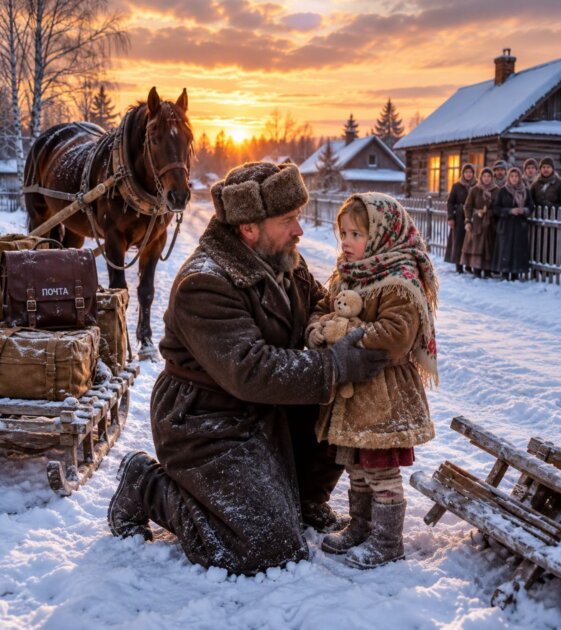
One freezing day in January 1943, Stepan was returning home from the district post office.
An overnight snowstorm had covered the road with a thick blanket of snow. The horse’s hooves sank deep into the drifts, and the old sleigh groaned plaintively with every bump.
There were twenty-seven letters in the postman’s bag, along with two newspapers and three official notices.
One of the letters was addressed to Kseniya Lapteva, whose two sons were both fighting at the front.
Throughout the journey, Stepan wondered which of them the letter might concern.
Then he angrily shook his head.
No. He must not think about that.
He was only eight kilometers from Malye Ozerki when the horse suddenly veered sideways.
“Whoa, you stupid animal!”
Stepan pulled on the reins.
For a few seconds, the wind fell silent.
And then he heard it.
A faint, barely perceptible sound coming from the ditch beside the road.
It was not a shout.
Nor was it quite a cry.
It was more like the thin whimper of a freezing puppy using the last of its strength to beg for help.
Stepan climbed down from the sleigh and brushed the snow aside.
He uncovered an overturned child’s sled, several broken wooden crates, and a tiny hand wearing a woolen mitten.
A little girl lay between the boards.
She looked about eight years old, perhaps a little older.
Her coat was at least three sizes too big, held together at the waist with a piece of rope. She wore no hat, and her dark hair had frozen against her forehead. One of her legs was pinned to the ground beneath a broken wooden crate.
Stepan knelt beside her.
“Hey, little girl! Can you hear me?”
The child opened her eyes.
They were enormous and dark, and she looked at the man as though she no longer expected anything from the world.
“What’s your name?”
She did not answer.
Stepan pushed the board aside and carefully lifted her. The girl was astonishingly light, as though barely any life remained in her.
As he adjusted her coat, he felt something hard against her chest.
A small wooden bird had been tied beneath her clothes with a piece of string.
Its wings were spread wide. A piece was broken off one of them, but the carving was still clearly the work of a careful hand.
A small cloth pouch hung around the girl’s neck. Inside was a soaked piece of paper. Most of the ink had run, but a few letters remained legible:
“Li… Boro… 1934.”
“Lida?” the man asked.
The little girl flinched.
She did not nod, but she clutched the wooden bird so tightly that it seemed she was afraid someone might snatch it away at any moment.
“All right, Lida. I’m taking you home now.”
The snow had almost completely erased the tracks on the road. A few meters away, Stepan found deep wheel ruts, broken crates, and torn pieces of canvas. It looked as though a truck carrying children had skidded off the road.
He shouted.
He called for help.
He even fired his old signal flare, but nothing moved across the white landscape.
No one answered.
Finally, he spread his own padded coat over the girl and laid her on the sleigh.
“The district office will find out where you came from,” he told her. “They’ll look for your relatives.”
Suddenly, Lida grabbed his sleeve.
She clung to it so tightly that her fingers turned white.
“Don’t be afraid!” Stepan said. “I won’t leave you here.”
The girl continued to stare at him rigidly.
She did not believe him.
Stepan understood that immediately.
Children who had always been protected did not look at adults that way.
## “We Don’t Even Have Enough Bread for Ourselves!”
By the time Stepan reached home, darkness had fallen.
Avdotya opened the door, and when she saw the child lying in the man’s arms, she recoiled in alarm.
“Good heavens! Who is that?”
“I found her by the road.”
“Is she dead?”
“She’s still alive.”
The old woman crossed herself.
They laid the girl in Andrei’s old bed. They removed her wet clothes, dressed her in a dry shirt, and wrapped her in blankets. Her body was covered in bruises, a fresh scratch ran across her shoulder, and her feet were ice-cold.
Avdotya gently rubbed her limbs, then began feeding her thin potato soup with a spoon.
Lida ate as though she were afraid someone might snatch the bowl from her hands at any moment.
When the soup was gone, she ran her finger around the bottom of the bowl and licked it clean.
Avdotya turned her head away.
“My God… how long has it been since this child last ate?”
Stepan did not answer.
That night, the little girl woke up screaming.
At least, it looked as though she was screaming.
Her mouth opened wide, her chest rose and fell wildly, but not a single sound came from her throat. She fought off something only she could see.
Stepan reached her first.
Lida slapped him across the face, scratched his neck, and then tried to crawl under the table.
The man did not touch her.
He simply sat down on the floor a few steps away.
“Calm down. No one here is going to hurt you.”
The little girl retreated into a corner and hugged the wooden bird to her chest.
Stepan lit the kerosene lamp, placed it on the floor, and sat down by the door.
He stayed there all night.
He asked no questions.
He did not try to touch her.
He simply guarded the door, as though darkness itself could not enter the house while he sat there.
By dawn, Lida had fallen asleep.
The next day, the village feldsher examined her.
“She’ll survive,” he said. “But I don’t know why she doesn’t speak. Perhaps she has been mute since birth. Or perhaps she experienced such terrible shock that she lost her voice.”
“I’ll take her to the district center,” Stepan replied.
The girl was standing beside the stove. When she heard the word reception center, her face turned white.
Stepan gathered his documents, but Lida crawled under the table and wrapped both hands around his leg.
“Let go,” he told her. “They’ll take care of you there.”
The little girl only clung more tightly.
Avdotya watched them for a long time.
“Perhaps she doesn’t want to be left alone again.”
“Mother, don’t start!” Stepan snapped. “We won’t have enough bread to last until spring as it is.”
The old woman looked her son in the eyes.
“We certainly don’t have much bread. But tell me, my son, do we have no room in this house either?”
Stepan clenched his jaw.
“We don’t even know who this child is.”
“We know she’s hungry, cold, and frightened.”
“She can’t stay here forever!”
Avdotya glanced toward the empty bed.
“Andrei’s bed has been empty all this time.”
“Don’t talk like that!”
“Then how should I talk? Should I pretend he’ll come home tomorrow and everything will go back to the way it was?”
Stepan turned away.
Andrei’s old padded jacket still hung on the wall. His notebooks, razor, a few cartridge cases, and a photograph of the village football team remained in the drawer.
Stepan had put nothing away.
It was as though his son might walk through the door at any moment and be angry if anyone had touched his belongings.
Finally, Stepan let out a deep sigh.
“She can stay for now.”
Avdotya did not smile or begin thanking him.
She simply stroked Lida’s head.
“Did you hear that, sweetheart? You can stay for now.”
The little girl looked up at her.
Then, for the first time in a long while, she let go of Stepan’s leg.
## The Grumpy Postman and the Silent Little Girl
By the following morning, the whole village knew what had happened.
By noon, the neighboring women were taking turns knocking on the door.
“Is it true he brought a strange child home?”
“What if she’s ill?”
“What if her relatives turn up and accuse him of kidnapping her?”
“You barely have enough to eat yourselves, and now you’ve taken on another mouth to feed?”
Praskovya was the loudest of them all.
“Styopa, grief has driven you completely mad! You’ve lost your son, and now you want to replace him with some strange little girl!”
Stepan slowly turned his head toward her.
“Have you come for a letter?”
“Yes.”
“Then take it and go home!”
“I’m only trying to help you!”
“Then next time, instead of counting what’s on someone else’s plate, count your own pigs!”
Praskovya stormed away in a huff.
By evening, everyone was saying that the postman had finally gone mad.
Nevertheless, the following day, Stepan took Lida to the district center.
There, they learned that an accident had indeed occurred. A truck carrying evacuated children had overturned on the road leading to the reception center near Malye Ozerki.
The vehicle had previously been damaged in an artillery attack. Despite this, the driver had continued the journey, only to lose control on the icy road during the night.
The driver had died.
The two female caregivers had been injured and had set off with the children toward the nearest village to seek help.
It was only several hours later that they realized one little girl was missing.
The telephone lines were down, and snow covered the road, so the search could not begin until morning.
By then, Stepan had already taken Lida home.
The caregivers’ documents had burned in a fire that broke out in the cab, but a copy of the admission register had survived at the reception center.
The document read:
“Lidiya Borodina, born in 1934. Place of birth unknown. Information concerning parents incomplete.”
The head of the district office believed the girl belonged at the reception center.
“At least she’ll be with the other children there.”
Stepan looked down the long corridor, at the identical beds and the children bending silently over their tin bowls.
Meanwhile, Lida was holding on to his hand with two fingers.
“She’ll stay with me for now,” the postman said.
The official raised an eyebrow.
“Are you related to her?”
“No.”
“Do you have a wife?”
“No. I live with my mother.”
“How old are you?”
“Fifty-two.”
“And your mother?”
“Seventy-one.”
The official shook his head.
“You’re not going to have an easy time of it.”
Stepan shrugged.
“Who has an easy time these days?”
He received a certificate granting him temporary guardianship and slipped it into his postman’s bag beside the letters.
That was how Lida Borodina came to live in the grumpy postman’s house.
At first, the girl barely ventured beyond the gate.
She was afraid of horses, trucks, and men wearing black coats. Whenever she heard an airplane, she immediately threw herself to the ground and covered her head with her hands.
She ate whatever was placed in front of her, but she always hid half her bread beneath the mattress.
At first, Avdotya tried to break her of the habit.
“Lida, you don’t have to hide food here. We’ll have bread tomorrow, too.”
The little girl did not believe her.
The next day, she hid the bread crusts again.
Eventually, Stepan sewed her a small cloth bag and placed a slice of bread beside her bed every evening.
“This is yours,” he told her. “If you’re hungry, eat it. If you’re not hungry, save it. No one will take it away from you.”
Lida stared at the bag for a long time.
A month later, the pieces of bread beneath the mattress disappeared.
But the little cloth bag remained untouched beside her bed for a long time.
It was as though the girl could only slowly bring herself to believe that an adult’s promise might actually mean something.
## The First Laughter
Stepan soon realized that Lida had a surprisingly good memory for letters.
At first, she simply sat beside the table, watching as the man sorted the letters by street and family name.
Later, she began handing him the envelopes herself.
She could barely read, but she recognized names by their shapes. The broad “Ж” meant the Zhukov family, the long-tailed “У” stood for the Ulyanovs, and the three vertical strokes side by side identified the Shishkin family.
One evening, Stepan deliberately mixed up two letters.
Lida frowned, took them from his hands, and put them back into the correct piles.
The man looked at her in surprise.
“Well, well! You certainly won’t let me make mistakes!”
He showed her one of the envelopes.
“This is the letter ‘K.’”
Lida traced its shape on the table with her finger.
“K,” Stepan said.
The little girl silently shaped the letter with her mouth.
“Try again!”
She tried once more.
No sound came from her throat.
Stepan did not rush her.
“That’s all right. We’ll try again tomorrow.”
From then on, he taught her letters every evening.
He was strict and patient, in his own quiet way.
“This is an ‘A.’”
Lida wrote it down.
“It’s crooked. Again!”
She wrote it once more.
“That’s better.”
Within two months, she had learned to read short family names. Three months later, she was already accompanying the postman on his rounds through the village.
People gradually grew accustomed to the unusual pair: the grumpy man and the thin little girl who wore Andrei’s old coat and held his hand with two fingers.
At first, the other children teased Lida.
One day, Kolka Bocharov crept up behind her and shouted directly into her ear.
“Ahhh! Why don’t you talk?”
Terrified, Lida fell into the snow and covered her head with her hands.
Stepan turned around so quickly that the boy recoiled.
“Stand up!”
“Uncle Styopa, I was only joking!”
“I said, stand up!”
Kolka obeyed.
Stepan took the postman’s bag off his shoulder and thrust it into the boy’s hands.
“You’re carrying this from now on.”
“But where?”
“All the way around the entire route. Twelve kilometers. If you have enough energy to frighten other people, you have enough energy for this.”
Kolka carried the heavy bag until evening.
The following day, he came to see Lida with a lump of sugar.
She refused to take it.
But a week later, they were already sledding together.
And then, in the spring, something happened that Stepan had never expected.
Lida began to laugh.
At first, it was silent laughter, visible only in her face. Then her whole body joined in. She threw her head back, and her eyes shone as though, after a long time, she had finally allowed herself to be happy.
It all happened because Praskovya’s old goat snatched the newspaper from Stepan’s hands and began eating the editorial.
The postman pulled at the newspaper.
The goat refused to let go.
Avdotya stood at the gate, laughing.
Lida watched them, and suddenly, silent laughter burst out of her.
Stepan froze.
By then, the goat had eaten half the newspaper.
But the postman did not even swear.
He simply looked at Lida.
“So you can laugh after all!”
The little girl blushed and hid behind his back.
From that day on, Avdotya officially became Grandma Dunya to her.
At first, Lida simply drew a letter in the air whenever she pointed to the old woman.
Then, one evening, she tried to speak.
“Gra…”
The spoon slipped from Avdotya’s hand.
The next moment, the old woman was crying and hugging the little girl as though she had always been her own granddaughter.
Stepan watched them from the doorway.
He said nothing.
But that evening, after Lida had fallen asleep, he took Andrei’s photograph out of the drawer for the first time in a long while and did not immediately put it away again.
## The Letter That Changed Everything
At the beginning of summer, an unusual shipment arrived at the district post office.
Several sacks of old letters had been discovered in the basement of a bombed railway station. They had lain there for nearly a year. Some were soaked, others had been burned, but the envelopes with addresses that could still be read were being sent to their intended recipients.
The head of the post office placed a huge bundle of letters in front of Stepan.
“Some of these are addressed to people in your area. Sort them out!”
Stepan worked for hours.
The envelopes were dirty, and many of the addresses had faded. Some of the people to whom the letters were addressed were already dead. Others had moved away or gone to the front.
Lida sat by the window, folding the empty sacks.
Suddenly, she stood up.
She walked to the table and pulled a small, unfranked envelope from the middle of the pile.
The address was still legible:
“To Stepan Averyanovich Korsunov, Malye Ozerki.”
The pencil slipped from Stepan’s hand.
He would have recognized the handwriting among a thousand others.
It was Andrei’s.
The letter was dated August 1942, just two months before his son disappeared.
With trembling hands, he opened it.
A folded sheet of paper and a photograph fell out.
The photograph showed three Red Army soldiers and several children standing beside a truck.
Andrei stood smiling in the middle. He was thin, and his arm was bandaged, but his eyes still shone with their familiar liveliness.
Beside him stood a little girl wearing an enormous, masculine-looking coat.
A wooden bird was fastened to her clothes with a piece of string.
Lida approached the table.
Her expression changed the moment she saw the photograph.
She snatched it from Stepan’s hand, gently stroked Andrei’s face with her finger, and pressed the picture against her chest.
“Do you know him?” Stepan asked.
The girl’s lips began to tremble.
She tried to speak, but only a soundless breath escaped her throat.
The postman unfolded the letter.
“Father!
I’m writing in a hurry. Our unit has been assigned to escort evacuated children. They’re taking them to a new reception center near Malye Ozerki, so we may be passing not far from you.
There is a little girl among them named Lida Borodina. She lost her mother in a bombing and hasn’t spoken since. She has become attached to me. She clings to the belt of my tunic and won’t let me get more than a step away.
I carved a little wooden bird for her. I told her it was a kite that always finds its way home.
If you hear about her or happen to see her, please don’t leave her alone. I know it’s a strange request, but she looks at everyone as though the whole world has wronged her.
I only suffered a minor wound. I’ll be returning to my unit soon.
Your son,
Andrei.”
Stepan read the letter again.
Then once more.
Finally, he put the paper down and looked at the wooden bird.
“Andrei saved you?”
Lida nodded.
Tears streamed down her cheeks.
She pointed at the photograph, then made an explosion gesture with her arms. Next, she covered her head with her hands and drew a building marked with a red cross on the table.
Then she drew a bed.
Then a person who was missing one leg.
Stepan leaned closer.
“Andrei was in a hospital?”
Lida nodded.
“After you were separated?”
Another nod.
“But he didn’t die?”
The little girl shook her head desperately.
Stepan felt as though he had suddenly forgotten how to breathe.
“You saw him alive?”
Lida nodded again.
She could not remember the name of the city. She could not say which station they had passed through, or exactly how much time had elapsed since then.
But one thing had become clear.
Andrei had been taken to a hospital after writing his summer letter.
That day, Stepan sent inquiries to the military records office, the health administration, and every hospital whose address he could obtain.
The head of the post office helped him prepare the official requests.
Lida, meanwhile, drew a tiny bird by hand and placed one beside every letter.
Three weeks passed without an answer.
Then four.
Stepan grew quiet again. But in the mornings, he no longer simply set off to work. Every day, he went to the post office and waited for the district vehicle to arrive.
Lida always accompanied him.
At the end of August, an official envelope finally arrived.
Stepan stared at it for a long time.
Then he tore it open.
The letter read:
“Red Army soldier Andrei Stepanovich Korsunov received hospital treatment following a serious injury sustained in October 1942. Due to administrative confusion during evacuation, his records were not forwarded to his unit, and he was incorrectly listed as missing. Following the amputation of his left leg, he was transferred to a rehabilitation hospital in the city of Molotov.”
Stepan read the lines again.
Then he sat down.
His son was alive.
Andrei was alive!
After suffering a second injury, he had been evacuated to the rear. Contact with his unit had been lost, and his papers had become mixed up. Since no one knew where he had been taken, he had been registered as missing.
While his mother had been setting three plates on the table every morning, her son had been lying in a hospital bed, trying to recover.
That very day, Stepan obtained permission to travel.
He packed bread, boiled potatoes, and a change of underwear. Avdotya put a pair of woolen socks into the bag.
Lida took the wooden bird with her.
“You’ll stay here with Grandma Dunya,” Stepan told her.
The little girl immediately grabbed his travel bag.
“It’s a long journey. It will be tiring and cold.”
Lida would not let go.
“I’m not taking you with me,” the man said firmly.
The little girl looked up at him.
Her entire body stiffened, and her lips began to tremble.
“An…”
Stepan froze.
“What did you say?”
The child swallowed.
“An-drei.”
Avdotya sat down on the bench and covered her mouth with her hand.
Stepan slowly knelt in front of Lida.
“Say it again!”
“Andrei.”
Her voice was weak and uncertain, as though a door that had been locked for years had finally opened.
But it was a real voice.
“You want to come with me to Andrei?”
Lida nodded.
Then she whispered:
“Yes.”
It was the second word she had spoken in many months.
Stepan no longer tried to persuade her to stay behind.
## The Reunion a Father Had Dared to Stop Hoping For
They traveled east for several days.
First, they reached the district station in a truck. Then they boarded a passenger train and finally continued their journey in a cold military freight car.
Lida held Stepan’s hand the entire time.
Not with two fingers anymore.
With her whole hand.
The hospital operated out of an old school building. The corridors smelled of medicine, boiled porridge, and damp bedding. Men with crutches moved back and forth, while others lay in beds with bandaged faces or missing limbs.
Stepan showed Andrei’s photograph everywhere.
He asked questions.
He went from ward to ward.
But he could not find his son.
Finally, they discovered an entry in the administration office:
“Korsunov A. S., following amputation of left leg, transferred to the hospital workshop. Preparing for discharge.”
“Where is the workshop?” Stepan asked.
The nurse pointed toward the courtyard.
Beside the wall, beneath a simple wooden shelter, a young man sat wearing gray hospital clothes. He had rolled up the left leg of his trousers and fastened it with a safety pin.
In front of him stood a crate full of wooden toys.
The man was carving a bird.
Exactly like the one Lida was clutching in her hands.
Stepan stopped dead.
The young man looked up.
The knife slipped from his fingers.
“Father?”
Stepan tried to speak, but no sound came from his throat.
Andrei attempted to stand. Forgetting that his leg was missing, he lost his balance and nearly fell to the ground.
Stepan rushed forward and caught him.
The next moment, they were embracing each other.
Neither spoke.
They simply held on to one another, as though each feared that if he let go, the other would disappear again.
Stepan felt his son’s thin body, his protruding shoulder blades, and his trembling arms.
At last, he managed to speak.
“Why didn’t you write, my son?”
Andrei laughed and cried at the same time.
“I did! Several times. My letters came back. Malye Ozerki was assigned to another district, and the addresses got mixed up. I thought you had moved away. I thought…”
He did not finish the sentence.
Lida stood a few steps away.
At first, Andrei did not even notice her.
Then he saw her.
His eyes fell on the bird in her hands.
“The bird…”
Lida slowly approached him and held out the old wooden figure.
“Uncle Andrei.”
The man buried his face in his hands.
“Little Lida…”
The girl threw her arms around him.
Andrei held her so tightly that it seemed he was trying to make up for all the time he had spent not knowing whether she was alive.
“You’re alive!” he whispered. “My God, you’re alive!”
Lida rested her head on his shoulder.
And at that moment, Stepan understood that his son had not merely saved this child.
The little girl had saved his son, too.
Without her, they might never have learned that Andrei had survived one of the darkest chapters of the war.
## The Wooden Bird Found Its Way Home
That day, Andrei told his father everything.
Lida had lost her mother during a bombing. The little girl had been so terrified that she could no longer speak. Andrei had met her while his unit was escorting evacuated children.
At first, Lida had been afraid of everyone, but she gradually grew calmer around Andrei. She clung constantly to his tunic and would only dare to sleep if he stayed nearby.
One day, Andrei picked up a piece of wood and carved a little bird for her.
“It’s a kite,” he told her. “Do you know what makes it special?”
The little girl shook her head.
“Because it always finds its way home. No matter how far it flies, it eventually returns.”
From that day on, Lida carried it everywhere.
When Andrei suffered a minor wound, he returned to his unit, while the children were taken onward to the reception center.
A few weeks later, another artillery attack struck his unit. Andrei was seriously wounded and lost his left leg.
During the urgent evacuation, his papers became mixed up, and contact with his family was lost.
Lida had seen him in a field hospital before the truck accident. That was how she knew Andrei had survived.
Then the truck carrying the children overturned.
The little girl was lost.
She did not know Stepan’s address. She could not read the names, and she had no idea how to find the man who had saved her life.
All she had left was the wooden bird.
And the memory of the soldier who had promised her that the bird would always find its way home.
In the end, the little girl really did find her way home.
Not because she knew which road to take.
But because her journey led her to the very man who had spent his entire life delivering letters to other people while knowing nothing about his own son.
Andrei returned home in the autumn.
Almost the entire village was waiting for him at the station.
The women were crying, the men removed their caps, and the children pushed forward to see the soldier who had come home on crutches.
Kolka Bocharov was holding a homemade sign.
The lettering was slightly crooked, but everyone could read it:
“WELCOME HOME!”
Stepan stood beside his son.
Lida stood on his other side.
When Avdotya saw the crutches, she turned pale for a moment. Then she approached Andrei, kissed his forehead, and tried to put on a stern expression.
“Thank God you at least still have one leg! Otherwise, I’d have to spend all day running after you!”
Andrei burst out laughing.
“Hello, Grandma!”
The old woman laughed through her tears and hugged him.
The villagers slowly turned their heads away so that no one would see their shame.
Only a few months earlier, they had been saying that Stepan had gone mad because he had taken in a child who was a stranger.
Now that very child had brought back the son everyone had believed would never return.
## “I’m Not Her Grandfather!”
In the autumn, the district committee finalized Stepan’s guardianship of Lida.
Her relatives could not be found anywhere.
Stepan signed the papers and brought them home in his postman’s bag.
Only that evening, when Lida was asleep, did he truly understand what his signature meant.
It did not simply mean that the girl could stay with them until the war ended.
Nor did it mean she could remain until one of her relatives was found.
It meant she could stay until she grew up.
It took Andrei a long time to get used to peaceful life.
He grew angry whenever he fell. He refused to let anyone help him. Sometimes he sat in the shed for hours, staring at his empty left boot.
At night, he would wake from nightmares.
Lida often came looking for him.
She would sit beside him on the doorstep and remain silent.
She asked no questions.
She understood better than anyone that sometimes silence is the only way a person can endure pain.
During the winter, Andrei learned to walk with his prosthetic leg. Later, he began carving wood again.
At first, he made toys only for Lida.
Then he started making them for the neighbors’ children, too.
Eventually, the village chairman offered him a job teaching handicrafts at the school.
“What kind of teacher would I be?” Andrei asked.
“One who knows something others don’t,” the chairman replied. “You have two hands and a good mind. You don’t need two legs to teach.”
Andrei finally accepted the offer.
Lida also started school, and it soon became clear that she was an exceptionally quick learner.
Her voice gradually returned. She sometimes struggled to speak in front of strangers, but at home, she talked more and more.
She wrote her first composition under the title “My Family.”
It consisted of only four sentences:
“I have a Grandma Dunya. I have a Grandpa Stepan, although he used to say he wasn’t my grandpa. I have a big brother named Andrei, who gave me a bird. I was lost once, but now I have been found.”
The teacher read the composition aloud to Stepan.
The postman turned toward the window.
“She made a mistake.”
“Where?” the teacher asked with a smile.
“I’m not her grandfather.”
“Then tell her that yourself!”
Stepan did not answer.
That evening, however, he brought Lida a new schoolbag.
The little girl took it and looked up at him.
“Grandpa, is this mine?”
Stepan froze as though someone had just placed an official notice in his hands.
Then he cleared his throat.
“It’s yours. Just take good care of it!”
From that day on, Lida called him Grandpa.
The man sometimes grumbled about it.
But he never forbade her again.
## The Postman’s Last Letter
Life did not suddenly become easy after the war.
The tables did not magically fill with plenty. Widows, orphans, and empty chairs did not disappear.
But the postman’s bag gradually began to carry more good news.
“I’m coming home.”
“I’m alive.”
“I’m on my way home.”
For the first time in many years, Stepan began entering people’s gates with a smile.
Lida walked beside him and particularly enjoyed reading letters aloud to elderly people who could not read.
She read slowly and carefully.
She never skipped a single word.
Years later, she became the head of the village post office herself.
By then, Stepan had almost completely lost his sight. He sat by the window and recognized passersby by the sound of their footsteps.
Every evening, Lida brought him the mail.
“Shall I read you the newspaper?”
“They always write the same things,” the old man grumbled.
“Then how about a letter?”
“From whom?”
“From Andrei. He sent it from the district.”
Andrei had since married a schoolteacher, raised two sons, and opened a small workshop making wooden toys.
Beneath the wing of every bird he carved, he engraved a single letter:
“L.”
In memory of Lida.
In memory of the little girl he had met beside an overturned truck, only to be separated from her by the war.
In memory of the sister he had found not through blood, but through a promise.
In one of his final letters, Andrei wrote:
“Father!
All your life, you believed your job was to carry other people’s letters from house to house.
But fate delivered its most important parcel to you without an envelope.
It left it at the side of the road, wrapped in an oversized coat, with a wooden bird in its hands.
It’s a good thing you didn’t walk past it.”
Lida finished reading the letter.
Stepan remained silent for a long time.
Then he spoke softly.
“Where is the bird?”
“In the cupboard. Under glass.”
“Bring it here!”
Lida took out the old wooden figure.
One of its wings was broken. The wood had darkened over the years, and its edges had worn smooth from being touched so often.
Stepan ran his fingers over it.
“Well, well… what a long journey it has made!”
Lida smiled.
“But it finally reached its destination, Grandpa.”
The old man nodded.
Outside, the first snow began to fall.
It was just as thick as on that January night when the horse had been startled by something beside the road and the grumpy postman had heard a child’s faint whimper coming from the ditch.
Back then, Stepan had believed he was simply taking a freezing little girl home so that she would not die in the cold.
He did not know that the child would one day give his son back to him.
He did not know that the little girl who could not speak would one day teach him how to hope again.
And he did not know that, while he had spent his entire life delivering other people’s letters, fate was preparing the most important delivery of all for him.
A child who had no home.
A wooden bird that no one could have imagined would travel so far.
And a promise made by a young soldier to a frightened little girl.
In the end, the bird truly found its way home.
But it did not lead Lida back only to Andrei.
It led her to a father who had almost given up hope.
To a grandmother whose love had never run out.
And to a family that the war had torn apart, but that a child who was a stranger brought together again.
Because sometimes the most important people in our lives are not those we are born alongside.
They are the people we refuse to abandon, even in the hardest moments.
And sometimes a single small act of kindness is enough to change the fate of an entire family.
That winter day, Stepan had simply bent down to help a child.
But when he lifted Lida out of the snow, he was really lifting his own hope.
And that hope never let go of his hand again.

