
# “Your Parents Can Just Put Up With It!” My Husband Seated My Parents in the Darkest Corner of the Reception Hall. What I Did Next Made His Mother Green With Envy
The mouse cursor trembled nervously on the bright laptop screen. My husband, Yegor, grabbed the gray rectangle labeled “Table No. 1” and dragged it a little to the left on the virtual floor plan of the banquet hall.
“No, Artem, you’re still not understanding me!” My husband’s voice vibrated with barely restrained tension as he spoke to the restaurant manager on speakerphone. “If we leave the first table in the center, the air from the main air conditioner will blow directly onto my mother’s neck. She already has problems with it! And don’t even get me started on the distance to the restroom. I specifically asked you to measure it yourself! My father struggles with every extra step. He’s not going to run a marathon across your restaurant! Move the table to the left, closer to the panoramic window, but make sure the sunlight doesn’t fall directly on them!”
I stood behind my husband, holding a cup of cold coffee, and watched in silence.
Our tenth wedding anniversary was approaching. We had decided to celebrate this milestone in style, with an elegant restaurant, beautiful decorations, and a lavish banquet.
Yet, strangely enough, I felt no excitement about the upcoming celebration.
Looking over Yegor’s shoulder, I noticed another rectangle on the screen.
“Table No. 5.”
Next to it were the names of my parents: Elena Maksimovna and Dmitry Petrovich.
Their table had been squeezed into the darkest corner of the hall, wedged between the DJ’s speakers, the kitchen door, and the exit leading to the smoking area.
All evening, waiters would be carrying trays of dirty dishes over their heads. The bass would pound in their ears, and the kitchen staff would be clattering pots and pans just a few feet away.
It wasn’t simply a bad table.
It was a place reserved for people whose comfort mattered to absolutely no one.
“Yegor,” I said quietly, setting my cup on the table. “My parents will spend the entire evening listening to dishes clattering and music pounding in their ears. That corner isn’t even suitable for seating guests.”
My husband waved me away as though I were an annoying fly. He quickly finished his conversation with the manager, slammed the laptop shut, and rubbed the bridge of his nose like a man who had just prevented a nuclear disaster.
“Oh, Ira, please don’t start again!” he sighed irritably. “Your parents are sociable people. They can have fun anywhere. Your father was a career military officer, for heaven’s sake. He’s used to Spartan conditions. Do you really think a DJ is going to bother him? My mother, on the other hand, gets high blood pressure from the slightest draft. She needs peace and quiet. Besides, it’s a perfectly normal table. Stop inventing problems where there aren’t any! All that matters to your parents is that we’re happy. They don’t care where they sit!”
I said nothing.
Because suddenly, I understood that this had never been about the speakers or the kitchen door.
Over our ten years of marriage, our two families had quietly been divided into two separate classes.
My husband’s parents had become the precious crystal vases of the Ming dynasty. Fragile, priceless treasures that had to be handled with extreme care. The temperature had to be perfect, the humidity carefully controlled, and the noise kept to an absolute minimum. Even the direction of the airflow and the angle of the sunlight had to be considered.
My parents, meanwhile, had been classified as the titanium people.
They didn’t need comfort. They didn’t need special treatment, appropriate meals, or anyone’s attention.
According to Yegor, they could practically survive on fresh air and their happiness for their daughter. They could sleep on nails and wake up smiling, grateful for the experience.
The worst part was that I had helped create this situation myself.
For years, I had been proud of the fact that my parents never complained. My mother, Elena, a retired physics teacher, and my father, Dmitry, a retired colonel, never made demands, threw tantrums, or tried to draw attention to themselves.
I thought I was making my husband’s life easier.
Instead, he had gradually mistaken their silence for permission to treat them however he pleased.
And now, as if someone had pressed the rewind button on my life, I could suddenly see every little humiliation that had built up over the years.
Three years earlier, for example, we had bought a country house. Yegor had taken two days off work to visit furniture stores and personally test mattresses for the guest bedroom.
“Ira, look at this!” he had exclaimed enthusiastically, bouncing on a king-sized bed that cost nearly two months of his salary. “Independent pocket springs and coconut fiber. Perfect support! My mother has lumbar osteochondrosis. She needs a firm mattress. We’re buying this one!”
“And what are we putting in the other bedroom, where my parents will sleep?” I had asked, calculating how little money we had left.
“Oh, come on! We’ll drag in the old sofa that came with the house. I had it cleaned!” he had replied dismissively. “Your parents only come on weekends anyway. They dig in the garden, make kebabs, and get so exhausted by evening that they could sleep on wooden boards. Your father spent half his life sleeping in tents!”
And my father had indeed slept on that sofa.
The springs dug into his ribs. Every morning, he spent a long time rubbing ointment into his aching lower back, but he never uttered a single word of complaint.
Then there were our enormous family Christmas gatherings.
Those were a special kind of psychological slavery.
At every family celebration, I automatically transformed into a free waitress and personal nurse for my in-laws. I tucked cushions behind the back of Nikolai Nikolaevich, rushed to open or close windows whenever Valeria Pavlovna so much as sighed, and listened endlessly to my mother-in-law complain about how incompetent the doctors at her local clinic were.
Meanwhile, my “titanium” parents quietly took care of all the unpleasant work.
My mother chopped vegetables and prepared salads in the kitchen. My father washed the dishes and carried out mountains of garbage.
Yegor took it all for granted. More than that, he genuinely believed that his father-in-law and mother-in-law enjoyed doing it.
My parents had gradually become something like second-class service staff at our family gatherings. They were guests of the cheap seats, expected to be grateful for whatever remained after the VIP section had been served.
That evening, I looked at my husband.
He was already sitting in front of the television, happily flipping through channels. He was convinced the argument had been settled before it had even begun.
But I had made up my mind.
After dinner, I took a notebook and calculator from the drawer and placed them in front of him.
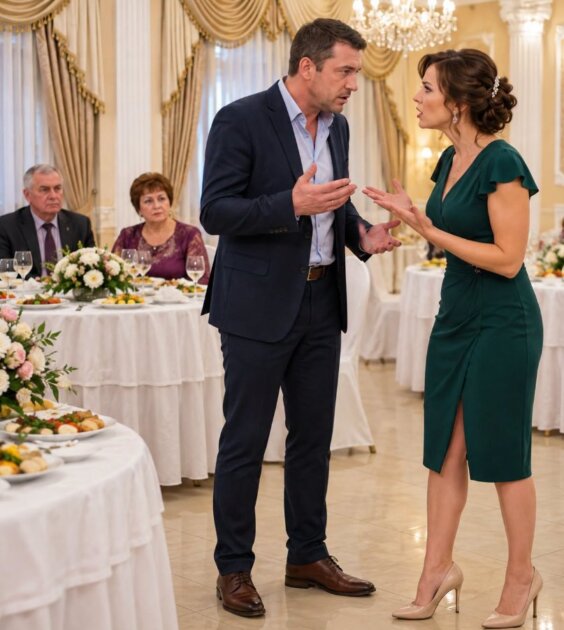
“We need to discuss the seating arrangements for the banquet.”
Yegor stopped with his fork halfway to his mouth.
“Ira. We. Have. Decided. Everything.” He emphasized each word as though explaining something painfully obvious to a foolish child. “I’ve already approved the plan with the manager.”
“You approved it without asking me.”
I pushed the notebook toward him.
“Our celebration has a budget of 300,000 rubles. We’re paying exactly half each. One hundred and fifty thousand from you, and one hundred and fifty thousand from me. I’m not asking for my parents to be seated on thrones at the head table. I’m asking you to move them from the kitchen passage to a decent, quiet area. For example, Table Three by the window.”
Yegor threw his fork onto the plate so forcefully that it clattered across the kitchen.
His defensiveness instantly turned into an aggressive attack.
“You’re going to ruin our first proper anniversary celebration over a stupid chair?!” he exploded. “Do you have to create drama out of absolutely nothing? You know perfectly well what my parents are like! They need to be comfortable, or they’ll spend the entire evening sitting there with sour faces and complaining!”
“So, to keep your parents from complaining, mine have to sit next to the kitchen and listen to dishes crashing around?”
“Don’t twist my words!” Yegor shouted, his neck turning red. “Your parents are normal, simple people! Why are you making such a big deal out of nothing? They won’t even notice where they’re sitting!”
“My parents are normal people. You’re right about that,” I replied coldly, looking him straight in the eyes. “But somehow, in our family, normal people always get whatever attention you have left over. Your relatives’ needs are the law. Mine are an optional extracurricular activity.”
“Oh, here we go again!” He threw up his hands, resorting to his favorite tactic of making me question my own feelings. “You’re just looking for an excuse to pick a fight! You always have to prove yourself at the expense of my sick mother! Are you really so selfish that you begrudge an elderly woman some comfort? How petty can you be, Ira? Counting money, tables, DJs… I do everything for this family, and all you do is nag me!”
“I’m not counting money, Yegor. I’m counting respect. And the balance in that equation has been negative for years. Just because my parents don’t throw tantrums over a draft doesn’t mean you can walk all over them.”
“Fine! Do whatever you want!” he roared, jumping to his feet. “You can seat them on the chandelier for all I care! But don’t come crying to me when my mother starts complaining about her migraine and how the whole party looks like some village disco!”
He shoved his chair back, stormed into the living room, and slammed the door behind him.
Yegor was absolutely certain his tried-and-tested scenario would work once again.
I would sit in the kitchen for a while, perhaps cry a little, then realize I had gone too far. After all, we couldn’t ruin such an important celebration over a trivial disagreement.
I was a smart, understanding wife.
I would calm down.
And everything would go back to normal.
I did stay in the kitchen that evening.
But this time, I had no intention of backing down.
The big day finally arrived.
The luxurious restaurant hall sparkled beneath crystal chandeliers. Warm spotlights illuminated the beautifully arranged tables, elegantly dressed guests chatted excitedly, and the air smelled of champagne and expensive perfume.
Yegor looked magnificent in his tailored navy-blue suit. He wore the smug expression of a man who believed he had orchestrated the perfect event.
And, as far as he was concerned, everything was going according to plan.
Valeria Pavlovna and Nikolai Nikolaevich sat proudly at Table One, right in the center of the hall, safely protected from every possible draft. The acoustics were perfect, and they had an excellent view of the head table, where my husband and I were seated.
Then Yegor glanced toward the far corner.
Something was wrong.
He narrowed his eyes, trying to see Table Five through the crowd.
The Bermuda Triangle between the speakers and the kitchen had disappeared.
The kitchen door was completely concealed behind an elegant designer screen decorated with lush greenery and white hydrangeas. The once-embarrassing corner had somehow transformed into an intimate, private VIP lounge.
“Ira, what is that botanical garden?” he hissed, leaning toward me after we had taken our seats at the head table. “And why is there a penguin in a tuxedo standing over there?”
I calmly took a sip of champagne.
“That’s their personal waiter. Remember, we had a joint budget. I decided not to waste my energy arguing about the kitchen door, so I used my half of the money exactly as I saw fit. Since you gave my parents a less-than-ideal location, I decided to compensate them for the inconvenience… gastronomically.”
Yegor stretched his neck to get a better look.
The other guests, including his precious “crystal vases,” were receiving the standard banquet menu. It was perfectly respectable, of course, with eggplant rolls, assorted cold cuts, and the usual side dishes.
But at Table Five, an entirely different performance was unfolding.
A waiter in pristine white gloves bowed as he poured chilled vintage champagne into my parents’ glasses.
A three-tier seafood platter towered over their table, displaying fresh oysters, king crab claws, and tuna tartare.
In a matter of minutes, the supposedly miserable back corner had become the most exclusive spot in the entire restaurant.
Yegor’s face turned bright red, but before he could start an argument, the master of ceremonies handed the microphone to Valeria Pavlovna for the first toast.
My mother-in-law rose heavily to her feet and delivered the usual obligatory speech about family happiness. Then, almost as if someone had flipped a switch, she slipped into her familiar routine of complaints.
“Oh, Ira, dear!” she whined into the microphone, without even lowering it. “I can still feel the air conditioner blowing on my legs! And this meat is so tough I can barely chew it. Could you ask the waiter to bring me some warm, still water? And perhaps a blanket?”
Normally, I would have jumped out of my chair immediately, transforming into her personal nurse and rushing to fulfill her every request.
But not tonight.
I remained seated.
With a dazzling smile, I drew my own microphone closer and answered in a sweet, caring voice that carried across the entire hall.
“Yegor, darling! Your mother is cold! You spent the entire evening yesterday calculating the air currents to protect her health. Please hurry over to the manager and arrange a blanket for Valeria Pavlovna!”
For one brief moment, the entire room fell silent.
Then someone at a distant table let out a knowing chuckle.
Yegor froze.
He stared at me as though expecting me to burst out laughing and admit it was all a cruel joke.
But I simply returned his gaze with perfect calm.
He had no choice.
With stiff, awkward movements, he stood up, squeezed his way between the chairs, and went looking for the restaurant manager.
From that moment on, my quiet strike began in earnest.
Whenever Nikolai Nikolaevich grumbled that he hadn’t received the right sauce, or Valeria Pavlovna complained that the bass was too loud, I cheerfully delegated the problem to my husband.
“Yegor, your father needs a different sauce!”
“Darling, your mother says the music is too loud!”
“Sweetheart, your mother is still cold. Could you see if they have a warmer blanket?”
The celebration gradually turned into an exhausting shift at work for Yegor.
His perfectly tailored suit became rumpled, and his shirt clung to his sweaty back. He didn’t manage to eat a single bite of his main course in peace, and he couldn’t even enjoy a glass of wine with his friends.
And he couldn’t afford to lose his temper in front of the guests.
After all, I was being perfectly polite.
Every request was met with a smile. Every problem received a solution.
I simply wasn’t the one solving them anymore.
My husband was.
Meanwhile, Valeria Pavlovna sat wrapped in the official-looking blanket her son had brought her, casting increasingly envious glances toward Table Five.
My parents were surrounded by seafood platters, enjoying soft jazz, laughing freely, and making the most of their evening.
They weren’t cold.
They weren’t bothered by the noise.
And, most importantly, someone was finally treating them like special guests.
When the master of ceremonies announced the final dance, a completely exhausted Yegor, red-faced and visibly defeated, practically collapsed into the chair beside me.
“You…” he hissed, breathing heavily as he loosened his tie. “You spent the entire evening making a fool of me! I haven’t even had a chance to sit down and eat properly!”
I took another sip of champagne, carefully placed my glass on the tablecloth, and looked him straight in the eyes.
“I wasn’t making a fool of you, Yegor. I simply gave you a wonderful opportunity to personally care for the people you consider so fragile and important. You spent the entire evening worrying about their comfort, didn’t you? Well, you made sure they were comfortable. With your own two hands.”
I adjusted a loose strand of hair and continued calmly.
“My titanium parents, as you can see, really can feel comfortable almost anywhere. But do you know where they feel best? Wherever they’re appreciated. If you need crystal vases in your life, then you can dust them yourself from now on. My shift is over. Forever.”
Yegor said nothing.
Perhaps, for the first time, he finally understood that our argument had never really been about a chair.
And it had never been just about one evening.
It was about ten years of silence, compromise, and one-sided accommodation finally coming to an end.
Because love and care in a family are not a cake that must always be divided according to the rule that whoever shouts the loudest gets the biggest slice.
When someone spends years putting their own relatives’ comfort first while dismissing their partner’s loved ones with phrases like “They can put up with it” or “They’re not demanding,” they eventually destroy the very trust their relationship depends on.
Quiet people have feelings, too.
Patient people have limits, too.
And just because someone doesn’t complain doesn’t mean they aren’t hurt by the way they’re treated.
Sometimes, the most important question isn’t who gets the most expensive food or the best seat at the celebration.
It’s who is considered important enough to deserve consideration in the first place.
Because one person’s comfort should never come at the expense of another person’s dignity.
Have you ever experienced a family where some relatives were treated as first-class guests while others were expected to accept whatever was left? What would you have done in Irina’s place?

