
# My Husband Asked Me to Cry Beautifully at Our Divorce Gala. I Gave Him the Clause That Could Destroy His Empire.
The first time my husband told me I knew nothing about business, we had been married for eleven months.
He said it with a smile, kissed my forehead, and dismissed a question that would eventually unravel his entire empire.
I should have recognized the warning.
Instead, I spent the next three years learning exactly how much a man could hide behind a charming smile.
By the time Callum Ashford handed me divorce papers in front of three hundred guests, I knew about the mistress, the penthouse, the private flights, the diamond necklace purchased with company money, and the lies his family had planted to make me look unstable.
What he didn’t know was that I had kept every receipt.
And he had forgotten one small detail in our prenuptial agreement.
Section Fourteen.
The clause he had been too arrogant to read.
## PART 1: CRY BEAUTIFULLY
“Give them one last performance, Sloane.”
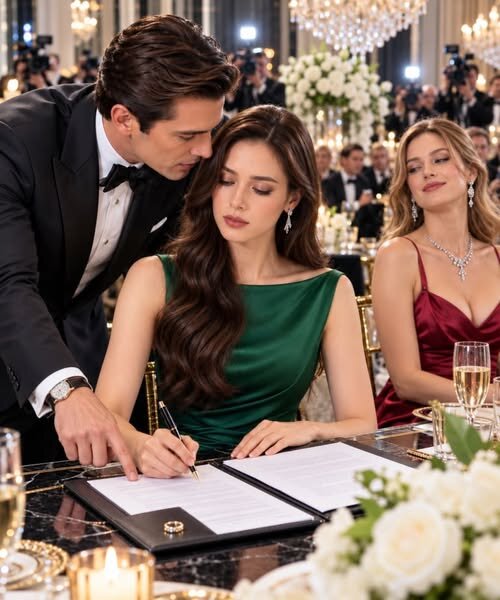
My husband leaned toward me beneath the glittering chandeliers of the Ashford Crown Hotel. To the photographers, we looked like a devoted couple sharing a private moment.
His fingers rested beside the divorce papers on the table.
His voice was almost affectionate.
“Cry beautifully.”
Across from us, Vivian Cross lifted her champagne glass. Emerald silk hugged her figure, and a diamond necklace worth $186,000 glittered against her throat.
My husband’s mistress was wearing jewelry purchased by the company he claimed to love more than anything in the world.
Ashford Luxe had paid for it.
I knew because I had the invoice.
Callum had no idea I knew.
Around us, Manhattan’s wealthiest guests pretended not to stare. They studied the white roses, whispered behind champagne glasses, and waited for the moment the supposedly fragile Mrs. Ashford finally fell apart.
Callum stood and raised his glass.
“Tonight should have been a celebration of thirty remarkable years of Ashford Luxe,” he announced. “But sometimes, life forces us to confront painful truths.”
His voice trembled at precisely the right moment.
I almost admired the performance.
“For months, Sloane and I have struggled. I’ve tried to protect her privacy, to give her space, and to handle our difficulties away from the public eye.”
A sympathetic murmur traveled through the ballroom.
He paused.
“I’ve been patient. I’ve tried everything. But sometimes, love simply isn’t enough.”
Three hundred people watched him play the wounded husband.
Not one of them knew that two hours earlier, his public relations director had discussed the most flattering camera angles for my humiliation.
Not one of them knew that Callum had spent months feeding the press stories about my supposed emotional instability.
And certainly none of them knew that his mistress had been living in a Central Park penthouse paid for through an Ashford Luxe subsidiary.
Callum turned toward me.
“Nathaniel?”
The family attorney approached with a black leather folder.
“The agreement is straightforward,” Nathaniel Pierce said quietly. “You retain the East Seventy-Second Street apartment, along with the agreed settlement.”
I stared at him.
The apartment had belonged to me before I married Callum.
My husband was presenting my own property as though he were bestowing a generous gift.
“Sign the papers,” Callum whispered. “Keep the apartment. Take the money. And we can all move on.”
“What about the truth?”
His smile tightened.
“Don’t make this difficult.”
“I’m not the one who brought divorce papers to an anniversary gala.”
For a fraction of a second, his mask slipped.
Then he leaned closer.
“One final scene, Sloane. Give them what they came to see.”
His eyes moved toward the cameras.
“Be grateful.”
I looked at the forty-seven pages spread before me. Yellow tabs marked every signature line. Tomorrow, the headlines would call me the troubled wife who had finally accepted that her billionaire husband deserved better.
That was the story Callum wanted.
For three years, his mother, Margaret, had chosen my clothes, approved my interviews, dictated my social calendar, and corrected my behavior whenever I embarrassed the family by expressing an independent opinion.
“You’re too emotional,” she would say.
“Let Callum handle the business.”
“People like us must be careful about appearances.”
I had learned to lower my eyes and let them underestimate me.
They mistook my silence for ignorance.
Their greatest mistake was assuming I had nothing to say.
I picked up Nathaniel’s pen and signed.
Callum’s shoulders relaxed.
He thought he had won.
At the third signature, I removed my wedding ring and placed it on the folder.
The tiny click silenced the table.
Then I looked at Nathaniel.
“Before we finish, I’d like you to confirm something.”
“Of course.”
“Section Fourteen of the prenuptial agreement. The morality clause.”
The color drained from his face.
Callum laughed.
“Sloane, don’t be ridiculous.”
I didn’t look at him.
“I’m asking your attorney.”
Nathaniel’s gaze flickered toward Margaret.
She rose so abruptly that the pearls around her neck trembled.
“This is neither the time nor the place.”
“Then perhaps you should have chosen a private room before asking your son to humiliate his wife in public.”
Her lips tightened.
“You have no idea what you’re talking about.”
“Actually, Margaret, I know exactly what I’m talking about.”
A voice behind her interrupted.
“No. She does.”
The ballroom doors opened.
An elderly man entered, leaning on a polished black cane. He wore a tailored suit, and his silver hair was unmistakable.
The whispers began immediately.
“Everett Whitmore?”
“I thought he had disappeared.”
“Isn’t that Sloane’s grandfather?”
My grandfather stopped beside my chair and rested a hand on my shoulder.
Everett Whitmore had built an international investment empire spanning hotels, commercial property, logistics, and finance. Seven years earlier, after losing his only daughter, he had withdrawn from public life.
The Ashfords knew he was my grandfather.
They simply believed his influence had faded and my inheritance was modest compared with their fortune.
They had never understood how much of Whitmore Holdings had been structured to protect my interests.
Grandfather looked directly at Nathaniel.
“My granddaughter asked you a question. I believe you should answer it.”
Callum stared at him.
“Granddaughter?”
Vivian’s fingers slipped against her necklace.
Margaret whispered a single word.
“No.”
I had never seen her look frightened before.
It was almost fascinating.
Nathaniel opened the folder.
“Section Fourteen provides consequences for specified material marital misconduct, including adultery and deliberate reputational harm. It also addresses unauthorized diversion of assets and certain related ownership protections.”
Callum’s expression changed.
“What ownership protections?”
I finally turned toward him.
For years, he had dismissed contracts as documents for lawyers and dismissed me as a woman who could never understand them.
Three days before our wedding, he had skimmed the prenuptial summary and hurried off to his bachelor party.
He had never bothered to ask what Section Fourteen meant.
“Callum,” I said softly, “you should have read what you signed.”
His face hardened.
“You set me up.”
“No. I trusted you.”
I let the words settle.
“You’re the one who decided to make that trust look foolish.”
Julian Maddox, my grandfather’s longtime attorney, stepped forward and placed a document on the table.
“The clause is only part of the problem.”
Callum looked at him.
“What does that mean?”
“It means,” I replied, “that your affair was the easiest thing to prove.”
Vivian’s smile disappeared.
Callum stared at me, searching for the frightened woman he had spent three years convincing the world I was.
I gave him nothing.
“No, Callum,” I said. “You should be asking yourself what I’ve discovered.”
Then my grandfather’s phone vibrated.
Julian glanced at the screen and exchanged a look with him.
The board had called an emergency meeting for the following morning.
And suddenly, Vivian was no longer smiling.
She reached up, unclasped the diamond necklace, and placed it on the table.
Callum watched her do it.
For the first time all evening, he looked genuinely afraid.
## PART 2: THE WIFE WHO KNEW NOTHING
Eleven months into our marriage, I asked Callum why Ashford Luxe was leasing three residential properties through a hospitality subsidiary.
We were returning from a board dinner when I mentioned the unusual expenses.
He laughed so loudly that our driver glanced at us in the rearview mirror.
“Corporate structuring would bore you to death.”
“I studied economics.”
“At Wellesley.”
“Yes, Callum. That’s where I studied economics.”
He squeezed my hand as though I were a child who had asked an amusing question.
“Reading about business isn’t the same as running one.”
I should have recognized the contempt hidden inside his affection.
Instead, I went home and checked the records.
One property was legitimate executive housing. Another had been vacant for fourteen months. The third was a Central Park penthouse leased through an Ashford subsidiary.
Months later, I discovered who lived there.
Vivian Cross.
By our second anniversary, Callum had perfected two personalities. In public, he was attentive, generous, and charming. At home, he was impatient with questions and irritated whenever I made decisions without consulting him.
His mother was worse.
Margaret arranged my wardrobe, selected my stylist, approved my charity appearances, and instructed me on which subjects I should avoid when speaking to reporters.
“You represent the Ashford family now,” she explained. “Everything you do reflects on us.”
Apparently, even my opinions required approval.
The family knew that my mother had been Everett Whitmore’s only daughter. They knew Grandfather had retreated from public life after her death.
What they didn’t know was the extent of his estate or the financial structures established for my benefit.
Before my wedding, Grandfather had taken my hands and said, “I want to know whether Callum loves Sloane before he discovers what Sloane owns.”
At twenty-six, I thought he was being unnecessarily suspicious.
By thirty, I understood.
Callum knew I had inherited money. He simply assumed it was insignificant compared with the Ashford fortune.
I let him believe it.
Then, nine months before the gala, he came home at 2:13 a.m.
I was waiting in the dark kitchen.
His shirt smelled of champagne and another woman’s perfume. A faint smear of rose lipstick marked the inside of his collar.
“Why are you awake?” he asked.
“I couldn’t sleep.”
He sighed.
“Again?”
That word told me everything about the story he was building around me.
Whenever I questioned him, I was anxious. Whenever I noticed inconsistencies, I was paranoid. Whenever I became upset, I was unstable.
“Where were you?”
“Client dinner.”
“Until two in the morning?”
“Sloane, please. Not tonight.”
“Which client?”
His expression hardened.
“You really need to speak to someone.”
Two weeks later, photographs of me leaving a therapist’s office appeared on a gossip website.
The article described me as emotionally fragile and suggested that my marriage was suffering because of my inability to handle the pressures of the Ashford lifestyle.
Callum held me while I cried.
“I’ll take care of it,” he promised.
Months later, I learned that his communications director had quietly confirmed the photographs to the press.
The affair had hurt me.
The deliberate campaign to make me doubt myself was worse.
So I stopped asking questions.
Instead, I collected answers.
I saved invoices, travel records, screenshots, expense reports, and messages. I photographed documents before they disappeared and kept copies outside our apartment.
I shared everything with Julian Maddox.
He spent twenty minutes examining the evidence before looking up.
“What do you want, Sloane?”
“I want to know whether I’m imagining this.”
“You’re not.”
“Then I want the truth.”
“Those are two different things.”
He closed the file.
“Proving an affair is one thing. Proving that a chief executive diverted corporate assets for personal use is something else entirely.”
I glanced at the invoice for Vivian’s necklace.
“Could he lose the company?”
“That depends on the evidence, the contracts, and the board.”
“And Section Fourteen?”
Julian’s expression sharpened.
“You remember it?”
“Every word.”
“Does Callum?”
“No.”
Julian leaned back.
“Then don’t remind him.”
After that, I waited.
Callum grew careless because he believed I had already surrendered.
Vivian moved from consultant to brand strategist. She appeared beside Margaret at charity dinners and sat close to the family at private events.
Margaret made no effort to hide her approval.
“Vivian understands the demands Callum faces,” she remarked one afternoon while a stylist adjusted my dress.
“I’m sure she does.”
Margaret smiled at my reflection.
“Jealousy is an unattractive quality.”
I lowered my eyes.
She mistook my restraint for defeat.
Three months before the gala, I found the penthouse lease. Two months before it, I matched private flights with weekends when Callum and Vivian were both absent. Six weeks before the event, Julian’s forensic team began tracing questionable expenses through Ashford Luxe’s hospitality accounts.
Then Callum asked for a divorce.
He was fastening his watch when he told me.
“I think this would be healthier for both of us.”
“Is there someone else?”
“No.”
The lie came effortlessly.
He offered me the apartment I already owned, along with a settlement that required silence and no public accusations against the company.
“You know how ugly divorces can become,” he explained.
“What happens if I refuse?”
His expression changed.
“Why would you?”
“Because you’re asking me to protect your reputation after you’ve spent months damaging mine.”
For the first time, he looked at me without affection.
“Don’t make this difficult.”
I smiled faintly.
“I wouldn’t dream of it.”
That night, Julian called.
“Ashford’s attorneys have requested documents relating to the prenuptial agreement.”
“Do they know about the evidence?”
“Not yet.”
“What should we do?”
His answer was simple.
“Let them choose the stage.”
They chose the anniversary gala.
They chose the cameras, the audience, the divorce papers, and the public humiliation.
They chose a stage where they believed I had no power.
They had no idea that I had been preparing for it.
## PART 3: THE EMPIRE BEGINS TO SHAKE
By nine the following morning, footage of the gala was everywhere.
At 9:15, news outlets replayed the moment Everett Whitmore entered the ballroom. By ten, financial reporters were questioning Ashford Luxe’s governance and the company’s undisclosed relationships with Whitmore-controlled investment entities.
Callum sent me twenty-three messages.
The first few were furious.
What the hell have you done?
Call me immediately.
You have no idea what you’ve started.
Then came threats from his lawyers, accusations of extortion, and increasingly desperate requests for a private conversation.
At 5:07 a.m., he sent one final message.
I loved you.
I stared at the screen for a long time.
Then I put the phone down.
Grandfather stood beside the window in Julian’s office, looking older than he had the previous night.
“Did you sleep?” I asked.
“At my age, sleep is a negotiation.”
I managed a brief smile.
Then the question I had been avoiding escaped me.
“Did I make a mistake marrying him?”
Grandfather turned toward me.
“No.”
“You answered very quickly.”
“Because I’ve had months to consider it.”
I looked down at my hands.
“He cheated on me. He lied about me. He tried to humiliate me in front of three hundred people.”
“Yes.”
“And you don’t think marrying him was a mistake?”
“I think loving someone who deceives you is painful. I think staying after you understand the truth can become a mistake.”
His voice softened.
“But you didn’t stay because you were afraid to leave. You stayed because you needed to understand what he had done.”
I wanted to believe him.
Before I could answer, Julian entered.
“The board is ready.”
At Ashford Luxe headquarters, reporters crowded the entrance. Cameras flashed as we crossed the lobby.
“Sloane, did you know about the affair?”
“Are you trying to take control of Ashford Luxe?”
“Did Callum misuse company funds?”
“Is Vivian Cross cooperating with the investigation?”
I kept walking.
Inside the elevator, my hands began to shake.
Julian noticed.
“You don’t have to speak unless you choose to.”
“I know.”
The doors opened onto the executive floor.
Callum was already in the boardroom. His tie was crooked, his face exhausted. Margaret sat beside him, while Nathaniel Pierce arranged documents in front of the independent directors.
Callum looked at me.
“Can we speak privately?”
“No.”
His jaw tightened.
“Sloane.”
“You wanted witnesses last night.”
“This is a business meeting.”
“Exactly.”
I took the seat opposite him.
Julian began presenting the findings.
The penthouse lease. Private flights. Jewelry. Hotel expenses. Consulting invoices. Reimbursements charged to corporate accounts.
Callum challenged every item.
“The flights were for business development.”
“Vivian was a legitimate consultant.”
“The residence was intended for executive use.”
“Client gifts are normal in luxury hospitality.”
Julian placed the necklace invoice in front of him.
“Who was the client?”
Callum didn’t answer.
I opened my own folder.
“The expenses were recorded as corporate rather than personal,” I explained. “The flight records don’t support the stated business purposes. The penthouse had no documented executive occupant other than Vivian. And the necklace was charged to a discretionary hospitality budget.”
Callum stared at me.
“You went through my accounts?”
“No. I reviewed records relevant to the company’s financial interests.”
“You had no authority.”
An independent director interrupted.
“Under the Whitmore financing agreements, specified inspection rights exist under certain conditions.”
Callum turned toward his mother.
“What financing agreements?”
Margaret closed her eyes.
Everett answered.
“When your father expanded Ashford Luxe fourteen years ago, the company needed additional capital.”
“My father raised that money privately.”
“Yes.”
Grandfather rested his hands on his cane.
“From me.”
Callum stared at him.
“No.”
“Through several investment vehicles. Your mother was aware of the arrangements.”
He turned toward Margaret.
“Is that true?”
She looked suddenly exhausted.
“Your father did what he believed was necessary to protect the company.”
“How much?”
“Callum—”
“How much?”
Everett answered.
“Enough that certain breaches can trigger contractual rights.”
Silence filled the room.
Callum finally understood that the company he believed belonged entirely to his family had long depended on capital connected to mine.
“You planned this,” he accused.
I looked at him.
“No.”
“You waited until you had everything.”
“I waited until I had the truth.”
“You could have confronted me.”
“I did.”
He opened his mouth, then closed it.
I continued.
“I asked where you were. I asked about the expenses. I asked whether there was someone else. Every time, you told me I was imagining things.”
His eyes flickered.
“You made people believe I was unstable,” I said. “You used my private life to protect your public image.”
“That wasn’t how it happened.”
“Then explain how it happened.”
He looked toward Nathaniel.
No one came to his rescue.
I stood.
“I spent months wondering what I had done to make you treat me this way. I questioned my judgment, my memory, and my worth. Meanwhile, you were using company money to maintain an affair and telling the world that I was the problem.”
Callum’s face reddened.
“You’re destroying everything my family built.”
“No. I’m showing the board what you did with it.”
“You want revenge.”
For a moment, I considered the accusation.
There had been nights when I imagined Callum losing everything. I had pictured Margaret being forced to answer questions she had spent years avoiding. I had imagined Vivian reading headlines that exposed her role.
But sitting across from him, I felt no triumph.
Only exhaustion.
“I wanted you to stop lying about me.”
His expression softened for a moment.
“Sloane—”
“You could have left me. You could have told me the truth. You could have ended our marriage without turning me into a public spectacle.”
“I know.”
“Do you?”
He lowered his eyes.
“I made mistakes.”
The word was too small.
“You made choices,” I corrected.
The chair called for a recess.
Callum followed me into the corridor.
“Sloane, wait.”
I continued toward the elevators until he caught my arm.
“Let go of me.”
He released me immediately.
“You’re going to destroy the company.”
“I’m not the one who charged his mistress’s jewelry to corporate accounts.”
“You think Whitmore is innocent? You think your grandfather built an empire by being kind?”
“This isn’t about kindness.”
“You want to punish me.”
I studied his face.
“No. I want you to stop being protected from the consequences of your own decisions.”
His expression shifted.
“I didn’t want this to happen.”
“You wanted the divorce. You wanted the cameras. You wanted me to cry.”
My voice broke slightly.
“You just didn’t want me to have a choice.”
For several seconds, neither of us spoke.
Then his phone rang.
He looked at the screen.
“Vivian?”
He answered sharply.
“What did you do?”
He listened.
“What agreement?”
His face lost its color.
“No. You cannot release anything. Vivian, listen to me.”
Another pause.
Then the call ended.
Margaret emerged from the boardroom.
“What happened?”
Callum stared at his phone.
“She’s hired a lawyer.”
“And?”
His voice was almost inaudible.
“She says she’s not taking the fall for me.”
For the first time, my husband understood that the woman he had chosen over me might not be willing to sacrifice herself for him.
And he was about to discover how much she knew.
## PART 4: THE MISTRESS WHO KEPT RECEIPTS
Vivian wasn’t my ally.
She had knowingly entered a relationship with my husband, accepted expensive gifts, and enjoyed the advantages of being welcomed into the Ashford family while I was treated as an embarrassment.
But she had no intention of becoming the sole scapegoat for Callum’s misconduct.
Three days after the board meeting, her attorney contacted Julian. Vivian would cooperate with the independent investigation, provide records of expenses Callum had approved, and answer questions about the penthouse, the flights, and the necklace.
She wanted to protect herself.
Not redeem herself.
We met in Julian’s office.
Vivian wore a plain cream blouse and dark trousers. Without the emerald silk and diamond necklace, she looked less like a society darling and more like someone who had finally realized how expensive her choices could become.
“I assume you hate me,” she said.
“I don’t know you well enough to hate you.”
She looked startled.
“Did you know Callum was married?”
“Yes.”
“Did you know he was lying to me about you?”
She hesitated.
“Yes.”
I nodded.
“Then don’t ask me to separate your part from his.”
“I’m not.”
“Good.”
She folded her hands.
“He told me your marriage was over.”
“Did he?”
“He said you refused to accept it. That you were financially dependent on him and couldn’t manage your inheritance.”
I almost smiled.
That was Callum’s favorite portrait of me: a woman wealthy enough to be useful, but too helpless to be dangerous.
“Why did you believe him?”
“Because I wanted to.”
Her answer was more honest than I expected.
She slid several printed conversations across the table.
“What are these?”
“Messages approving the expenses. Flight arrangements. The necklace. Some of the invoices.”
I looked at the papers.
“Why did you keep them?”
“Because I knew he could turn on me.”
At least Vivian understood one thing about my husband.
She had protected herself in the same way I had: by keeping evidence.
One message stopped me cold.
Vivian had written to Callum: Sloane looked upset tonight. Does she know?
His reply was brief.
She suspects. Doesn’t matter. Everyone already thinks she’s unstable. If she makes noise, it proves the point.
I read it twice.
For months, I had tried to understand how Callum could watch me suffer and still convince himself he was the victim.
Now I had my answer.
He had built a story in which my pain was evidence against me.
If I cried, I was unstable.
If I questioned him, I was jealous.
If I defended myself, I was vindictive.
There had been no winning because he had designed the rules to ensure that I could never win.
Vivian watched me put the message down.
“I didn’t respond.”
“You didn’t object either.”
“No.”
“Why?”
She looked at her hands.
“Because I wanted him to choose me.”
I believed her.
That didn’t mean I forgave her.
The investigation lasted twelve days. The findings were more complicated than the headlines suggested. Some expenses were legitimate business costs. Others lacked adequate documentation or had been improperly classified. The problem was not simply the money. It was the approvals, the concealment, and the use of corporate resources for personal benefit.
Ashford Luxe had thousands of employees who had nothing to do with Callum’s affair.
I didn’t want them punished for his behavior.
On the seventh night of the investigation, I found Grandfather making tea in his townhouse kitchen.
“You’re doing that wrong,” I told him.
He looked offended.
“I have been making tea longer than you’ve been alive.”
“You’re boiling it to death.”
“It is water.”
“That’s not a defense.”
He handed me the kettle.
For a few minutes, we talked about nothing important. Then he mentioned that Callum had requested a private meeting.
“Do you think I should see him?” I asked.
“That isn’t my decision.”
“Do you think I should forgive him?”
Grandfather considered the question.
“Forgiveness is not the same as allowing someone back into your life.”
I looked at him.
“And what if I still love him?”
“Then you still love him.”
He said it without judgment.
“Feelings do not disappear simply because someone has proved unworthy of your trust.”
The words stayed with me.
The following afternoon, Callum arrived.
He looked thinner, tired, and strangely ordinary without the confidence that had once filled every room he entered.
We sat across from each other in the library where he had proposed to me.
“I remember this room,” he said.
“So do I.”
“You wore blue that night.”
I hadn’t expected him to remember.
For a moment, the man before me was the one who had brought me coffee while I studied, danced barefoot with me in the kitchen, and held my hand at my mother’s memorial.
Those memories were real.
That was what made everything so difficult.
“I did love you,” he said.
I looked at him.
“I think you believe that.”
“You don’t?”
“I think you loved the way I made you feel.”
His expression tightened.
“That’s unfair.”
“You liked that I wasn’t impressed by your name. Then we married, and you spent three years trying to make me feel small enough to need it.”
He looked down.
“I made mistakes.”
“You keep calling them mistakes.”
“What should I call them?”
“Choices.”
He was silent.
Finally, he looked up.
“I cheated. I lied. I used company money. And I made people doubt you.”
The last admission hurt more than the others.
“Why?”
He rubbed his forehead.
“I don’t know.”
For once, he wasn’t offering an excuse.
I stood, wiping the tears from my cheeks.
“Do you remember the gala?”
His face changed.
“You asked me to cry beautifully.”
“I was angry.”
“No. You were confident.”
He looked away.
“You thought you could control the way everyone saw me. You thought that if you made me look weak enough, no one would believe me.”
“Sloane—”
“You didn’t just betray our marriage. You tried to take away my right to tell my own story.”
He rose.
“What happens to Ashford Luxe?”
Even then, he returned to the company.
I gave him a sad smile.
“The board will decide.”
“You could stop your grandfather.”
“I won’t interfere to protect you from consequences you created.”
“So this is revenge.”
“No.”
I stepped closer.
“Revenge would be destroying Ashford Luxe because it carries your name. Thousands of people work there. They didn’t cheat on me. They didn’t lie about me. They didn’t buy Vivian’s necklace.”
He stared at me.
“I want the company protected from you.”
For the first time, he seemed to understand the difference between losing a company and losing control.
“You planned all this,” he whispered.
“No.”
I looked at the man I had once trusted with everything.
“I planned to survive you.”
He left without another word.
That evening, Julian called.
“The board will vote tomorrow.”
“And Section Fourteen?”
“Your position is significantly stronger. The evidence supports the contractual remedies available to you, though the final outcome depends on the agreements and the board’s decisions.”
“What happens to Callum?”
“That’s what tomorrow will determine.”
I ended the call and looked out over Manhattan.
For three years, I had believed that leaving my marriage meant losing the life I had built around it.
Now I understood that I had been trying to save something that was already gone.
The only question left was what I would choose to keep.
## PART 5: THE CLAUSE HE SHOULD HAVE READ
At 11:42 the next morning, the board removed Callum Ashford as CEO.
I wasn’t in the boardroom when the vote was announced.
I was sitting in a quiet office, watching the sunlight move across the floor, when Julian appeared in the doorway.
He nodded once.
“It’s done.”
There was no applause. No dramatic collapse. No guards dragging Callum from the building.
There was only a decision.
The independent directors had concluded that Callum’s handling of corporate expenditures and his failure to maintain appropriate governance standards created unacceptable risks for Ashford Luxe. The Whitmore-linked entities then exercised the contractual rights available to them under existing agreements.
The company survived.
Its hotels remained open. Its employees kept their jobs. The Ashford name stayed on the buildings.
Callum simply lost the unquestioned control he had mistaken for ownership.
Our divorce was finalized privately.
Section Fourteen weakened the settlement protections he had expected to rely upon, while the evidence strengthened my legal position. I retained my apartment and secured a correction of the false claims about my mental health.
Callum fought the correction harder than some of the financial terms.
That told me everything.
Money could be earned again.
But admitting that he had deliberately damaged my reputation meant acknowledging that I had never been the woman he had described.
Eventually, he signed.
Three weeks later, I returned to my apartment on East Seventy-Second Street.
Most of Callum’s belongings were gone. One box remained in the bedroom closet, filled with photographs from our marriage.
Our wedding.
A holiday in Italy.
Christmas with Grandfather.
Callum asleep with his head in my lap while I read.
Me laughing at something outside the frame.
I sat on the floor and looked through every picture.
Some memories were beautiful.
That was the hardest part.
His coffee deliveries had been real. So had the late-night conversations, the tenderness after my mother’s funeral, and the comfort I had felt in his arms before I knew what he was capable of.
Perhaps he had loved me once.
Perhaps he had even loved me while he was betraying me.
But love did not excuse deliberate cruelty.
One truth did not cancel the other.
I pulled on an old T-shirt, pressed my face into a pillow, and cried until my nose ran and my eyes burned.
There was no audience.
No camera.
No one telling me how a respectable woman should grieve.
For the first time in years, I didn’t have to make my pain beautiful for anyone.
Six months later, Ashford Luxe appointed a permanent CEO from outside the family.
Grandfather offered me a seat on the board.
I declined.
“You spent a year learning that company,” he observed over breakfast.
“I spent a year learning my husband.”
“There is some overlap.”
I laughed despite myself.
Then I set down my coffee.
“I don’t want my next decision to be about Callum.”
Grandfather studied me before nodding.
“Good.”
I eventually took a more active role in overseeing the Whitmore interests held for me. Not because I wanted to build an empire of my own, but because I had learned how dangerous it was to treat ownership as an ornament.
I read the agreements.
I questioned vague answers.
I asked why expenses had been approved and who benefited from them.
And I never apologized for understanding the details.
Vivian disappeared from the society pages for a while. Eventually, I heard she had resumed consulting work elsewhere.
We never became friends.
I didn’t need her apology to move forward, although when she offered one, I believed she meant it.
Margaret never apologized.
Several months after the gala, she called me.
“You can still stop this,” she said.
“The board has already made its decision.”
“You have influence with Everett.”
“So do you, apparently. You knew about the financing arrangements.”
Silence.
“I was protecting my family,” she finally replied.
I looked at the pale line on my finger where my wedding ring had rested.
“So was I.”
“You are no longer an Ashford.”
For once, the words didn’t hurt.
“No,” I said. “I’m not.”
She hung up.
I stood by the window for a long time afterward, thinking about the woman I had been when I married Callum.
She had trusted him.
She had believed his kindness.
She had mistaken his confidence for strength and his attention for devotion.
I refused to blame her for that.
She had loved someone who had not yet shown her the full extent of his character.
That wasn’t stupidity.
It was being human.
Near midnight, I stepped onto the terrace overlooking Manhattan. Grandfather followed me outside.
“Cold?”
“A little.”
He began removing his coat.
“I don’t need it.”
“I wasn’t offering it. This is Italian.”
I laughed, and he smiled.
We watched the city for a while before he asked the question I had been avoiding.
“Do you regret it?”
“Which part?”
“Any of it.”
I thought about the wedding, the affair, Vivian’s necklace, Margaret’s pearls, the divorce papers, and the expression on Callum’s face when Grandfather entered the ballroom.
Then I thought about the woman I had been before everything fell apart.
“I regret what Callum chose to do,” I answered. “But I don’t regret loving him before I knew the truth.”
Grandfather nodded thoughtfully.
“That sounds expensive.”
“It was.”
He laughed.
Through the glass doors, I could see the city lights reflected in the ballroom windows. I remembered Callum’s carefully prepared speech, the photographers, and the divorce papers arranged like props.
He had controlled the guest list, the timing, the attorneys, and the story he wanted the world to believe.
He had assumed that because I was quiet, I had nothing to say.
Because I was patient, I would never act.
Because I loved him, I would protect him no matter what he did to me.
He was wrong about all three.
His affair hadn’t destroyed him. Neither had Vivian, my grandfather, or a single paragraph in a prenuptial agreement.
What changed everything was the evidence he believed I was too ignorant to collect, the questions he assumed I was too timid to ask, and the truth he thought he could bury beneath a beautiful performance.
Section Fourteen gave me leverage.
The records gave me proof.
But I was the one who had to decide what to do with them.
Callum wanted me to cry beautifully so that he could leave the ballroom looking like the patient, generous husband who had finally escaped a troubled wife.
Instead, I signed the papers, removed my ring, and asked one question.
He had spent three years telling me I knew nothing about business.
In the end, he learned that I knew enough to read the contract he had ignored.
And I knew enough to walk away.
Callum got his gala.
He got his cameras, his audience, and his dramatic announcement.
But he never got the ending he had planned.
Because the woman he expected to break had stopped asking him for permission to stand.
And the clause he had forgotten was only the beginning.

