
# My Husband Said, “They’ll Bring a Cake.” So I Refused to Buy Meat and Charcoal for Twelve People…
“Larisa, my kids are coming on Saturday,” Viktor announced without looking up from his phone. “All three of them, with their families.”
Larisa stood at the sink, washing cherries. The water rushed into the colander, and the ripe berries tapped against its bottom.
“All three?” she asked. “That means twelve people, Viktor.”
“So what? They miss their father. It’s summer, we have the country house. They can’t spend the whole weekend sitting in their apartments!”
“Saturday is the day after tomorrow.”
“Yeah. Artyom texted me. They’ll be here around noon. Kostya might arrive a little later because he’s working a shift. You know how Kostya is.”
Larisa knew them all very well. Artyom, Sveta, Alina, Denis, Olga, and Viktor’s six grandchildren: Miron, Eva, Vasilisa, Timofey, and the twins, Mark and Marta.
She knew their preferences by heart, too. Who refused to eat onions, who wanted compote without fruit, who needed a separate portion without spices, and who would eat nothing except macaroni and cheese.
She dried her hands and sat down on a kitchen stool.
“Vitya, are they bringing anything?”
“What do you mean?”
“Exactly what I said. Meat. Vegetables. Anything at all?”
“Larisa, come on. They’re visiting their father. What do you expect them to do, travel with pots and pans? They’ll bring a cake, as always.”
“A cake,” she repeated with a nod. “One cake for twelve people.”
“There’ll be plenty of food. You’ll cook, as usual.”
And that was that. He said it as casually as if he were asking her to turn on a light.
*You’ll cook, as usual.*
Six years earlier, during the first summer after their wedding, Larisa had gone out of her way to make a good impression. She had worried that Viktor’s children might think their father had made a mistake by marrying her.
She got up at five in the morning, marinated the meat, baked pies, prepared several dishes, washed the veranda windows, and laid out the beautiful tablecloth she had been saving for special occasions.
The children arrived at one. They ate, went down to the river, returned and ate again, then left at nine in the evening because they had to get up early the next day.
Larisa finished washing the dishes at half past midnight.
Viktor was already asleep.
“Larisa, you’re a magician!” Alina, Artyom’s wife, exclaimed as she said goodbye. She kissed the air beside Larisa’s cheek. “What a feast! We ate so much!”
That phrase—*you’re a magician*—became a family tradition. Every summer, someone said it, almost word for word.
By the third year, Larisa knew the routine by heart.
Three families arrived. They brought one cake and plenty of good cheer. Everyone enjoyed themselves, everyone ate until they could barely move, and everyone went home refreshed.
Everyone except Larisa.
She bought the meat herself, usually four kilograms because Artyom ate a lot and Denis ate even more. She bought the charcoal, vegetables, herbs, bread, mineral water, juice for the children, and beer for the men.
She prepared everything, remembered everyone’s preferences, and made sure no one went home hungry.
One Saturday gathering cost her at least twelve thousand rubles.
Back when she still bothered to keep track.
“Why don’t you ask them to contribute?” Nina, her friend and coworker, once suggested.
“How could I ask? I’m not their mother or their mother-in-law. I’m just their father’s wife.”
“And what are you now?”
Larisa laughed bitterly.
“A magician.”
The truth was that she genuinely wanted Viktor and his children to have a good relationship. She didn’t want anyone accusing her of coming between them or making their father forget his family.
So she baked raspberry pies because Sveta loved raspberries. She kept homemade dumplings in the freezer because the twins refused to eat anything else. She even planted three extra rows of cucumbers because everyone wanted to take jars of her lightly salted pickles home to their own apartments.
Then came the previous June.
That month, Larisa hurt her back while carrying heavy buckets to the greenhouse. For three days, she could barely straighten up without doing it in stages.
The guests arrived at noon, as always.
She had been on her feet since six in the morning.
By four o’clock, most of the food was gone. The children went to the river with Denis, while the men settled into the shade.
Larisa stepped onto the veranda to collect the empty plates. As she approached, she heard Alina talking to Olga.
“I love coming here. It’s like staying at a resort. You arrive, everything is ready, everything is clean, and all you have to do is eat!”
“You’re lucky,” Olga sighed. “I spent half of yesterday in the kitchen at my place.”
“Well, you have your mother. You’re supposed to help her. But Larisa…” Alina lowered her voice, although not nearly enough. “She enjoys it. She’s home all day. What else does she have to do? Pick cucumbers and bake pies? She should be grateful we visit. Otherwise, she and Viktor would just sit in front of the television together.”
Larisa stood motionless, holding the plates.
They felt heavy. Her back was throbbing. And all she could think was that she did not spend her days sitting at home.
She had worked as an accountant for a property management company for twenty-eight years. She had taken two unpaid days off specifically to prepare for this visit.
Yet she said nothing.
She carried the plates inside, made another batch of compote, and stayed up until half past one cleaning the barbecue grill.
Artyom had simply told his father, “Tomorrow, Dad. Come on, we’re not doing that tonight.”
The next morning, they left at nine.
Half the honey cake remained. Alina packed it up and took it home.
“Otherwise, it’ll go bad,” she explained. “Eva loves it.”
On Monday, Larisa visited a neurologist.
“You have a disc protrusion in your lower back,” the doctor told her, studying the scan. “Nothing catastrophic, but you must avoid heavy lifting and standing at the stove for ten hours a day. What you do from here is up to you. I’m not your supervisor.”
She carried those words with her for an entire year.
*What you do from here is up to you.*
Her daughter, Zhenya, tried to persuade her to stand up for herself.
“Mom, just tell them directly. Tell them to bring groceries!”
Zhenya lived in Voronezh, worked at a veterinary clinic, and visited only twice a year.
“They’ll be offended,” Larisa replied.
“Offended by what? By being expected to bring something when they visit? Mom, that’s completely normal!”
“It’s normal for you and me. But to them, I’m just Aunt Larisa, with her house, her cucumbers, and her two hands.”
“Then stop being Aunt Larisa with the two hands for once!”
Larisa fell silent.
“Your father will get angry.”
“Viktor Sergeyevich isn’t my father,” Zhenya said gently. “And he isn’t your boss, either. Mom, you’re fifty-three. Are you planning to cook for them until you’re seventy?”
That evening, Larisa sat on the porch long after sunset. The air smelled of lilacs and barbecue from the neighboring property.
She wasn’t thinking about the meat or the twelve thousand rubles.
She was thinking about the fact that, in six years, not one of Viktor’s three children had ever asked her a simple question.
“Larisa, aren’t you tired?”
Not once.
And the most painful part was that if they had asked, she probably would have smiled and said everything was fine. She would have told them to relax and enjoy themselves.
But nobody had even bothered to ask.
On Thursday, she finally told Nina everything at work.
“Twelve people,” Nina repeated. “And one cake.”
“One cake.”
“Larisa, do they at least bring napkins?” Valya from the neighboring office chimed in. “My son-in-law once brought a packet of napkins to his mother-in-law and bragged about his generosity for six months!”
The women laughed, but there was little humor in it.
“My mother-in-law spent forty years cooking and washing for everyone,” Valya said. “When she became bedridden, guess who visited her? Me. Her own children called once a month to tell her to hang in there.”
Nina turned to Larisa.
“See? You’re not a family member to them. You’re the staff. Nobody visits the staff. They show up when they’re hungry.”
“Thanks, Nina. That’s very comforting.”
“I’m not trying to comfort you. I’m trying to make you understand. You can talk until you’re blue in the face, and they’ll nod, then show up with another cake. You have to show them what it looks like when you stop doing everything.”
“How?”
“Simple. No shouting, no slamming doors. Put exactly what they bring on the table. Then sit down beside them.”
Larisa went pale just imagining it.
“Viktor will kill me!”
“He won’t. He’ll sulk for a while, then eat your pies. You’re fifty-three. In ten years, you’ll be just as kind, except your back and knees will be ruined. And eventually, they’ll stop visiting because there’ll be nobody left to feed them.”
That last sentence hit her harder than anything else.
Not the thought of her aching back.
The thought that one day they might stop coming altogether.
That evening, she picked up her phone and stared at it for nearly twenty minutes. Finally, she called Kostya, Viktor’s youngest son.
“Hello, Kostya. Are you coming on Saturday?”
“Of course. Why? Has something changed?”
“No. I wanted to ask you something. Could you bring three kilograms of meat for the barbecue and a bag of charcoal?”
“Sure. Got it. Anything else?”
Larisa was so surprised that she hesitated.
“Bring plenty of water and some juice for the children.”
“Okay. Should I get tomatoes, too? They have some good ones at the market.”
“Yes, please.”
The conversation lasted thirty seconds.
Larisa sat staring at her phone for another three minutes, wondering why such a simple request had felt like a monumental achievement.
Sveta was more difficult.
“Oh, we were hoping to travel light,” her stepdaughter said hesitantly. “You know how much stuff you have to pack with the children…”
“Sveta, could you make a couple of salads? You make them so well.”
“All right. I’ll do that. Larisa, you’re not upset with us, are you?”
“No.”
“You sound different.”
Artyom was the last person she called. But Alina answered the phone.
“Artyom is in the shower. Is something urgent?”
“No. Alina, I wanted to ask if you could bring four kilograms of meat for the barbecue and a bag of charcoal on Saturday.”
There was a three-second pause.
“What do you mean?” Alina asked, her voice suddenly very controlled. “We’re coming as guests, not attending a corporate event where everyone has to contribute money. We’re visiting Dad! He raised those children, and they’ve been coming to see him for twenty years. Nobody has ever given us a list of assignments before!”
“I’m not giving you an assignment. I’m making a request.”
“Well, we’ll see what we can manage.”
Larisa knew exactly what that meant in Alina’s vocabulary.
*No.*
Viktor came home that evening, ate dinner, and sat down opposite her.
“Alina called me.”
“I thought she might.”
“Larisa, why did you have to do that? Now they’ll think we’re broke.”
“We’re not exactly swimming in money. We helped Zhenya pay down her mortgage, remember? And the roof over the veranda needs replacing. The roofer quoted us one hundred and twenty thousand rubles, and he said that was a very reasonable price.”
“But they’re my children!”
“Artyom is thirty-three. He works as a car dealership manager, and his car is newer than ours. Kostya works shifts. Denis drives a taxi for twelve hours at a time. I know they’re busy, Viktor. But they’re grown adults!”
“You’ve started talking like a market trader. You count every little thing!”
“I’m an accountant. I’ve been counting things for twenty-eight years.”
He got up and went into the living room. A moment later, she heard him mutter under his breath:
“You’ve humiliated me in front of my children…”
Larisa continued washing the dishes.
Spending twelve thousand rubles of their shared money to feed twelve people was apparently perfectly acceptable.
Asking those people to bring the meat was a disgrace.
On Saturday, Larisa got up at seven.
Not five.
Seven.
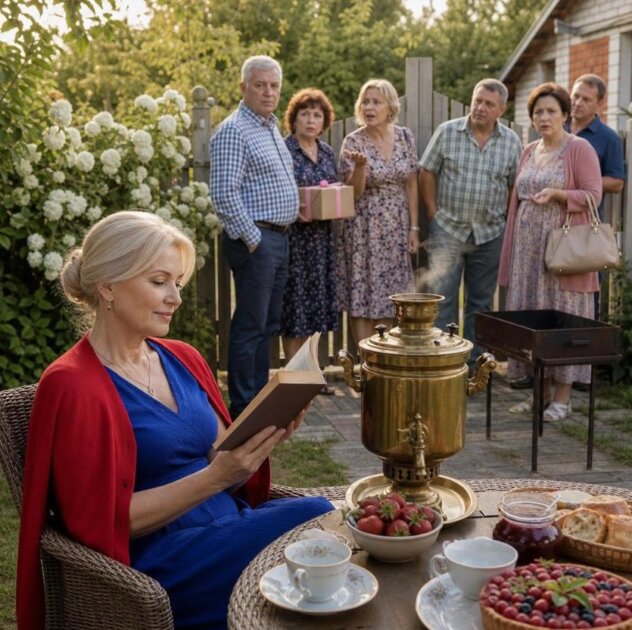
She baked two pies, one with raspberries and one with cabbage. She brought a jar of lightly salted cucumbers up from the cellar, sliced bread, prepared the samovar, cleaned the veranda, and arranged the cups, candy dish, and homemade jam on the table.
Everything looked lovely.
And that was all.
She bought no meat. She bought no charcoal. She put no large pots on the stove.
Viktor came outside at half past eleven and stared at the table.
“What… is this?”
“Tea.”
“Larisa!”
“What? I called everyone and asked them to bring something. I’ve brought my share: the house, the pies, the cucumbers, and the samovar. The rest will arrive with everyone else.”
“And what if it doesn’t?”
“Then we’ll drink tea. With cake. There’s always cake.”
Viktor stood there for a moment, then stormed into the yard and began moving the barbecue grill around with exaggerated force.
Artyom and Alina arrived first.
Miron and Eva immediately ran toward the swings. Alina stepped out of the car wearing white trousers and carrying a large box.
“Hello, everyone! We brought a honey cake!”
She had nothing else.
“Hello, my darlings!” Larisa kissed the children and accepted the box. “Artyom, where’s the meat?”
Artyom scratched the back of his neck.
“Well, Larisa… We stopped at the store, but the checkout line was so long that we figured you’d probably already bought everything.”
“I haven’t.”
“Nothing at all?” Alina asked incredulously.
“Nothing at all. Come inside. The tea is hot, and the pies are fresh.”
Twenty minutes later, Sveta arrived with Denis, Vasilisa, and Timofey.
Sveta was holding a shopping bag.
“We brought salad!”
Larisa peeked inside. It contained a small container of crab-stick and corn salad, enough for about two people.
“Thank you, Sveta. That’s very thoughtful.”
Kostya arrived last, around one o’clock. He climbed out of his battered car, opened the trunk, and started unloading supplies: two five-liter bottles of water, bread, juice, tomatoes, cucumbers, three kilograms of marinated pork neck, and a bag of charcoal.
“Hello, Larisa! Olga, give me a hand, will you? I brought a little of everything, just in case. Artyom always forgets something.”
Larisa walked over and hugged him.
Kostya looked surprised, but he hugged her back.
At half past one, everyone sat down at the table.
There was the samovar, the two pies, a jar of cucumbers, a dish of candy, the small container of salad, and the honey cake.
The six children stared at the spread with wide eyes.
“Where’s the barbecue?” Miron asked.
“The barbecue will be ready when the men cook it,” Larisa replied calmly. “Uncle Kostya brought the meat and charcoal. One bag won’t be enough for everyone, though. Artyom was supposed to bring another one.”
Viktor’s face turned red.
“Larisa, enough already!”
“I called Alina on Thursday and asked her to bring the meat. I haven’t let anyone down, Viktor. For once, I simply haven’t rescued everyone by doing their share of the work.”
The silence was so complete that they could hear a dog barking in the neighboring yard.
Denis finally stood up.
“Right. I’ll go to the store. Where is it?”
“Lugovoye, seven kilometers away,” Kostya answered. “I’ll go with you. We’ll split the cost.”
“Wait a minute!” Alina interrupted. “Why should we have to go shopping? We came as guests! We’ve been getting the children dressed and ready since six this morning!”
“I’ve been baking pies since six this morning,” Larisa replied.
“But nobody forced you to!”
“Exactly. Nobody did. For six years, nobody did.”
Alina looked at her husband. Artyom stared down at his plate.
“Artyom, say something!”
He sighed.
“Honestly, Larisa is right. We really do show up with nothing but a cake every time.”
“We only see Dad twice a year!” Alina protested. “Are we supposed to pay for visiting him now?”
“It’s not about the money,” Larisa said quietly. “I’ve always managed to find the money somehow. I’ve done it all my life. It’s the exhaustion, Alina. My back hurts. The doctor told me not to spend ten hours a day standing at the stove. Last year, I finally realized something: I’m not obligated to do all of this alone. I’ve simply gotten used to it.”
Denis and Kostya drove to the store and returned with more charcoal, dumplings, ketchup, and ice cream for the children.
Olga silently took the tomatoes into the kitchen and began washing them.
Sveta stood there for a moment, blinking in confusion. Then she suddenly asked:
“Larisa, would you like me to peel the potatoes?”
“There are some in the shed, in a bucket.”
“How many should I peel?”
Larisa settled into the armchair on the veranda.
“Enough for twelve people.”
She sat down.
In the middle of the day.
With guests in her house.
For the first time in six years.
Then she took out a book. It was an ordinary detective novel with a torn cover, but holding it in her hands felt wonderful.
Later, Alina wandered around the yard, taking pictures of the children on her phone. Eventually, she sat down beside Larisa.
“Larisa… I think I was too harsh earlier.”
“It happens.”
“It’s just that my mother always did everything herself. Always. Whenever we arrived, the table was overflowing with food. She hardly ever sat down. She was always running around, making sure everyone had everything they needed. I suppose we got used to thinking that was how things were supposed to be.”
Larisa thought for a moment.
“How is your mother doing now?”
Alina lowered her eyes.
“She has high blood pressure. She hasn’t invited us to her country house for two years because she says it’s too tiring. We were actually offended.”
“Did you ever ask her why she stopped inviting you?”
Alina was quiet for a long moment.
“No. We never thought to ask.”
Larisa nodded.
She wasn’t angry anymore. She only felt an uncomfortable sadness at the thought of another woman, somewhere in another town, who had perhaps stopped inviting her children because she no longer had the strength to serve them.
At four o’clock, the barbecue finally went on the grill.
Artyom took charge because Viktor had become so offended by the entire world that he was lying in the hammock.
“Dad, what’s wrong with you?”
“Nothing. I’m relaxing. Apparently, I’m not allowed to do anything here anymore!”
“Dad, nobody said you couldn’t relax. But nine people are working while you lie in the hammock. Come on, at least help turn the skewers!”
With a grunt, Viktor climbed out.
In the end, they had a wonderful meal.
Olga boiled the dumplings. Denis fried potatoes with onions and bacon. Sveta chopped the tomatoes and cucumbers, while the children carried bread to the table.
The pies disappeared in minutes. The cucumbers went just as quickly. Everyone ate the honey cake down to the last crumb, and nobody packed any leftovers to take home.
Then, at eight o’clock, something happened that Larisa had not witnessed in six years.
Alina stood up and started collecting the plates.
“Olga, come on, let’s wash the dishes. Sveta, bring everything in from the table!”
Three women worked together in the little country-house kitchen while Larisa sat on the veranda, listening to them laugh about something of their own.
Timofey fell asleep on her lap.
The air smelled of charcoal and evening grass.
By half past ten, not a single plate remained in the yard. Kostya cleaned the barbecue grill, and Denis took the garbage with him to throw away on the way home.
Before leaving, Sveta hugged Larisa tightly.
“Thank you for everything. And please forgive us, okay?”
“Come again,” Larisa replied.
For the first time in six years, she said it and genuinely meant it.
The argument began as soon as the last car door slammed shut.
“Well, you certainly made a mess of things!” Viktor paced around the kitchen. “My children came to visit their father, and you made them peel potatoes!”
“Didn’t you enjoy the day?”
“That’s not the point! You made me look like a beggar in front of my own children! A tea table and one cake! Is that how you welcome guests?”
“One cake,” Larisa repeated. “That’s exactly what I told you on Tuesday. One cake for twelve people. I simply showed everyone what happens when they assume I’ll provide everything.”
“This is a house! You’re supposed to welcome guests properly!”
“This is my house,” Larisa said quietly.
Viktor fell silent.
“My parents’ house. I grew up here.”
“Oh, here we go again! ‘My house, my house!’ I repaired the fence, didn’t I?”
“Yes. Once, two years ago, with Kostya. Thank you for that.”
She folded the dish towel.
“Viktor, this isn’t about the fence. It’s about the fact that my contribution to this family is measured only in clean pots and cooked meals.”
Viktor sat down.
He was silent for a long time. Then he said the very thing Larisa had been expecting—and dreading.
“By the way, I’ve been thinking. Maybe we should transfer the country house to Artyom. He’s the eldest. He has a family to support. You and I don’t need that much anymore.”
Larisa turned toward him very slowly.
“So that’s what this is about.”
“You’ve misunderstood!”
“No. I understand perfectly.”
On Monday, during her lunch break, she walked into a law office across the street from work. She had passed it every day for twenty years without ever stepping inside.
The lawyer examined her inheritance certificate and the property registry extract.
“You inherited the house and land before your marriage,” he explained. “Under family law, this is your separate property. It is not part of the marital estate and cannot be divided in a divorce. Only you, as the owner, can decide what happens to it. Neither your husband’s wishes nor his consent can replace your own decision and signature. He cannot sell it, give it away, or transfer it into someone else’s name without your personal authorization.”
“So that’s it?”
“That’s it. If you decide to gift the property to one of your children, we can prepare the documents. If you don’t want to, nobody can force you.”
Larisa walked back to work with a smile on her face.
Not because she was happy.
But because, after many years, she finally understood exactly where *we* ended and *I* began.
Viktor sulked for nine days.
On the tenth day, he came home from work, lingered awkwardly in the hallway, and finally spoke.
“Larisa, how about we go to the country house on Saturday?”
“Why not?”
“I bought charcoal. Two bags.”
“Oh, really?”
“I’ll get the meat, too. You just make your marinade. Yours is better than anyone else’s.”
“I will.”
About two weeks later, Sveta called her in the evening, for no particular reason.
She had never done that before.
“Larisa, I’ve been thinking about what happened. We really did behave terribly. Denis told me to imagine twelve people arriving at our place and sitting around waiting for me to cook their barbecue.”
“And could you imagine it?”
“I could. It was horrifying! Could we come in August? Just tell us what to bring.”
“Would you like me to dictate a shopping list?”
“Please! That would make everything so much easier. Without a list, I always forget something.”
In August, the family gathered again.
Artyom brought the meat and charcoal. Kostya brought water, vegetables, and a huge watermelon. Sveta arrived with three different salads in containers and meat patties for the children.
Alina brought another honey cake. But this time, she also carried a large bag of disposable plates and cutlery out of the car.
“So we won’t have to wash so many dishes,” she explained. “I thought it would be unfair to leave you with a mountain of plates again.”
“Alina, you’re a star!” Larisa laughed.
Alina sighed.
“Actually, I’m a perfectly normal person. It’s just that nobody ever told me before that one person doesn’t have to do everything.”
In September, Larisa and Viktor closed the country house for the season.
Viktor washed the preserving jars in a barrel, while Larisa cut the last asters from the garden.
“Larisa?”
“Hmm?”
“Would you really have served us nothing but tea if Kostya hadn’t brought the meat?”
“Yes.”
“And you wouldn’t have felt bad about it?”
Larisa thought for a moment.
“You know what I regret? Those six years. In six years, I never once sat in an armchair at my own country house in the middle of the day. I never went down to the river with my grandchildren because I was always stuck in the kitchen. That’s what I regret.”
Viktor rubbed a jar with the dish towel.
“I suppose I wasn’t much better. I was lying in the hammock while everyone else worked.”
“You were,” Larisa agreed.
“Well… I’m sorry.”
Larisa placed the asters in a bucket of water.
“Put the jars in the shed. And take the charcoal in there, too, so it stays dry until spring.”
“They’ll be coming again next summer anyway,” Viktor remarked.
Larisa smiled.
“Let them come. With meat and charcoal.”
And at that moment, Viktor finally understood something.
His wife had never wanted to punish the guests.
She had simply wanted, for the first time in six years, to be a guest in her own home.

