
Zinaida woke up at four every morning. Always. No alarm clock needed. Her body had learned the rhythm of her life so well that it knew when it was time to rise.
She dressed in the darkness, careful not to wake her husband or the children. She drank a dipper of cold water, stepped outside, and headed into the freezing dawn.
She walked through the sleeping village, past dark windows, snow-covered fences, and doghouses where even the dogs refused to stick their noses out at such an ungodly hour. She walked quickly, steadily, and without hesitation. The road was familiar by heart: two kilometers to the farm.
Snow, mud, slush—it made no difference.
The cows were waiting for her.
Forty-seven of them.
Zinaida knew every single one by name. She knew their temperaments, their habits, and the little movements that revealed their moods. There was Zinka, the young heifer; Zorka, the old one; Romashka, the gentlest of them all; and Bujnaya, who was forever trying to kick over the milking pail.
Zinaida didn’t simply milk cows. She understood them. She could tell when one was uncomfortable, when another was restless, and when something wasn’t quite right.
She was the best dairywoman in the entire district.
For three consecutive years, her photograph had hung on the farm’s honor board. Her milk yields were so impressive that specialists came from the regional center to take measurements, record figures, and marvel at her results.
Zinaida merely shrugged.
“What is there to be surprised about? You have to love your cows. That’s the whole secret.”
But her hands told a different story.
They were broad and powerful, with short fingers, rough skin, deep cracks, thick calluses, and old scars. No matter how thoroughly she washed them, traces of work always seemed to remain beneath her nails.
Those hands could do almost anything.
They could milk forty-seven cows before breakfast, carry buckets of water, chop firewood, knead bread, bandage wounds, and rock a crying child to sleep.
And those were the very hands her husband had come to despise.
Alexei worked at the district administration office. He spent his days in a warm room, shuffling paperwork and drinking tea with biscuits. His salary wasn’t particularly impressive, but he considered his job respectable because it was “clean work.”
He took pride in his appearance. He wore suits and ties, polished his shoes, and shaved every morning. He smelled of expensive cologne.
His wife, he believed, smelled of manure.
Yet once, Alexei had loved Zinaida—or at least, he had believed he did.
She was tall and graceful, with fair hair and gray eyes that seemed to reflect the northern sky. Her beauty was natural, quiet, and strong, the kind that didn’t need expensive cosmetics or fashionable clothes.
When they first married, Alexei used to tell her:
“You’re my queen! But why do you need to work at that farm? You could get a job in a shop or an office. I’ll arrange something for you.”
“And what about the cows?” Zinaida would laugh. “Who’s going to milk them?”
“Oh, come on! It’s not as if you’re irreplaceable. There are ten people who would gladly take your place.”
But Zinaida never left.
She loved the smell of fresh milk, the warmth of a cow’s flank, and the steady sound of milk splashing into the pail. She loved watching the first rays of sunlight spill through the barn windows as the morning milking came to an end.
That was her world.
Her work. Her home. Her truth.
Alexei, however, was slowly drifting away from her.
He began staying late in the district center. There were always meetings, reports, and urgent matters that supposedly couldn’t wait. He came home later and later, spoke less and less, and ate his meals as though every bite were a burden.
One evening, Zinaida approached him and gently placed her hand on his shoulder.
She wasn’t asking for anything. She simply wanted to touch the man she loved, the way she had done countless times before.
Alexei flinched.
Then he moved away and stared at her hand with a look of disgust.
“Zina, honestly, what’s happened to your hands? They’re like a man’s! Couldn’t you at least put some cream on them?”
Zinaida slowly withdrew her hand.
She said nothing.
But something inside her broke—a tiny, fragile thread she had somehow managed to protect through years of hard work and quiet disappointments.
It wasn’t her hands that hurt her. It was the realization that the man she had spent years caring for was now ashamed of the very things that made her who she was.
Then Marina appeared in his life.
She worked as an accountant in the same administration office as Alexei. She had moved from the city, was young and impeccably groomed, with smooth hair, elegant clothes, and a perfect manicure. She wore expensive perfume, and her hands were pale and soft, as though they had never done a day’s hard work.
To Alexei, Marina represented everything he wanted his life to become.
Urban sophistication. Elegance. Social success.
And a woman he could show off without feeling embarrassed in front of his colleagues.
Alexei left Zinaida just before New Year’s.
He packed his suitcase carefully, folding his suits, arranging his ties, and placing his polished shoes neatly inside.
He didn’t look back even once.
“I’m sorry, Zina. I can’t do this anymore. You’re a good woman, but this whole life… It’s not for me. The cows, the manure, your hands… I want something different. You understand?”
Zinaida sat at the kitchen table, staring at the wood beneath her fingers.
“What about the children?”
“They’re grown up. They’ll manage.”
“And what about me?”
Alexei hesitated for a moment before shrugging.
“You’re strong. You’ll be fine.”
Then he picked up his suitcase and walked out.
Zinaida remained at the table for a long time, listening to his footsteps fade along the frozen road.
She didn’t cry. She didn’t scream. She didn’t smash a single plate.
Eventually, she stood up, picked up her milking pail, and went to the evening shift.
Because the cows were waiting.
And at least the cows wouldn’t abandon her because her hands had grown rough.
Of course, the entire village soon knew what had happened.
The women whispered among themselves at the farm. Some pitied Zinaida. Others blamed Alexei, while a few blamed Zinaida herself.
“She should have taken better care of her appearance,” they said. “A man needs to find his wife attractive.”
One morning, Nyurka, another dairywoman, approached her.
“How are you holding up, Zinaida Petrovna? Is there anything I can do to help?”
Zinaida didn’t even look up from her work.
“What could possibly happen to me? I’ll milk the cows, and then I’ll put myself back together. Life goes on.”
And it did.
Every morning, she woke at four. She walked to the farm, milked the cows, fed them, cleaned the stalls, and returned to the empty, cold house where Alexei was no longer waiting for her.
But at night, when nobody could see, she began using hand cream.
She bought the cheapest one at the pharmacy. Before going to bed, she rubbed it carefully into her palms, pulled an old pair of mittens over her hands, and fell asleep like that.
Gradually, the cracks began to heal.
Her heart, however, was a different matter.
A year passed.
Work and daily responsibilities carried Zinaida forward so relentlessly that she barely noticed the months slipping away. She lost weight, and exhaustion etched itself into her face, but she never stopped standing tall.
At the district dairywoman competition, she won first place again. She received a certificate and a bonus of ten thousand rubles.
She bought new boots for her children and saved the rest to repair the roof.
She tried not to think about Alexei.
Sometimes, though, she would wake in the middle of the night and instinctively reach toward the other side of the bed. Her hand would meet nothing but cold emptiness.
Then she would lie awake for hours, staring at the ceiling.
Occasionally, news of Alexei reached the village.
He and Marina were living in a rented apartment in the district center. He still wore his suits and ties, still used cologne, and still tried to look like a successful man.
But Marina wanted more and more.
A new car. Vacations abroad. More expensive clothes. A lifestyle that his modest salary could barely support.
Alexei began borrowing money, stumbling from one financial problem into another, desperately trying to keep up with the world he had once dreamed of entering.
Then, one day, the gossip stopped.
Silence settled over the village.
Until the end of February.
It was a bright, sunny day. The sky above the village was a deep, cloudless blue, and the snow had frozen hard beneath everyone’s feet. The air was so cold that every breath appeared as a little cloud.
Zinaida had just finished the morning milking. Her cheeks were flushed from the cold, her apron was splattered with milk and mud, and her eyes shone with the quiet satisfaction of a job well done.
She stepped out of the barn and suddenly stopped.
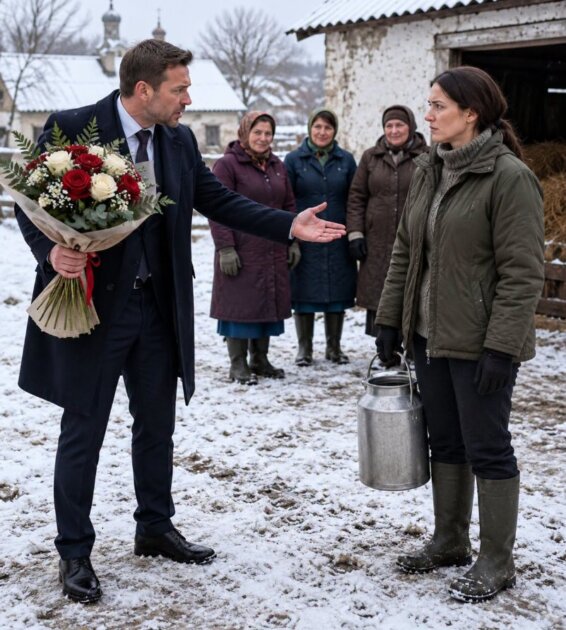
Alexei was standing by the farm gate.
He looked different. Thinner. More tired. His face had grown gaunt, his suit was wrinkled, and his tie hung crookedly around his neck.
In one hand, he held a brightly colored bouquet of flowers. In the other, a box of chocolates.
The flowers looked as though they had been bought at a cheap kiosk in the district center. Still, Alexei clutched them as if his entire future depended on them.
When he saw Zinaida, he offered her an uncertain, guilty smile.
“Zina… Hello.”
She didn’t answer.
Other dairywomen began coming out of the barn. When they recognized Alexei, they stopped and exchanged glances.
He cleared his throat nervously.
“I, uh… I wanted to talk to you. Could we?”
Zinaida studied his wrinkled suit, his crooked tie, and the flowers trembling slightly in his hand.
Something stirred inside her.
But it wasn’t happiness.
And it wasn’t anger, either.
It was something else—the strange feeling that comes when you look at someone after a long time and suddenly realize that they no longer have the same power over you.
“Go ahead,” she said calmly.
Alexei glanced at the women watching them.
“Here? In front of everyone?”
Zinaida gave him a faint smile.
“Why not? The whole village knew when we separated. You weren’t ashamed then. So go ahead and speak now.”
Alexei lowered his eyes.
For several seconds, he remained silent. Then he took a deep breath.
“Marina left me.”
One of the women gave a quiet snort, but nobody interrupted.
“She found someone else. Some businessman from the city. She told me I wasn’t good enough for her. That my salary was pathetic, that we were living in a rented apartment, and that I had no future. Then she simply walked away.”
Alexei paused before stepping closer and holding out the flowers.
“Forgive me, Zina. I was an idiot. I didn’t understand how lucky I was to have you. You’re a real woman. Faithful. Decent. Dependable…”
His voice faltered.
“I want to come home. I want to come back to you. If you’ll take me.”
Silence fell over the farmyard.
It was so quiet that the crunch of frozen snow seemed unusually loud.
Zinaida looked at the flowers, then at her husband’s face.
Suddenly, she laughed.
Not cruelly. Not spitefully.
She laughed with the astonishment of someone who had finally understood something she had never quite seen clearly before.
“You know something, Lyosha?” she said at last. “I think I forgave you a long time ago.”
Hope flashed across Alexei’s face.
“Then maybe…”
“Don’t rush. I’m not finished.”
He fell silent.
Zinaida slowly removed her mittens and held out her hands.
“Look at them carefully. These are the same hands you were so ashamed of. The same cracks, the same calluses. Sometimes I put cream on them, but they’ll never be as soft as Marina’s.”
She paused and looked straight into his eyes.
“But you know what? I don’t want them to be.”
Alexei stood motionless.
“I’m proud of these hands. They take care of forty-seven cows. They raised our children. They cooked your meals, washed your clothes, and kept our home running. These hands worked while you sat comfortably in your office.”
Then she tilted her head slightly.
“And your hands, Alexei? What can they show for themselves? Shuffling papers? Tying a necktie? Spraying expensive cologne on your shirt?”
Alexei’s face turned red. He lowered his head.
“You left me a year ago because you were ashamed of me,” Zinaida continued. “But I was never ashamed of you. I loved you. I loved you in your suit, with your tie and your cologne. I never expected you to start milking cows. I only expected you to respect me.”
Her voice remained quiet, but every word landed with painful clarity.
“You didn’t love me the way I loved you. You merely tolerated me. And now that Marina has discovered you can’t give her the life she wants, suddenly you’ve remembered that I’m a good, faithful woman.”
Zinaida took a small step toward him.
“Tell me something, Alexei. If Marina hadn’t left you, would you be standing here today with flowers in your hands?”
He said nothing.
He didn’t need to.
His silence told her everything.
“It’s too late, Lyosha,” she said. “That train has already left the station.”
“Zina, please! Don’t do this to me!”
She raised one hand.
“Don’t humiliate yourself. And don’t humiliate me by pretending you’ve only just discovered what I mean to you. Go in peace.”
The flowers trembled in Alexei’s hand. The box of chocolates slipped from his fingers, hit the ground, and burst open. Chocolates scattered across the frozen earth.
He stared at them as though his last remaining hope had fallen apart with the box.
“Where am I supposed to go now?” he whispered.
Zinaida looked at him for a moment.
“That’s for you to decide. You’re a grown man, Alexei. It’s time you started acting like one.”
Then she turned away.
“My break is over. My cows are waiting.”
And she walked back into the barn.
Her back was straight. Her head was held high.
The other dairywomen stepped aside to let her pass. They watched her with admiration and a deep, wordless sense of sisterhood. Nobody said anything, because they all understood that there are moments when a woman doesn’t need comforting.
She simply needs to stop being made to feel ashamed of who she is.
Alexei remained alone by the gate.
He stood there holding the flowers, with scattered chocolates at his feet and the life he had destroyed lying in pieces around him.
The entire village had witnessed it.
Yet nobody said a word.
Because everything that needed to be said had already been said.
That evening, Zinaida finished her work as usual. She delivered the milk, washed her pail, put on her coat, and walked out of the barn.
Nobody was waiting at the gate.
Only a few crushed chocolates lay on the frozen ground. Beside them was a single red rose.
Its stem had snapped in half.
Zinaida bent down and picked it up. She studied the flower for a long time.
Then she let out a quiet sigh.
“Oh, Lyosha… You foolish man. I really did love you. I truly loved you.”
Her voice trembled slightly, but she didn’t cry.
She slipped the rose into her coat pocket and started walking home.
She didn’t know why she had taken it.
Perhaps as a keepsake.
Perhaps because her heart hadn’t completely forgotten the man she had once loved more than anything in the world.
Or perhaps because sometimes we find it difficult to throw away even a broken flower when it once meant so much to us.
That night, Zinaida prepared for another ordinary day.
And the next morning, she woke at four again. She washed her face, dressed, drank her cold water, and set off along the familiar two-kilometer road to the farm.
The snow was beginning to melt. Dark patches of earth appeared in the gardens, and something new had entered the air—something everyone recognized after a long, bitter winter.
The promise of spring.
Zinaida knew that everything eventually passed. Love, pain, anger—even the harshest winter.
Spring would come. The cows would give birth to calves. The earth would turn green again. And life would move forward.
With a man or without one.
Because a woman who rises at four every morning, works until her body aches, and still finds the strength to stand tall after heartbreak carries something inside her that cannot easily be broken.
Not by an Alexei.
Not by a Marina.
Not even by a shattered heart.
And Zinaida finally understood something important: the greatest loss isn’t when a man walks away from you. It’s when you begin to feel ashamed of yourself because of him.
Zinaida would never be ashamed of her hands again.
Because those hands had never made her less of a woman.
They had proved that she was far stronger than her husband had ever understood.

