
“MY SON IS THE ONE WHO SUPPORTS YOU!” MY MOTHER-IN-LAW THREW IN MY FACE. SO I CANCELED EVERY PAYMENT COMING OUT OF MY BANK CARD THAT MY HUSBAND HAD BEEN LIVING OFF.
The fork froze in Alisa’s hand when Tatyana Petrovna spoke again.
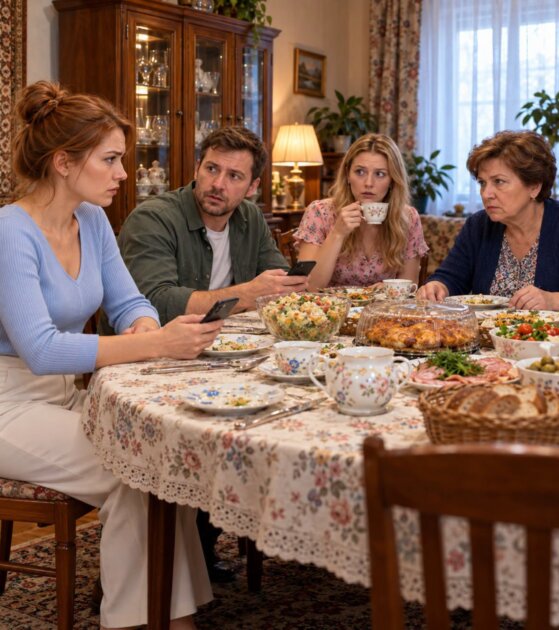
“Well, Alisa, you certainly have made yourself comfortable! Everything was handed to you on a silver platter: an apartment, a husband, a comfortable life. And yet you sit here looking as though you’ve spent the whole day shoveling coal.”
It was Friday evening. Alisa had arrived home from work barely forty minutes earlier. She had hardly had time to catch her breath before getting started on dinner: she prepared a salad, reheated the meat, and had even stopped at the bakery to buy a pie for her mother-in-law.
She had spent the entire bus ride home standing. Her back hurt, her legs ached, and all she wanted was to take a shower and go quietly to bed.
Instead, she was sitting at the table, listening to the woman she had tried to respect for five years portray her as a freeloader.
Anton, her husband, sat beside his mother, scrolling through his phone. His younger sister, Lera, stirred her tea while checking her hairstyle in the black screen of the television, which was turned off.
“I worked all day,” Alisa said quietly.
“So what? Other people work, too,” Tatyana Petrovna replied. “They just don’t expect everyone to feel sorry for them.”
With that, she placed the largest slice of pie on Anton’s plate.
Alisa looked at her husband.
Over five years, she had learned to recognize every variation of Anton’s silence. Sometimes he was genuinely tired. Sometimes he was angry. And then there was this familiar kind of silence: the one he used when he knew perfectly well that his wife was being insulted but found it more convenient to pretend he hadn’t heard anything.
“Anton, do you also think everything was handed to me?”
The man reluctantly looked up.
“Alisa, please don’t start this again! Mom hasn’t said anything unusual.”
“I only asked you a question.”
Anton put down his fork.
“The apartment is mine. I bought it. What did you bring into this marriage?”
Lera’s hand froze above her teacup.
Suddenly, Alisa pictured her old blue suitcase. One of its wheels had already been sticking when she moved into Anton’s apartment five years earlier. Inside had been two pairs of shoes, a few dresses, some books, and a towel embroidered with cornflowers that her mother had given her.
Back then, she had laughed at how little luggage she owned.
Anton had pulled her close in the hallway, kissed her forehead, and whispered:
“From now on, we’ll do everything together.”
Alisa had believed him.
But the word “together” had acquired a very peculiar meaning in their marriage.
The apartment had remained in Anton’s name. Yet increasingly, Alisa’s salary had been used to pay the mortgage. Whenever Anton’s bonus was delayed, she covered the installment. When the kitchen needed renovating, Alisa paid for the furniture. When Tatyana Petrovna needed money for her car, they came to Alisa again.
Then came her mother-in-law’s washing machine, Lera’s new phone, the grocery bills, and countless other expenses Anton always justified with the same words:
“Let’s help them out for now. We’ll settle everything later.”
But later never came.
A few weeks earlier, Alisa had finally sat down and calculated how much she had spent on their life together over the previous five years. The total came to nearly 1.5 million rubles.
When she saw the figure, she closed the spreadsheet.
She felt ashamed. She thought that counting money like this somehow cheapened her marriage.
But now, as Anton bragged about his apartment, something inside her finally changed.
“I didn’t bring an apartment with me,” she replied calmly. “I brought my salary. And I brought the habit of keeping my promises and paying what I owe.”
Tatyana Petrovna curled her lip.
“Now you’re counting money, too? My son took you into his home, and now you’re going to bill him for every plate you use?”
Alisa didn’t answer immediately.
Instead, she took out her phone and opened her banking app.
“What are you doing?” Anton asked.
“Checking exactly who supports whom.”
The list of recurring payments seemed endless.
Mortgage. Utility bills. Other transfers. Expenses Anton had arranged to be charged to his wife’s card for the sake of convenience.
One by one, Alisa canceled the automatic payments.
Her phone vibrated softly after each confirmation.
Anton finally put his own phone aside.
“Have you lost your mind?!”
“No. From now on, everyone pays their own obligations.”
“And the mortgage?!”
“It’s yours. The apartment is in your name.”
“But you’ve been paying it!”
“Until now.”
Alisa sent her husband a list of the canceled payments, then placed her phone on the table.
Tatyana Petrovna let out an incredulous laugh.
“We’ll see how long this courage lasts. You’ll turn everything back on tomorrow.”
Alisa stood up and placed her plate beside the sink.
“And from now on, you can wash tonight’s dishes without me.”
In the bedroom, she sat on the edge of the bed. Her hands were shaking so badly that she couldn’t undo the clasp of her bracelet on the first try.
Her mother-in-law’s voice carried through the wall from the other room.
“I told you! You should never give young wives everything on a silver platter!”
Anton came into the bedroom half an hour later.
“Are you satisfied? My mother nearly had a spike in her blood pressure because of you!”
Alisa looked up tiredly.
“You didn’t ask me once tonight why I was hurting.”
“You always have something to complain about!”
Anton lay down, turned his back to her, and fell asleep a few minutes later.
Alisa stared at the light filtering beneath the door for a long time.
Then she quietly made a decision: she would never again try to save a marriage in which she mattered only when something needed to be paid for.
THE FIRST CRACKS
When they married, Alisa worked as an economist for a company that distributed construction materials, while Anton was an engineer at a smaller firm. They earned roughly the same amount.
Later, Alisa was promoted. She took on more responsibility, worked longer hours, and her salary gradually increased.
Anton was delighted.
“See? Things will be much easier for us now!”
And they did become easier.
Just about exclusively for him.
At first, Alisa paid only for the groceries. Then she started covering part of the mortgage. Eventually, the utility bills were charged to her card, too.
Whenever she brought it up, Anton always said the same thing:
“What difference does it make which card we use? We’re married, aren’t we?”
And Alisa believed him.
The strange thing was that although the family budget was supposedly shared, she had to justify herself every time she bought a new coat. Anton, on the other hand, never had to explain what he spent his money on.
On Saturday, Alisa organized her documents into a separate folder. On Sunday, she visited her mother but didn’t say a word about what had happened.
They sat in the little kitchen eating cottage-cheese pancakes while her mother talked about her seedlings.
“You’ve been awfully quiet lately,” her mother remarked eventually.
“I’m just tired.”
Her mother didn’t ask any more questions. She simply placed another pancake on Alisa’s plate.
That small gesture brought tears to Alisa’s eyes.
Perhaps it was because, for the first time in a long while, someone was taking care of her without expecting anything in return.
On Tuesday, Anton called her during working hours.
Alisa was in a meeting and didn’t answer.
A few seconds later, the first message arrived.
“Turn the payments back on immediately!”
Then another.
“Because of you, the mortgage payment is going to be late!”
Alisa replied with just one sentence:
“I told you on Friday. The apartment is in your name, and the mortgage is your responsibility.”
That evening, Anton was waiting for her in the hallway.
“Are you trying to ruin my credit history?”
“How am I supposed to know how you plan to pay your own loan?”
“You earn more than I do!”
Alisa took off her coat and hung it up.
Tatyana Petrovna emerged from the living room, too. It looked as though they had agreed beforehand that two of them would have a better chance of bringing Alisa to her senses.
“In a family, everyone needs to understand their responsibilities,” her mother-in-law declared.
“I understand mine. When will Anton understand his?”
“He’s the man! He put a roof over your head!”
“A roof whose expenses I paid.”
Her mother-in-law’s face turned red.
“Then let’s make this clear! Either you start behaving normally, give the family the money, and stop throwing these tantrums, or you move out!”
Alisa stared at her for a few seconds.
The burgundy cardigan she herself had once given Tatyana Petrovna. The expensive handbag they had also bought with Alisa’s money. The woman who now acted as though she were the real owner of the apartment and the person entitled to dictate Alisa’s life.
“All right,” Alisa said.
Anton breathed out in relief.
“Finally! I knew you’d come to your senses.”
“I’m moving out.”
The smile vanished from his face.
Alisa went into the bedroom and took out her old blue suitcase. One of its wheels still stuck.
Five years earlier, she had arrived with it.
Now she was leaving with the same suitcase.
Anton followed her.
“Where are you going?!”
“To Olga’s.”
“You’ve been complaining to her about me, too? What did you tell her?”
Alisa didn’t answer. She packed clothes, documents, medication, and her work laptop.
When she reached for her bag on the top shelf, Anton suddenly grabbed her forearm.
“I’m talking to you!”
Alisa knocked her elbow against the wardrobe door.
“Let go of me!”
“We’re going to settle this first!”
His grip hurt.
Alisa looked down at his hand, then straight into his eyes.
“Let go of me right now. And move away from the door.”
Anton eventually released her, but he continued blocking her way.
Alisa took out her phone and called Olga. She put the call on speaker.
“I’m coming to your place. Anton won’t let me leave. Please stay on the line.”
Olga’s voice immediately changed.
“I’m ordering a car right now. If he won’t let you out, we’ll call the police.”
Anton stepped back.
“You’re both completely insane! I haven’t laid a finger on her!”
Alisa didn’t argue. She pulled on her boots, whose zipper stubbornly refused to cooperate, and lifted her suitcase.
Tatyana Petrovna watched from the living-room doorway.
“If you ever want to come back, we’ll see whether we let you in!”
Alisa stepped over the threshold with her suitcase.
“Don’t wait for me.”
Olga was waiting outside her building. When she saw Alisa, she wordlessly took the heavy bag from her and hugged her.
“Tea or a shower?”
Alisa closed her eyes.
“Can I just sit down for a while?”
“Of course.”
That was all. Olga didn’t ask why Alisa had put up with it for so long. She didn’t say, “I told you so.” She didn’t lecture her about how a strong woman ought to behave.
She simply sat down beside her on the sofa.
And Alisa began to cry.
Not prettily, not quietly. She sobbed, gasped for breath, and buried her face in her hands. Olga placed a hand on her shoulder and stayed beside her.
The next morning, Alisa called the bank. She revoked her husband’s access to the services he had previously been able to use, requested a new bank card, and changed her security settings.
Anton knew her codes. Back when they first got married, she had trusted him to manage their shared expenses.
Now Alisa felt as though she had finally closed a door she had left open for far too long.
Olga advised her to obtain all her bank statements from the previous years.
“Don’t just look at the big expenses,” she said. “Let’s check every transaction.”
Olga worked as a financial analyst. She disliked guesswork and especially disliked it when someone tried to prove themselves right without evidence.
On Saturday, the kitchen table was covered with documents. Two cups of coffee sat beside the laptop, and a thick notebook lay in front of them.
At first, everything matched Alisa’s recollection.
Mortgage payments. Kitchen furniture. Utility bills. Money sent to her mother-in-law for the car.
Then Olga stopped at one transaction.
“What’s this?”
Thirty-eight thousand rubles.
Recipient: Tatyana Petrovna.
Alisa frowned.
“I don’t know. Maybe it was for the renovation?”
“The renovation was in May. This transaction is from September.”
They kept looking.
Another twenty-five thousand rubles. Then forty-two thousand. Several transfers to Lera, too.
Some had been made immediately after Alisa’s salary arrived. Others had taken place while she was away on business.
Anton had always managed to explain where the money went.
A large grocery bill. An unexpected expense. The apartment costs. A little help for his mother.
And Alisa had believed him every time.
When she had little money left, she stopped buying new clothes, postponed buying shoes, and told herself she would get them the following month.
Suddenly, Olga pointed to another transaction.
“Alisa, look at the date!”
Alisa leaned closer.
The money had been transferred on the exact day she was in the hospital recovering from surgery.
She remembered that day. She was still feeling the effects of anesthesia, weak and barely able to sit up in bed without assistance.
Anton had visited only the following evening. He said he had been running errands all day and that hospitals always made him nervous.
On that very same day, he had transferred sixty thousand rubles to his mother.
With trembling hands, Alisa opened the family group chat.
Tatyana Petrovna had sent photographs from a shopping mall. She was standing in front of a mirror wearing her new fur coat, her shoulders proudly squared.
The caption read:
“My son has spoiled his mommy!”
Anton had reacted with a heart.
Alisa remembered what she herself had written beneath the picture:
“Beautiful! It looks wonderful on you!”
Back then, she had believed Anton had bought the gift with his own money.
After returning home from the hospital, she had given up buying new winter boots because she needed to save money for her recovery and the apartment expenses.
Now she discovered that while she lay in a hospital bed, her husband had bought his mother a fur coat with Alisa’s money.
Olga silently placed a glass of water in front of her.
“Everything’s fine,” Alisa said, although her voice was barely audible.
“No, it isn’t,” Olga replied. “But at least now you know what happened. And no one can access your money behind your back anymore.”
By evening, the total of transfers and purchases Alisa hadn’t known about had approached eight hundred thousand rubles. These were not included in the larger expenses she had previously calculated, and every item needed to be checked separately to avoid counting the same money twice.
Alisa stared at the spreadsheet for a long time.
“I thought I simply didn’t know how to save money.”
Olga closed the notebook.
“You knew how to earn it. You just trusted someone who wasn’t honest with you for far too long.”
That evening, Anton called.
“When are you coming home?”
“Explain the transfers first.”
“What transfers?”
Alisa listed the dates and amounts.
Anton fell silent.
“I helped my mother. And Lera, too. What was I supposed to do? Abandon my own family?”
“With my money. While I was lying in the hospital.”
“Our money is shared!”
“Then why did you lie about what you were spending it on?”
Anton sighed irritably.
“Because I knew you’d react exactly like this!”
Alisa turned on the call recording, then asked him to repeat what he had said.
Anton repeated it.
He admitted that he knew Alisa hadn’t agreed to those expenses, so he had pretended the money was going toward shared household costs.
“Let’s meet,” he said eventually. “But without Olga. She’s just turning you against me.”
“At a café. On Saturday.”
Anton arrived with his mother.
Alisa wasn’t surprised at all. She chose a table from which she could clearly see the exit, then placed the documents in front of her. Olga waited nearby.
Tatyana Petrovna hadn’t even finished unbuttoning her coat.
“Well, show us what you’ve found! Look what you’ve done to my son! He’s barely recognizable!”
Anton did look tired. Dark circles shadowed his eyes, and his shirt was wrinkled.
But for the first time, Alisa felt no urge to solve all his problems immediately.
“Here are the transfers,” she said. “Here are your messages claiming the money was for shared expenses. And here is the purchase of the fur coat.”
Tatyana Petrovna slammed her hand on the table.
“The fur coat was a gift! My son gave it to me!”
“It was paid for with my money.”
“He had every right to do that!”
Alisa looked at Anton.
“Are you going to pay me back?”
“Come home, and we’ll discuss it.”
“I asked you about the money.”
Anton reached across the table to take her hand. Alisa pulled away.
“Please don’t do this! I’ve already postponed two mortgage payments. I’ve asked my employer for a salary advance. Everything is falling apart around me!”
Alisa answered calmly.
“When I couldn’t afford to buy myself winter boots, you told me I was bad at managing money.”
Anton suddenly stood up, walked around the table, and knelt in front of her.
The people at the next table fell silent. A waitress stopped in her tracks, holding a tray.
“Please! Come home! I can’t manage without you!”
For five years, Alisa had longed to hear her husband say that he needed her.
Now he had finally said it.
But he hadn’t said he missed her. He hadn’t asked whether she was sleeping properly, whether her arm still hurt, or how she was coping with the past few days.
He had talked only about the mortgage payments.
“Get up, Anton,” she said softly.
“Please!”
“I hear you. My answer is still no.”
Tatyana Petrovna grabbed her son by the shoulder.
“Get up! You’re humiliating yourself in front of her? She’s completely destroyed your common sense!”
Anton sat back down. His expression hardened.
“Then don’t forget that the apartment is mine. You won’t get a single penny from it!”
Alisa took out a prepared copy of the divorce petition.
“I’m not asking you to give me your apartment as a gift. My lawyer will handle everything else.”
“You have money for a lawyer, but you didn’t have money for your family!” her mother-in-law hissed.
Alisa gathered her documents and stood up.
A cold wind blew outside. She zipped up her coat and paused for a moment in front of the café window.
Inside, people were ordering pastries, drinking coffee, laughing, and chatting about trivial things.
Alisa longed for the day when she could sit somewhere without having to explain herself to anyone. Without having to prove that she had the right to leave.
And for the first time, she knew that day would eventually come.
A LAWYER, A TEST, AND A NEW LIFE
Yelena Viktorovna, the lawyer, saw her on Tuesday.
She was around fifty, with a calm voice and a habit of reading every document from beginning to end before asking questions.
She listened to Alisa, reviewed the bank statements, and then spoke plainly.
“We won’t automatically recover every penny you spent over five years. Ordinary family expenses do not become debts simply because a couple divorces. Nor is the fact that the money came from your card sufficient on its own. Every item must be proven separately.”
Alisa nodded.
“I’m not trying to demand reimbursement for every dinner. I just want them to stop pretending that I was the one being supported.”
“Then we’ll focus on the expenses we can substantiate. We’ll distinguish between money invested in the apartment, personal expenses, and transfers made without your informed consent. Preserve the complete message threads.”
For months, they collected documents, compared dates, and checked the descriptions attached to the transfers. Yelena Viktorovna removed every amount that could not be adequately supported.
She never promised a quick victory.
That was precisely why Alisa began to trust her.
Then, one morning, Alisa felt sick at the smell of Olga’s coffee.
At first, she thought her stomach was acting up again. She could barely eat lunch at work, and every evening she collapsed into bed without even taking off her watch.
When she finally checked her calendar, she suddenly had to sit down.
She bought a pregnancy test at a pharmacy farther from home. For some reason, she didn’t want to go to the nearest one, as though the pharmacist might be able to read her secret from her face.
The two lines appeared almost immediately.
Alisa sat on the closed lid of the washing machine, clutching the test with both hands.
For five years, she had imagined how she would tell Anton they were going to have a baby. She had looked at pictures of tiny baby socks, saved funny greeting cards, and sometimes imagined the look on her husband’s face when he heard the news.
But Anton had always postponed having children.
First, the mortgage. Then the renovation. After that, his new position. Then a little more time.
Now Alisa was pregnant. She was living at her friend’s place, preparing to divorce, and had no idea how she would manage.
She didn’t even know whether to feel happy or afraid.
Olga knocked on the bathroom door.
“Alisa, is everything all right?”
“Come in!”
Olga saw the test and sat down beside her.
She didn’t ask what Anton would say. She didn’t ask how Alisa would support the baby.
She simply asked:
“What do you want?”
Alisa looked at the test.
“I want this baby.”
At that moment, she burst into tears.
Olga wrapped her arms around her.
“Then we’ll figure out how I can help.”
The doctor confirmed the pregnancy. At the first appointment, Alisa barely remembered anything: the white walls, the rustling paper, and the doctor’s calm voice.
But she remembered holding her hand against her stomach all the way home.
That evening, she called her mother.
She told her everything. The dinner, the money, Anton’s behavior, the suitcase, and the days she had spent at Olga’s place.
Her mother was silent for a long time.
“Why didn’t you tell me sooner?”
“I was ashamed. I didn’t want to upset you.”
“What upsets me is that you carried all of this alone.”
Then Alisa told her about the baby.
Her mother began to cry.
“Come and stay with me if you want to! We don’t have much space, but we’ll find a way.”
“For now, I’ll stay with Olga. It’s close to work. Just please don’t tell anyone!”
“All right, sweetheart.”
The next day, her mother called again. This time, her voice was tense.
Tatyana Petrovna had found her phone number and had already given her own version of events.
According to her, Alisa had robbed the family, moved in with another man, and was even trying to take the apartment.
Her mother-in-law had confidently recited her story and even mentioned amounts of money. The only problem was that those amounts did not match the bank statements.
“I told her I had no interest in her stories,” her mother said. “I know my own daughter.”
Alisa closed her eyes.
“Thank you, Mom.”
“Have you eaten today?”
Alisa started crying again.
How strange, she thought. A single, simple question could show her just how different it was when someone cared for you out of love and when care was used as a weapon against you.
Tatyana Petrovna didn’t stop at phone calls.
She called Alisa’s workplace and demanded to speak to management. She called her daughter-in-law dishonest and claimed she couldn’t be trusted with financial matters.
Lera even sent a lengthy message to the company’s customer service department.
After lunch, Alisa was summoned to her manager’s office.
She was already preparing herself to explain everything.
“Are you going through a difficult divorce?” her manager asked.
“Yes.”
“I thought so. I have absolutely no complaints about your work. I’m not going to discuss private allegations with strangers. If anyone shows up in person, notify security.”
Alisa stared at her in disbelief.
“Thank you. I was afraid this might…”
“Your reports haven’t changed just because someone called the company.”
Alisa walked out of the office feeling as though she could finally take a deep breath after weeks of barely being able to breathe.
Her lawyer asked her to preserve every message and avoid arguing with relatives. If another meeting became necessary, she should not attend alone.
Anton alternated between apologizing and raging.
One day, he wrote that he missed her. The next, he called her ungrateful. He sent a photograph of the empty kitchen and asked whether she was satisfied with having destroyed the family.
Alisa stared at the picture for a long time.
She remembered sitting at that same table with a fever, worrying about the next mortgage payment. Anton had simply asked her not to block the television with her laptop.
One evening, the man showed up drunk outside Olga’s apartment.
First, he rang the bell. Then he began pounding on the door with his fists.
“I know you’re in there! Open up!”
Olga stepped toward the peephole, then moved back.
“We’re not opening the door.”
Alisa immediately called the police. She explained who was outside and that he was threatening her.
Anton continued shouting.
“You’ll come back eventually! Where else would you go? You’ll regret this!”
One of the neighbors opened their door a crack and told him to leave. Anton responded rudely, then kicked the lower part of the door.
When the police arrived, he tried to appear calm.
“I came to see my wife. She’s hiding at her friend’s place, even though it’s time she came home.”
With Olga beside her, Alisa spoke to the officers. She showed them the messages, described the threats, and explained how Anton had prevented her from leaving when she tried to pack her belongings.
She asked them to make an official record of the incident.
When Anton saw her doing this, he raised his voice again.
“You’re ruining my life!”
Alisa didn’t answer.
She no longer wanted to explain to him that she hadn’t ruined his life. She had simply stopped financing it.
That night, Olga admitted that she had been frightened, too.
“If this is too much for you, I’ll move out,” Alisa said.
Olga looked at her incredulously.
“I’m afraid of him, not you. Don’t confuse the two!”
They sat in the kitchen until midnight. Alisa drank lukewarm water while Olga sipped her cold tea.
For the first time in a long while, Alisa no longer felt the need to apologize for being mistreated.
IN THE COURTROOM
The divorce was nothing like the movies.
There was no solemn music, and nobody presented a single document that instantly put everything right.
The hearings were postponed, additional paperwork was requested, and Anton kept coming up with new explanations.
First, he claimed Alisa had known about every transfer. Later, he said the money had been his. Then he cited his mother’s debts, which he claimed they had jointly decided to pay off.
Yelena Viktorovna returned to the evidence every time.
Alisa grew exhausted. Sometimes she felt as though it would never end, that she would have to tell the same story over and over forever.
But she gradually realized that here, at least, she was allowed to finish her sentences. Nobody could simply shout her down and declare the matter closed.
Anton learned about her pregnancy from a mutual acquaintance. The person had encountered Alisa near her gynecologist’s office and decided that her husband had a right to know.
On the day of the divorce hearing, Anton was waiting for her in the corridor with a strange expression on his face.
“Why did you hide it from me?”
Alisa’s stomach tightened.
“We’ll discuss this in the presence of my lawyer.”
“I know about the baby! You’re pregnant, and you still think you can just walk away? You have to come home!”
He repeated the same thing in the courtroom. He declared that he did not agree to the divorce because they were expecting a child and that Alisa was acting under her friend’s influence.
He promised he would take her home that very day.
Alisa listened and pictured his hand gripping her arm, his fingers tightening, the blocked doorway, and the drunken shouting outside Olga’s apartment.
Suddenly, fear overwhelmed her common sense.
“The baby isn’t yours,” she said.
The courtroom fell silent.
Anton looked at her as though he had been struck. Then he slowly smiled.
“I knew it! I told you there was someone else!”
Yelena Viktorovna requested a private conversation with her client.
In the corridor, Alisa sat on a bench and buried her face in her hands.
“I was scared. He said he would take me home.”
The lawyer sat beside her.
“You don’t have to invent another father to have the right to divorce. Nobody can force you to live with your husband. We’ll correct that statement before it causes further problems.”
Alisa felt ashamed. She hated Anton’s lies, and now she had lied, too.
When the hearing resumed, her voice trembled.
“I would like to clarify my previous statement. I was not telling the truth about paternity. I was afraid of my husband’s pressure. However, my decision to divorce is my own, and I will not change it.”
Anton tried to interrupt, but the judge stopped him.
At that moment, Alisa finally understood how accustomed she had become to asking permission for even the simplest decisions.
She had even searched for a reason to leave that her husband might consider acceptable.
But she did not have to justify why she no longer wanted to live with him.
The marriage was dissolved.
Her pregnancy could not be used as a means of forcing her to remain in Anton’s apartment.
The dispute over their finances, however, continued. The secret transfers, the money invested in the apartment, and their shared expenses were examined separately.
Eventually, the court awarded Alisa compensation of eight hundred thousand rubles for the claims it found sufficiently substantiated. She was unable to prove every expense. Some items were classified as ordinary family costs, while others lacked the necessary documentation.
Alisa listened to the judgment without smiling.
She would not get her five years back.
She would not get back the evenings when she had sat exhausted in the kitchen, wondering why she wasn’t a good enough wife.
But there was one thing nobody could erase with a single sentence anymore:
What she herself had contributed to that marriage.
When the judgment became final, Yelena Viktorovna helped initiate enforcement proceedings. Anton sold some of his possessions, asked his mother for help, and transferred the first substantial payment.
He paid the remainder more slowly.
Alisa did not sit beside her phone waiting for every installment. She received official notifications of the payments and left the disputed matters to her lawyer.
Tatyana Petrovna sent her a message:
“You left us without a penny. Are you happy now?”
Alisa saved the message with the rest of the documents.
She did not reply.
AN APARTMENT WHERE NOBODY CALLED HER A FREeloader
By then, Alisa had rented a small apartment near her mother.
Olga helped her pack.
“At least now you’ll invite me over instead of just coming out into the kitchen,” she said with a smile.
“You can come over anytime, even without an invitation.”
Olga looked at her over a box.
“I’ll still call first, though!”
They both laughed.
Alisa’s pregnancy was becoming increasingly visible. She slowly learned that she didn’t have to lift every heavy shopping bag, reach for everything on the top shelf, or feel ashamed when she got tired.
Her mother visited on weekends. She brought soup, washed the dishes, or simply let her daughter sleep for an hour.
She never told Alisa she owed her anything in return.
When most of the compensation arrived, Alisa revisited an old plan: she wanted a home of her own.
She didn’t want to rush into another loan simply to prove to Anton what she was capable of.
For evenings on end, she calculated her expenses, savings, expected mortgage payments, and the money she would need for the months after giving birth.
Olga checked the calculations.
“The first apartment you looked at would put too much pressure on you. Even if everything goes according to plan.”
“Then we’ll find a smaller one.”
Eventually, they found a tiny one-room apartment on the second floor of an old but well-maintained building.
The window overlooked a quiet courtyard. There was a pharmacy in the building opposite. The wallpaper needed replacing, but the wiring and plumbing were in good condition.
The kitchen had room for a small table and two chairs. There was also space beside the window for a crib.
Alisa used her own savings and part of the compensation she had already received to make the down payment. The bank approved the mortgage only after checking that she met all the necessary requirements. Alisa chose a monthly payment she could safely afford even after giving birth.
Anton’s future promises were not part of her calculations.
When she signed the purchase agreement, she read her own name several times.
Then she stepped outside and called her mother.
“Mom, we have our own home now.”
Her mother’s voice softened.
“You always had a home, sweetheart. But I understand what you mean.”
Her little boy was born about six months after the divorce.
Alisa named him Misha.
The baby was tiny and red, protested loudly every time she changed him, and made such a serious face in his sleep that he looked as though he already had important decisions to make.
Anton was also informed of his son’s birth.
Alisa handled questions concerning the child’s documents and financial support with the help of her lawyer, keeping them separate from the earlier dispute over their finances. She did not want to deprive her son of the support he was entitled to, and she no longer wanted to lie out of fear.
The child did not erase the divorce.
And the divorce did not erase the father’s responsibilities.
When Alisa brought Misha home, her mother and Olga were already waiting. Soup was simmering in the kitchen, and clean diapers were neatly arranged beside the crib.
“Eat something first,” her mother said. “I’ll hold the baby.”
Alisa sat down at the table.
Suddenly, she remembered that old dinner.
The fork frozen above the plate. Her mother-in-law’s voice. Anton’s indifference.
“What did you bring into this marriage?”
Now she knew the answer.
She had brought herself. Her work, her perseverance, her love, and everything they had taken for granted over the years.
And now she was finally surrounded by people who didn’t demand that she prove her worth over and over again.
“WE TOOK YOU IN WHEN YOU HAD NOTHING!”
Two weeks later, Tatyana Petrovna called from an unfamiliar number.
“Hello, new mommy!”
Alisa glanced at her peacefully sleeping son.
“What do you want?”
“Let’s forget our grievances! He is still my grandson, after all. Why should he grow up without a family? Anton is suffering, too. Come home, and we’ll help you.”
Alisa already knew where the conversation was going.
“I’m not going back.”
“You’re not making decisions just for yourself anymore!”
Alisa recognized the old tone of voice. In the past, she would have started explaining herself. She would have listed her reasons and tried to prove that she deserved consideration, too.
But now she remained calm.
“We’ll handle matters concerning the child separately and peacefully. I don’t want to restart our relationship. Please stop telling me that I should go back.”
Tatyana Petrovna was silent for a few seconds.
“You’ve become so proud! We took you in when you had nothing!”
Alisa closed her eyes.
“I already had my own life back then. I just forgot about it for a long time.”
She ended the call and blocked the number.
Anton could still address important matters concerning the child through the appropriate official channels. But Alisa no longer intended to endure insults simply to maintain the appearance of family harmony.
At first, it wasn’t easy.
Misha woke up during the night, the bills kept arriving, and sometimes Alisa cried in the shower from sheer exhaustion.
But the exhaustion was no longer accompanied by humiliation.
She could call her mother and say:
“Could you please watch him for an hour?”
She could ask Olga to pick up a few things from the store and transfer the money afterward without worrying that someone would demand ownership of her apartment along with the shopping bag.
The final installment of the compensation arrived when Misha had learned to walk along the sofa while holding on to it.
Alisa checked the amount, sent confirmation to her lawyer, and closed the folder containing years of bank statements.
This time, there was nothing left for Anton to prove.
Her son reached for her phone, so Alisa moved it higher.
In the corner of the room stood a box containing a new pair of winter boots. They were comfortable and warm, the kind she had once postponed buying until the following month.
This time, she had bought them without delay.
Alisa tried them on and walked across the room.
Misha laughed as he clung to the edge of the sofa.
“Do you like them?” she asked him.
The little boy happily slapped a cushion.
Outside the window, snow began to fall slowly.
Soon, they would need to go for a walk. Misha would wear his snowsuit and hat, and Alisa would pack an extra wipe in the diaper bag. They would buy some bread on the way, visit Grandma, and Olga would come over in the evening with a freshly baked pie.
A notification appeared on Alisa’s phone, reminding her about the mortgage payment.
She opened her banking app, checked her balance, and calmly closed the screen.
Everything was accounted for.
She paid for her own home herself.
But in this home, nobody would ever call her a freeloader again.
Because Alisa had finally understood something:
A true home is not a place where you are tolerated as long as you are useful. It is a place where you are loved even when you have nothing left to give.

