
# After My Wife Died, I Threw Her Son Out of My House Because I Never Considered Him My Own Child. Ten Years Later, a Phone Call from a Stranger Revealed a Secret That Changed My Life Forever… 😨
I never imagined that I would see the boy again—the one I had thrown out onto the street at sixteen with a single cruel sentence. Back then, I felt I had nothing more to do with him. He wasn’t my blood, he wasn’t my child, and I no longer wanted to take responsibility for him.
But ten years later, my phone rang.
An unfamiliar woman was calling, and with just a few sentences, she brought back memories I had spent years trying to bury.
But before I tell you what I discovered that day, I need to explain how we reached the point where a boy who should have found safety in his own home was forced to build a new life with the help of strangers.
## The Morning Everything Changed
My wife died unexpectedly.
Our last morning together began like any other. She was standing in the kitchen, holding her coffee cup in one hand and searching through her handbag with the other. Sunlight fell at an angle across the table, while a gentle breeze stirred the flowers on the windowsill.
“Don’t forget to pick up some groceries on your way home!” she called after me with a smile. “We’re out of milk again.”
I was already standing by the door and answered without giving it much thought.
“Okay, sure. I’ll get it.”
I didn’t give her a long hug. I didn’t turn around to look into her eyes one more time. It never crossed my mind that this might be the last time I would hear her voice.
By the next day, she was gone.
After the funeral, an unusual silence settled over our house. It wasn’t the peaceful kind of silence that feels comforting after a long day. It was something heavy and oppressive, something that seemed to linger in every room.
Her mug was still in the kitchen cupboard. Her clothes hung in the wardrobe, and her books stood beside the bed. Her favorite perfume was still sitting in the bathroom.
Sometimes, I woke in the middle of the night and instinctively turned toward the other side of the bed, as though I expected to find her lying there.
But the bed remained empty.
And I wasn’t the only one grieving in that house.
My wife’s son was there, too.
## The Boy I Never Truly Accepted
When I met my wife, she already had a young son. His biological father had disappeared from their lives years earlier, and my wife rarely spoke about him.
The boy was six when we got married.
I remember how cautiously he approached me during those first months. Sometimes, he would stop in the doorway and ask if he could help me with anything. Other times, he would bring me his drawings and proudly show me what he had made at school.
I provided for him. I paid his school expenses, bought him clothes, and took him to the doctor whenever he got sick. When people asked how I was getting along with my stepson, I always told them there were no problems.
From the outside, I probably looked like a good father.
But deep down, I could never shake the feeling that the boy was a stranger to me.
He didn’t look like me. He hadn’t been born with my surname. My blood didn’t run through his veins.
I never said these thoughts aloud in front of my wife. I knew her son meant the world to her, and I didn’t want to force her to choose between us.
So I kept everything to myself.
But when my wife died, the feelings I had carefully hidden for years slowly began to surface.
The boy’s presence painfully reminded me that I had lost the woman I loved. His silence irritated me, his sadness frustrated me, and with every passing day, I found it harder to tolerate having him in the house.
Today, I understand how terrible that was.
Back then, however, I cared only about my own pain.
## “Pack Your Things! You Mean Nothing to Me!”
The boy was sixteen when everything between us came to an end.
Since his mother’s death, he had withdrawn almost completely into himself. He spent long hours in his bedroom and often didn’t even come downstairs for dinner. Whenever I asked him what was wrong, he usually gave me the same answer.
“Nothing.”
Sometimes, he sat by the window, staring at the garden where his mother used to tend her flowers.
I considered his behavior disrespectful and ungrateful. It never occurred to me that a teenage boy was trying to process a loss I could barely bear myself, even as an adult.
One evening, we argued over something trivial. Perhaps he hadn’t answered me quickly enough, or perhaps he hadn’t done something I had asked him to do. I can no longer remember the details.
But I remember the moment I suddenly lost control.
“I’ve had enough of all this!” I shouted. “I’m not going to keep pretending you’re my own son!”
The boy froze.
For a moment, his eyes filled with tears, but he didn’t cry. He simply stood there, staring at me as though he couldn’t believe I had actually said those words.
But I didn’t stop.
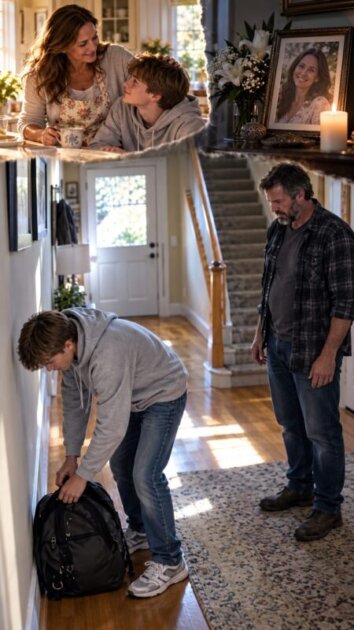
“Pack your things and get out! This is my house. You mean nothing to me!”
The room fell so silent that I could hear the faint ticking of the clock’s second hand.
I expected him to argue. I thought he would raise his voice, ask where he was supposed to go, or at least remind me that since his mother’s death, I was the only adult he could depend on.
Instead, he slowly nodded.
He didn’t argue. He didn’t beg.
He simply turned around and went upstairs.
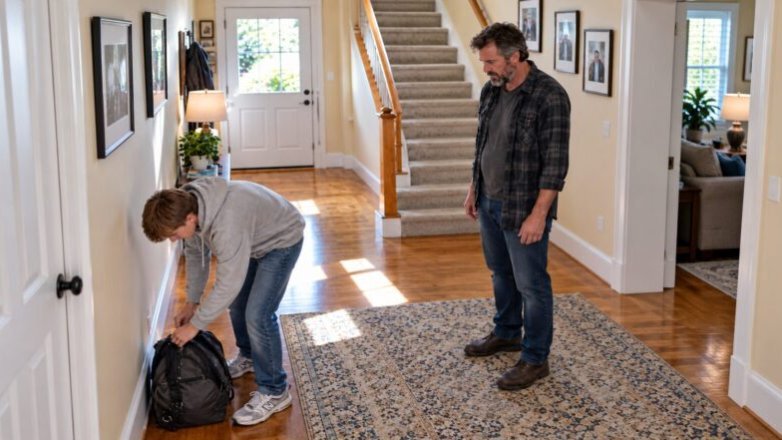
A few minutes later, I heard him opening his wardrobe. Then drawers slammed shut, footsteps crossed the floor, and finally, he appeared at the top of the stairs carrying an old, faded backpack.
He took only a few items of clothing.
He stopped by the front door and looked at me for a moment. It seemed as though he wanted to say something.
But I turned my eyes away.
The boy pressed down on the handle, stepped out into the night, and quietly closed the door behind him.
I didn’t follow him.
I didn’t ask whether he had anywhere to go.
I didn’t care where he would spend the night.
That evening, a sixteen-year-old boy lost his mother and then lost the man he may have secretly hoped would one day see him as a real son.
And I let him face the world alone.
## The Phone Call That Broke Ten Years of Silence
A few months later, I sold the house. I moved into a new apartment, devoted more time to my business, and tried to live as though that part of my past had never existed.
I never saw the boy again.
During the first few years, he occasionally crossed my mind. Had he found a job? Had he managed to finish school? Was there anyone helping him?
But every time those questions surfaced, I found an excuse to silence my conscience.
I told myself he was no longer a little child. That he had to fight his way through life, just like everyone else. And that I wasn’t responsible for everything that happened to him.
And so, ten years passed.
Then, on a chilly autumn afternoon, an unfamiliar number appeared on my phone screen.
“Good afternoon,” a woman said. “I’m calling to invite you to the opening of a special exhibition. Someone has personally asked us to make sure you receive an invitation.”
At first, I assumed it was some kind of business event.
Then she mentioned the name of a famous painter whose work I had seen in newspapers and art magazines.
“I don’t understand,” I said. “Why would someone like that want to meet me?”
The woman fell silent.
When she spoke again, her voice had changed completely.
“Perhaps you no longer think about the sixteen-year-old boy you sent away from home ten years ago. But he has never forgotten that night.”
My heart began pounding.
“Who are you? What do you want from me?”
“If you truly want to know what happened to him, come on Saturday. I think there are some things you need to see with your own eyes.”
The line went dead.
I sat motionless for a long time, clutching my phone.
After ten years, someone had finally brought me news of him.
And from that moment on, I could no longer pretend my past didn’t exist.
## The Photographs That Shattered My Conscience
On Saturday, I went to the exhibition.
The gallery occupied an elegant building with high ceilings, enormous windows, bright walls, and the soft murmur of conversation. Well-dressed guests wandered between the artworks. Some held champagne glasses, while others took photographs.
But I barely noticed anything around me.
Because the walls weren’t covered with paintings alone.
Photographs lined the gallery, each revealing another chapter of a story.
In the first photograph, a thin, exhausted teenage boy was lying on a bench at a railway station. He had pulled his coat over his chest and rested his head on a worn-out backpack. People hurried past him, seemingly unaware that a child had nowhere to go.
In the second photograph, the boy sat leaning against the wall of a shop. A piece of cardboard lay in front of him, and he held a pencil in his hand.
Even in such a desperate situation, he was drawing.
The next photograph showed a cramped room in a homeless shelter. After that came a tiny, shabby rented apartment, where a pile of sketches and several inexpensive tubes of paint lay beside the bed.
I saw him working on a construction site, wearing work clothes and looking exhausted. I saw him in a workshop where he worked nights, and in a classroom where he looked older than the other students because life had forced him to grow up too soon.
I stopped in front of every photograph.
My throat tightened, and my palms grew damp.
Because for the first time, I was seeing what had happened to the child I had once sent out into the street without a second thought.
One of the gallery employees noticed how shaken I was and quietly approached me.
“You know him, don’t you?”
I couldn’t answer immediately.
Finally, I managed to say just one thing.
“He’s my wife’s son.”
The man nodded and began telling me what he knew.
During the first few weeks, the boy slept on the streets. Sometimes he found shelter at railway stations; other times, he tried to escape the rain beneath the covered entrances of shops. He didn’t have enough money for proper meals, and often, he had no idea where he would sleep the following night.
Eventually, he found his way to a shelter, where a volunteer noticed that he spent every spare moment drawing.
He didn’t complain. He rarely spoke about his past. Give him a piece of paper and a pencil, and he could lose himself in drawing for hours.
The volunteer gave him some old paints and paper.
Perhaps that was when the first small change began.
Slowly, the boy found work in a small workshop. He worked at night, studied during the day, and held on to the one thing he refused to give up: drawing.
For years, nobody knew his name.
Then, one day, a respected painter saw his work.
The artist recognized a rare sensitivity in his drawings, something that couldn’t simply be taught. He helped the boy continue his education, introduced him to several professionals, and gave him the opportunity to exhibit his first works.
Gradually, the world began to notice him.
But the boy never forgot where he had started.
## The Man Standing Beside the Enormous Painting
At the far end of the gallery hung an enormous photograph.
A young man stood beside a monumental painting. He wore an elegant suit, carried himself with confidence, and had a calm expression. Journalists and art lovers surrounded him, but he was looking directly into the camera.
I recognized him immediately.
It was him.
The boy I had once sent away from my house with an old backpack.
But the thin, sorrowful teenager I remembered was gone. In his place stood a grown man whose work was being showcased in an entire gallery.
A small plaque beneath the photograph read:
“This exhibition is dedicated to the man who learned how to build a new home for himself, even after losing everything.”
I read the sentence again and again.
Then I looked at the photograph once more.
I couldn’t tell whether I felt pride, shame, or pain.
Perhaps all three at once.
Suddenly, I heard quiet footsteps behind me.
I turned around.
The famous painter was standing there.
“Are you the man?” he asked.
I nodded.
He studied my face for a few seconds before speaking.
“He asked me to give you something. He said it was important that you receive it in person.”
He was holding an old, worn backpack.
Its color had faded, the straps were frayed, and one corner had torn open.
Yet I recognized it immediately.
It was the same backpack the boy had carried on his shoulders ten years earlier when he walked out of my house.
My hands trembling, I reached for it.
“What’s inside?” I asked hoarsely.
“What he took with him when he left. And something he wanted you to have.”
Slowly, I unzipped the bag.
Inside were a few old items of clothing, a battered notebook, and a photograph.
The photograph showed my wife smiling. Her eyes were so warm that, for a moment, I felt as though she were standing beside me in the kitchen again, reminding me not to forget the groceries.
I turned the photograph over.
There were handwritten lines on the back.
At first, I simply stared at them.
Then I began to read.
“Thank you for abandoning me when I needed you most.
“For a long time, I thought you sent me away because I wasn’t good enough. That I would never become someone you could accept.
“During those first nights on the street, I hated you. Later, all I wanted was to understand why I wasn’t worthy of you even trying to protect me.
“Eventually, I realized that you hadn’t passed judgment on my worth. You had revealed something about your own heart.
“Since then, I’ve rebuilt my life. I’ve learned how to work, study, create, and trust people again.
“I didn’t get this far because you abandoned me. I got this far despite the fact that you did.
“But there’s still one thing I want to know.
“Would my mother be proud of me?”
The paper began to tremble between my fingers.
My eyes filled with tears, but I couldn’t speak.
Around me, people continued chatting. Footsteps came and went, and someone laughed at the other end of the room. The world carried on as though nothing had happened.
But inside me, something had broken beyond repair.
## What I Should Have Understood Ten Years Earlier
In that moment, I finally understood the terrible mistake I had made.
I had convinced myself that the boy was nothing but a burden. I thought that if I sent him away, I could free myself from the pain of losing my wife.
But he wasn’t the cause of my pain.
He was grieving, too.
The difference was that he had no other adult to turn to. He had no home to return to and nobody to hold his hand when his life fell apart overnight.
And yet, he had found a way to stand on his own feet.
A stranger who volunteered at a shelter and a painter had believed in him when I—the man who could have called him family for ten years—hadn’t even given him a chance.
The boy had become someone whose talent was admired by thousands.
And only now, ten years later, did I understand what I had lost that night.
It wasn’t just a child I could have cared for.
It was the chance to build a real family together.
I stood in the middle of the gallery for a long time, holding the old backpack in my hands. Finally, I looked at the painter.
“Where is he now?” I asked. “I want to talk to him.”
The man paused to think before answering quietly.
“He knew you would ask that. But he said you needed to read the letter first. Afterward, you should decide why you want to find him.”
I looked down at the photograph.
For years, I had told myself that the boy was no longer my responsibility. That I didn’t owe him anything and didn’t need to look back.
But for the first time, I no longer wanted to make excuses.
I didn’t want to explain why I had behaved the way I did.
There was only one thing I wanted.
To find him, look him in the eyes, and apologize for the night when he needed me more than ever.
I didn’t know whether he would ever be able to forgive me.
I didn’t even know whether he wanted to see me again.
But one thing was certain: if I still had a chance to tell him how deeply sorry I was, I wasn’t going to let that opportunity slip away.
Because ten years earlier, I had closed the door on him once.
And if I was given another chance now, I never wanted to do it again.
But would the boy agree to meet the man who had once thrown him out onto the street? And if they finally stood face-to-face again, would an apology be enough to heal the wound I had inflicted on him ten years earlier?

