
The file Dad sent me before my meeting with Sergey wasn’t a new recording or someone else’s testimony. It was simply a separately saved copy of the same long video recorded in the kitchen, left completely intact—without cuts, speeding up, or editing.
Dad had done exactly what he had warned me about that morning: he hadn’t touched the original, and he wouldn’t let anyone reduce several seconds of footage to a convenient family version of events.
I opened the file again.
At the beginning, everything looked so ordinary that just a few hours earlier, I might have deleted the recording without a second thought to free up space on my phone.
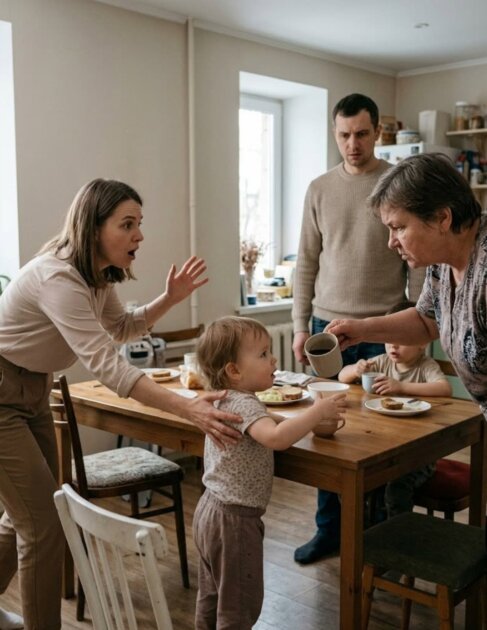
Plates were scattered across the table. Kolya sat beside Lera. I was cutting strawberries into tiny pieces for my daughter, while the adults chatted casually, as though this lunch were no different from dozens of other family gatherings.
Then Lera reached for Kolya’s cup.
The footage showed it clearly.
She didn’t grab Galina’s hand. She didn’t push her. She didn’t pull at the table or even touch the coffee mug.
Galina was sitting to one side.
When Lera reached out, she pushed her chair back, leaned forward, picked up her own mug, and moved it toward the child.
The next moment, Lera screamed.
I paused the video.
It was still difficult to watch those few seconds because I knew what had followed: the emergency department, the treatment for the burns on her cheek and neck, the marks beneath the collar of her little shirt, her crying behind the hospital doors, and Galina telling the medical staff that she had supposedly just “flinched.”
But this time, I noticed something else.
Not new evidence.
The difference between what the video actually showed and how quickly the family had begun changing the meaning of what they had witnessed.
Galina called it an accident.
Grigory had already messaged Sergey, claiming that Lera had suddenly reached for the cup and startled her grandmother.
Artyom suggested that everyone stop blaming one another until we supposedly figured out what had really happened.
Sergey went even further.
His message was still on my screen. He had asked me not to stir up a family feud and to write that everything had happened because of a terrible accident.
That was when Dad told me to respond with just one sentence.
I wrote:
**“I have the complete kitchen recording.”**
Nothing more.
I didn’t threaten anyone.
I didn’t describe what the footage showed.
I didn’t send screenshots.
I didn’t explain who had already received a copy.
A few minutes later, Sergey called.
His voice had changed so noticeably that I didn’t even need to ask whether he understood the significance of my message.
“We need to talk tonight,” he said. “Calmly.”
I looked at the door to Lera’s hospital room.
“About what?”
“About what we do next.”
Until yesterday, those words from my husband would have meant that we were going to face a problem together and find a solution.
Now I heard something entirely different in them.
What were we going to do about the video?
Not Lera’s burns.
Not Galina’s lies.
The video.
“All right,” I said.
My answer was brief, without a single explanation.
Sergey fell silent, as though he expected me to add something.
I didn’t.
Dad sat beside me without interfering.
When I ended the call, he asked only one question.
“Did you hear it?”
“Yes.”
“What did you hear?”
I didn’t answer immediately.
“He didn’t ask how Lera was.”
Dad nodded.
That hurt more than any argument could have.
Sergey knew that his two-year-old daughter was receiving treatment for burns. He knew she was crying. He knew who had been holding the mug.
And yet, once he learned that a complete recording existed, his first concern still wasn’t his daughter.
It was the family story he needed to protect.
That evening, we didn’t go to Galina’s house.
I refused to take my child back to a place where something like this had already happened to her. But I wasn’t going to leave Lera behind just so the adults could gather and collectively decide how we were supposed to remember the incident.
Sergey came to see me alone.
Dad stayed with me, but he sat a little farther away. Before my husband could say anything, Dad made it clear that he wouldn’t speak on my behalf.
This was my family.
My child.
And my decision.
Sergey entered looking tense. He wasn’t carrying anything. He looked at me, then at my father.
“I thought we were going to talk privately.”
“We can talk,” I replied. “Dad won’t answer for me.”
He sat down.
For the first few minutes, he said exactly what I had expected.
His mother was frightened. His father was upset. Everyone had said things they shouldn’t have said. Nobody had wanted Lera to get hurt.
We needed to wait until the little girl was feeling better, and then discuss everything calmly, without hysteria.
I listened.
I didn’t interrupt.
Then I asked one question.
“Did you see what happened?”
Sergey pressed his lips together.
“I was standing at the wrong angle.”
“That’s not an answer.”
“I didn’t see everything.”
“But you heard your mother tell the medical staff that she had simply flinched, didn’t you?”
He looked away.
“Yes.”
“And you said nothing.”
“Everything was chaotic.”
“You said nothing?”
He rubbed his forehead with his palm.
“Yes.”
One word.
Galina hadn’t said it for him.
Neither had Grigory.
Nor Artyom.
Sergey himself had admitted that he had played a part in what happened that evening.
I took out my phone.
“Then let’s watch the recording.”
He raised his head sharply.
“I believe you.”
“Then watching it shouldn’t be difficult.”
“I didn’t say it would be difficult.”
“Good.”
I positioned the phone so that we could both see the screen.
Dad didn’t move closer. He remained where he was sitting.
I started the video from the very beginning.
Almost immediately, Sergey asked, “Why do we have to watch twenty minutes when everything happened at the end?”
“Because that’s exactly what they want now,” I replied. “They want to take a few seconds out of context and explain them for us instead of looking at the entire scene.”
He said nothing.
On the screen, Lera was eating strawberries. Kolya was showing her something beside his plate. I was moving between the table and the kitchen counter.
Galina remained in the frame for most of the recording.
Then the moment we both knew was coming approached.
Sergey leaned forward.
Lera reached out her hand.
Galina moved her chair.
Her hand went to the mug.
She moved it forward.
A scream.
I didn’t stop the recording.
The video showed me dropping the knife onto the cutting board and rushing toward my daughter.
The adults’ voices could be heard.
Kolya was crying.
And so was Sergey’s voice.
For a few seconds, he kept repeating Lera’s name. Then he turned to his mother.
That was when his expression changed.
Not because of new evidence.
Because he heard his own voice.
On the recording, he was asking Galina why she had done it.
Quietly, almost breathlessly, but the words were perfectly clear.
Sergey reached toward the phone.
“Go back.”
I rewound a few seconds.
He heard it again.
“Mom, why did you do that?”
Sergey slowly withdrew his hand.
Now he was facing a problem he could no longer hide behind the excuse that he had been standing at the wrong angle.
In the first moments after Lera screamed, he had reacted like someone who believed he had witnessed his own mother do something to the child.
Later, after talking to his family, that initial reaction had been replaced by “I didn’t see everything,” “Everyone was upset,” and “We shouldn’t stir up a family feud.”
I stopped the video.
“Why did your version change?”
“I was in shock.”
“So, in your shock, you asked your mother why she had done it, but a few hours later, you asked me to call it an accident?”
“I was trying to keep our family from falling apart.”
That was when I realized our real conversation was only just beginning.
Until then, I had thought the most important question was whether Sergey would continue defending his mother after watching the video.
But the real question was much more painful.
He had already seen enough in the kitchen to understand that something was terribly wrong.
And he had still chosen to try to keep everything as it was.
“Which family are you trying to save?” I asked.
Sergey frowned.
“Don’t start.”
“I’m not starting anything. I’m asking you a question.”
“My mother made a terrible mistake.”
“You just called it a mistake.”
“What am I supposed to call it?”
“The truth.”
He suddenly stood up, walked a few steps, and turned back toward me.
“Do you want me to say that she deliberately poured it on Lera?”
“I want you to stop saying things you don’t know just because they’re more convenient for your mother.”
Sergey looked at me.
“And what are you going to do with the recording?”
Dad shifted in his chair, but I answered before he could speak.
“Whatever is necessary to protect Lera.”
“What does that mean?”
“It means your mother will never be alone with her again.”
Sergey immediately shook his head.
“Don’t make permanent decisions because of one moment!”
“This isn’t a permanent decision.”
“You know exactly how this will sound to her.”
“Right now, I care much more about how Lera will feel when she sees the person who ended up sending her to the hospital.”
Sergey fell silent.
This time, I didn’t wait for him to come up with another phrase about preserving family peace.
“And one more thing,” I continued. “Nobody is going to ask me to change my account of what happened for the doctors or anyone else.”
“I never asked you to do that.”
I opened his message and placed the phone in front of him.
*Write that it was a terrible accident.*
Sergey read his own words.
“I was thinking about the family.”
“You didn’t specify that.”
“I didn’t think you’d interpret it that way.”
“How else was I supposed to interpret it?”
He had no answer.
Finally, Dad spoke.
But he wasn’t addressing Sergey.
He was speaking to me.
“Have you told him what you need from him tonight?”
I understood why he was asking.
We could spend hours arguing over every word, but nothing would change unless Sergey made a real choice.
I looked at my husband.
“Not quite.”
Then I made it clear.
“I don’t need you to give a speech against your mother, Sergey. I need to know whether you accept two simple facts. The video doesn’t show what your mother told the medical staff happened. And you will never again ask me to call this an accident.”
He stared at the dark screen for a long time.
“I accept the first.”
I waited.
“And the second?”
“I won’t ask you to lie.”
“That isn’t what I asked.”
He understood.
For the first time that evening, the desperation to find wording that wouldn’t offend anyone disappeared from his voice.
“I won’t call it an accident again.”
I nodded.
That didn’t restore my trust.
It didn’t erase the fact that he had stood beside his mother and remained silent.
Nor did it change the fact that, after we reached the hospital, he had worried about the family conflict before he worried about his daughter.
But it was the first answer he had given me that wasn’t an excuse.
It was a boundary.
The next morning, Galina sent me a long message.
She didn’t apologize for giving the medical staff a different account of what had happened.
Instead, she wrote that she hadn’t slept all night, that she loved Lera, that she had never wanted to hurt her, and that one terrible movement shouldn’t deprive a grandmother of her granddaughter.
I read the message once.
In the past, I would probably have responded to every paragraph.
I would have challenged every sentence.
I would have asked why she had immediately told the medical staff that she had merely flinched.
I would have reminded her that her husband had already started shifting the blame onto a two-year-old child.
This time, I wrote much less.
“Lera is recovering. You will not have contact with her without me present. Any further decisions will be made with her safety as our only priority.”
Then I put my phone down.
Galina replied almost immediately.
Then she sent another message.
Finally, Grigory called me.
I didn’t get into an argument with any of them.
All their messages shared one thing: they talked about what would happen to the family if I refused to give in.
I thought about what had already happened to my child when the adults decided that the family’s comfort mattered more than the truth.
Lera came home tired.
During the first few days, she became fussy whenever I touched the fabric near her neck. I learned to dress her more slowly, carefully moving the material so it wouldn’t rub against her sensitive skin.
We followed the doctors’ instructions and monitored how her burns were healing.
During those days, I barely thought about winning.
I cut up her food.
I tucked her into bed.
I moved cups away from the edge of the table, even though I knew that the real problem that day hadn’t been where a cup was placed.
That was one of the cruelest aftereffects: the mind kept searching for some small, ordinary change that might allow it to believe the same thing could never happen again.
Move hot drinks farther away.
Seat the children somewhere else.
Don’t leave the phone beside the vase.
As though one small adjustment could restore the sense of safety that had vanished in a single moment.
But the real change was something else.
I stopped leaving Lera in situations where adults could hurt her and then collectively dismiss what happened as a misunderstanding.
Sergey found that boundary much harder to accept.
He returned to the subject of his mother several times.
He didn’t demand that I take Lera to see Galina, but he kept asking how long the restriction would last, what his mother needed to do, and whether even a brief visit in our presence might be possible.
I made no promises.
“First, she needs to stop rewriting what happened,” I told him.
“And if she says she accepts responsibility?”
“Then I’ll listen to exactly what she says.”
That distinction mattered enormously to me.
Someone can say, “I’m sorry,” and then add in the very next sentence that the child reached for the cup herself, everyone was nervous, her hand slipped, and now her daughter-in-law is destroying the family.
That isn’t taking responsibility.
It’s simply wrapping the same old story in new packaging.
A few days later, Sergey asked to watch the video again.
This time, we were alone.
I handed him the phone.
He didn’t immediately skip to the moment with the mug.
He watched from the beginning.
When the recording reached the moment he had asked his mother, “Why did you do that?” he paused the video.
“I remembered this differently,” he said.
“How?”
“As though I hadn’t understood what happened even then.”
I sat down across from him.
“When did you start remembering it differently?”
Sergey ran his finger along the edge of the phone.
“When Mom started repeating that it had been an accident.”
That answer meant more than all his previous words.
Because now he could no longer hide behind the claim that he simply hadn’t seen anything.
He was acknowledging the mechanism itself.
The version of events repeated over and over by his family had gradually become more comfortable for him than his own initial reaction to what he had witnessed.
“I don’t want to keep doing that,” he said.
I didn’t tell him I believed him.
Trust doesn’t return because someone finally says the right thing.
It returns when that person repeatedly does the right thing, even when doing so comes at a cost.
And he soon had the opportunity to prove it.
Galina called Sergey while we were at home with Lera.
I couldn’t hear every word, only fragments, but I understood that she was talking again about the “child’s sudden movement” and the “unfortunate accident.”
Previously, Sergey would have gone into another room.
This time, he stayed where he was.
“Mom,” he said, “don’t say that Lera caused this.”
Galina replied with something I couldn’t make out.
Sergey closed his eyes, but he didn’t back down.
“I saw the recording.”
Another pause.
“No. I’m not going to ask her to change her account of what happened.”
He ended the call.
He didn’t look like a man who had won.
He looked like someone who had just lost an easy way of being both a good son and a good father without having to stand up for anything.
But that was precisely what mattered to me.
Not humiliating Galina.
Not forcing the family to surrender.
Not creating some beautiful, cinematic moment after which everyone suddenly became a different person.
What mattered was that Sergey had finally agreed to pay the uncomfortable price for drawing a boundary he should have established in the hospital.
Our marriage didn’t instantly return to what it had been before.
I couldn’t forget his silence beside his mother.
And he couldn’t undo what he had already done with a single phone call.
We spoke less about Galina and more about what it meant to protect our own child when the danger came not from a stranger, but from someone we had been taught since childhood to accommodate.
Galina didn’t see Lera for some time.
I didn’t give her a date for when that might change.
To me, it was no longer a punishment.
It was a condition of safety.
When Galina finally sent a message without the words *but*, *accidentally*, or *Lera did it herself*, I didn’t feel the relief I might once have expected.
I simply saw the first message in which she no longer made a two-year-old child a participant in what had happened to her.
That wasn’t enough to restore the way things used to be.
But it was enough to help me understand something: a boundary only works if you refuse to erase it simply because it makes someone else uncomfortable.
We kept the video.
We didn’t watch it every night, and we didn’t turn it into a weapon in family arguments.
The original file remained untouched, the copy was stored separately, and the phone became just a phone again.
A few weeks later, I placed it back in the kitchen, near the same ceramic fruit bowl.
Not to gather evidence.
Lera was sitting at the table, trying to spear a piece of strawberry with her little fork. Sergey held her cup so she wouldn’t accidentally knock over the water.
I turned on the camera.
For a moment, my hand froze above the screen.
Then I pressed the record button.
There was no Galina in the frame, no arguments, no hospital doors.
There was only a little girl laughing because the strawberry had slipped off her fork.
Her father leaned over to help her, then instinctively moved his own hot cup farther away from the edge of the table.
Beside them stood the same ceramic vase, the one next to which my phone had accidentally been left on that terrible day.
The phone that had preserved a few seconds of footage while the adults were already trying to rewrite what had happened.
Now it was recording something entirely different.
Not evidence.
Not an accusation.
Not the collapse of a family.
Just an ordinary day in which Lera’s safety no longer depended on which version of events the adults found more convenient to believe.
And that was when I finally understood: the most important thing wasn’t that the video had preserved the truth. It was that we had finally become willing to protect it.

