
My Husband Said Buying a Washing Machine for My Mother Was “None of Our Business”—But He Had No Problem Spending Our Money on His Family
Friday evening was supposed to be peaceful. Autumn rain tapped gently against the windows, the kettle was boiling on the stove, and the apartment smelled of freshly baked pastries. I sat at the kitchen table, reviewing our family budget on my laptop.
At thirty-two, I was proud of how carefully I managed our finances. My husband, Denis, was thirty-four, and together we had built what I believed was a comfortable life. We paid our bills, contributed to our savings account, and still had money left over at the end of the month.
Everything looked perfect on paper.
Denis was stretched out on the sofa, mindlessly scrolling through videos on his phone. I smiled at him, expecting him to be happy about the idea I was about to suggest.
“Denis, listen,” I began, turning my laptop toward him. “Mom’s turning sixty next month. Her washing machine has finally broken, and she’s been washing everything by hand for a week. Their refrigerator is barely working, too. It makes a terrible noise, and I’m afraid it could stop working any day now.”
He continued scrolling.
“I was thinking we could take two hundred thousand rubles from our joint savings and buy them new appliances. A good washing machine and a modern refrigerator. It would make their lives so much easier.”
Denis finally reacted, but not in the way I expected.
“Why are you coming up with these things, Oksana? We have our own plans for that money. We’ll give your mother twenty thousand rubles in an envelope, buy her a nice bouquet, and that’s more than enough. Spending two hundred thousand on appliances is none of our business. Your parents have pensions. They can save up themselves.”
For a moment, I felt as though someone had poured ice water over my head.
None of our business?
I turned toward the dark window. From our apartment, I could clearly see the parking lot below. But our expensive, shiny four-wheel-drive SUV wasn’t in its usual space.
We were still paying a substantial monthly loan on that vehicle.
And I knew exactly where it was.
Two days earlier, Denis’s thirty-year-old brother, Pavel, had dropped by for tea. While stirring sugar into his cup, he had casually announced his plans.
“Den, do me a favor. The guys and I are going fishing in the neighboring region this weekend. My sedan won’t fit the boat and all the equipment, and I’ll get stuck in the mud on those roads. Can I borrow your beast until Sunday?”
“Of course!” Denis had answered immediately. “Take it!”
I had tried to intervene.
“Denis, wait. Those roads are full of mud and branches. The car is practically new, and we still have three years of payments left.”
Pavel had laughed dismissively.
“Oh, come on, Oksana. Don’t be so difficult. It’s an SUV, not a museum exhibit. What do you think will happen to it? We’re family. We’re supposed to help each other!”
Denis had simply taken the keys off the hook and handed them over.
Our SUV had been purchased with our money, yet somehow it was always available whenever his relatives wanted it.
And Denis saw absolutely nothing wrong with that.
Staring at the empty parking space, I felt the comfortable illusion of our big, happy family begin to crumble.
To understand how we had reached this point, I had to go back three years.
That was when both our careers began improving. I worked as a senior analyst at a major logistics company and received a significant promotion. My salary became almost twice as high as Denis’s.
We lived in a modest two-bedroom apartment and dreamed of buying a small country cottage. I imagined quiet weekends on the porch, drinking coffee, reading books, and enjoying a little peace away from the city.
But when we began discussing major purchases, Denis’s mother, Tamara, entered the picture.
Tamara was loud, controlling, and obsessed with her philosophy of an inseparable family clan. The moment she heard about our plans, she arrived with a cake and launched into a passionate speech.
“My children! A tiny cottage? How selfish can you be? We’re one family! Pavel has children who need fresh air. We should buy a large country house where everyone can gather. We’ll barbecue together, celebrate New Year’s Eve, and make wonderful memories. I’ll even contribute some of my savings!”
I had grown up as an only child in a quiet, modest household. The idea of belonging to a large, lively family touched something deep inside me. I wanted that sense of togetherness so badly that I agreed.
We bought a huge two-story country house with a mortgage.
Tamara contributed barely ten percent of the purchase price. I covered the lion’s share of the monthly payments from my salary.
Then came the SUV.
“Just think how convenient it will be!” Denis insisted. “We can take Mom’s plants to the cottage, help Pavel with construction materials, and drive the whole family into the countryside. It’s an investment in the family!”
We bought it. I put in my personal savings and helped finance the rest through an auto loan.
Soon, the garage filled with expensive equipment: power drills, chainsaws, lawn mowers, and professional tools.
“We need all this to maintain the house,” Denis explained. “Pavel is good with his hands. He’ll help everyone, so the tools should belong to the whole family.”
I paid the bills while everyone else enjoyed the benefits.
For a long time, I genuinely believed I was building something meaningful.
Then the warning signs started appearing.
Six months earlier, my father had needed an urgent consultation at a regional cardiac center. It was pouring rain that morning, and I wanted to take him in our SUV rather than make him wait for a taxi.
“Denis, where are the keys? I need to drive Dad to the hospital.”
He looked uncomfortable.
“Oh, Pavel took the car last night. He went to an amusement park in another city with his wife and kids. Their old car isn’t safe for a long trip with the children. Just call your father a premium taxi. I’ll pay for it.”
I stood beneath the entrance canopy with my pale, anxious father and waited forty minutes for a taxi to arrive.
That evening, I saw Pavel’s cheerful photographs online. He was posing beside our SUV in the amusement park parking lot.
I said nothing.
I wanted to believe it had been an unfortunate coincidence.
But the final blow came during the summer.
My parents had never once spent a night at our supposedly shared country house. They were modest people who hated imposing on anyone. One weekend, they finally asked whether they could visit for two days.
They wanted nothing more than fresh air, a little peace, and perhaps a chance to pick some berries.
I called Tamara to let her know.
“Oh, sweetheart, you’ve chosen the worst possible time!” she chirped. “Pavel and his family are here on vacation. We’ve occupied every bedroom!”
“Tamara, there are four bedrooms in that house. My parents only need one room for two nights.”
“And where am I supposed to put the children? They fight, so they need separate rooms. My husband and I sleep separately, and Pavel and his wife are using your bedroom upstairs. The living room is a passageway. Surely you don’t expect your refined parents to sleep on a folding bed in the hallway? Let them come in September, when we’re back in the city.”
Then she hung up.
I turned to Denis, who was calmly eating his soup.
“Your mother just refused to let my parents visit our country house. She says there’s no room because Pavel is there. We pay sixty thousand rubles a month toward that mortgage. Couldn’t you ask your brother to make a little space for two days?”
Denis put down his spoon.
“Mom is right, actually. The kids run around, the television is loud, and your parents like peace and quiet. They wouldn’t be comfortable in all that chaos. Mom is only thinking about their comfort!”
That was when I finally understood.
When his family wanted something, every sacrifice was justified.
When my family needed help, there was always an excuse.
My parents couldn’t even spend two nights in a house I helped pay for, yet Pavel could use our bedroom whenever he pleased.
His family borrowed our car, damaged our tools, and returned the SUV with an empty tank and a filthy interior. Meanwhile, my parents had received absolutely nothing from all those supposedly wonderful family investments.
And now Denis was telling me that helping my mother buy a washing machine was none of our business.
That Friday, I didn’t argue. I closed my laptop, finished my cold tea, and went to bed.
But something inside me had changed.
I was done being the family’s unlimited source of money.
A week later, my opportunity arrived.
On Friday morning, I received a notification from my banking app. Our company had completed a complicated project I had been leading for an entire year, and management had rewarded my work with a substantial annual bonus.
Five hundred thousand rubles.
That evening, Denis was suspiciously cheerful. He served me salad, poured me a drink, and smiled as though he had won the lottery.
After dinner, he placed his phone on the table. A website selling recreational vehicles was open on the screen.
“Oksana, I’ve had a brilliant idea!” he announced. “Your bonus has arrived. Five hundred thousand rubles! I talked to Mom and Pavel, and we all agree this is the perfect opportunity. We need a quad bike for the country house!”
I put down my fork.
“A quad bike?”
“Absolutely! Imagine how much fun we’ll have riding through the forest and picking mushrooms. Pavel has already found a trailer for our SUV and picked out a reliable Japanese model. It fits perfectly into your bonus!”
He spoke as if the money already belonged to him, his mother, and his brother.
They had planned everything without even asking me.
I looked at his delighted face and smiled.
“You know what, Denis? You’re absolutely right. Money should be spent on the people closest to us.”
His face lit up. He reached for his phone, ready to place the order.
“Except there won’t be a quad bike,” I said quietly.
His hand froze.
I stood up, took a transparent folder from my bag, and placed it on the table beside his phone.
“What’s this?” he asked, frowning.
“Receipts and purchase agreements.”
I opened the folder.
“My parents are getting a new washing machine, a good refrigerator, and a brand-new kitchen. Everything will be installed before Mom’s birthday.”
Denis’s face began turning pale.
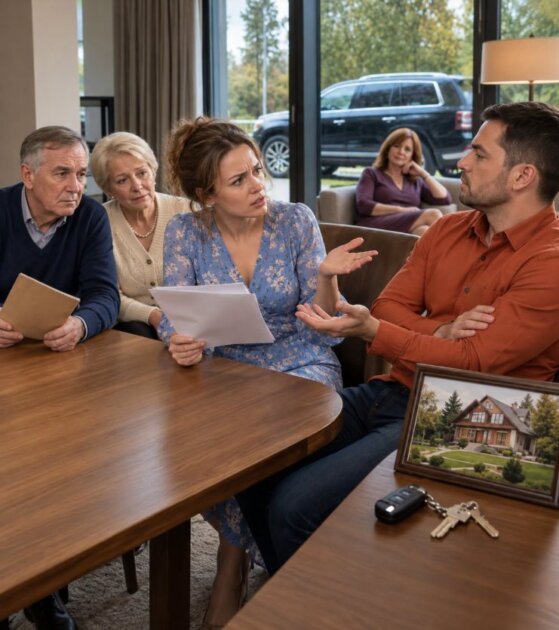
“And the rest of the money? I transferred it to a dental clinic this afternoon. Dad has needed major implant surgery for a long time. My parents have been saving for it for years, sacrificing all kinds of things. Now Dad will finally be able to eat properly again.”
I closed the folder.
“My bonus is gone, Denis. I spent it on my family.”
He shot to his feet so violently that his chair toppled over.
“What have you done?! You spent half a million of our money on your parents without asking me? We had plans! We agreed to buy something for the family! How could you betray me like this?”
I calmly picked up the fallen chair and sat down again.
“Sit down, Denis.”
Something in my voice made him obey.
I took out my work notebook and a pen.
“Since you’re so concerned about family, let’s calculate exactly how much we’ve invested in yours.”
He stared at me, speechless.
“Our SUV cost five million rubles. The down payment of one and a half million came from my personal savings. We split the loan payments, yet your brother is using the vehicle right now to drive through muddy roads on his fishing trip. Last month, he borrowed it for two entire weeks. Your family uses the car as though it belongs to them.”
Denis opened his mouth, but I raised my hand.
“I’m not finished. The mortgage on our country house is eighty thousand rubles a month. I pay sixty thousand. My parents haven’t spent a single night there in two years because your mother claimed there was no room for them. Yet Pavel and his family use our bedroom whenever they want.”
I turned another page.
“The tools in the garage cost two hundred thousand rubles. I bought them with my bonus. Pavel damaged the angle grinder and didn’t even apologize. Your family uses our things, empties our fuel tank, and expects us to pay for the repairs.”
I looked directly at him.
“But when I asked for two hundred thousand rubles to buy a basic washing machine for my mother, you looked me in the eyes and said, ‘That’s none of our business.’”
Denis sat motionless, his jaw clenched.
He had no answer.
“So listen carefully,” I continued. “If my parents aren’t part of your family, then my money is no longer available to support yours. The era of unlimited generosity is over.”
“You’re destroying our family over a few bills!” he shouted. “My mother was right about you. You’re selfish! You don’t understand what real family means!”
I stood up.
“Real family helps one another. Both ways. When someone can only take, when they expect one person to pay for everything but refuse to help that person’s loved ones, that’s not family loyalty. That’s exploitation.”
I paused at the doorway.
“My parents have never asked us for a single ruble. They have spent their entire lives trying not to inconvenience anyone. I will never again allow them to feel like strangers while your relatives enjoy everything I work for.”
The consequences arrived quickly.
The next morning, my phone rang. Tamara’s name flashed across the screen.
The moment I answered, she launched into a furious tirade.
“Oksana! How could you deprive Denis and Pavel of their quad bike? We had already discussed it! And now you’re wasting money on your parents instead of thinking about the family!”
I didn’t argue.
I simply ended the call.
I was finished listening to lectures about family loyalty from a woman who treated my property as though it belonged to her.
That evening, I placed a printed document in front of Denis.
“From now on, we will manage our finances separately,” I told him. “We’ll agree on shared expenses like groceries and utilities, and each of us will pay our fair share. But I refuse to keep financing the country house almost single-handedly.”
He stared at me in disbelief.
“If your mother wants to control that property, she and Pavel can take responsibility for the mortgage and maintenance. Otherwise, we’ll put the house up for sale and divide the proceeds according to our legal interests.”
He started to protest, but I continued.
“And Pavel is no longer allowed to take our SUV. The rules have changed, Denis. Either we live as equal partners, or we get divorced. The choice is yours.”
For once, he had nothing to say.
A month later, my mother’s sixtieth birthday arrived.
We celebrated in my parents’ home, surrounded by the warmth and laughter I had always associated with a real family. My mother could hardly stop admiring her new kitchen. My father, beaming with his new smile, happily ate a piece of meat he had struggled to chew for years.
“I feel twenty years younger!” he joked.
My mother hugged me, tears in her eyes.
“You didn’t have to do all this, sweetheart.”
“Yes, Mom,” I whispered. “I did.”
Looking at their happiness, I knew I had spent that money exactly where it belonged.
Meanwhile, Denis’s family was falling apart.
Pavel exploded when Denis demanded the SUV keys back and refused to finance the quad bike. Tamara tried crying, manipulating, and making her son feel guilty. But for the first time in his life, Denis understood that he might actually lose his wife, his comfortable lifestyle, and the home they had built together.
Eventually, he had to choose between protecting his marriage and continuing to satisfy every demand made by his mother and brother.
The country house was put up for sale. Without my financial contributions, neither Tamara nor Pavel could afford the mortgage and maintenance costs.
The supposedly inseparable family clan began to crumble the moment its free source of money disappeared.
Denis became quieter, more cooperative, and far less eager to hand our possessions to his relatives. I still don’t know whether he genuinely understood how unfairly he had treated me or whether he was simply afraid of losing everything.
But I finally understood something important.
A family budget isn’t built on grand speeches about loyalty. It is built on fairness, respect, and mutual responsibility.
You cannot demand that one person sacrifice everything for your relatives while dismissing that person’s parents as someone else’s problem.
Love is not measured by how much money you give away. It is measured by whether the people who claim to love you are willing to stand beside you when your own loved ones need help.
And I would never again apologize for taking care of the people who had spent their entire lives taking care of me.
Because the real betrayal would not have been spending my bonus on my parents.
The real betrayal would have been continuing to let everyone else matter more than me and the people I loved.

