
# Her Husband Abused and Humiliated Her for Years, but Nobody Helped. One Night, She Fled With Her One-Year-Old Daughter and Spent the Night in a Haystack.
Katerina married for love. When she first met Sergey, he was a completely different man from the one she would eventually come to fear. He was cheerful, hardworking, and incredibly handy. There seemed to be nothing he couldn’t fix. He could turn an old, rusted tractor into something that ran like new, repair a damaged roof, mend a broken fence, or sweep Katerina into his arms as though carrying her was the most natural thing in the world.
The first time Sergey saw her at a dance in the village community hall, he spent the entire evening standing against the wall, stealing glances at her but never quite finding the courage to approach. Eventually, Katerina made the first move.
She was captivated by the tall, broad-shouldered young man with eyes as blue as the summer sky. Sergey, in turn, looked at her as though nobody else in the room existed.
They married three months later. A year after that, their daughter, Anechka, was born.
In the beginning, their life together was everything Katerina had dreamed of. Sergey worked as a mechanic at the local state farm, while Katerina stayed home with their baby. They didn’t have much, but they had enough. In the evenings, the three of them often walked along the village streets. Sergey proudly pushed the stroller, carefully lifting it over the larger puddles, while Katerina laughed beside him.
The neighboring women watched them with envy.
“That woman certainly got lucky!” they would say. “A hardworking husband and a healthy little girl. What more could anyone ask for?”
Back then, Katerina believed her life would always be filled with that kind of happiness.
Then the state farm closed.
Sergey suddenly found himself unemployed.
During the first month, he tried to remain optimistic. He kept saying that he would find another job soon. A mechanic as skilled as he was could find work anywhere, he insisted.
By the second month, his complaints became more frequent. Nobody appreciated him, he said. He had worked hard his entire life, and now they had thrown him aside as though he were worthless.
By the third month, he had started drinking.
At first, it was only a few beers in the evening. Katerina didn’t worry too much. She thought her husband was going through a difficult period and needed something to help him forget his troubles.
But a few beers soon became a bottle of vodka. Eventually, it didn’t matter what kind of alcohol he drank, as long as he could get his hands on something.
Their savings disappeared quickly. Katerina tried talking to him, but he brushed her off. When she hid money, he found it. When she begged him through tears to stop drinking, he became furious.
He grew increasingly irritable. His voice became harsher, his gaze more threatening, and Katerina slowly learned that even asking the wrong question at the wrong moment could send him into a rage.
Then, one day, Sergey hit her.
Anechka was only six months old.
Years later, Katerina would struggle to remember exactly what had triggered that first blow. Perhaps she had put too much salt in the soup. Perhaps she had spoken at the wrong moment. Or perhaps Sergey had simply been looking for an excuse, because by then he seemed determined to find something—anything—to be angry about.
The slap came without warning. The back of his hand struck her face, and she stumbled backward in shock.
Her lip wasn’t bleeding, and no obvious bruise appeared. Yet Katerina felt as though something inside her had shattered beyond repair.
She sat in the kitchen for a long time, one hand pressed against her cheek.
She couldn’t understand what had just happened.
To her? To Katerina? To the woman Sergey had once held so carefully, as though he were afraid the world might take her away from him?
The next morning, he begged for forgiveness. He fell to his knees, cried, kissed her hands, and promised that it would never happen again.
“Katya, please forgive me! I don’t know what came over me. It was the alcohol. I swear I’ll never raise my hand against you again!”
Katerina believed him.
Or, at least, she wanted to believe him. She still loved her husband and clung to the memory of the man he had once been.
A month later, he hit her again.
A week after that, it happened once more.
Eventually, she stopped counting.
She was still in her twenties, a petite, delicate woman with thin wrists and tired eyes. Sergey was nearly twice her weight. When he struck her, she often didn’t even cry out. She was terrified of waking their daughter.
She clenched her teeth, bit her lip, and tried to endure the pain in silence.
But Sergey seemed to become more aggressive with every passing month. It was as though he took satisfaction in seeing her frightened, watching her remain silent, and knowing she was too afraid to stand up to him.
Gradually, it became about more than his anger. He wanted her to understand that he was the master of the house and that she was nobody without him.
One day, a neighbor finally couldn’t bear it any longer and called the police.
The responding officer was a young, inexperienced man. By the time he arrived, Sergey had sobered up. He stood on the front porch perfectly calm, as though nothing unusual had happened.
“It’s a family matter,” he said with a dismissive shrug. “We’ll sort it out ourselves.”
The officer hesitated, asked a few questions, and eventually left.
That evening, Sergey beat Katerina so badly that she was afraid to leave the house for an entire week. Her face swelled, her lip split open, and dark purple bruises covered her body.
He leaned over her and looked directly into her eyes.
“Do you understand now? Nobody is going to help you. You’re my wife. I can do whatever I want with you.”
That was when Katerina finally understood that she couldn’t keep waiting for someone to rescue her.
If she wanted to survive and save her daughter, she would have to take the first step herself.
The idea of escaping didn’t come to her all at once. For weeks, she quietly planned while pretending that everything at home was continuing as usual.
She saved small amounts of money and hid them inside an old felt boot behind the stove. She gathered a few changes of clothes for Anechka and packed the essentials into a small bundle. She arranged her documents—her passport, her daughter’s birth certificate, and her medical papers—so she could grab them quickly if the opportunity arose.
Every day, she watched Sergey’s moods and waited for the moment when she could finally leave.
That moment came in November.
Sergey had been drinking for three days straight. That evening, he came home late, staggering slightly, his eyes clouded and his temper already simmering. Katerina was sitting in the kitchen, feeding Anechka.
He sat down at the table and stared at her.
She immediately recognized that look.
She knew trouble was coming.
“Get me something to eat!”
“Just a moment, Sergey. Let me finish feeding the baby, and then—”
With one violent sweep of his arm, Sergey knocked a cup off the table. It smashed against the floor. Anechka startled and burst into tears.
Katerina instinctively pulled her daughter close.
“Are you deaf?” Sergey shouted. “I said, get me something to eat!”
Katerina placed the little girl in her crib and went to the stove. She tried to act as though nothing had happened, but her hands were shaking so badly that she could barely hold the plate.
She could feel Sergey’s eyes burning into her back. It was like having the barrel of a gun pointed at her.
“You don’t respect me anymore,” he suddenly said in a quieter voice. “I’m nobody to you. I worked and worked, and this is how you treat me…”
“Sergey, that’s not true. I respect you. The food is almost ready.”
Katerina placed the plate in front of him.
The next moment, his fist slammed into her face.
She was thrown against the wall, the back of her head striking the hard plaster. For a moment, the room went dark. Then her daughter’s terrified screams pulled her back to reality.
“Shut her up!” Sergey roared.
Katerina struggled to her feet. Her head was ringing, her face burning, and her legs barely supported her. She hurried to the crib, lifted Anechka into her arms, and held her tightly against her chest.
And suddenly, something inside her changed.
She didn’t magically become brave. She wasn’t suddenly free of fear. She simply understood, with terrifying clarity, that if she didn’t leave now, she might never get another chance.
It was now or never.
“Just a moment, Sergey,” she whispered.
Then she walked out of the kitchen.
In the bedroom, she pulled on her coat without even changing out of her house clothes. She grabbed the bundle she had prepared and shoved her bare feet into her boots.
Sergey continued shouting from the kitchen, but the blood pounding in her ears was so loud that she could no longer make out his words.
She opened the door and stepped into the night.
Outside, November had unleashed a miserable mixture of snow and freezing rain. The wind tore at her coat, trying to force her back toward the house. Anechka was crying, and Katerina desperately tried to shield her with the edge of her coat and the blanket she had brought along.
She hurried down the street, then turned between the gardens, hoping nobody would see her. She followed the fences until she reached the open fields.
Her boots sank into the frozen mud. Her fingers grew numb, and the cold made her face ache. Each step became harder than the one before.
But she kept going.
Behind her stood the house, with Sergey inside it, along with his fists and his threats.
It was the place where she had once been happy, but where every day had become a struggle to stay alive.
Perhaps she wouldn’t have died that very night. Perhaps not the next day, either. Maybe it would have taken another year or two. But she had begun to feel with growing certainty that if she stayed, one day her husband would hurt her so badly that she would never get back up.
Ahead of her lay nothing but darkness.
She had no plan for where they would sleep, how she would support her daughter, or who might be willing to take them in. She didn’t know where to go or how she would survive.
She only knew that she couldn’t turn back.
She was almost too exhausted to walk when she spotted an enormous haystack at the edge of the field.
She stumbled toward it and began pulling the dry stalks apart with trembling hands. She scraped out a small hollow in the hay and carefully settled Anechka inside.
The hay smelled of summer. Surprisingly, it was warm, and the dry stalks surrounded them like a protective blanket, shielding their bodies from the freezing night air.
Katerina wrapped her coat around herself and pressed her daughter against her chest.
Then, for the first time in months, she began to cry.
Not loudly. She was afraid someone might hear her. Tears simply rolled down her cheeks, mingling with the raindrops clinging to her skin.
“Forgive me, sweetheart,” she whispered into her daughter’s hair. “Forgive me for putting you through this. I’m only trying to save you. I promise we’ll survive. Do you hear me? The two of us will survive.”
Anechka gradually settled down. Her sobs grew quieter, her tiny fingers relaxed, and eventually she fell asleep in her mother’s arms.
But Katerina remained awake throughout the night.
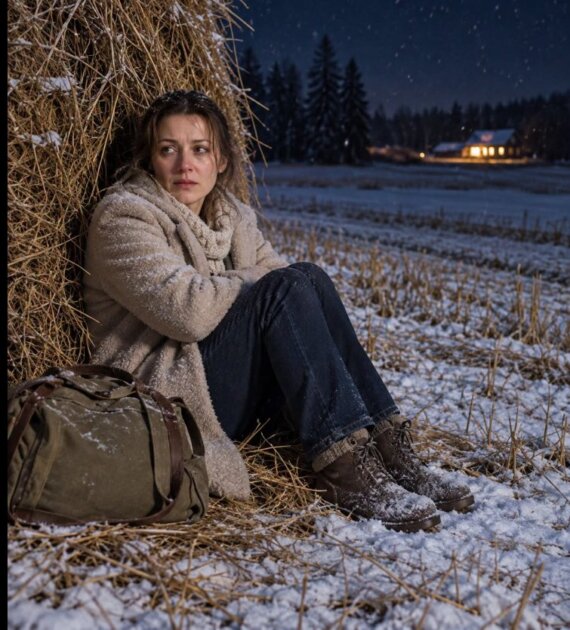
Through the gaps in the haystack, she watched the wind blow tiny snowflakes into their shelter. Whenever she shivered, she held her daughter even closer. Each time the little girl stirred, Katerina immediately bent down to check that she was breathing normally.
The dark field stretched endlessly around them. There was nobody nearby who could help them. Nobody who could promise that the next day would be better.
And yet, in that small hollow lined with hay, surrounded by cold and fear, Katerina felt something she hadn’t felt at home for a very long time.
For at least that night, nobody could hurt them.
She didn’t close her eyes until morning.
When the pale light of dawn began filtering through the gaps in the haystack, she knew she had to return to the house.
Her passport was still in the drawer.
Without it, she couldn’t travel far, find formal employment, or take care of the necessary paperwork. She also needed her daughter’s documents. No matter how terrified she was, she couldn’t leave without them.
She waited until it was fully light, then started back toward the village.
By the time she reached their house, her heart was pounding so violently that she thought she might collapse. She opened the door quietly and stepped inside like a burglar breaking into her own home.
Sergey was nowhere to be seen.
Perhaps he had gone looking for them. Perhaps he had passed out drunk at a neighbor’s house. Katerina didn’t want to guess.
She didn’t waste a second.
She retrieved her passport, took Anechka’s birth certificate, and looked around the room one final time.
Four years of her life remained within those walls.
The walls where she had once laughed. The table where she had eaten dinner with her husband. The bed where they had once slept curled up together.
It was the same house, yet she felt as though she were standing among the ruins of a stranger’s life.
She didn’t cry anymore.
She picked up her bundle, gathered her daughter into her arms, and headed for the bus station.
She had just enough money for a single ticket to the capital of the republic.
On the bus, Anechka soon fell asleep in her lap. Katerina watched the fields, bare trees, and distant villages slide past the window.
One thought repeated itself in her mind.
*From now on, I’m starting over. A new life. From nothing.*
Of course, she was afraid.
But this was a different kind of fear. It wasn’t the paralyzing terror that had forced her to remain silent whenever Sergey raised his hand.
This was the fear of the unknown. The fear of not knowing what awaited her or whether she could manage on her own.
Yet there was something strangely invigorating about it.
It didn’t paralyze her.
It pushed her forward.
On the outskirts of the capital, she rented a tiny room from an elderly woman. The space was cramped, the walls were worn, and the furniture was old, but the landlady agreed to let her stay with her child. The rent was cheap, and Katerina couldn’t afford anything better.
Soon afterward, she found a job at a small roadside café.
The work was exhausting. She spent twelve hours on her feet, carrying trays, washing greasy dishes, and patiently smiling at tired truck drivers, even when they spoke rudely to her.
By the end of each shift, every muscle in her body ached.
But she received a paycheck.
And, more importantly, nobody hit her.
During the day, the elderly landlady looked after Anechka. At first, she complained that the child was noisy, cried too much, and disrupted her routine. But little by little, she grew fond of the girl. She learned how to soothe her, feed her, and make her smile.
When Katerina returned home around midnight, Anechka was usually already asleep.
Her mother would sit beside the little bed and watch her for long minutes.
She watched the tiny rise and fall of her daughter’s chest. She listened to her quiet breathing.
*She’s alive.*
*She’s healthy.*
*She’s safe.*
*And I’m alive, too,* Katerina would think.
Six months later, she could afford a slightly better place. She rented a separate room in an old wooden house, complete with a tiny kitchen. It wasn’t beautiful or spacious, but at least they no longer had to share their living space with anyone else.
Meanwhile, Anechka was learning to walk.
At first, she clung to the side of her crib, taking cautious little steps along the wall. Then, one day, she managed to cross a short distance on her own. She laughed so joyfully that you would have thought she had accomplished something extraordinary.
That was when Katerina bought her first proper pair of shoes.
They were bright red, with tiny buckles, and Anechka wore them as proudly as though they were the most precious treasure in the world.
Katerina watched her daughter toddle across the room, smiling.
For the first time in a long while, she was genuinely happy herself.
But at night, she still dreamed about Sergey.
Sometimes she woke up drenched in sweat, her heart pounding in her throat, desperately searching the darkness for the door.
In some dreams, Sergey stood beside her bed. In others, he had found them and was trying to take Anechka away.
Whenever that happened, Katerina would sit up, wrap her arms around her knees, and quietly repeat the same words to herself.
*It’s only a dream. He’s not here. He can’t come inside. We’re safe. Anechka is safe.*
Yet deep inside, she always knew that Sergey wouldn’t let her go so easily.
And she was right.
He found her a year after she escaped.
It was March. The snow was melting, little streams were running along the roadsides, and the sun filled the café windows with warm light.
Katerina was carrying an order to a table when she saw him sitting at the far end of the room.
Sergey was seated beside the window.
He was looking directly at her.
Calmly, almost indifferently, as though it were perfectly natural for him to be there, waiting for his wife to serve him.
The tray trembled in Katerina’s hands. For one terrible moment, she felt as though the ground had disappeared beneath her feet.
An entire year had passed.
Three hundred and sixty-five days in which she had tried to rebuild her life. She had worked, saved money, cared for her daughter, and slowly learned to fall asleep without waking at every unfamiliar sound.
But her body had not forgotten.
It remembered every blow, every threat, every moment when she had crouched in the corner of the kitchen, waiting for Sergey to stop hurting her.
Her body screamed at her to run.
But this time, she didn’t flee.
She walked slowly toward his table and placed the tray on the neighboring chair.
“What are you doing here?”
Sergey smiled.
It was the same smile that had once made her fall in love with him. The charming, disarming smile he had used to win people over.
“Hello, Katya. I’ve been looking for you for an entire year. Please don’t be angry about what happened. I was stupid. Alcohol ruined me. But it’s over now. I’ve stopped drinking, I swear.”
“You’ve stopped drinking,” Katerina repeated quietly.
Then she looked him straight in the eyes.
“I’m glad. Now leave.”
The smile slowly disappeared from Sergey’s face.
“Katya, don’t do this. I’ve come here with good intentions. I’ve found a job at an auto repair shop. I’ll earn decent money. I’ll rent an apartment. And I want to see Anechka. How is my daughter?”
“She’s healthy. She’s growing. She can walk now.”
Katerina paused.
“But you won’t be going anywhere near her.”
Sergey’s expression changed. His eyes darkened, his jaw tightened, and Katerina recognized the look she knew all too well.
“You’re my wife,” he said quietly. “And Anechka is my daughter. I can report you for kidnapping my child. Who are you? A waitress. Nobody important. But I’m her father, and I have rights. The court will give her to me. Do you understand?”
Katerina said nothing.
Sergey leaned closer.
“So you’ll pack your things and come home with me. Enough of this nonsense. I’ll even forgive you for running away.”
Katerina stared at him for several seconds.
Then something inside her finally clicked into place.
It wasn’t that her fear had disappeared. Something much deeper had changed. After months of struggling to rebuild her life, she had finally understood that she no longer owed obedience to the man who had destroyed it.
“You’re going to forgive me?” she asked slowly.
She took out her phone.
Sergey narrowed his eyes.
“Who are you calling?”
“The police.”
“Don’t you dare do something stupid!”
He tried to grab her wrist, but Katerina stepped back and dialed the number.
“Hello? Police? I need help. A man has come to my workplace and is threatening me. He used to abuse me regularly. I’m afraid he might hurt me or my child. I’m at the café near the railway station, at 12 Privokzalnaya Street.”
Sergey stared at her.
He couldn’t believe what he was hearing.
His Katya—the woman who once swallowed her own sobs to avoid making him angrier—had called the police on him.
On him, her own husband!
“Have you lost your mind, you stupid woman?” he hissed. “I’m your husband!”
“Not anymore,” Katerina replied. “You’re my ex-husband. Do you understand? Ex. Everything between us is over.”
Sergey suddenly lunged toward her, but the café manager, Sasha, stepped between them. He had heard the shouting and immediately come out of the back room. Two customers also stood up from their tables.
“Hey, buddy!” Sasha said firmly. “You’d better leave.”
“She’s my wife!” Sergey shouted. “I have a right to her!”
“You may have your rights, but you’re not going to threaten anyone here. Leave!”
A few minutes later, the sound of a police siren filled the street.
Two officers entered the café. One was young, while the other was older and appeared more experienced.
Katerina explained what had happened. She showed them an old bruise still faintly visible on her wrist, a mark left by that final night before she escaped. A thin scar above her eyebrow also reminded her of the night she had finally run away.
She told them about the beatings, the threats, the previous police visit, and the November night when she had wandered through a freezing field with her one-year-old daughter in her arms.
She explained how she had crawled into a haystack, how she had feared her little girl would freeze, and how she had set off the following morning with almost nothing.
Sergey kept interrupting her.
“She’s lying! This is a family matter! We’ll settle it ourselves! You have no business interfering!”
The older officer raised his hand.
“That’s enough. We’ll determine what happened.”
The officers escorted Sergey outside and placed him in the police car.
Before the vehicle pulled away, he turned around one last time.
His face was filled with anger, confusion, and wounded pride. He looked at Katerina as though she were the one who had betrayed their family.
As though he genuinely couldn’t understand why he should be held accountable for what he had done.
Perhaps he truly didn’t understand.
Perhaps he had always believed that his wife belonged to him and that he had the right to treat her however he pleased.
Katerina watched the police car disappear down the road.
Her heart was racing. Her knees trembled, and her palms were damp with cold sweat.
But she no longer felt the same terror she had once known.
Something else filled her instead.
Relief.
And freedom.
She stepped outside the café. The March sunshine fell directly across her face. Meltwater dripped from the roof, puddles glistened along the street, and the air carried the damp, fresh scent of approaching spring.
Katerina stood on the steps and took a deep breath.
The world around her was the same, yet everything seemed different.
She was no longer the woman who had once crouched trembling in her own kitchen. She was no longer the woman who believed nobody would ever help her.
She was standing on her own two feet.
And she no longer needed anyone’s permission to live.
“Thank you,” she said to Sasha.
He shrugged.
“Don’t mention it. If anything happens, tell us. We won’t let anyone hurt one of our own.”
*One of our own.*
Katerina stared at him for a moment.
All her life, she had been told that she belonged to Sergey. That she was his wife, his woman, his property.
Now, for the first time, someone had made her feel that she could belong somewhere without surrendering her freedom.
That there were people who would stand beside her rather than turn against her.
And she began to cry.
But these were no longer tears of pain.
They were the tears of someone who had finally stopped treating herself like a stranger.
Later, Katerina changed her surname and filed for divorce. The proceedings were relatively quick, partly because several witnesses were able to support her account of what had happened.
Sergey tried to challenge the decision and demanded visitation rights. The court allowed him to see his daughter, but only in the presence of another person.
He came to one supervised visit.
He sat beside Anechka and stared at the little girl for a long time. She was three years old by then and barely remembered the man who had once been called her father.
Sergey remained silent for several minutes. Then he stood up and left.
He never returned.
Katerina never learned what happened to him. Perhaps he moved away. Perhaps he started drinking again. Perhaps he found another woman who believed his promises, someone who might suffer beside him just as Katerina had suffered for years.
She didn’t know, and she no longer wanted to find out.
Her life finally no longer revolved around Sergey.
Today, she still works at the same café, but she is no longer a waitress. Sasha eventually received a promotion and recommended her as his replacement.
“You can do this, Katya,” he told her. “You’re strong. I know you’ll manage.”
And she did.
Anechka attends kindergarten and loves drawing colorful pictures. Most of them feature her mother, the sun, and a little house.
Every evening, Katerina picks her up from kindergarten. They hold hands and walk home together to their small room.
Their apartment isn’t large. It has no expensive furniture, plush carpets, or elegant curtains. But they can lock the door from the inside, and Katerina can finally lay her head on the pillow without fearing that someone will burst in during the night.
That little room is their fortress.
Their home.
The place where nobody has to be afraid.
Sometimes, Katerina remembers that November night. The freezing wind, the muddy field, and her little daughter trembling beneath her coat. She remembers pulling the hay apart with her bare hands and lying there for hours while the world around them seemed dark and endless.
Sometimes, she stops and asks herself:
*Was that really me? Was I truly capable of doing all that? How did I survive?*
Then Anechka runs toward her, wraps her little arms around her mother’s legs, and looks up with wide, curious eyes.
“Mommy, will you tell me a story?”
Katerina bends down, lifts her into her arms, and holds her close.
And in that moment, she knows the answer.
Yes, she was capable of it.
She survived. She saved her daughter. And she built a new life for them from nothing.
Whenever someone tells her, “You’re strong, Katya!” she simply smiles and says nothing.
She doesn’t feel particularly strong. She doesn’t think of herself as a brave heroine. Even now, she sometimes gets tired, sometimes feels afraid, and sometimes has days when all she wants to do is sit down and cry.
She is simply a mother.
A mother who, one night, realized that if she didn’t escape, her daughter might never discover what it meant to grow up feeling safe.
A mother who found enough strength in the darkest moment of her life to stand up and walk toward the unknown.
Because sometimes, courage doesn’t mean that you’re not afraid.
It means taking the next step even when your legs are shaking.
Even when a storm is raging outside. Even when you have nowhere to go. Even when your only shelter is a haystack standing at the edge of a frozen field.
That night, Katerina had no idea how she would change her life. She didn’t know where she would work the next day, whether they would have a roof over their heads, or how she would find money for their next meal.
But she knew one thing for certain.
She would not allow her daughter to grow up trapped in the same fear that had imprisoned her for years.
And in the end, she succeeded.
Because a mother will sometimes push beyond the very limits of her strength for her child. She will walk through darkness, endure the storm, and keep moving even when she feels she has nothing left.
Not because it doesn’t hurt.
But because there is someone she refuses to lose.
And no matter how long the night lasts, no matter how cold the field becomes, and no matter how deep the despair grows, morning will eventually come.
For Katerina, that morning began when she crawled out of the haystack with her one-year-old daughter in her arms and decided she would never turn back.
She had almost nothing: a few documents, a small bundle of clothes, and her little girl.
But it was enough to begin again.
And sometimes, that is all a person needs to find herself once more: one decision, one step forward, and the belief that tomorrow might still hold something better.

