
Twelve Days After Our Divorce, My Ex-Husband Demanded $10,000 From My Account. I Blocked His Card That Morning, and by Noon, He Was Facing an Unexpected Problem.
Twelve days after our divorce, Sergey sent me a message.
“Leave about ten thousand rubles in the account tomorrow. The delivery will arrive between twelve and two.”
I read it twice. Then I opened my banking app. Two cards were linked to one account: mine and my ex-husband’s, which we had ordered years earlier.
Back then, we had considered it perfectly normal that what belonged to me also belonged to him.
But we were divorced now.
I didn’t reply. I wasn’t planning revenge. I had simply realized that Sergey believed our marriage might be over, but his access to my money wasn’t.
Three years earlier, I had given him a supplementary card because my salary went into that account, and he often stopped at the supermarket after work. At first, he bought groceries, cleaning supplies, and things our daughter, Nastya, needed.
Then things slowly began to change.
One Saturday, I noticed a charge of almost four thousand rubles at an auto accessories store.
“Why did you use my card?” I asked when Sergey came home.
“Because I needed things for the car!”
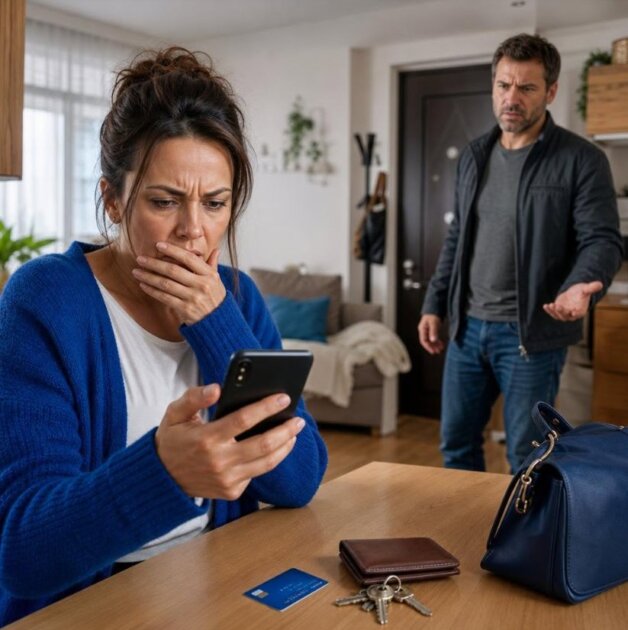
“Your car.”
“And? I drive Nastya to school and do the shopping. Isn’t that for the family?”
I let it go. Later, he began paying for lunches for his colleagues and ordering food for friends who came over to watch football, all with my money.
He always gave me the same answer: he would pay me back.
And every time, I argued with him instead of simply removing his access to the account.
Eventually, we divorced for reasons that had nothing to do with the card itself. Sergey regularly made decisions without consulting me, then expected me to adjust to them. When I moved out, I thought we would at least manage to separate our finances.
I was wrong.
He never returned the supplementary card. Once, he even used it to buy groceries when our daughter was staying with him. I didn’t want another argument because Nastya genuinely needed food.
Then Sergey promised again that he wouldn’t use the card anymore.
For almost a month, nothing happened.
After the divorce, it seemed we had finally learned to cooperate. We discussed our daughter’s school expenses, divided the costs, and stopped looking for reasons to argue.
Then came the message demanding ten thousand rubles.
I replied, “What delivery?”
“Groceries. A big order. I’ll pay with your card.”
“Use your own.”
He called immediately.
“Nadya, don’t start! I’ll pay you back.”
“You promised you wouldn’t use that card anymore.”
“That was different! This is food. Nastya stays with me, too.”
“She’ll be with me tomorrow and the day after.”
“And what about next week? Am I supposed to fill the refrigerator every single day?”
“Buy what you need with your own money.”
Then he said the words that finally settled the matter.
“But you have money in your account anyway!”
He wasn’t asking for a loan. He wasn’t asking for help. He simply assumed my money was still available whenever he wanted it.
That morning, I opened my banking app and permanently blocked his supplementary card. I didn’t send him a warning. I had already explained myself enough times.
At half past twelve, my phone rang.
“What did you do to the card?” Sergey demanded angrily.
“I closed it.”
“What do you mean, you closed it? The delivery guy is standing right here! The terminal keeps declining the payment!”
In the background, I heard the courier offer to accept another card or a QR-code payment.
Sergey lowered his voice.
“Transfer nine thousand rubles to me. I’ll pay you back tonight.”
“No.”
“It’s inconvenient to pay from my own account right now.”
“Why?”
There was a brief silence.
“That money is set aside.”
Suddenly, everything became clear. He had his own money. He simply didn’t want to spend it. It was much more convenient to use mine.
“Then decide whether you really need that order,” I said.
I heard him turn to the courier.
“Fine. Let’s try another card.”
A few seconds later, the terminal beeped.
“It went through,” the courier said.
Sergey returned to the phone.
“We lived together for twelve years, and now you’re doing this over a grocery card?”
I almost started arguing. I wanted to remind him how many times he had crossed my boundaries and how often he had made me feel petty for saying no.
But I said only one thing.
“We didn’t get divorced because of a card.”
That evening, Nastya messaged me to say her father was angry because I had blocked his card.
I replied, “This is a financial matter between adults. You don’t need to worry about it.”
Two days later, Sergey informed me that he had ordered himself a new bank card. I didn’t respond.
A week later, he transferred his share of our daughter’s school trip expenses. He didn’t complain, mention his previous purchases, or ask me to deduct the cost of the groceries. He simply sent the money.
That evening, I opened my banking app again. Only one card appeared under my account.
Mine.
Our divorce didn’t become final in a banking app. It became final when I finally understood that sharing a life with someone did not mean giving them permanent access to my money.
Sometimes freedom doesn’t begin with a loud argument.
Sometimes it begins when you finally press the right button and stop apologizing for setting boundaries.

