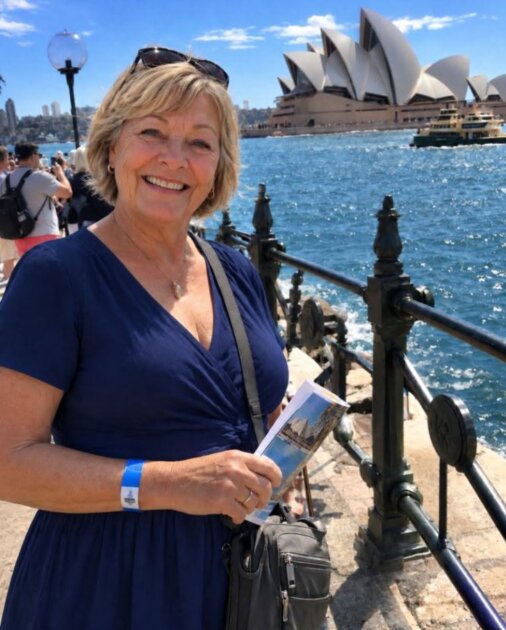
I had traveled halfway around the world because, for once in my life, I wanted to do something that belonged entirely to me.
No children asking where I was going.
No grandchildren needing a ride.
No appointments scribbled across my calendar.
No one waiting for me to solve a problem.
Just me, a suitcase, a passport, and a long list of places I had spent decades promising myself I would someday see.
I never imagined that an ordinary invitation for coffee in Australia would bring me face-to-face with something I had believed was lost forever.
Something that had belonged to my husband.
Something that would change the way I understood the last years of his life.
And perhaps even change the way I understood my own.
The moment I stepped into Arthur’s living room, I froze.
My purse slipped from my shoulder and landed softly against the floor.
For several seconds, I couldn’t move.
I couldn’t hear the kettle whistling in the kitchen.
I couldn’t hear the old clock ticking somewhere behind me.
I couldn’t even hear Arthur’s footsteps.
All I could see was the painting hanging above his fireplace.
A small cottage beside a quiet lake.
Two tall pine trees bending slightly toward the water.
A crooked wooden dock stretching into the blue-gray surface.
A narrow strip of wild grass along the shore.
And in the lower corner, almost hidden among the painted blades of grass, were three tiny letters.
R.M.
My husband’s initials.
Robert Miller.
My Robert.
I knew that painting.
I knew every detail.
Every uneven brushstroke.
Every little imperfection.
I had watched Robert paint it more than twenty years ago, sitting at our kitchen table with an old shirt protecting his clothes from the oil paint.
He had complained about the pine trees for three days because he could never make them look the way he wanted.
I had teased him about it.
He had laughed.
And now that painting was hanging in a stranger’s home thousands of miles away.
I had believed it was gone.
Destroyed.
Lost somewhere in the years after Robert died.
“Abigail?”
Arthur’s voice finally reached me.
I turned slowly.
He stood in the doorway holding two coffee mugs, his expression changing the moment he saw my face.
I pointed toward the fireplace.
My voice barely came out.
“Where did you get that?”
Arthur didn’t answer immediately.
He looked at the painting.
Then at me.
And something in his eyes told me that whatever explanation he was about to give me was going to hurt.
Or surprise me.
Maybe both.
For most of my adult life, I had taken care of everyone except myself.
First, there was Robert.
Then our children.
Then our grandchildren.
Then everyone else’s emergencies somehow became mine.
I worked for thirty-two years as a school secretary.
I packed lunches.
I stayed home with sick children.
I babysat when someone had a last-minute appointment.
I drove people to airports.
I helped with bills.
I lent money.
I organized birthday parties.
I remembered everyone’s birthdays while quietly accepting that very few people remembered mine without being reminded.
Whenever someone called, I answered.
Whenever someone needed something, I found a way.
After Robert died twelve years ago, I became even more useful.
My children weren’t bad people.
That was the difficult part.
They loved me.
But over the years, they had become accustomed to me always being available.
If Karen needed someone to watch her boys, she called.
If David was short on rent, he called.
If Melissa needed help preparing for a birthday party, she called.
If Eric needed a ride from the airport, I was usually the first person he contacted.
And sometimes weeks passed without anyone calling simply to ask:
“Mom, how are you?”
I told myself it was normal.
Everyone was busy.
Families depended on one another.
That was what mothers did.
At least, that was what I had always believed.
Then, one Tuesday morning, I stood alone in my kitchen with a cup of coffee growing cold between my hands.
I looked at my calendar.
Almost every square was filled.
My grandson’s soccer tournament.
Melissa’s dentist appointment because I was watching her daughter.
A reminder to transfer money to David.
A doctor’s appointment for someone else.
Errands for someone else.
A birthday dinner for someone else.
Everywhere I looked, there were other people’s plans.
There wasn’t a single thing on that calendar that belonged to me.
I stared at it for a long time.
Then I looked around the kitchen.
The same kitchen where Robert and I had once talked about traveling.
Italy.
Japan.
Australia.
France.
We had always said, “Someday.”
Someday, after retirement.
Someday, when the children were older.
Someday, when the mortgage was smaller.
Someday, when we had more money.
Someday, when there was more time.
But someday never came.
Robert got sick.
And our someday ended before it ever began.
I was sixty-nine years old when I finally understood something painful.
If I kept waiting for the perfect moment, I might spend the rest of my life waiting.
So I made a decision.
I sold my house.
Then I booked a trip around the world.
My children reacted as if I had betrayed them.
“You’re being selfish, Mom,” Karen said.
“What about the grandchildren?” Melissa asked.
David simply stared at me as though I had announced something absurd.
“You’re really going to waste all that money traveling?”
Then Eric said something that hurt more than the others.
“That house was supposed to stay in the family.”
I looked at him.
“It was my house.”
He didn’t like that answer.
None of them did.
When I refused to cancel my plans, Karen and David stopped speaking to me for a while.
I cried the night before my flight.
Not because I regretted my decision.
Because I wondered whether I had spent so many years teaching my family that my life didn’t matter that they genuinely couldn’t understand why it mattered now.
The next morning, I went anyway.
I told myself that while I could still walk through airports, carry my own suitcase, climb unfamiliar stairs, and explore a new city without asking anyone’s permission, I was going to see as much of the world as I could.
Australia was my fourth stop.
And that was where I met Arthur.
He was seventy-one, widowed, quietly charming, and possessed the kind of dry humor that made you smile a few seconds after he said something.
We met in a secondhand bookstore in Melbourne.
We both reached for the same detective novel.
Our hands touched.
Arthur looked at me.
“I suppose fighting over it would be undignified at our age.”
“At our age?”
He smiled.
“Fair point. You look thirty-five.”
I raised an eyebrow.
“Now I know you’re a liar.”
He laughed.
It was the first time I’d laughed like that in weeks.
Two days later, we ran into each other again.
Then again.
Soon we were walking together through the city, browsing bookstores, listening to old jazz records, and arguing about whether roses were overrated.
“They’re needy,” Arthur told me one afternoon.
“They’re flowers.”
“Exactly. Imagine being that demanding and not even paying rent.”
I laughed until my sides hurt.
I hadn’t realized how long it had been since someone had made me laugh simply because they enjoyed my company.
Arthur had been married to Anne for thirty-eight years before she died.
So neither of us pretended grief disappeared simply because enough time had passed.
We talked about our spouses.
Our children.
Our mistakes.
Our regrets.
Our loneliness.
One afternoon, while we were sitting on a bench overlooking the water, Arthur said quietly:
“Nobody warns you that grief becomes quieter without actually leaving.”
I looked at him.
“I know.”
And I did.
After several weeks, Arthur invited me to his home.
“I have an old collection of records you might like,” he said. “Come for coffee.”
I trusted him.
So I went.
I expected an ordinary afternoon.
A cup of coffee.
Some music.
A little conversation.
Instead, the moment I stepped into his living room, I saw the painting.
The one that had belonged to Robert.
Arthur placed the mugs on the table.
“Abigail,” he said softly, “sit down.”
I didn’t.
I pointed at the fireplace.
“Tell me where you got that.”
Arthur looked at the painting.
Then he took a slow breath.
“From Robert.”
The room seemed to tilt.
“What?”
“Robert gave it to me.”
I stared at him.
“You knew my husband?”
Arthur nodded.
“I knew him when we were young.”
He explained that Robert had spent almost a year in Australia before we met.
He and Arthur had worked together at a hotel outside Melbourne.
They had been young, broke, and convinced they had their whole lives ahead of them.
They traveled on weekends whenever they could afford it.
They played cards.
They listened to records.
They worked miserable jobs and laughed about them afterward.
And Robert painted whenever he could afford canvas and paint.
Arthur pointed toward the fireplace.
“That painting came from one of those weekends.”
“But Robert painted that after we were married.”
“He painted more than one.”
Arthur smiled sadly.
“The original was created during his time here. Years later, he painted another version for you.”
I stared at the cottage.
“The one I remember was destroyed.”
“No,” Arthur said.
“There were actually three.”
My heart began pounding.
“Why would he send one to you?”
Arthur didn’t answer.
Instead, he walked into another room.
When he returned, he was carrying a small wooden box.
It was old.
The corners were worn smooth.
He placed it carefully on the coffee table.
Inside were dozens of envelopes.
My breath caught.
Every envelope carried the same handwriting.
Robert’s handwriting.
My hands began to tremble.
“How long were you writing to each other?”
“On and off for decades.”
I looked at him.
“Robert never told me.”
Arthur shook his head.
“He wasn’t hiding an affair, Abigail.”
“I never said he was.”
“You thought it.”
I almost laughed.
He was right.
Arthur explained that after Robert returned to America, they stayed in contact.
Sometimes they wrote several times a year.
Sometimes years passed.
Life became complicated.
Marriage.
Children.
Work.
Bills.
Illness.
But when Robert became sick, he found Arthur again through an old friend.
Their correspondence became regular.
“Why didn’t he tell me?”
Arthur looked down at the box.
“Because most of what he wrote was about you.”
I stopped breathing for a moment.
“Me?”
Arthur reached inside and removed one envelope.
He placed it gently on the table.
My name was written across the front.
I recognized the handwriting instantly.
My fingers hovered over the envelope.
“Why do you have this?”
“Robert asked me to keep it.”
“For twelve years?”
Arthur nodded.
“Why?”
He looked at me.
“Because he hoped you’d eventually come to Australia.”
I stared at him.
Arthur told me that Robert always remembered how much I wanted to travel.
He knew how often I had postponed my dreams for the sake of everyone else.
“He worried that after he died, you’d spend the rest of your life taking care of everyone except yourself.”
My throat tightened.
“He said you gave everything away,” Arthur continued. “Your time. Your money. Your energy.”
I looked down.
“He said you were happiest whenever you were planning trips you never actually took.”
A tear slipped down my cheek.
Then Arthur said something that broke my heart.
“Robert wrote that his biggest regret wasn’t dying before retirement.”
He paused.
“It was helping you believe life could always be postponed.”
For twelve years, I had thought Robert’s death was the reason I never traveled.
But suddenly I wondered if perhaps I had been using his death as another excuse to keep waiting.
My fingers shook as I picked up the envelope.
“I want to read it.”
Arthur nodded.
The envelope was still sealed.
I opened it carefully.
Inside were four handwritten pages.
I couldn’t read the first paragraph without crying.
I had to stop several times.
But one passage made my entire body go still.
“Abigail,
If you’re reading this in Australia, then you finally did something we spent years talking about.
And if I’m not there with you, don’t turn the trip into a memorial for me.
See things because you want to see them.”
I covered my mouth.
The tears came harder.
The letter continued.
“Eat food I would have hated.
Stay too long somewhere beautiful.
Leave somewhere boring early.
Spend money on yourself without explaining it to anyone.
The children love you, but don’t let loving them become the reason you never live without permission.”
I had to put the letter down.
Arthur looked away, giving me privacy.
After a few moments, I continued reading.
“I asked Arthur to keep this because Australia always felt like the place where my life became mine for the first time.
Maybe it will do the same for you.
And if Arthur is still around, make him buy the coffee.
He still owes me twelve dollars.”
I laughed through my tears.
Arthur looked over.
“I was hoping he’d forgotten about that.”
I laughed harder.
Then I cried again.
But this time, my tears felt different.
There was grief in them.
Of course there was.
But there was also relief.
For years, I had carried a strange guilt whenever I enjoyed something Robert would never experience.
Selling the house.
Traveling alone.
Laughing.
Being happy.
Part of me had believed that moving forward meant leaving him behind.
But there he was, in his own handwriting, telling me to go.
Arthur and I talked until the coffee grew cold.
He told me stories about Robert I had never heard.
Robert falling asleep during a jazz concert.
Getting hopelessly lost while insisting he knew exactly where he was going.
Trying to cook fish over a campfire and dropping the entire thing into the dirt.
“That sounds exactly like him,” I said.
Arthur smiled.
“He talked about you constantly near the end.”
I looked at him.
“You knew who I was when we met?”
“Not immediately.”
He explained that he hadn’t seen a recent photograph of me.
Only after our second meeting, when I mentioned Robert and where we had lived, did he begin to suspect.
“Why didn’t you tell me?”
Arthur raised an eyebrow.
“Imagine traveling alone in Australia and having a strange man say, ‘By the way, I knew your dead husband and I’ve been keeping his letters for twelve years.’”
I smiled.
“That would have been memorable.”
“So I waited.”
Then he became serious.
“Partly because of the painting.”
“And the other part?”
For the first time, Arthur looked almost embarrassed.
“I wanted to spend more time with my best friend’s wife.”
He paused.
“The woman he loved with all his heart.”
Something changed in the room.
Neither of us spoke.
Arthur slowly placed his hand on the table, palm facing upward.
I looked at it.
Then I placed my hand in his.
It didn’t feel like betrayal.
It didn’t feel like replacing Robert.
It felt like two lonely people acknowledging that life had somehow brought them together at exactly the moment they needed someone.
I stayed in Australia three weeks longer than I had planned.
Arthur showed me places tourists rarely visited.
We listened to old records.
We ate terrible sandwiches beside the beach.
We argued about movies.
We watched sunsets without needing to fill the silence.
And one afternoon, he took me to the lake where he and Robert had stayed as young men.
The cottage was gone.
The old dock was gone.
The landscape had changed.
But the lake remained.
The same water.
The same quiet horizon.
I stood beside Arthur on the shore.
“I thought coming here would make me sad.”
“Does it?”
“A little.”
I looked across the water.
Then I smiled.
“But not only sad.”
I didn’t cancel the rest of my trip.
Arthur joined me for two more stops.
Then I continued alone.
For the first time, I discovered that being alone and being lonely were not the same thing.
I could sit in a café by myself.
Walk through a museum alone.
Take a train without explaining where I was going.
Eat dinner at a little restaurant simply because the smell coming through the doorway made me curious.
I could make decisions based on what I wanted.
And I could miss Robert without feeling guilty for continuing to live.
Eventually, my children began calling again.
Karen apologized first.
Melissa admitted that my leaving had forced her to realize just how much she had depended on me.
David took longer.
Eric took the longest.
Then one evening, he finally said:
“I guess I thought the house meant you’d always be there.”
I laughed softly.
“I’m still your mother.”
Then I added:
“I’m just not your furniture.”
There was a long silence.
Then Eric laughed.
And for the first time in months, so did I.
Arthur and I continued talking every day.
Six months later, I returned to Australia.
Not because Robert had somehow sent me there.
Not because my children had pushed me away.
Not because Arthur needed me.
I returned because I wanted to.
When I walked through the arrivals hall, I saw Arthur waiting for me.
He was holding a small cardboard sign.
ABIGAIL — COFFEE STILL OWED!
I laughed so hard that I started crying.
He hugged me.
And for a moment, standing there with my suitcase beside me, I realized something.
I wasn’t starting my life over.
I was finally living the life I had spent decades postponing.
I still travel.
Sometimes with Arthur.
Sometimes alone.
The painting now hangs in the small apartment we share for part of the year.
Beside it is Robert’s letter.
And underneath them is the receipt from the first coffee Arthur bought me after I returned.
Exactly twelve dollars.
At sixty-nine, I thought selling my house meant walking away from everything I had built.
I was wrong.
I wasn’t walking away from my life.
I was finally walking toward it.
Halfway around the world, I found a piece of the man I had loved for most of my adult life.
I found a friendship I never knew existed.
I found a man who understood grief without asking me to forget it.
And, unexpectedly, I found a future I had never dared to imagine.
For most of my life, I had treated “someday” like a destination that would eventually arrive at my doorstep.
But someday doesn’t arrive.
You have to walk toward it.
At sixty-nine, I finally did.
And when I look back now, I realize the greatest gift Robert left me wasn’t the painting.
It wasn’t the letter.
It wasn’t even the memories.
It was permission.
Permission to stop waiting.
Permission to spend money on myself.
Permission to laugh again.
Permission to love life without feeling guilty for the life I had lost.
And perhaps most importantly, permission to understand that moving forward isn’t the same as leaving someone behind.
Sometimes, moving forward is exactly how we carry them with us.