
Mrs. Clooney walked into first class wearing a pair of worn white sneakers and carrying a small brown paper bag folded neatly at the top.
The woman sitting beside the window looked her up and down.
First the bag.
Then the sneakers.
Then Mrs. Clooney’s face.
And with a cold little smile, she said:
“Maybe you should go back to where you came from.”
Twenty minutes later, the captain announced Mrs. Clooney’s name over the loudspeaker.
No one in the cabin touched their drink.
My name is Emily, and that was my first time flying first class.
I had spent the first ten minutes pretending I knew exactly what I was doing.
I was flying from Chicago to Seattle for a work conference. That morning, an upgrade notification had appeared on my phone, and I was still convinced there had been some kind of administrative mistake.
I checked my seat number three times.
Then I stood in the aisle trying to shove my carry-on into the overhead compartment while everyone behind me waited.
Eventually, a flight attendant came to my rescue.
“First time in first class?” she asked gently.
“Is it that obvious?”
“Only because you said ‘thank you.’”
She smiled and walked away.
I took my seat by the window, 3A.
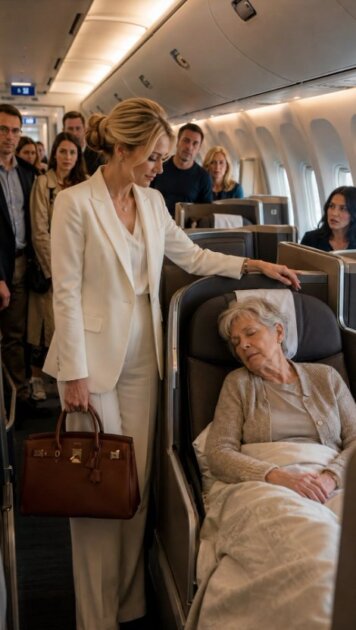
Across the aisle sat a woman in a perfectly fitted white blazer, typing on a silver laptop.
Her hair was immaculate. Not one strand was out of place.
On the empty seat beside her was an expensive designer handbag.
She looked like the kind of person who had never once wondered whether she belonged somewhere.
Then Mrs. Clooney appeared.
She walked slowly down the aisle, using the backs of the seats for balance.
Her navy trousers were neatly pressed.
Her cardigan was buttoned all the way to her neck.
Her white sneakers were clean, but the toes were visibly worn.
In one hand she carried a small canvas purse.
In the other was the brown paper bag.
She smiled at almost every passenger she passed.
Most didn’t even look up.
When she reached our row, she checked her boarding pass.
“Excuse me,” she said softly. “I believe this is my seat.”
The woman in the white blazer looked at the paper bag first.
Then the sneakers.
Then Mrs. Clooney.
“You must be mistaken.”
Mrs. Clooney checked her boarding pass again.
“2F.”
The woman gave a short laugh.
“Economy is farther back.”
“I know.”
The woman turned her laptop toward herself.
“Then maybe you should go back to where you came from.”
Her voice carried through the cabin.
The smile disappeared from Mrs. Clooney’s face.
“I don’t want to cause any trouble,” she whispered.
The flight attendant took the boarding pass, checked it, and pointed toward the window seat.
“You aren’t causing any trouble, ma’am. This is your seat.”
The woman in the white blazer leaned back.
“Seriously?”
“Your bag will need to be moved from the seat,” the flight attendant said.
“So now anyone can just walk into first class?” the woman snapped.
Mrs. Clooney lowered her eyes.
“I can sit somewhere else.”
“No, ma’am,” the flight attendant replied firmly. “You paid for this seat.”
The woman grabbed her designer bag with two fingers and moved it as though even being asked had offended her.
Mrs. Clooney sat by the window.
Before fastening her seat belt, she turned toward the woman.
“I’m sorry for the inconvenience.”
That sentence hurt more than the insult.
I wanted to say something.
I wanted to tell that woman exactly what everyone around us was thinking.
But I didn’t.
My courage usually arrives about five minutes after it would have been useful.
The plane began taxiing.
As we lifted into the clouds, Mrs. Clooney placed two fingers against the window.
Far below us, baggage carts moved between airplanes.
A young ground worker waved toward the cabin.
Mrs. Clooney waved back, even though there was no way he could see her.
The woman in the white blazer noticed.
“Do you mind?” she said. “I’m trying to work.”
Mrs. Clooney immediately lowered her hand.
“Of course.”
A few minutes later, the seat-belt sign went off and the flight attendants began serving drinks.
The woman in white ordered sparkling water with lime.
Mrs. Clooney asked for tea.
“Anything is fine, sweetheart.”
“Would you like breakfast?” the flight attendant asked.
Mrs. Clooney studied the menu.
“Oh, no. Thank you.”
“Breakfast is included, ma’am.”
Mrs. Clooney looked surprised.
“Well, then… perhaps oatmeal.”
The woman beside her gave an irritated little scoff.
Mrs. Clooney handed the menu back.
That’s when I noticed her looking at the brown paper bag.
The top had opened slightly.
Inside were envelopes.
Dozens of them.
Some white.
Some pale blue.
Others decorated with tiny balloons and birthday cakes.
There was a name written on every one.
Mrs. Clooney gently pressed the bag closed with the toe of her shoe.
The woman beside her looked down.
“Are you selling something?”
“No.”
“Because selling things isn’t allowed on board.”
Mrs. Clooney nervously rubbed the edge of her cardigan.
“They’re just cards.”
“For what?”
She hesitated.
“Birthdays.”
The woman turned back to her laptop.
“How sweet.”
Mrs. Clooney looked out the window.
A few minutes later, the captain’s voice came over the speakers.
“Ladies and gentlemen, we’ve reached our cruising altitude. Weather along the route is favorable, and we’re currently expecting to arrive in Seattle a few minutes ahead of schedule.”
The cabin returned to its normal rhythm.
Keyboards clicked.
Pages rustled.
Coffee cups touched down on tray tables.
Then the captain spoke again.
“Before we continue our service, I’d like to recognize a very special passenger traveling with us today.”
The flight attendant stopped pouring coffee.
Several passengers looked up.
The woman in the white blazer turned toward the front.
“Mrs. Clooney, seat 2F.”
Mrs. Clooney looked around.
For a moment, she seemed to wonder if there was another Mrs. Clooney on the plane.
Every head turned toward her.
The woman beside her slowly closed her laptop.
“Mrs. Clooney,” the captain continued. “I don’t know if you remember me.”
Mrs. Clooney’s hand stopped on the paper bag.
“But I have remembered you for twenty-six years.”
The cabin became completely silent.
“When I was eleven years old, my mother died.”
Mrs. Clooney’s fingers tightened around the bag.
“Not long afterward, my father disappeared from my life. I went into foster care with one backpack, two shirts, and a pair of shoes that were too small.”
The woman in the white blazer closed her laptop completely.
The captain continued.
“After that, birthdays stopped meaning much to me. In foster care, a birthday can pass like any other day. Sometimes adults are too busy. Sometimes paperwork gets mixed up. Sometimes nobody knows.”
Mrs. Clooney stared at the speaker above her seat.
“On my twelfth birthday, I came home from school and found an envelope on my bed.”
She slowly lifted the brown paper bag onto her lap.
“There was no present inside. No money. Not even a gift card.”
The captain’s voice became softer.
“Just a birthday card.”
He paused.
“Inside, there was one sentence.”
The entire cabin seemed to hold its breath.
“Today, someone is glad you were born.”
Mrs. Clooney covered her mouth.
The paper bag crinkled softly beneath her hand.
“Signed simply, ‘With love, Mrs. C.’”
A man across the aisle removed his glasses and wiped his eyes.
“I didn’t know who Mrs. C. was,” the captain continued. “I thought maybe she was an old teacher. Or a friend of my mother’s.”
Mrs. Clooney lowered her head.
“For years, I imagined she was someone who knew me.”
The captain paused.
“But she wasn’t.”
The flight attendant near the galley pressed her fingers beneath one eye.
“Later, I learned that Mrs. Clooney volunteered for an organization that sent handwritten birthday cards to children in foster care.”
Mrs. Clooney shook her head modestly.
“She wrote hundreds every year. Eventually, thousands.”
She looked almost embarrassed.
“Most of those children never met her. Many never wrote back.”
The captain’s voice trembled.
“But she kept writing.”
He paused.
“And I kept that card.”
Mrs. Clooney’s shoulders began to shake.
“I carried it through six foster homes.”
The captain continued.
“I kept it when I failed algebra. I kept it when a school counselor told me flight school was an unrealistic dream for someone without a family or money.”
Nobody moved.
“I carried it through college. Through my first flying lesson. Through the interview where I showed up in a borrowed suit because I didn’t own one.”
Mrs. Clooney opened her canvas purse.
She searched through tissues, reading glasses and a small coin pouch.
“I carried it on my first solo flight.”
Her fingers found a handkerchief.
“And I carried it into the cockpit on my first day as a captain.”
The cockpit door opened.
The captain stepped out.
The first officer had apparently taken over while he came back into the cabin.
The captain was probably around forty, broad-shouldered, with a little gray at his temples.
But when he looked at Mrs. Clooney, he suddenly seemed much younger.
He held something small in his hand.
The woman in the white blazer quietly moved her knees aside to let him pass.
He stopped beside Mrs. Clooney.
It was an old birthday card.
Its corners were soft from years of handling.
The fold in the middle had turned white.
On the front was a cartoon airplane beneath the words:
HAPPY BIRTHDAY.
Mrs. Clooney stared at it.
“I wrote that,” she whispered.
“Yes, you did.”
The captain opened it.
Beneath the printed message was a handwritten sentence in blue ink.
He read it aloud.
“Today, someone is glad you were born.”
Mrs. Clooney touched the card with one finger.
“I always wondered…”
Her voice broke.
“Did any of them keep the cards?”
The captain smiled.
His chin trembled.
“I never stopped keeping mine.”
Tears filled her eyes.
“I thought it was just a card.”
“No, ma’am.”
He carefully placed it in her hands.
“It was the first proof I ever had that I mattered to someone.”
Mrs. Clooney looked at him.
“You became a pilot.”
“Yes.”
“You grew up.”
He smiled.
“So did you.”
She shook her head.
“I only sent a card.”
“No, ma’am.”
His voice was barely above a whisper.
“You sent hope.”
Mrs. Clooney pulled him into a hug.
He hugged her back without hesitation.
For a few seconds, he wasn’t a captain standing in first class.
He was twelve years old again.
A lonely boy holding the one person who had remembered his birthday.
Nobody applauded.
Some moments are too important for applause.
People simply sat there with tears in their eyes and untouched coffee on their tray tables.
Eventually, the captain stood.
Mrs. Clooney tried to hand the card back.
“This is yours.”
He shook his head.
“It already did what it was supposed to do.”
She looked confused.
“What?”
“It brought me here.”
Then he returned to the cockpit.
The flight attendants quietly resumed their service.
Mrs. Clooney ate her oatmeal.
The woman beside her remained completely still.
She didn’t open her laptop again for the rest of the flight.
She simply stared at the faded birthday card.
When we landed in Seattle, nobody rushed into the aisle.
The captain was waiting near the cockpit door.
Mrs. Clooney slowly walked toward him with her canvas purse and brown paper bag.
Before she could leave, the woman in the white blazer touched her arm.
Mrs. Clooney turned.
The woman’s mascara had run beneath her eyes.
“I’m sorry,” she whispered.
Mrs. Clooney waited.
“For what I said. For the way I looked at you. I was cruel.”
Mrs. Clooney studied her face.
Then she took the woman’s hand in both of hers.
“It is never too late to make someone feel welcome.”
The woman began to cry.
Mrs. Clooney gently squeezed her fingers and continued toward the captain.
He opened his arms.
She stepped into them.
I walked through the terminal afterward, watching people reunite beneath the arrival screens.
A little boy ran straight into his grandmother’s arms.
A man stood alone holding a bouquet of flowers, studying every face coming through the doors.
I stopped outside a gift shop.
I bought a fountain pen.
And a pack of blank cards.
“Could I have a brown paper bag too?” I asked.
The cashier looked at the cards, placed them inside the bag, and carefully folded the top.
That evening, in my hotel room, I put the brown bag on the desk.
I took out the first card.
For several minutes, I simply stared at the blank page.
I didn’t know how to begin.
Then I uncapped the pen.
And finally, I wrote the first sentence:
“Today, someone is glad you were born.”
And for the first time, I understood something Mrs. Clooney had known all along:
Sometimes, one small act of kindness can travel much farther than the person who sends it will ever know.

