
Absolutely — I’ll make it more gripping and emotionally engaging while keeping the core plot, characters, and twist intact, at about 800–900 words.
My name is Jacob. I’m twenty-nine, and when my parents died, they left me the one thing I never wanted to inherit under those circumstances: our family ranch.
Eighty acres of rolling hills. A farmhouse that had belonged to our family for three generations. Stables, pastures, old wooden fences, and a barn my father had repaired so many times that he used to joke he knew every nail personally.
To everyone else, the ranch was worth around $1.2 million.
To me, it was worth far more.
It was the last place where my parents still felt close.
I had grown up there. Dad taught me to ride before I could properly ride a bicycle. Mom used to stand at the kitchen window every morning with a cup of coffee, watching the horses in the pasture.
After they died, I stayed.
My older sister Clare didn’t.
Clare was a lawyer, ambitious and confident. She had moved to the city years earlier and built a completely different life. She visited occasionally, but she never understood why I wanted to spend my life maintaining fences, feeding horses, fixing roofs, and worrying about weather.
When the will was read, the ranch was left entirely to me.
Clare smiled.
“Congratulations,” she said.
But there was something cold behind that smile.
A few weeks later, the comments began.
“You really got the golden ticket.”
“Must be nice inheriting something worth more than everything else.”
Then, during dinner, she laughed and said, “Well, Jacob needs somewhere to live.”
Everyone laughed.
I didn’t.
Still, I tried to ignore it.
Then Clare started visiting the ranch more often.
At first, she claimed she was checking on me. Soon she was rearranging furniture, suggesting renovations, and talking about how profitable the property could become.
One afternoon, she arrived with her fiancé and casually pointed toward the farmhouse.
“We could put a nursery over there someday.”
I stared at her.
“We?”
She laughed as if I were being difficult.
Two weeks later, she brought paperwork.
“Just routine estate documents,” she said.
I read them carefully.
They were anything but routine.
There were transfer agreements and title documents that could potentially affect my ownership.
I refused to sign.
That night, I called a friend who worked in real estate law.
His advice was simple.
“Protect yourself before you regret not doing it.”
So I did.
I placed the ranch into an LLC under my control and documented everything.
I didn’t tell Clare.
A month later, she arrived with an attorney.
She barely greeted me.
“The deed is in my name now,” she announced. “You should start packing.”
I was sitting in Dad’s old chair.
I looked at her and said quietly,
“Good luck with that.”
Her expression hardened.
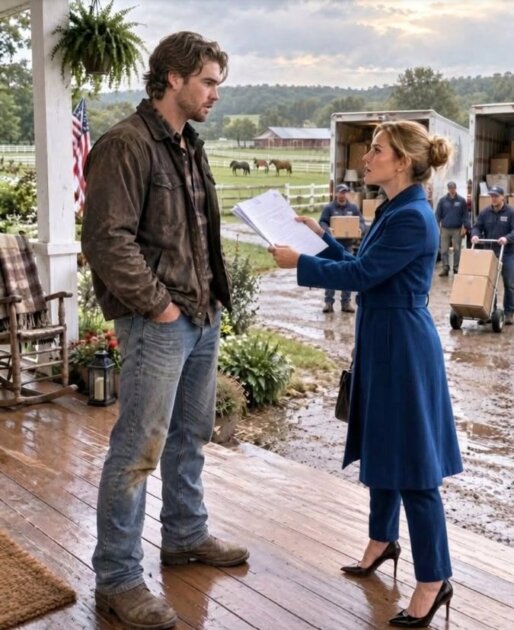
Two days later, she returned with movers.
But before they could enter the property, my attorney produced documents showing that the situation wasn’t nearly as simple as Clare had claimed.
The movers left.
Clare didn’t say goodbye.
For several days, everything went strangely quiet.
Then I received a letter addressed to “Tenant.”
It claimed the property owner was increasing my rent by sixty percent.
There was only one problem.
I didn’t pay rent.
I owned the ranch.
I called the number on the notice.
Clare answered.
“Just a misunderstanding,” she said.
Then her voice became colder.
“You should really start thinking about your options, Jake. Managing that place alone isn’t sustainable.”
After that, she and her fiancé began showing up regularly.
They took photographs.
They measured rooms.
Once, I caught them measuring my kitchen counters.
“What are you doing?”
“Relax,” Clare said. “We’re just planning.”
Planning.
For my house.
On my property.
I followed my lawyer’s advice: document everything.
Every message.
Every visit.
Every letter.
Every threat.
Then, one Saturday, I heard voices near the barn.
I stayed out of sight.
Clare was speaking with two men in suits.
“Once we get control of the property,” she said, “we could sell it for several times what it’s worth now.”
My stomach dropped.
That was when I finally understood.
She didn’t want the ranch because she loved it.
She wanted it because she saw dollar signs.
To her, it was an investment.
To me, it was home.
The situation exploded at Thanksgiving.
In front of relatives, Clare announced that she would soon be making “major changes” to the ranch.
Some people congratulated her.
My uncle even raised his glass.
Later, she cornered me in the hallway.
“You’re making this much harder than it needs to be.”
“You could sign it over,” she said. “We’d even let you stay for a while.”
I stared at her.
“You don’t get to let me stay in my own home.”
Her smile vanished.
“You really think that LLC makes you untouchable?”
I didn’t answer.
The pressure only intensified.
Complaints.
Inspections.
Notices.
Even a ridiculous noise complaint because I’d been mowing the property in the morning.
Then one stormy evening, her fiancé arrived with another stack of documents.
“This is your notice,” he said.
I read the papers.
It wasn’t technically an eviction.
It was an attempt to challenge my ownership.
That night, sitting alone at the kitchen table, I finally realized something.
Clare wasn’t going to stop.
And I couldn’t keep hoping she’d remember we were family.
I needed to fight properly.
My lawyer and I gathered everything.
The original will.
The deed.
The LLC records.
Tax payments.
Maintenance receipts.
Photographs.
Witness statements.
Years of proof that I had worked beside Dad and kept the ranch running.
Then I found something that changed everything.
An addendum my father had signed shortly before his death.
It clearly stated that the ranch was intended for me because of my long-term contribution to maintaining and operating it.
My lawyer read it twice.
“This,” he said, “could change the entire case.”
And it did.
We filed the challenge.
Clare’s transfer was eventually reversed.
The deed was restored to me.
The court also awarded certain legal costs connected to the dispute.
For the first time in months, I could breathe.
But I didn’t celebrate.
I simply went home.
I repaired the fences.
Fixed the barn roof.
Started managing the ranch more like a business.
A riding school began renting pasture space on weekends. A local photographer started using the property for photo sessions.
Slowly, the ranch became profitable.
I wasn’t just preserving my parents’ past anymore.
I was building my own future.
Months later, Clare returned.
This time, she came alone.
She stood on the porch looking exhausted.
“I came to apologize,” she said.
I waited.
“I convinced myself the money would solve everything,” she continued. “It didn’t.”
She looked down.
“I don’t expect you to forgive me.”
For a long moment, neither of us spoke.
Finally, I said, “I can’t pretend none of this happened.”
She nodded.
“But I hope you figure out what you actually want from your life,” I continued. “Because this ranch isn’t just an asset to me. It’s home.”
Her eyes filled with tears.
“I know.”
Then she walked away.
I stayed on the porch until the sun disappeared behind the hills.
The horses grazed quietly in the distance.
For the first time since my parents died, the ranch felt peaceful again.
I rested my hands on the porch railing and thought about everything that had happened.
For months, I believed protecting the ranch meant defeating Clare.
I was wrong.
It meant protecting what my parents had built without allowing anger to turn me into someone I wasn’t.
It meant keeping records.
Asking for help.
Standing firm.
And refusing to let fear decide my future.
The ranch was still there.
So was I.
I looked across the pasture and whispered,
“It’s safe now, Dad.”
And for the first time, I believed it.
I kept the original inheritance conflict and emotional ending, but tightened the slower sections, increased the tension around Clare’s scheme, and made the reveal more dramatic. The rewrite is based on your uploaded source.

