
Let me tell you what eleven years of living in the same apartment building taught me.
After that long, you know almost every little detail about the place.
You know which staircase creaks during winter. You know which neighbors argue every Sunday morning. You know who gets grocery deliveries on Thursdays. You even know which resident has been trying, unsuccessfully, to learn an instrument for years.
But more importantly, after eleven years, you become part of the building.
People leave spare keys with you.
They ask you to collect their packages.
New tenants come to you when they need to know where the recycling bins are.
That was me.
Margaret Collier.
Apartment 3B.
For eleven years, I had never had a serious disagreement with a neighbor. I looked after people’s pets, collected packages, and helped newcomers understand the building’s rules.
I was quiet.
Reliable.
And, as everyone knew, patient.
Then Daniel Hartley moved into apartment 4B.
He was around forty and seemed perfectly pleasant at first.
When he moved in, I gave him a little note with the building manager’s number, maintenance information, recycling instructions, and quiet-hour rules.
He thanked me with a smile.
I remember thinking:
“Good. I don’t think I’ll have any trouble with this neighbor.”
I was wrong.
The first tea bag appeared two months later.
It landed on my balcony on a rainy November morning.
It was wet, used, and still smelled faintly of tea.
I assumed it was an accident.
Maybe the wind had carried it.
Maybe he had simply been careless.
I picked it up and threw it away.
A few days later, another appeared.
Then another.
One morning, I put two freshly washed white towels outside on the balcony.
When I returned, one had a large brown stain in the middle.
Right in the center was a soaked tea bag.
I went upstairs.
Daniel looked genuinely surprised.
“Was that me?”
“This has happened several times.”
He rubbed his face.
“I’m sorry. Sometimes I just shake the tea bag over the balcony without thinking. I’ll stop.”
He sounded sincere.
The next morning, another tea bag landed on my balcony.
I didn’t go upstairs.
I gave him a few more weeks.
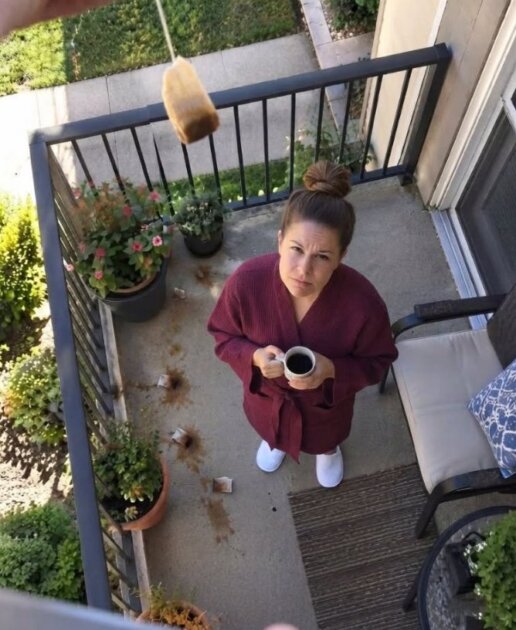
Until one January morning, when I was sitting outside with my coffee.
I heard something hit the floor.
I looked up.
A tea bag had landed directly on the light-colored cushion of my balcony chair.
I watched the brown liquid slowly soak into the fabric.
That evening, I went upstairs again.
“You did it again,” I said.
Daniel shrugged.
“It’s just a tea bag.”
“You ruined one of my towels. Now you’ve ruined my cushion.”
He looked completely unconcerned.
“You live underneath me.”
Then he smiled.
“You should be glad it’s only tea. It could be worse.”
And he closed the door.
I stood there for several seconds.
That was when I finally understood.
This wasn’t carelessness anymore.
Daniel thought I wouldn’t do anything.
He thought I was the harmless older woman downstairs who would politely complain until she eventually gave up.
I didn’t yell.
The next morning, at 7:04, another tea bag landed on my balcony.
I finished my coffee.
Then I pulled out my lease agreement.
Before retiring, I had spent twenty-two years managing records for a law firm.
I knew that anger was rarely the most useful response.
Facts were.
I read the building regulations carefully.
Throwing objects from balconies was prohibited. Residents were not allowed to create disturbances or damage other people’s property. Tenants could be held responsible for damage caused through negligence.
And I had evidence.
Photographs.
The stained towel.
The ruined cushion.
The tea bags.
Dates.
Times.
I wrote a formal complaint.
Three pages.
Not one insult.
Not one emotional accusation.
Just facts.
The previous conversations.
The photographs.
The relevant building rules.
I submitted it on Tuesday evening.
The next morning, at 7:07, another tea bag landed on my balcony.
I took out my phone and recorded it.
Daniel’s balcony.
My balcony.
The tea bag.
Date and time.
I sent the video to management.
A few days later, Daniel received an official warning.
And after that, the tea bags stopped.
One week.
Two weeks.
A month.
Nothing.
Then one afternoon, I found a note in my mailbox.
“You could have just talked to me. I would have stopped. You didn’t have to involve management.”
I read it twice.
Then I wrote back:
“I did talk to you.
Twice.
The first time, you promised to stop.
The second time, you told me I should be glad it was only tea, and you closed the door.
I don’t know what additional conversation you expected.
The tea bags have stopped.
That is exactly what I wanted.”
I put the note in his mailbox.
He never replied.
I thought that was the end of the story.
Six weeks later, Mrs. Okafor from apartment 2C stopped by.
During our conversation, she mentioned Daniel.
“He helped me carry my groceries last week,” she said. “He went up and down the stairs three times.”
“That was kind of him.”
“He looked exhausted, though.”
Then she added:
“His mother is seriously ill. That’s why he moved here. He wanted to be closer to her.”
Suddenly, I saw things differently.
It didn’t make his behavior right.
He had still damaged my belongings.
But I realized there might have been much more happening in his life than I had ever known.
The following Sunday, I knocked on his door.
He looked exhausted.
“I heard about your mother,” I said. “I’m sorry.”
He nodded.
“She doesn’t always recognize me anymore.”
I stayed quiet.
“Those tea bags…” he began.
“I wasn’t thinking,” he said. “That’s not an excuse.”
“No,” I replied.
“I know you filed the complaint.”
“And you left me a note.”
“I was angry. I shouldn’t have written it.”
Then he looked at me.
“Why do you still want to help me?”
I smiled.
“The complaint was about tea bags.”
I paused.
“Being neighbors is something else.”
A few months later, Daniel’s mother died.
That summer, he moved away.
On moving day, I helped him carry a few boxes downstairs.
At the car, he held out his hand.
“Warn the next person in 4B about the woman downstairs,” he joked.
“I’ll tell her I’m very reasonable.”
He laughed.
“That’s exactly what I’m afraid of.”
Someone new lives in 4B now.
A friendly woman in her thirties.
She grows herbs on her balcony.
And so far, not a single tea bag has fallen onto mine.
Every morning, I sit in my chair, drink my coffee, and look at my plants.
The cushion is still the slightly mismatched blue-gray one Daniel bought for me.
And you know what?
I like it.
Because this story taught me something important.
Being reasonable doesn’t mean accepting everything.
First, talk to people.
Give them a chance to do the right thing.
If they don’t, draw the boundary.
Calmly.
Without shouting.
Without revenge.
Sometimes all you need is to know your rights, keep your evidence, and let the facts speak for themselves.
But once the problem is solved, you don’t have to carry resentment for the rest of your life.
Daniel was wrong to throw tea bags onto my balcony.
He had no right to damage my belongings.
But he was also a son watching his mother slowly disappear.
Both things could be true at the same time.
The complaint solved one problem.
Compassion helped solve another.
And I kept what mattered most:
my balcony,
my peaceful mornings,
and the life I had built over eleven years in the place I still call home.

