
I hung up the phone and stared at the screen for another half minute.
My daughter had called me in the middle of the day, on a Thursday. That alone was unusual. Normally, she would send me a short message:
“How are you?”
“How’s your blood pressure?”
But this time her voice was bright and energetic, moving at that familiar speed of hers, as if her mind had already jumped ahead to ten other things.
“Mom, I’m calling because we decided to celebrate my birthday with some colleagues. We’re renting a room at a restaurant. There’ll be about twenty of us.”
She paused.
“I was thinking… you probably wouldn’t really fit in. It’s a young crowd, it’ll be noisy, and it might be tiring for you. And we’ll mostly be talking about work. You’re not offended, are you?”
For a moment, I didn’t know what to say.
Then I answered calmly.
“No, sweetheart. Of course I’m not offended. Celebrate however you want. Don’t worry about me.”
My voice sounded perfectly steady.
I had learned to speak like that years ago when I worked as an educational coordinator. When you spend enough time talking to parents, you learn how to keep your voice calm even when the person on the other end is already preparing to shout.
My daughter said she would call me sometime during the week and hung up.
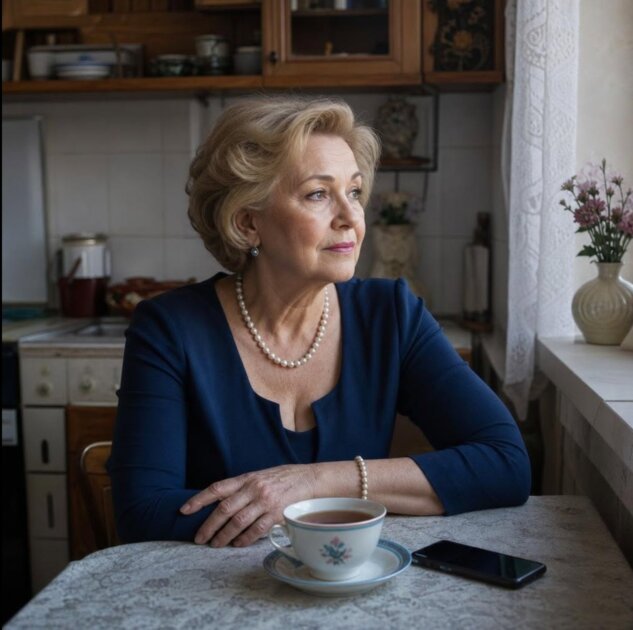
Only then did I sit down on the little stool in the kitchen.
Right in the middle of the room.
I didn’t make tea. I didn’t pick up my phone.
I simply sat there and stared at the refrigerator door.
A small magnet was stuck to it, holding a photograph.
My daughter was twenty-five in that picture.
She was laughing, and I was standing beside her.
The photograph had been taken fifteen years earlier, during a May trip we had taken together.
Back then, I never imagined that one day I might wonder whether I still had a place in her life.
The next day, I didn’t call her.
Not because I wanted to punish her.
I simply thought that if she had said I didn’t fit in, I should respect her decision.
Before that, I used to call every two or three days.
I’d ask what she was cooking, how work was going, whether she needed anything, whether I should bring over some of my homemade preserves or food I had prepared.
This time, I stopped.
Not because I was angry.
At least, that’s what I told myself.
I was respecting her choice.
If I didn’t fit into her life, there was no reason to keep forcing myself into it.
Nine days later, on a Sunday evening, my phone vibrated on the windowsill.
I was setting the table.
“Mom, where have you disappeared to?” my daughter asked immediately. “I’ve been calling you. You don’t even seem interested in how I’m doing anymore.”
I was silent for a moment.
Then I answered quietly.
“You said I didn’t fit in with your crowd. I didn’t want to interfere. If you need me, you know my number.”
There was silence on the other end.
Then she sighed.
“Mom… seriously?”
She said something about having something boiling on the stove and promised she would call me back.
She didn’t.
Not that evening.
Not the next day either.
I didn’t torture myself trying to figure out why.
I didn’t want to turn an ordinary evening into another painful story.
It was easier to turn on the television than to sit looking through old photographs and wishing I could change something that had already happened.
Three weeks passed.
One afternoon, I went to the city market. They had brought in some beautiful fabrics, and I had been searching for thick linen for my summer curtains.
The weather was windy. The market was crowded and noisy.
I finally found the fabric I wanted, paid for it, and was walking toward the bus stop when my phone chimed.
A message from my daughter.
“Are you really not angry with me?”
I replied with one word:
“No.”
Then I pressed send.
The following morning, she appeared at my door without warning.
I opened it and found her standing there.
She wasn’t wearing a coat, even though it was chilly outside. She had only a sweater on. Apparently, she had come straight from downtown and left her coat in the car.
“Can I come in?”
Before I could answer, she stepped inside.
She took off her ankle boots and placed them neatly side by side, with the toes pointing toward the door.
I would have recognized that habit anywhere.
She had done it since childhood.
I put the kettle on.
When the water boiled, I made her chamomile tea and poured myself black tea with bergamot.
We sat at the kitchen table.
My daughter turned her mug around and around in her hands.
Finally, she spoke.
“Mom, I didn’t mean to hurt you.”
I said nothing.
“You understand what I meant, right? The group really is… specific. They’re all from work, mostly between thirty and thirty-five. They talk about things you wouldn’t be interested in. They joke about things you probably wouldn’t understand. You would have been sitting there bored.”
I took a sip of tea.
“You did the right thing.”
She looked up.
“You did?”
“Yes. You were honest. That’s better than inviting someone and then making them sit in a corner feeling like they don’t belong.”
“But then why did you stop calling me?”
“Because I respected what you said.”
“But I only meant that one evening!”
“I know.”
“Then why are you acting like this?”
I put my cup down.
“Because I heard what you said.”
She stared at me.
“Mom, you completely misunderstood me!”
“Maybe.”
“I wasn’t trying to erase you from my life.”
“I believe you.”
“Then why?”
“Because once you say something like that, you can’t make me unhear it.”
She looked away.
I continued quietly.
“I didn’t want to put myself in a position where I would feel unwanted again. You told me I didn’t fit in. So I stepped back.”
“But you’re my mother!”
“Exactly.”
Silence filled the kitchen.
The refrigerator hummed quietly in the background.
Eventually, my daughter left.
I washed the mugs, wiped the table, and that evening, for the first time in a long while, I didn’t turn on the television.
I went to bed early.
But I couldn’t sleep.
The next day, I went to the local library.
Twice a month, they held a quilting group there. I wouldn’t say I was passionate about sewing. I mostly went because I didn’t want to spend all my time alone at home.
The women argued cheerfully about seam allowances. Someone had brought homemade cookies.
Nobody asked me about my daughter.
And I didn’t tell anyone what had happened.
Five days later, she called again.
I was standing in the hallway, putting on my coat. I was about to go to the clinic to pick up some medical paperwork.
“Mom…”
Her voice sounded tired.
“I miss you.”
I took off my coat and sat down on the little bench by the door.
“Can you just talk to me?” she continued. “Not in this ‘I don’t want to bother you’ mode. Just talk to me like you used to.”
“I miss you too,” I admitted.
“Then why are you doing this?”
“Because I don’t know how to talk to you anymore without feeling like I’m going to become unwanted again.”
“Oh, Mom. What boundary?”
“I didn’t create the boundary. You did.”
“I invited my colleagues, not my family!”
“I know.”
“If you had come, who would you have talked to? My department manager? The girls who spend the entire evening talking about work? You would have wanted to leave after half an hour!”
I didn’t answer immediately.
I straightened my shoes and put them neatly into their box.
Then I said:
“You know, you’re my only family.”
She went quiet.
“Your father moved to another city before you even started school. Your grandparents have been gone for years. I have my own life too. I had work, friends, things to do. I didn’t build my entire existence around you.”
I took a breath.
“But when you said I wouldn’t fit in, I didn’t hear ‘you wouldn’t fit in at the restaurant.’”
I paused.
“I heard, ‘You don’t fit into my life.’”
My daughter didn’t say anything for a long time.
Finally, she whispered:
“That’s not what I meant.”
“I believe you.”
“Then…”
“But you already said it. And I can’t pretend I didn’t hear it.”
We ended the conversation calmly.
I went to the clinic, picked up my paperwork, stopped at the pharmacy, and came home.
That evening, I texted her:
“I’m home. Everything is fine.”
She sent me a heart.
That was all.
Two more weeks passed.
One Friday evening, I decided to make a large pot of soup that would last for several days.
I filled the pot with water and put it on the stove.
Then the doorbell rang.
I wasn’t expecting anyone.
I opened the door.
It was my daughter again.
She was holding a large paper bag.
“Here.”
She handed it to me.
“What is it?”
“A cake.”
“For me?”
“Yes. And don’t tell me you don’t eat sweets.”
She smiled.
“There was a similar one at my birthday. It immediately made me think of you.”
I invited her inside.
She took off her shoes and walked into the kitchen.
The same table.
The same chairs.
The same place where we had had so many difficult conversations.
I opened the box.
Inside was a beautiful cake covered with berries.
“It’s lovely,” I said.
“I don’t want any,” she replied. “I just wanted to bring it to you.”
Then she looked at me carefully.
“And I want to ask you something.”
I sat down across from her.
She looked at me the way she used to when she was a child and was about to ask me something serious.
“Mom… are you going to hold yourself back like this forever?”
I didn’t understand.
“What do you mean?”
“You don’t call me like you used to. You don’t ask about my life. You don’t come over just because you feel like it. You’re always measuring every word.”
I folded my hands on the table.
“I’m afraid.”
“Of what?”
“That one day you’ll make me feel unwanted again.”
She lowered her eyes.
“I feel like you’ve built a wall between us.”
“The wall isn’t between us.”
I looked at her.
“It’s inside me.”
She said nothing.
“Every time I think about calling you, I wonder if I’ll be bothering you. Every time I want to come over, I wonder whether you actually want me there. So I stay away.”
“But why?”
“Because I’d rather be missed a little than feel completely unnecessary.”
My daughter covered her face with her hands.
She sat like that for several seconds.
Then she lowered them and looked at me.
Her eyes were dry, but her cheeks had turned red.
“You are needed,” she said quietly.
I said nothing.
“You’re needed by me.”
Her voice trembled.
“I just don’t always know how to show it. My life moves so fast. Work, deadlines, colleagues, plans… I thought you simply knew that you were one of the most important people in my life.”
“I know now.”
She gave a small nod.
“But knowing isn’t the same as feeling.”
She looked at me.
“And I still can’t simply forget that sentence. It’s too fresh.”
She stayed until late.
I walked her to the elevator.
Before she stepped inside, she turned around.
“I’ll call you tomorrow.”
I nodded.
“Just answer, okay?”
“I will.”
I closed the door and went back into the kitchen.
The cake was still sitting in its box.
I didn’t eat it.
I put it in the refrigerator, even though I knew it would take up almost the entire top shelf.
The soup was still on the stove.
I turned the heat back on and calmly finished cooking.
The next day, she really did call.
I answered.
We talked for about fifteen minutes about ordinary things.
I didn’t ask how her birthday celebration had gone.
She brought it up herself.
She told me the restaurant had been noisy, that her colleagues had given her a gift certificate for a beauty salon, and that what touched her most was a speech one of her coworkers had given.
I listened.
I didn’t interrogate her.
I didn’t try to squeeze reassurance out of every sentence.
I simply listened.
A week later, I decided something had to change.
Not her.
Me.
I stopped waiting for her to call first.
I made a rule for myself: every four or five days, I would call her. I would ask how she was, how work was going, whether everything was okay.
And if she was busy, I would let her go.
Strangely, everything became easier.
She seemed more relaxed too.
Sometimes she stayed on the phone longer than necessary.
She told me about her neighbor. About their office moving to another floor. About the fact that her access card suddenly stopped working.
Little things.
Ordinary things.
But they were ours.
A month passed.
One evening, I stopped at the little grocery store near my home.
I bought kefir, bread, and a packet of rice.
At the checkout, I noticed a birthday card with large golden numbers on it.
I almost picked it up.
Then I didn’t.
I simply thought that perhaps, someday, I would be able to remember that birthday without seeing it as rejection.
Just one painful misunderstanding.
That evening, I received a message from my daughter.
“I signed up for an online financial literacy course. Remember when you said you were interested in that? Let’s do it together. You can be my classmate.”
I stared at the screen for a long time.
Then I typed:
“Okay. Let’s do it.”
For the first time in a long while, I smiled at my phone.
She called that same evening.
She sounded excited, almost like a teenager.
For half an hour, we discussed which days the classes would be held.
“Tuesday and Friday work better for me,” I said.
“Me too.”
Nothing extraordinary had happened.
We had simply found two days that worked for both of us.
And yet it felt strangely important.
As if we were building something again.
Not from where we had left off.
From somewhere new.
More carefully.
More honestly.
Even now, I still think about that Thursday.
Did I do the right thing by stepping back?
Or should I have told her immediately how deeply her words had hurt me?
Maybe I should have said:
“You hurt me so much that I didn’t know what to do with the feeling.”
Perhaps we would have argued.
Perhaps we would have understood each other sooner.
I honestly don’t know.
What I do know is that two months passed while both of us waited for the other person to make the first move.
And sometimes I wonder whether those two months could have been different.
Maybe the real question isn’t who was right.
Maybe the real question is this:
When someone we love says something that cuts deeply, should we tell them immediately how much it hurt—or should we give ourselves time to heal, step back, and let them understand what our absence feels like?

