
Twelve doctors spent four days trying to save the life of a dying mafia boss, but none of them could understand why his condition kept getting worse.
Every test led them nowhere.
The surgery had been successful. His injuries had been treated. His vital organs had initially responded well.
Yet hour after hour, Adrián Moretti grew weaker.
Then a simple cleaning woman, who was mopping the marble floor beside his bed, noticed something inside the trash bin.
A tiny glass ampoule.
The moment she read the label, the color drained from her face.
For several seconds, she simply stood there, staring at the little bottle in her trembling hand.
Then she ran toward the doctors.
“You need to look at this immediately!”
For the past four days, Adrián Moretti’s enormous mansion had looked less like a luxurious home and more like a private hospital.
The elegant master bedroom had been transformed into an intensive-care unit.
Medical monitors glowed beside the enormous bed. IV stands stood near the walls. Tubes ran beneath the sheets. Machines emitted quiet electronic beeps that never seemed to stop.
Doctors came and went at all hours.
Armed guards patrolled the corridors.
Nobody entered the room without permission.
Nobody left the mansion without being questioned.
Adrián Moretti was only thirty-five years old, yet an entire city feared his name.
As one of the most powerful figures in organized crime, he had accumulated an enormous fortune. Dozens of men followed his orders without hesitation. Businessmen knew that one phone call from Adrián could change the fate of a major deal.
People were accustomed to seeing others step aside when he entered a room.
Now he could barely sit up in bed without help.
Four days earlier, his car had exploded near his office.
The blast had been deafening.
Windows in nearby buildings had shattered, alarms had begun screaming, and smoke had filled the street.
His bodyguards had dragged him from the burning vehicle only seconds before the flames consumed the passenger compartment.
Adrián had suffered severe injuries.
At first, nobody was certain he would survive.
But the surgeons operated for hours.
Eventually, they managed to stabilize him.
The operation was considered a success.
The next morning, Adrián even opened his eyes.
Only for a few seconds.
But it was enough.
His younger brother had stood beside the bed with tears in his eyes.
“He’s going to make it,” he had whispered.
Everyone believed the worst was over.
They were wrong.
Several hours later, Adrián’s blood pressure suddenly began to fall.
The doctors initially suspected complications from the explosion.
Then his breathing became increasingly difficult.
His chest rose and fell with shallow, uneven movements while the monitor beside him began emitting increasingly frequent warning sounds.
More tests were ordered.
Blood samples were taken.
Scans were performed.
His heart was examined.
His lungs were checked.
His kidneys were monitored.
His medication was changed.
Dosages were adjusted.
Specialists were brought in from different hospitals.
Yet nobody could explain what was happening.
Adrián’s condition simply did not match the expected course of recovery.
The fourth day was the worst.
Twelve doctors gathered around his bed.
The atmosphere in the room was suffocating.
The only sounds were the quiet beeping of the monitors and the occasional hiss of the oxygen equipment.
Adrián lay motionless beneath the white sheets.
His face had become frighteningly pale.
His lips were almost colorless.
The senior physician slowly removed his glasses and looked at Adrián’s younger brother.
“We are doing everything we can,” he said quietly.
The younger man clenched his jaw.
“Then why is he getting worse?”
The doctor hesitated.
“His body is responding less and less to treatment.”
“What does that mean?”
The doctor looked toward Adrián.
“It means we may not have much time left.”
Nobody spoke.
There was no need to.
Everyone in the room understood.
If Adrián died during the night, the struggle for control of his organization could begin before sunrise.
The villa was already filled with nervous phone calls.
Men whispered in the corridors.
Bodyguards watched one another suspiciously.
Everyone was waiting.
But there was one person inside the mansion whom almost nobody noticed.
A young cleaning woman named Sofia.
She had worked for the Moretti family for only a few months.
She knew almost nothing about their business.
And she didn’t want to know.
She wasn’t interested in money.
She wasn’t interested in power.
And she certainly wasn’t interested in Adrián Moretti’s reputation.
Her job was simple.
Clean the house.
Every morning she changed towels, emptied wastebaskets, dusted furniture, cleaned bathrooms and polished the enormous marble floors until they reflected the lights overhead.
Since Adrián’s bedroom had been turned into a hospital room, she was only allowed inside when the doctors gave permission.
That evening, she entered quietly.
The doctors were gathered on the other side of the room, discussing the latest test results.
Sofia barely listened.
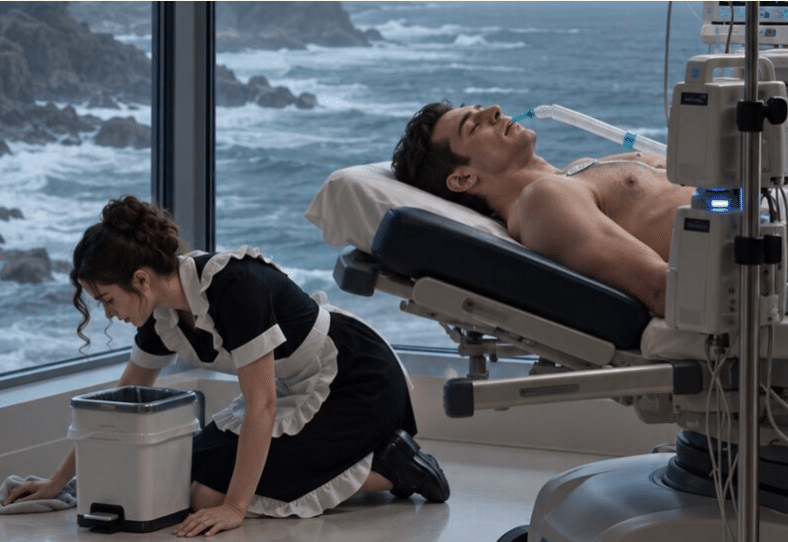
She had more immediate work to do.
She bent down beside the small wastebasket near Adrián’s bed.
She pulled out the full garbage bag.
She was just about to tie it shut when something caught the light at the bottom of the bin.
A tiny glass bottle.
Sofia stopped.
She looked down.
Then she crouched and picked it up.
At first, it seemed completely ordinary.
A small transparent ampoule.
A simple label.
Nothing remarkable.
But something about it made her hesitate.
She turned it toward the light.
Her eyes moved across the writing.
And suddenly, her entire expression changed.
She knew that name.
Years earlier, Sofia had cared for her mother during a serious illness.
She had been young, but she had spent countless hours beside her mother’s bed.
She had prepared her medications.
Checked the dosages.
Read labels carefully.
And one particular warning from her mother’s doctor had remained burned into her memory.
There were two medications with almost identical names.
They looked remarkably similar.
But they were not interchangeable.
They could never be confused.
Sofia stared at the ampoule in her hand.
Then she looked toward Adrián’s IV line.
Her eyes returned to the label.
Her heart began pounding.
“No…”
She checked the ampoule again.
There was no mistake.
She suddenly turned toward the doctors.
“Excuse me!”
Nobody heard her.
The specialists continued talking.
“Excuse me!”
This time she shouted.
Several doctors turned toward her with visible irritation.
“What happened?”
Sofia raised the ampoule.
“Was this medication given to him?”
The senior physician walked toward her.
He took the bottle from her hand.
At first, he barely glanced at it.
Then he held it closer.
His eyes narrowed.
He read the label again.
And his expression changed instantly.
“Where did you find this?”
“In the trash.”
She pointed toward the bin.
“Right beside his bed.”
The doctor turned sharply.
“Bring me the medication chart.”
One of the doctors immediately grabbed the medical records.
The senior physician began flipping through the pages.
“What are you looking for?” another doctor asked.
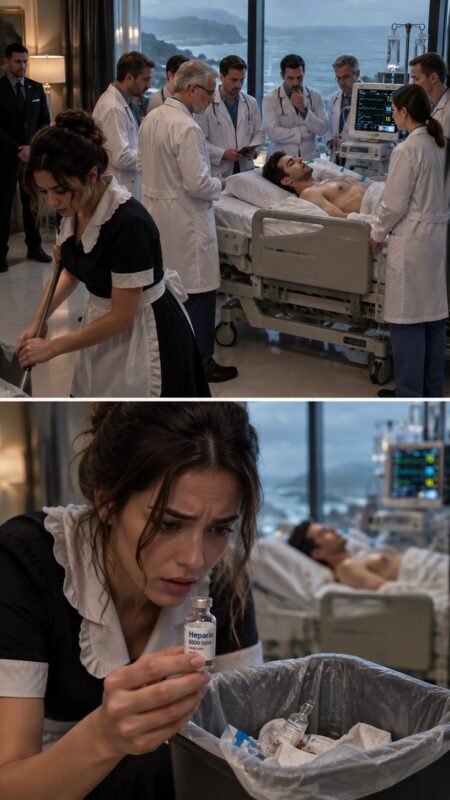
He didn’t answer.
He compared the name on the ampoule with the medication listed in the chart.
Then he opened a drawer.
He pulled out another ampoule.
The room fell silent.
He placed the two bottles side by side.
They looked almost identical.
Same shape.
Similar labels.
Nearly identical names.
But the medications had completely different effects.
The doctor’s face slowly turned pale.
“This can’t be…”
“What?” Adrián’s brother demanded.
The doctor didn’t answer immediately.
He checked the chart again.
Then the ampoule.
Then the IV line.
Finally, he looked up.
“He’s been receiving the wrong medication for two days.”
Nobody moved.
For several seconds, the room seemed frozen.
Then everyone began speaking at once.
The doctors hurried to review every medication administered during the previous forty-eight hours.
Suddenly, the mystery that had haunted them for days began to make sense.
Adrián’s unexplained drop in blood pressure.
His worsening breathing.
His increasing weakness.
The strange changes in his laboratory results.
The fact that his condition had deteriorated despite a successful operation.
They had been looking for a complication caused by the explosion.
The problem had been sitting beside his bed.
Part of his treatment had become the danger.
Someone had confused two almost identical ampoules.
And the mistake had gone unnoticed for two days.
The medication was stopped immediately.
A new treatment plan was prepared.
Every medication Adrián had received was checked again.
Every dosage was reviewed.
Every entry in the medical records was examined.
That night, nobody left Adrián’s bedside.
For the first time in four days, his condition stopped deteriorating.
Sofia remained standing quietly near the doorway.
She clasped her hands together, still trembling.
One of the doctors eventually approached her.
“How did you know?”
Sofia looked down.
“My mother took a similar medication,” she said quietly. “I remembered the name.”
The doctor stared at her for a moment.
Then he looked toward Adrián.
“If you hadn’t noticed that ampoule…”
He stopped.
He didn’t need to finish the sentence.
Everyone understood.
If Sofia had arrived a few minutes later…
If she had simply thrown the ampoule away…
If she had never looked at the label…
Adrián Moretti might not have survived until morning.
One tiny ampoule.
One forgotten label.
One memory from years ago.
And a young cleaning woman whom nobody had considered important enough to notice may have been the person who saved the life of one of the most feared men in the city.

