
— Twelve years have passed, and you’re still up to your elbows in grease? — her ex-husband sneered when he saw Nadezhda standing beside the lift.
Seventeen minutes later, there was no trace of a smile on his face.
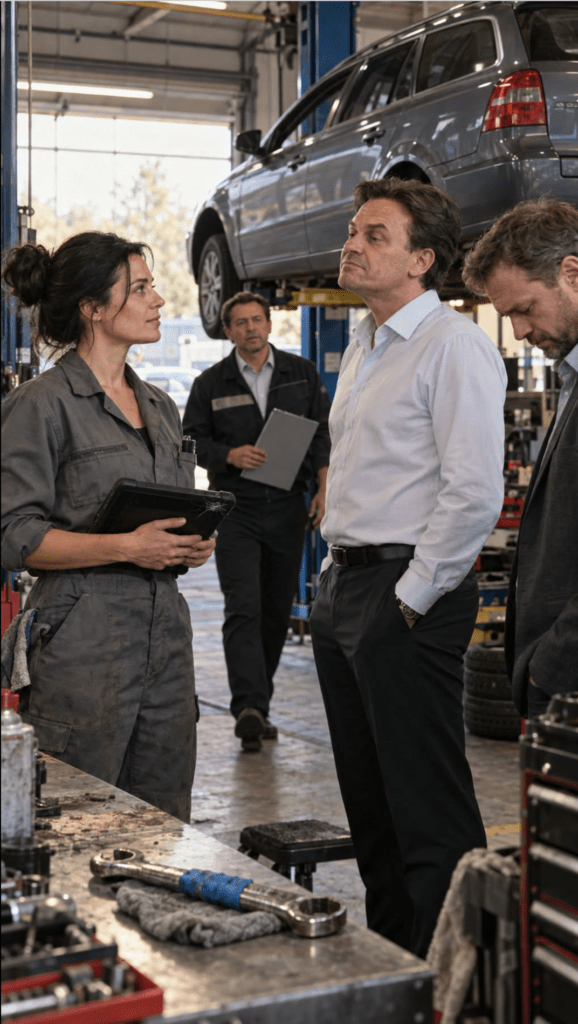
It was Saturday, just before noon. The auto repair shop beside the ring road was running at its usual rhythm. The compressor roared to life every few minutes, the distinctive smell of hot rubber and oil drifted from the open workshop, and an old seventeen-millimeter wrench lay on the workbench.
Blue electrical tape was wrapped around its handle.
Nadezhda had just pulled off her gloves and reached for the cracked-corner black diagnostic tablet when a car transporter rolled into the yard.
A gray station wagon was sitting on its platform.
In the driver’s cab sat a girl of about seventeen, wearing a white blouse and holding a neatly organized folder on her lap.
Kirill was the first to jump down from the truck.
Nadezhda recognized him immediately.
Twelve years had passed, but certain gestures were impossible to forget.
Whenever Kirill was nervous, he always adjusted his cuff.
He did it now, too.
His slightly raised eyebrow hadn’t changed either. It was the same look he had worn years ago when he tried to explain to her:
“Adult life is no place for childish dreams.”
After Kirill, his wife, Oksana, and his older brother, Maksim, got out as well.
Kirill spotted Nadezhda beside the third lift.
He stopped for a moment.
Then he laughed.
— Well, well! I thought you’d given up fiddling with all this metal a long time ago.
Nadezhda put down the tablet.
— What happened to the car?
— The brake pedal went soft, and a warning light came on. I’m not completely stupid, so I didn’t keep driving. I called a tow truck.
Kirill looked her up and down.
Then he smiled again.
— But I didn’t expect to run into you here. Twelve years have passed, and you’re still working among wrenches.
Oksana gently took her husband’s arm.
— Kirill, stop it. Eva is already nervous enough.
The girl looked at her watch.
Maksim spoke up:
— She has an interview at the design college at two. If she misses it, the next appointment won’t be for another month.
Nadezhda gestured toward the mechanic standing by the gate.
— Artyom, put it on the third lift. Check the fluid level first, then the lines. No test drive until we know what’s wrong.
Kirill snorted.
— Excuse me, but who are you here? The receptionist? The mechanic’s assistant?
Maksim suddenly looked down at the toes of his shoes.
Nadezhda noticed.
He had looked at the floor exactly the same way twelve years earlier.
In their old apartment kitchen.
When Kirill had announced in front of the entire family:
— A wrench looks ridiculous in a woman’s hands. Find a proper job and stop embarrassing me.
Maksim had been silent then.
He was silent now, too.
But Nadezhda wasn’t.
— Diagnostics will take about half an hour — she said calmly. — If there’s a problem in the brake circuit, we won’t let the car back onto the road without checking it.
Kirill laughed mockingly.
— Just don’t start lecturing me. I’m paying for the repair. Get it done quickly, without the speech. And call the owner. I’ll discuss it with him.
Oksana slowly closed her eyes.
— Kirill…
— What? I’m speaking normally. I simply like to know who makes the decisions around here.
Nadezhda didn’t answer.
She opened the bottom drawer of the workbench, carefully placed the old wrench with the blue electrical tape inside, and wiped her hands.
Then she looked at Eva.
— Is the interview important?
The girl nodded.
— Very.
— All right. Then we’ll deal with the car first.
A few minutes later, the gray station wagon was already hanging in the air.
Artyom illuminated the right front wheel with a portable lamp.
— Nadezhda!
She walked over.
She crouched down.
She ran her gloved finger along the wet streak beside the brake line.
— Press the pedal.
Artyom did.
A tiny drop of brake fluid appeared at the connection.
Then it fell.
Kirill stepped closer.
— Well? Nothing serious?
Nadezhda stood up.
— No. This car must not be driven right now.
— I don’t need to hear that I “must not.” I have to be downtown by two.
— Then you’ll need another car.
Kirill laughed incredulously.
— Are you organizing my transportation now, too?
Then he added more loudly:
— Enough with this theater. Call someone who actually knows how to get things done.
The workshop suddenly went silent.
Only the compressor clicked once.
Then it roared back to life.
At that moment, the glass door opened.
A man holding a gray folder stepped out of the office and walked straight toward Nadezhda.
— Nadezhda Sergeyevna, the partners are waiting for your signature.
Kirill looked at him.
Then at Nadezhda.
The man only now sensed the strange atmosphere.
— For the third location. We’ve already finalized the equipment contract. We just need the signatures of the technical director and co-owner.
Kirill blinked.
— Co-owner of what?
The man looked at Nadezhda.
— Of our company. Nadezhda Sergeyevna is the co-owner.
He handed the folder to her.
Nadezhda didn’t even glance at Kirill.
She flipped through the documents, checked the number of lifts, and signed where indicated.
The scratching of the pen sounded unusually loud in the silence.
Oksana was the first to break it.
— This is your repair shop?
— This one too. And two more — Nadezhda replied. — I’m responsible for the technical side here.
Kirill tried to smile.
But the smile was no longer as confident.
— Co-owner… Come on. Half the city owns something on paper these days.
Maksim slowly raised his head.
— Kirill, enough.
Nadezhda turned back toward the car.
— Artyom, show me the connection again.
The mechanic pressed the pedal.
A wet drop appeared on the brake line again.
— There’s a leak in the right front flexible brake hose — Nadezhda said. — Pressure is escaping. I don’t recommend driving it even out of the yard under its own power.
Kirill clenched his jaw.
— And what if I drive it anyway?
Nadezhda looked at him calmly.
— The car is yours. The decision is yours. But we’ll record on the work order that we warned you about the defect.
Kirill glanced at his daughter.
Eva hugged the folder to her chest.
— Dad, please. It’s still forty minutes away.
Kirill rubbed the bridge of his nose.
— How long will the repair take?
— If we have the correct brake hose in stock, two to three hours. That includes replacing it, bleeding the system, and checking everything. If we don’t have it, we’ll have to keep the car here and have the part delivered by this evening.
— And the interview?
Nadezhda pointed toward the office.
— We have a company car. The driver can take Eva and Oksana. Then bring them back.
Kirill opened his mouth.
Then closed it.
— Thank you — Oksana said quietly.
Nadezhda looked at Eva.
— You’ll get there before two.
For the first time, an honest smile appeared on the girl’s face.
Kirill simply stood there.
He looked around as if searching for some kind of joke.
Some mockery.
Some explanation.
But there was nothing.
And perhaps that was what bothered him most.
When Kirill later told his acquaintances that Nadezhda “had always liked tinkering with cars,” he told only the part of the story that made him look good.
The rest he preferred to forget.
Nadezhda’s father, Sergei Ivanovich, had worked as a mechanic for decades.
As a little girl, she often sat on an upside-down bucket beside the garage, handing her father tools.
She learned the names of car parts before she learned multiplication tables.
The old seventeen-millimeter wrench had belonged to her father, too.
She had wrapped the blue electrical tape around it after dropping it once.
— A tool doesn’t have to be pretty — Sergei Ivanovich had said. — It has to be comfortable.
Nadezhda carried those words with her all her life.
After college, she wanted to continue her technical studies.
Then she married Kirill.
They didn’t have much money. Rent, bills, groceries.
So Nadezhda took a job as an administrator at an auto-parts store.
At first, Kirill joked about it.
Then he found it less and less funny.
He liked telling his friends:
— My wife just sells filters.
But he didn’t like it when Nadezhda knew better than he did why the coolant was disappearing or what a particular brake fluid was used for.
When the woman enrolled in an evening diagnostics course, Kirill looked at her in confusion.
— After work, you want to hang around the garage too?
— I want to get qualified.
— Why?
— Because I can.
Kirill laughed.
Maksim was sitting in the kitchen too.
He was drinking tea.
And he smiled.
Not cruelly.
More dismissively.
Nadezhda never forgot that smile.
A year later, Kirill was promoted, and he began taking his wife to more and more corporate dinners.
One evening, he noticed the dark streak beneath her fingernail.
— Couldn’t you at least look normal tonight?
Nadezhda didn’t answer.
She went into the bathroom.
Two months later, Kirill announced:
— I want a divorce.
He didn’t say it privately.
His mother and Maksim were there too.
As if he needed an audience.
— We’re too different — he declared. — I need a woman I won’t be ashamed to appear in public with.
Nadezhda asked only one thing:
— Are you ashamed of me?
Kirill looked at his hands.
— A wrench looks ridiculous in a woman’s hands. Find a proper job and stop embarrassing me.
Maksim lowered his head.
He said nothing.
That evening, Nadezhda packed her belongings into two bags.
She went to her father’s house.
Sergei Ivanovich didn’t ask what had happened.
He simply put a plate of potatoes in front of her, sat down across from her, and listened.
Then he opened a drawer.
He took out the old wrench.
The blue electrical tape was still wrapped around it.
— Tomorrow we’ll go see Volodya — he said. — He needs a service advisor.
Nadezhda shook her head.
— Dad, I’m thirty. I’m starting from zero.
Her father smiled.
— No. Someone who knows nothing starts from zero.
The next day, Nadezhda started work.
At first, she received cars and filled out work orders.
Six months later, she was working alongside the diagnostic technician.
Another year later, she earned certifications in automotive electronics and brake systems.
There was no fairy-tale breakthrough.
A huge repair shop did not appear overnight.
The first four years were about two lifts, a cramped workshop, equipment bought on installment, and lunches brought from home.
Then Artyom came along.
He handled purchasing and customers, while Nadezhda handled the technical work.
Their first major customer arrived with an old van.
It had already been to three repair shops.
All three had wanted to replace a sensor.
Nadezhda didn’t order a part.
She spent half a day searching for the problem.
Finally, she found it.
A wire had been rubbing against its mounting point.
That evening, she returned the vehicle.
A week later, the same customer came back.
This time with a different car.
Then he sent his neighbor.
Then a colleague.
That was how the business began to grow.
Not through flashy advertising.
But because Nadezhda and her team often found the real problem before the customer unnecessarily spent hundreds of thousands of forints on replacement parts.
They took out a loan for diagnostic equipment.
For three years, they never missed a single payment.
The second repair shop opened when the first could no longer accommodate all the cars waiting for service.
Nadezhda gradually bought out the ownership stake.
But Sergei Ivanovich did not live to see the third location.
He died two years before it opened.
After the funeral, Nadezhda brought the old wrench into the repair shop.
She had kept it in the bottom drawer of the workbench ever since.
Sometimes she used it.
More often, she simply knew it was there.
When Oksana and Eva left in the company car, four people remained beside the lift.
Nadezhda.
Kirill.
Maksim.
And Artyom.
Artyom quickly checked the inventory system.
— We have the correct brake hose. We can do it today.
— Great — Kirill said. — Then get started.
Nadezhda glanced at her watch.
— There are two other cars scheduled before yours. We took yours ahead of them for diagnostics because brakes are a safety issue. We’ll start the repair when the lift becomes available.
Kirill looked at her incredulously.
— Nadezhda, we’re not strangers.
Nadezhda looked up.
The sentence was familiar.
Not mockery.
Not a threat.
A demand for privilege.
— As far as the queue is concerned, you are strangers — she replied. — And as far as safety is concerned, every customer is treated equally.
Kirill’s face tightened.
— Are you doing this deliberately?
— Doing what?
— All of this. Are you trying to show me how important you’ve become?
Nadezhda pushed the tablet aside.
— I’ve already shown you where the brake hose is leaking. The rest is something you’re imagining.
Kirill turned away.
Maksim spoke quietly.
— Kirill, I wasn’t any better back then.
Kirill immediately looked at him.
— Don’t start.
— Why not? You humiliated her, and I sat there and stayed silent. Because it was easier to agree with you.
— Maksim…
— I remember that kitchen. And I remember what you said about the wrench. I even smiled.
Maksim gave a bitter smile.
— I was an idiot.
Kirill turned his head away.
— Don’t turn this into some kind of family confession session.
— Uncomfortable?
— Ridiculous that you’re turning an old argument into a tragedy.
Nadezhda spoke then.
— I didn’t turn it into anything.
Kirill looked at her.
— I haven’t talked to you about this for twelve years.
— Because you were offended.
— Because my life moved on.
The sentence was simple.
And that was precisely why it hit home.
Kirill looked around.
Everyone in the shop knew whom to turn to when faced with a difficult technical decision.
The plan for the third location hung on the wall.
The employees moved naturally around Nadezhda.
No one questioned whether she had the right to be there.
Everyone knew.
— And you did all this? — Kirill finally asked.
— Not alone. With people. Over many years.
— I didn’t know anything about you.
— We didn’t keep in touch.
— You could have told me.
Nadezhda looked at him.
— Why?
Kirill had no answer.
An hour later, Oksana returned.
Eva was still at the interview.
— We got there twenty minutes before it started — Oksana said. — Thank you.
— You’re welcome.
Oksana turned to Kirill.
— Did you apologize?
Kirill frowned.
— Exactly what for?
Oksana looked at him for a long moment.
— That’s why I asked.
Maksim didn’t look at the floor this time.
He stared out the window.
Kirill gripped his phone.
Then he walked back to Nadezhda.
— All right. I was an idiot back then.
Nadezhda waited.
— You were thirty-three — she said.
— Fine. Not a young idiot. Just an idiot.
Nadezhda remained silent.
Kirill swallowed hard.
— I never would have thought that you would actually…
— Finish the sentence.
— That you’d really achieve something like this.
Artyom stopped sorting the paperwork.
Oksana touched her forehead.
Maksim quietly exhaled.
But Nadezhda remained calm.
— Well, at least that’s honest.
Kirill immediately realized he had said the wrong thing again.
— I only meant…
— Don’t explain. That’s enough.
Then Artyom spoke:
— We’re done with the brake hose.
The old part lay on a metal tray.
The cracks were clearly visible in the rubber.
Nadezhda placed it in front of Kirill.
— This caused the soft brake pedal. We replaced it, checked the other side as well, bled the system, and inspected everything. Now it goes onto the test bench.
Kirill stared at the old brake hose.
— Could it actually have burst?
— The leak could have gotten worse. It’s impossible to predict the exact moment of complete failure. You did the right thing by stopping and calling a tow truck.
Kirill looked up.
— So at least today I didn’t do one thing completely stupid.
Nadezhda smiled.
— Today, you didn’t.
Maksim laughed.
Oksana did too.
Kirill tried to join them.
But his smile disappeared after a few seconds.
Part 4 — What Doesn’t Need to Be Relived
Four hours later, Eva returned.
She was tired, but glowing.
— I think it went well! — she said from the doorway. — They looked at my portfolio for about twenty minutes!
She walked over to Nadezhda.
— Thank you for taking us there.
— The driver took you.
— But Mom said you approved it.
Nadezhda nodded.
— Then let’s say the team worked well together.
Eva smiled.
Then she hesitated.
— Dad told me about you.
Kirill’s face tightened.
Oksana immediately looked at her daughter.
— Eva…
— I didn’t say anything bad. I just said that Dad thought you always started things and then gave up.
Silence fell.
Nadezhda didn’t look at Kirill.
— Your father knew me during a period when I was learning how to start over.
Eva thought about that.
— It looks like you didn’t give up.
Nadezhda smiled faintly.
— It looks that way.
Half an hour later, the car was ready.
The brake pedal held firm pressure.
There were no leaks.
Kirill signed the work order, paid for the repair, and took the keys.
He was almost out the door when he stopped.
— Nadya.
The woman looked up.
— Can I ask you something?
— You can.
Kirill was silent for several seconds.
— If I hadn’t left back then… would you still have done all this?
Nadezhda looked at the old wrench with the blue electrical tape.
— I don’t know.
Kirill seemed to have expected a different answer.
— I thought you’d say that by leaving, I helped you.
Nadezhda looked at him.
— You didn’t help me. You left. I did the rest.
Kirill slowly nodded.
He didn’t argue.
He didn’t explain himself.
That was the last thing they said about the past that day.
At the car, Maksim stopped one more time.
Kirill was already behind the wheel.
Oksana fastened her seat belt, while Eva was looking at something on her phone.
Maksim walked over to Nadezhda.
— I want to apologize properly.
Nadezhda looked at him.
— Not with “if I hurt you,” — Maksim continued. — I saw how he humiliated you. And I stayed silent. Because he was my brother, and it was easier to agree with him.
He took a deep breath.
— For years, I told myself it wasn’t my business. But it was. I was there.
Nadezhda nodded.
— Thank you for saying it.
— Will you forgive me?
Nadezhda was silent for several seconds.
— I stopped carrying this with me a long time ago.
Maksim looked at her carefully.
— That’s not exactly an answer.
— I don’t have another answer.
Maksim finally nodded.
He accepted it.
Eight months later, the third repair shop was already running steadily without Nadezhda needing to be there every day.
She still came in for complicated cases and personally visited the workshops once a week.
She checked recurring problems.
Inspected repairs.
Listened to the employees.
And on her wall hung an old seventeen-millimeter wrench.
One day, Artyom suggested putting it behind glass.
Nadezhda refused.
— A tool is meant to be used.
Eva was accepted into college.
One day, Oksana sent a photo of the girl’s student ID.
Underneath it, she wrote only:
“We didn’t get there in time for nothing.”
Maksim visited the repair shop twice.
The first time, he brought coffee.
The second time, he didn’t try to atone for the past with any gift.
He simply came in.
Kirill and Nadezhda did not become friends.
They didn’t want to.
But in the spring, Kirill brought his car to them again.
He made an appointment through the online system.
He arrived on time.
He sat in the waiting room.
He didn’t ask to be moved ahead in line.
When Nadezhda walked past him, he stood up.
— Good afternoon, Nadezhda Sergeyevna.
The woman stopped.
— Good afternoon, Kirill.
And that was it.
There were no excuses.
No old jokes.
They didn’t try to bring back what had ended twelve years earlier.
Nadezhda went into the office.
She took the old wrench off the wall.
She ran her fingers over the blue electrical tape on its handle.
The tape had worn thin.
But the wrench was still holding up.
Exactly as she was.

