PART 1
I was twenty-four years old when I became a mother.
But I didn’t feel like one.
Not at the beginning.
All night, while I was in labor, I kept imagining the moment they would place my baby on my chest. I imagined crying from happiness. I imagined my husband Brian holding my hand, smiling through tears, saying our son was perfect.
But when my baby was born, the room went silent.
Too silent.
No one laughed.
No one said, “Congratulations.”
No one told me he was beautiful.
The doctor lowered his voice and said carefully:
“Your baby has Down syndrome.”
I didn’t understand at first.
All I remember is looking at the nurse’s face. She looked sad, as if she already knew something heavy had happened to me before I even had the chance to love my child.
Brian stood near the wall, pale and frozen.
He didn’t ask to hold the baby.
He didn’t even step closer.
Later, when they took our son for checks, Brian sat beside my bed and whispered:
“We can’t do this.”
I slowly turned my head.
“What do you mean?”
He looked down at the floor.
“We’re young. We’re not ready for this kind of life.”
This kind of life.
Those words settled in my chest like a stone.
I cried and told him it was our child.
But Brian kept talking—about doctors, money, hospitals, people staring, a life that would never be “normal.”
And I was so tired. So weak. So frightened.
By morning, fear had filled the space where joy should have been.
A social worker came in with papers.
Brian stood beside me, not holding my hand, just watching.
“It’s only temporary,” he said. “Until we can think clearly.”
But I already knew.
A mother knows when something is goodbye.
Before I signed, the nurse brought my baby to me one last time.
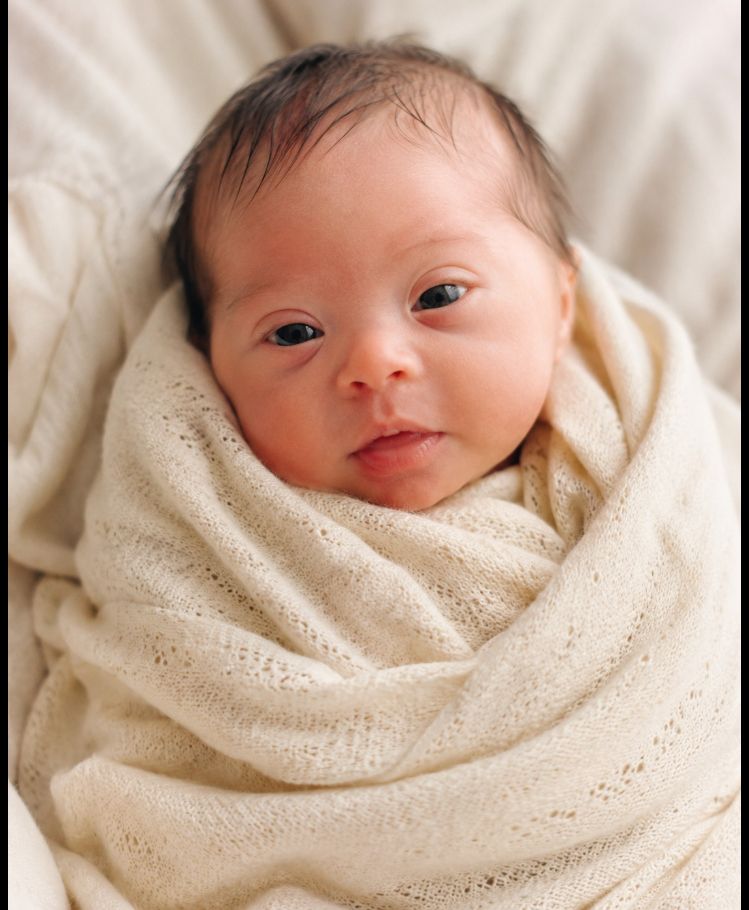
He was wrapped in a white blanket.
So small.
So quiet.
His tiny mouth moved as if he was searching for me.
The nurse placed him beside my arm.
I touched his cheek with my finger.
He opened his little hand and wrapped it around my finger.
And in that moment something inside me screamed:
Don’t do it.
But Brian’s voice came from the door.
“Please. Don’t make this harder.”
I looked at my baby.
Then at the papers.
Then at my husband.
And I signed.
An hour later, I walked out of the hospital carrying an empty car seat.
Every step toward the parking lot felt like I was leaving a piece of my soul behind.
Then I heard someone running behind me.
It was the nurse.
She was crying.
She held a folded paper and said:
“Please… before you leave, you need to know what your husband asked us to do.”
PART 2
I stopped in the middle of the hospital entrance.
The automatic doors opened and closed behind me, releasing the cold smell of medicine and rain.
The empty car seat hung from my arm.
It felt heavier than if my baby had been inside.
Brian turned sharply.
“What is she doing?” he asked the nurse.
But she didn’t look at him.
She looked at me.
Her eyes were red.
“I’m sorry,” she said. “I tried to remain professional. But I saw you with your baby. And I can’t let you leave believing this was entirely your choice.”
My heart started pounding in my throat.
“What do you mean?”
Brian stepped between us.
“She’s exhausted. Leave us alone.”
The nurse’s voice shook.
“No. She deserves to know.”
She handed me the paper.
My hands trembled as I opened it.
At the top was a hospital note.
I read slowly, my vision blurred with tears.
It said that the father had requested the baby not be given back to the mother before discharge. That the mother appeared overwhelmed, emotional, unstable. That the mother had repeatedly asked to hold her child.
The words swam on the page.
I looked up at Brian.
“You asked them to keep him away from me?”
His jaw tightened.
“I was trying to protect you.”
“From my own baby?”
He looked away.
The nurse stepped closer.
“He told us seeing the baby would upset you,” she said softly. “But I didn’t see that. I saw a young mother who kept asking if her baby had eaten. I saw her crying every time they took him away. I saw her reaching for him even when she thought no one noticed.”
Something inside me cracked open.
Because I remembered.
I had asked.
More than once.
But every time Brian said:
“Rest.”
“Don’t get upset.”
“They’re taking care of him.”
“You’re not thinking clearly.”
And slowly, his voice had replaced mine.
I looked at the empty car seat.
I had bought it two months earlier, imagining a peaceful future.
Now it was empty because I had been convinced emptiness was easier.
The nurse whispered:
“You still have time.”
Brian turned to me.
“No. We already decided.”
That word again.
We.
But I had never felt less part of a “we” in my life.
I looked at him and asked:
“Did you ever love him?”
His face changed.
He didn’t answer.
And that silence told me everything.
He had loved the idea of the baby. The perfect one. The easy one. The one that made people smile and say congratulations.
But the real child?
He had already rejected him.
My knees weakened.
For a moment, I almost hated myself for how easily I had been pushed.
What kind of mother signs away her newborn?
Then I remembered something—the tiny hand wrapping around my finger.
Not strong.
Not demanding.
Just holding on.
As if my baby had already forgiven me before I even understood what I had done.
I handed the car seat back to the nurse.
“Take me back,” I said.
Brian grabbed my arm.
“You don’t understand what you’re choosing.”
I pulled away.
For the first time since the delivery room, I looked at him without needing his approval.
“No,” I whispered. “I finally do.”
He stared at me.
“You’ll ruin your life.”
I shook my head.
“No. I almost did.”
The nurse walked with me back into the hospital.
My whole body hurt—physically, emotionally, everything.
But nothing hurt more than knowing my baby had spent his first hours in a world where people whispered about what was “wrong” with him.
No one had said he was beautiful.
Then I went back.
And they brought him to me again.
And this time, I didn’t just touch him.
I held him.
I pulled him close and cried into his blanket.
“I’m sorry,” I whispered. “I’m so sorry. Mama got scared. Mama listened to the wrong voice.”
He made a tiny sound.
Barely anything.
But it felt like an answer.
The doctor and social worker spoke with me again. This time, without judgment, without seeing him as a tragedy.
They explained support, appointments, challenges—but also said something simple:
“He is not a diagnosis. He is your child.”
And I broke down.
Because that was the first truth I could finally hold.
Brian left the hospital that day.
He did not come back.
But I stayed.
And so did my son.
I named him Matthew.
When I finally left the hospital, the car seat was no longer empty.
And over time, life was not easy.
There were hard nights, exhaustion, fear.
But there were also his first smile, his warm hand on my cheek, his laughter when I sang badly.
And slowly I understood:
The world had taught me to fear him before I even knew him.
But love taught me differently.
And the child I almost left behind…
became the reason I finally learned what love really is.