The elderly woman, Erzsébet Fekete, fed three homeless children without realizing that this simple, instinctive choice would, years later, turn her life upside down. Steam rose lazily from the pot, mingling with the scent of hot soup and the sweet aroma of freshly cooked pancakes.
Her stall was far from flashy—indeed, it was downright modest—but every detail spoke of a love for order and cleanliness. The old, rusty wheelbarrow, the sun-bleached tarpaulin, the sizzling pan, and the neatly lined-up jars of sauce stood as if soldiers on a faded parade ground.
The city buzzed around her: cars whooshed past, hurried footsteps clicked on the asphalt, a horn honked somewhere in the distance, voices overlapped in a chaotic hum, each person seemingly lost in their own world. Erzsébet’s hands bore the marks of decades of labor:
small burn scars, cracked skin, tired nails, each telling the story of a life defined by persistent struggle.She adjusted her slightly stained apron and handed a plate to a regular customer who had been coming to her for years.“God bless you with good health,
Erzsébet!” the man said, dropping some coins into the box.Erzsébet barely smiled. It wasn’t the wide, carefree smile one gives without thought—it was a brief, weary curve of her lips, the kind reserved for moments when life never seems to pause.
“To your health, son,” she replied softly.Once the customer disappeared into the crowd, Erzsébet glanced at the coin box. It had never been full, and today it felt particularly light. Fewer people came by due to road repairs, and a new vendor with a flashier stall and louder calls had appeared just a couple of streets away.
Yet she carried on. She always carried on.It was around six in the evening, the sun dipping low and casting long shadows across the street from her tarp, when she noticed them: three children. They didn’t run, they didn’t shout; they moved close together, as if the world was too vast for them to walk alone.
Their faces were nearly identical: dark eyes, pronounced cheekbones, tousled black hair. Their clothes were worn, oversized, and their sneakers had long since lost their shape.They carried no backpacks, and no adult accompanied them—only hunger.
Erzsébet watched them calmly, without any theatrical shock. She didn’t clutch her chest, didn’t make a scene; she simply observed them as one looks at a painful truth, knowing that acknowledgment alone does not make it disappear.
The children stopped a couple of steps from the stall, hesitant. The one in the middle finally stepped forward and spoke softly:“Auntie… do you have anything you can’t sell anymore?”Erzsébet froze, her spoon hanging midair. She had heard this before, from other children, in other years.
But there was something different about these three: they asked not out of cunning, but quietly, with shame.“Do you have a mother?” she asked, gently, without accusation.The three glanced at each other as if the question had struck them.
“No,” the middle one whispered, his voice trembling. “We have no one.”Erzsébet swallowed. She looked at the pot, then the plates, the coin box, and finally back at the children. The boy on the right lowered his gaze, while the one on the left pressed his lips together, as if holding back tears.
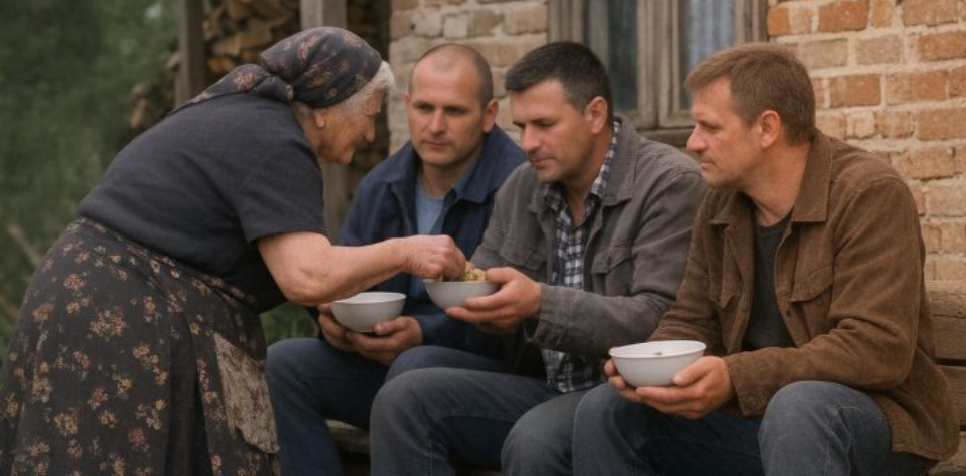
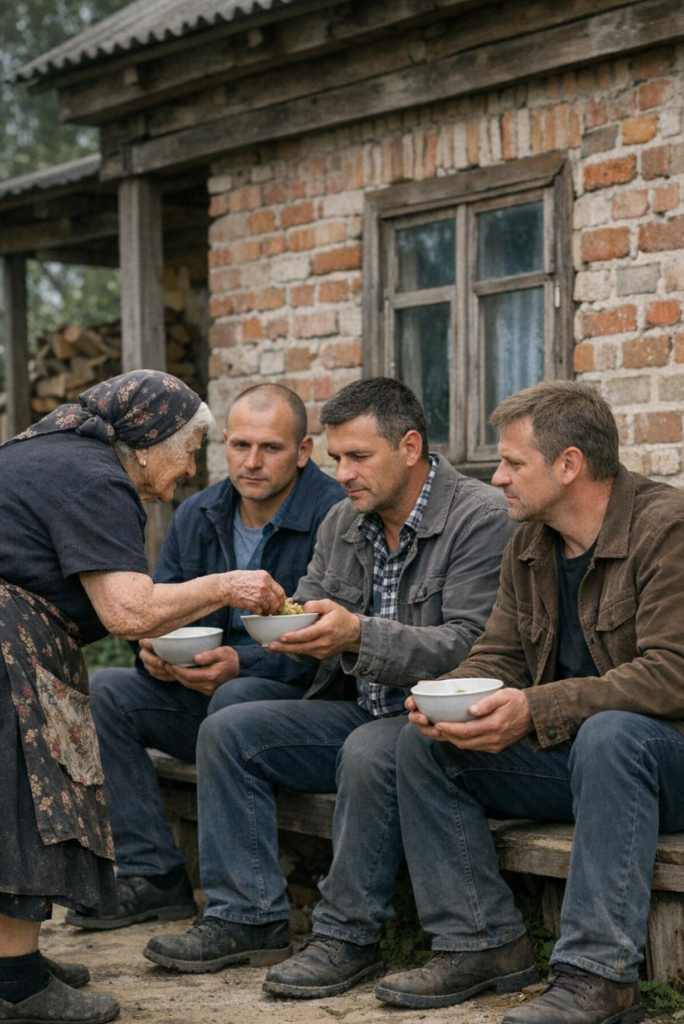
Erzsébet took a deep breath and made a decision that felt entirely natural to her.“Come here,” she gestured. “Don’t be afraid. I don’t bite.”They approached slowly, as though wary of a trap. Erzsébet served each of them a small portion of what remained.
The plates were not full by adult standards, but the food was hot. And when someone is hungry, hot food is a promise.The children sat on plastic stools, almost touching. At first, they ate greedily, then more slowly, as if their bodies were only now believing that the food would not disappear.
Erzsébet watched them, feeling a tightening in her chest she couldn’t explain. Perhaps she thought of her own child. Perhaps it was years of exhaustion. Or perhaps it was the bitter thought that no child should ever have to eat as if this were their last chance.
“What are your names?” she asked gently.“I’m Levente Vincze,” said one.“Kornél Molnár,” said the middle one.“And Norbert Illés,” added the third.Erzsébet nodded slowly, committing the names to memory as though they were fragile treasures.
“And where do you sleep?” she asked quietly.All three lowered their eyes.“Wherever we can…” Kornél whispered.Erzsébet gripped the ladle tighter, scanning her surroundings. People came and went, shopping, turning their heads away. A laughing couple crossed the street, oblivious to the children.
A well-dressed man scowled at them as if hunger were contagious. Anger pricked Erzsébet.Then a cold, grating voice spoke behind her:“Erzsébet, giving out food again?”She turned. Sándor Rácz, a familiar figure on the block, stood there—the type of man who spoke as if the street belonged to him.
“Don’t be surprised if you run out of money,” he added, looking at the children as if they were trash.The boys stiffened. Erzsébet straightened, despite her aching back.“I’m not complaining,” she said firmly. “And they are eating.”Rácz snorted.
“You’re just gathering beggars here,” he muttered. “Then the inspection comes, and it’s all over.”Erzsébet did not avert her gaze.“Let them come,” she said. “There’s no filth here. Only hunger.”Rácz clicked his tongue and walked away, but his threat lingered in the air.
Erzsébet looked back at the children. Levente blinked in confusion, not understanding why someone would defend them. Kornél swallowed slowly, and Norbert’s eyes burned with restrained anger.“Eat,” Erzsébet said softly. “And when you’re done, tell me where you’re going.
I won’t abandon you.”The boys exchanged glances. For the first time, something flickered in their eyes beyond hunger: a tiny spark of hope, trembling like a fragile flame. Erzsébet did not know it yet, but in that moment, with three simple plates and one resolute sentence,
she had done something the world rarely forgives—and never forgets.The street did not change. Cars continued to move, people continued to shop, the pan sizzled like a tired heart. But for Erzsébet, the evening would never be the same again.