Ulyana pressed the back of her head against the cool metal door of the galley storage unit and allowed the exhaustion of a long shift to settle into her bones like a heavy tide.
Her legs ached with a dull persistence, the kind that came not from one flight but from many layered on top of each other, and that fatigue spread through her body with every breath she took.
The air on board was always too dry, scraping at her eyes, while the stiff collar of her uniform rubbed against her skin somewhere above the Caspian route they had crossed hours earlier.
In her jacket pocket lay a switched-off phone. She didn’t need to turn it on to hear her aunt’s message again. She had read it on the ground, in a cramped airport hotel room before departure, and since then the words had refused to leave her mind.
“The foundation rejected your mother’s rehabilitation request. They said they can’t take her case this quarter. The clinic is demanding full payment. If we don’t pay by Thursday, they’ll give the place to someone else.”
Tasia, her adoptive mother, had become her entire family years ago.
When illness took away her ability to walk, Ulyana had not hesitated. She took double shifts, flew the most exhausting routes, and sent every possible cent home, surviving on cheap food and sleep in rented rooms that never felt like home.
But even that was not enough for the specialized treatment Tasia needed.
Her real father had been a scholar of Eastern languages, a man who left no money behind, but something far more enduring.
Ulyana grew up in his study, surrounded by old books and the scent of strong tea, learning Arabic script not as a subject but as a way of seeing the world. He used to say language was not a tool, but a bridge into meaning itself.
A rustle of the curtain pulled her back.
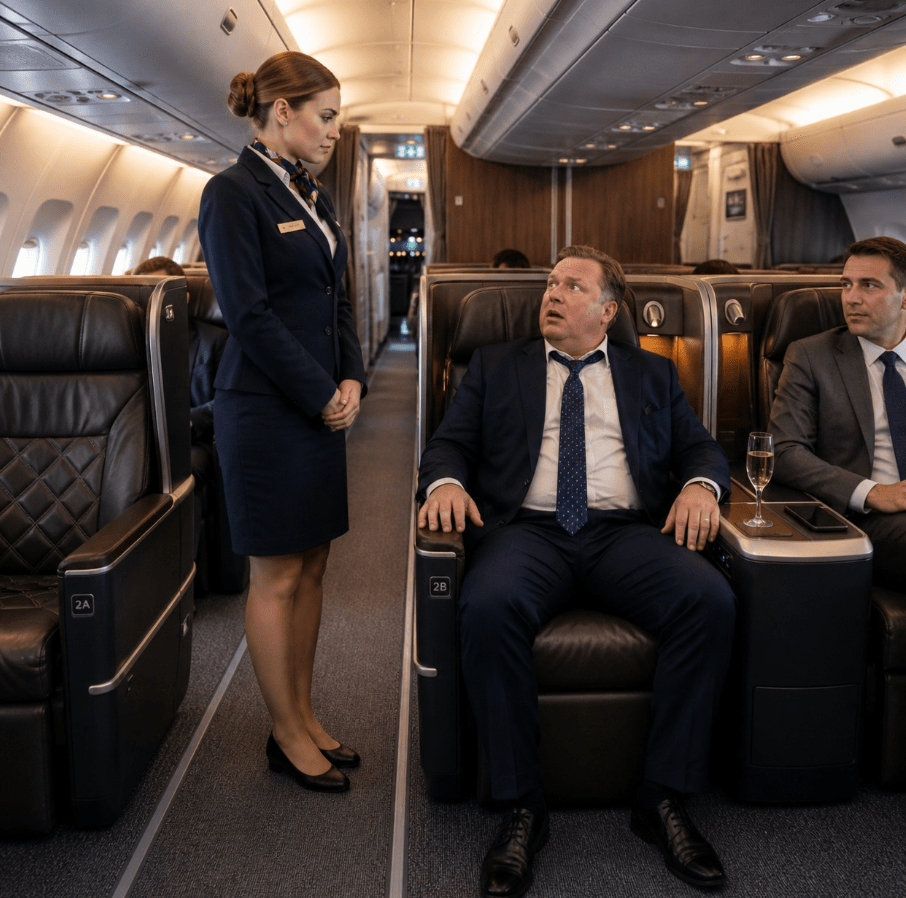
“Uli, first row, seat one-alpha,” whispered Inna, the senior flight attendant. “Passenger keeps pressing the call button. Not enough ice in his drink. Take fresh water. And be careful—he’s premium status. One complaint and we both lose our bonus.”
Ulyana nodded.She placed ice into a crystal glass, poured still water, and set it carefully on a tray. Then she straightened her posture and stepped into the dim first-class cabin.
Arkady sat in the first row. He was a heavy-set man in an expensive suit that strained slightly at the seams, constantly checking his watch, speaking loudly as if volume alone confirmed importance.
Next to him sat Amir, a calm, composed investor with sharp, attentive eyes and a neatly trimmed beard, reading a book with quiet patience. Arkady was trying to impress him—this flight was the beginning of a major deal.
“My company operates exclusively in the premium segment,” Arkady was saying, gesturing broadly. “We don’t compromise. Only top materials, top service.”
Amir turned a page.“A company’s true standard,” he said calmly, “is revealed in how it treats those who cannot benefit from its success.”
Arkady smirked, dismissing it as philosophy.
Ulyana approached silently.“Your water, sir,” she said in polite English, placing the glass on the small table.At that exact moment, the aircraft hit mild turbulence.
The glass shifted slightly as Arkady, mid-gesture, knocked his elbow against the tray. A few drops spilled onto the cuff of his white shirt.
His expression changed instantly.
“What are you doing?” he snapped. “Can’t you even handle a tray properly?”Ulyana kept her voice steady.“I apologize. I’ll replace it immediately.”
But Arkady had already turned away, embarrassed in front of Amir. To regain control, he switched languages—fluent Arabic, but rough, dismissive, sharpened by arrogance.
“This service staff can’t even serve a glass properly,” he said with a contemptuous smile, assuming she wouldn’t understand. “They hire anyone off the street.”
Amir slowly closed his book.“You are being unnecessarily harsh,” he said quietly in Arabic. “Turbulence does not choose who it shakes.”But Arkady continued.
Ulyana froze for a fraction of a second. The words hit her like something familiar and bitter—years of cleaning work on her days off, chemical smell on her hands, exhaustion she never showed anyone.
She had lived both worlds: the cabin and the back rooms of survival.Then something in her shifted.Not anger. Not humiliation.Clarity.She straightened slowly and looked directly at Arkady.
“And true dignity,” she said in flawless, precise Arabic, “is not measured by the price of a ticket, nor by the smoothness of one’s hands.”
Arkady blinked, confused.
Ulyana continued, her voice calm but unwavering.“It is measured by how a person behaves toward those who cannot answer them as equals in that moment. Crystal only shines brightest when the intentions behind it are clean.”
A silence fell over the row.Amir’s eyes narrowed slightly, impressed.“That is remarkable Arabic,” he said. “Where did you study?”“My father was a linguist of Eastern languages,” she replied softly.
“He taught me that language exists to understand people—not to insult them.”Amir nodded with respect.As the plane began its descent, he handed her a business card.
“We are expanding,” he said. “We need analysts—people who understand language and meaning, not just words.”Ulyana took it, her fingers tightening slightly around the card. For the first time in a long while, something like relief touched her chest.
Three years later.Rain tapped softly against the glass walls of a modern office tower. Ulyana sat at the head of a long meeting table, composed, precise, fully in command.
She was no longer moving through spaces as service staff. She was part of the structure that made decisions.Tasia had recovered enough to walk again, slowly but steadily, her voice stronger with every call.
The door opened.Arkady walked in.But he was no longer the same man. His suit hung loosely, his confidence gone, replaced by exhaustion and desperation.
His business had collapsed after losing major partnerships, reputational damage spreading faster than he could repair.He stopped when he saw her.
Recognition struck first. Then disbelief.“Hello, Arkady,” Ulyana said evenly.His papers slipped from his hands and fell to the floor.For a moment, neither spoke.
Then he sat down heavily, as if the weight of everything he had once dismissed had finally caught up to him.“We… submitted the revised proposal,” he said weakly.Ulyana opened her laptop.
“I’ve reviewed your documents,” she said. “Your logistics model is outdated. Your risk calculations are inflated. You are compensating for internal financial instability through our investment structure.”
Each sentence was calm, precise, and final.“This proposal is rejected on economic grounds.”Silence filled the room.Arkady nodded slowly. There was no anger left in him now—only the realization that consequences do not always arrive loudly.
Sometimes they simply take their seat across from you.He stood up, gathered his papers, and left without another word.Ulyana walked to the window.
Outside, the rain had stopped, and weak sunlight broke through the clouds, touching the city in uneven patches of gold.Her father’s words returned to her once more.Language can build bridges.But only for those willing to cross them.