At Fort Bragg, the gavel struck sharply in the military courtroom, echoing off the polished wood and high ceilings. Sergeant Elena Brooks sat calmly in the defendant’s chair, accused of wearing a medal she supposedly didn’t earn.
Her Navy Cross caught the harsh fluorescent lights, shining with quiet defiance. The prosecution, confident and eager, immediately dismissed it as a $49 replica bought online. Lieutenant Colonel Marcus Reed’s smug smile conveyed certainty—this case was closed before it even began.
The courtroom murmured in agreement with the prosecution. Elena’s service record was clean but unremarkable: four years in logistics, no combat deployments, no heroic awards beyond the Army Commendation Medal. Some whispered “fake hero,”
others shook their heads in disgust, convinced this woman had claimed honors she didn’t deserve. But Elena remained still. Years of experience had taught her that silence could cut deeper than any protest.
Her hands rested on her lap, pale scars faintly visible on her wrists—scars that went unnoticed, just like the truth behind her quiet demeanor.
Colonel William Hayes, the presiding judge, called the tribunal to order. Charges of stolen valor against Sergeant Brooks were read aloud: she was accused of fraudulently wearing the Navy Cross and claiming special operations service.
Reed rose confidently, his voice dripping with authority. He painted the case as simple: Elena Brooks had allegedly attended veteran events claiming service she never performed. Her record, he said, showed only logistics work.
The courtroom reacted with murmurs of approval; the gallery seemed convinced.
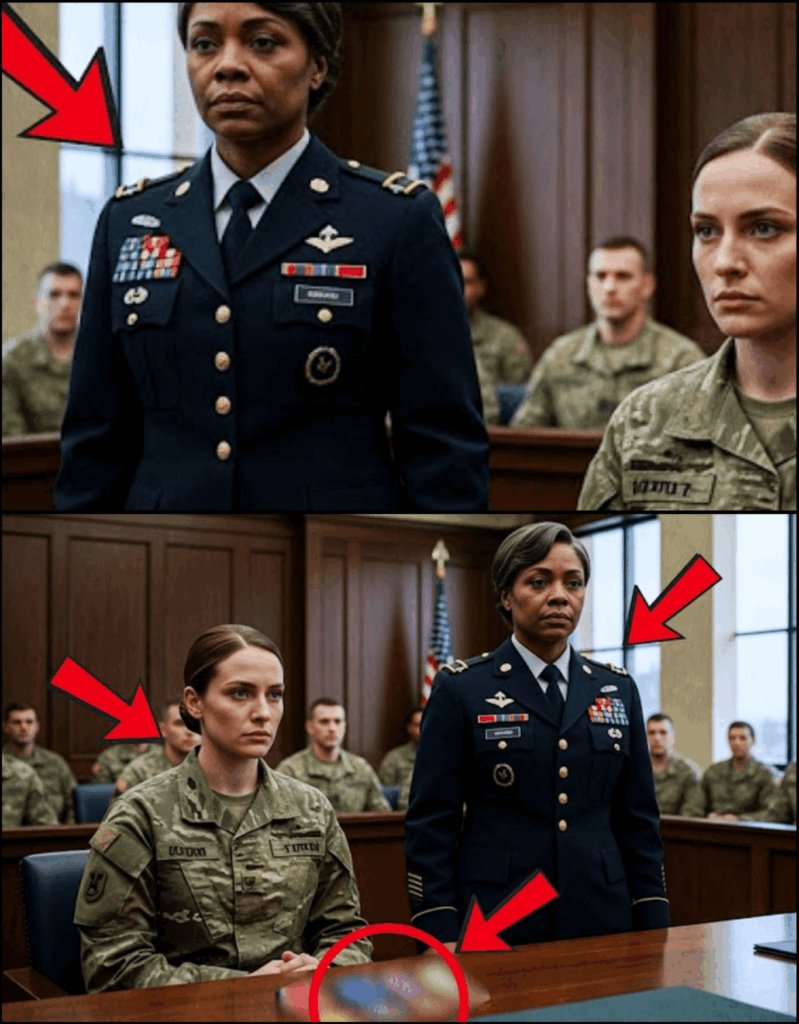
The first witness, a retired Marine, took the stand. He alleged that Elena claimed involvement in classified operations in Syria in 2019—missions in which women were never deployed. Her defense counsel muttered a half-hearted objection,
which was swiftly overruled. Reed methodically built his case, presenting Elena’s official service record for all to see: enlisted in 2015, discharged in 2019, logistics specialist, with no combat decorations beyond the Army Commendation Medal.
A photograph from a veteran gathering, with Elena wearing the Navy Cross prominently on her uniform, was displayed. Reed triumphantly declared it a replica, purchased online for $49, meant to falsely lend her credibility.
Whispers of “disgrace” and “fraud” rippled through the courtroom, but Elena sat motionless, eyes fixed on the grain of the wooden table as a thunderstorm raged outside, thunder crashing like artillery.
Finally, Judge Hayes asked her if she had anything to say. Elena spoke calmly, with quiet authority: “My service record speaks for itself, sir.” The gallery erupted in cruel laughter, convinced she had nothing to back her claim.
Reed, sensing victory, allowed himself a self-satisfied smirk. Then, the courtroom door opened. Not gently, but decisively. Two soldiers in dress blues entered, exuding unmistakable command presence. Behind them walked General Patricia Stone,
a three-star general whose very presence silenced the room without a word. Hayes rose in shock. Stone’s calm, authoritative voice stopped him mid-sentence: “Remain seated.” The gallery froze, Elena’s eyes shifting for
the first time from the table to the general as she approached. Stone’s sharp gaze fell on Reed. “Explain this trial to me,” she demanded.
Reed’s confidence faltered but remained outwardly steady. He summarized the accusations: Elena had allegedly claimed service she never performed, her record showed only logistics, and she had attended veteran events under false pretenses.
Stone listened silently, then turned her piercing attention to Elena. “Sergeant Brooks, do you know why I’m here?” she asked. Elena responded evenly, “No, ma’am.” Stone reached into her coat and retrieved a weathered velvet case, placing it on the judge’s desk.
Opening it, she revealed a Navy Cross—but not just any medal. This cross bore specific engravings: a date and a classified operational code. Gasps filled the room. Hayes pounded his gavel for order, but the gallery remained stunned into silence.
“This,” Stone declared, her voice firm, “is Sergeant Brooks’s medal, awarded in a classified ceremony for her actions during Operation Silent Thunder in Syria. She saved 18 civilians and extracted critical intelligence that prevented a terrorist attack.”
Whispers erupted across the courtroom. Reed blinked, struggling to process the revelation. He tried to interject, but Stone cut him down with a single word, sharp and unyielding, the weight of command evident in her tone.
Stepping closer to Reed, her presence overwhelming, Stone continued: Elena’s service had been classified precisely because of the nature of her work. She had never claimed to be in special forces, but assumptions had been made.
Her actions had been part of a program so sensitive that even most flag officers were unaware of its existence. The courtroom, which had been so quick to judge, now felt the weight of ignorance and arrogance.
The storm outside mirrored the intensity inside, rain lashing the windows like a chorus of unspoken applause. Elena sat, controlled and composed, her hands finally unclenching. Stone turned directly to Elena, her voice softer now.
“Sergeant, you’ve carried a burden this nation asked you to bear, and you did it with honor. You deserved recognition, not accusations.” Hayes, regaining some composure, asked if the charges were to be dismissed. Stone’s response was flat, decisive:
“Dismissed. Effective immediately. This tribunal is over.” She closed the metal case and tucked it back into her coat. “You are not alone anymore, Sergeant. Not after today.”
With that, General Stone turned and exited, flanked by her disciplined escorts. The gallery remained frozen in disbelief, the electric tension of the room still palpable. As she stepped out into the storm, a flash of lightning illuminated the courtroom.
For the first time since the proceedings began, Elena allowed herself a small, almost imperceptible smile. The war she had fought in silence, both abroad and in the courtroom, was not over, but the truth had finally breathed. Reed, who had believed he was victorious, now faced the undeniable weight of reality.
The story of Sergeant Elena Brooks, accused of fraud but ultimately vindicated by a three-star general and the truth of classified heroism, left the courtroom transformed.
Silence, once a shield for Elena, now celebrated her courage, integrity, and extraordinary service—a reminder that valor often remains hidden until the right moment brings it to light.