I was eleven the first time I saw Charlotte.It was one of those late afternoons where the streets seemed forgotten, as if the world had paused just for me. I trudged home from school, hands shoved deep into my jacket pockets,
replaying the day’s little humiliations—the laughter at my worn sneakers, the teacher’s sharp words, the silence waiting for me at home like a weight.And then I saw her.She was at the edge of the road, half on the grass, half on the gravel shoulder.
A grocery bag had split open beside her; an apple rolled lazily down the slope. Her hand pressed to the ground, shoulders trembling, not from cold, but from something heavier.“Ma’am?” I called, my voice small, unsure if I should come closer.
She lifted her head slowly. Her gray hair was tied back loosely, strands falling across a pale, drawn face. Her voice, when it came, was barely above a whisper.“Sweetheart… could you help me?”I didn’t think about danger, rules, or anything beyond the immediate need to help. I crouched down, brushing dirt from cans, stacking them carefully in my arms.
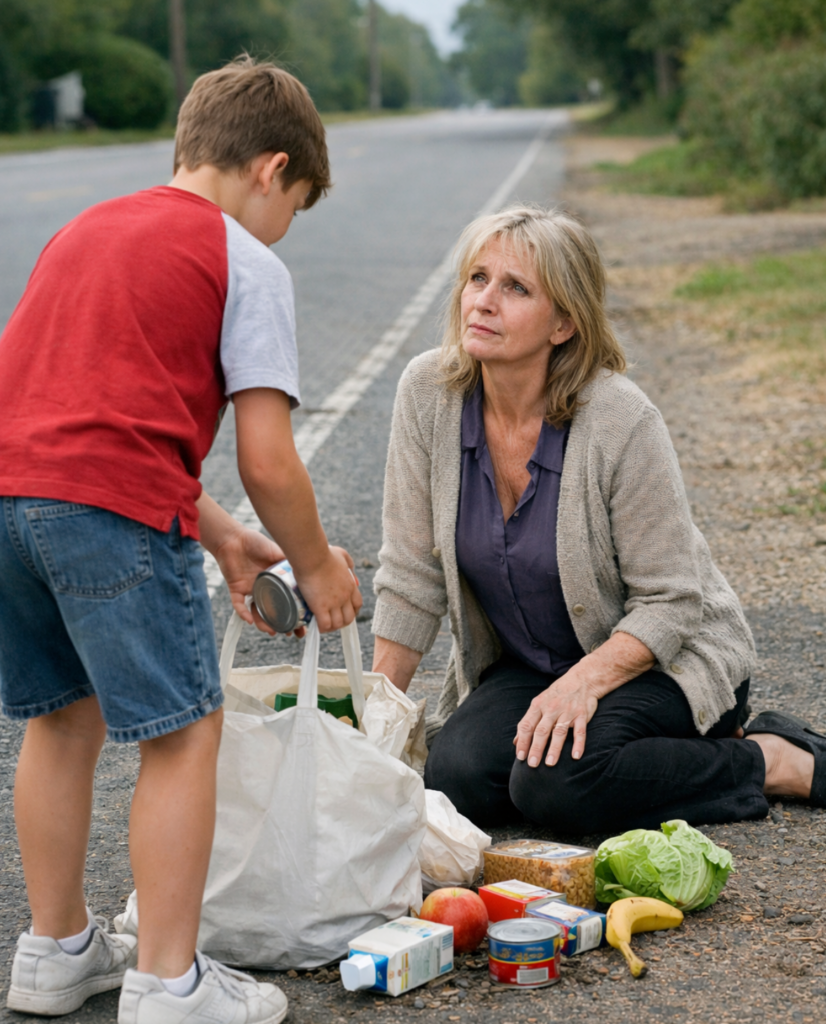
“My name is Charlotte,” she said, unevenly. “I was walking home… felt weak. The hill… I lost my balance.”“Are you hurt?”“No,” she said softly. “Just tired. Very tired.”Her house was only a few doors down, a small place with peeling paint and a porch light that flickered as if it might give up any second.
I walked beside her, letting her lean on my shoulder. She felt lighter than she should.Inside, the air smelled faintly of cinnamon and old books. Everything was clean, but sparse, as if she had kept only what she truly needed.
She insisted on making me hot cocoa. Her hands shook as she stirred, and she cut a sandwich in half, apologizing that it wasn’t much. I accepted it like it was a treasure.That should have been the end—a single, fleeting kindness.
It wasn’t.I returned the next day. Then the next week. Soon, it became routine. Charlotte became my secret sanctuary.She never questioned me. Never demanded more than I could give. She listened in a way that made silence feel like company rather than emptiness.
She remembered the small details—my least favorite subjects, what made me laugh, which days were hardest.One afternoon, after I admitted that I usually ate lunch alone, she reached across the table and rested her hand over mine.
“Being alone doesn’t mean you’re unlovable,” she said.I shrugged, staring at the tabletop. “Feels like it does.”She didn’t argue. She just said, “I used to think that too.”I noticed the little things over time. The wooden box in her living room, always locked.
Her avoidance of family talk. The care she put into ordinary routines, folding napkins, straightening the tablecloth.She said she had no children, no one else.But she had me.For a while, Charlotte made the world feel softer, safer. Then, one day, she was gone.
It was a Tuesday. I had saved half a cookie to bring her. Her porch light was dark. Curtains torn down. Doormat gone.I knocked. Nothing.Her house was empty, stripped of life. A neighbor shrugged. She must have moved.
No note. No explanation. No goodbye.I didn’t know how to process that loss. I only knew the steady warmth I had relied on had vanished. The world felt colder.So I learned a lesson that shadowed me for decades: even the kindest hearts leave.I grew up.
I kept people at arm’s length. I left before I could be left. Charlotte became a memory, something brief, unfinished.Thirty years passed.Then my phone rang.“Good afternoon,” a man said. “I’m calling regarding a woman named Charlotte Harper.”
My chest tightened.“She passed away recently,” he continued. “I’m her attorney. She named you in her will. You’ll need to come to my office.”I didn’t sleep that night.The next day, I sat across from him as he slid an envelope toward me. My name was written in familiar, careful handwriting.
“Before anything else, you should read this,” he said.My hands shook as I opened the letter.If you’re reading this, it means I didn’t get the chance to see you again. I’m sorry.Tears blurred my vision.
The day I disappeared, she had learned her illness was advancing faster than expected. She’d been moved to a long-term care facility in another state immediately, leaving to protect me—a child—from the helplessness of watching her fade.
“You gave me something I hadn’t felt in years,” she wrote. “Purpose. A reason to wake up, to turn on the porch light. I never forgot you.”The attorney waited quietly as I read the rest. Charlotte had no family.
She’d sold most of her belongings years ago, but kept her house and a modest savings—now mine. Not a fortune, just enough, she wrote, “to help him stand on his own feet, the way he once helped me stand on mine.”“I was just a kid,” I whispered.
“You were her family,” he said.A month later, I unlocked Charlotte’s house. For the first time in thirty years, the porch light glowed steadily.The wooden box was on the table—unlocked. Inside were folded notes, memories of afternoons together, proof that what we shared was real.
I live here now.Every night, I turn on the porch light—not to wait for someone, but to honor the truth that some kindnesses don’t vanish. They wait quietly, until you’re old enough to understand they never truly left.