Madrid is a city crisscrossed by invisible boundaries. These aren’t lines on a map, but glass walls that hover over the same streets, dividing the city into separate worlds. On one side lies the Salamanca district: wide avenues lined with meticulously trimmed trees,
elegant stone palaces, and shop windows where the price of a single coat equals the annual salary of an average family. On the other side pulses Lavapiés, a labyrinth of narrow streets filled with the scents of spices, freshly baked bread, and the everyday struggle to survive.
Luciana Herrera knew both worlds. But she lived in only one.She was twenty-eight and worked as a sales associate at the Valencourt boutique—one of Salamanca’s most luxurious stores. The place was like a theater for the wealthy: perfectly designed lighting, endless mirrors, and silks that shimmered softly under crystal chandeliers.
To the customers, Luciana was not a person. She was part of the décor. An elegant, silent shadow in a perfectly tailored uniform, tasked with pouring champagne, folding silk scarves, and always smiling—without ever truly being noticed.She had learned to accept this invisibility.
Because every evening, when the store closed, she would take the subway back to one of Lavapiés’ crumbling buildings. There, her grandmother Mercedes waited. The woman who had raised her alone: washing other people’s clothes, selling old wedding jewelry just so Luciana could study.
But now, she was ill. Gravely ill. Medicines costing hundreds of euros per month kept her alive.Luciana swallowed her pride. She endured the condescending glances, the impatient finger snaps, the voices that spoke to her as if she were merely an object.
But there is a breaking point in every person.That afternoon, among Italian silks and luxury perfumes, the seed of a story of revenge was planted.A powerful man entered the store: Joaquín Aristegui. Thirty-eight, heir to a vast fortune. The kind of man who walked into a room as if it were already his.
Luciana had just popped into the store on her day off. She wore worn jeans and a simple blouse, intending only to pick up her schedule and rush back to the hospital to see her grandmother.But Aristegui noticed her.
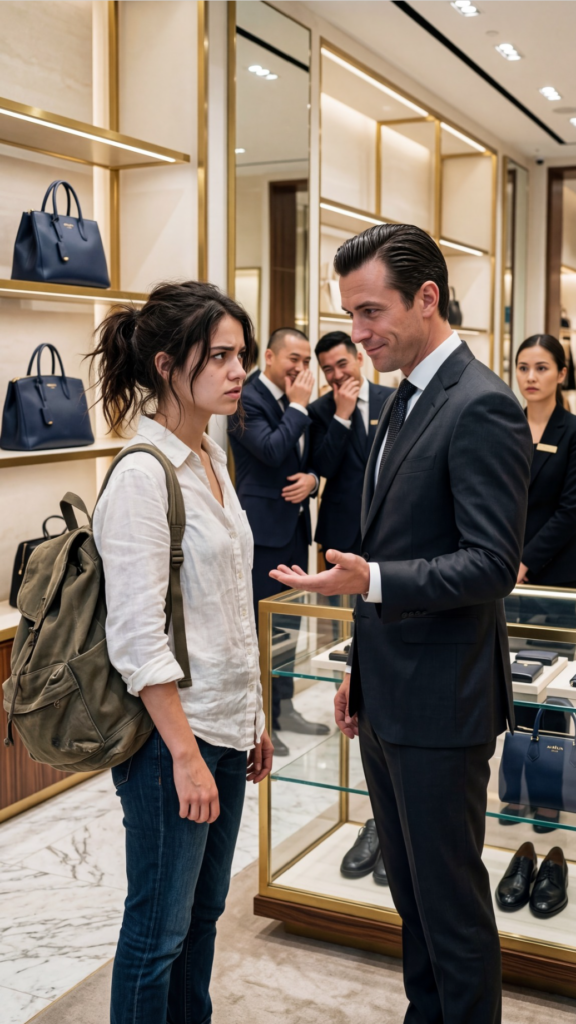
He didn’t really look at her—just cast a glance as if she were a blemish on the perfectly arranged space. Then, in French, with an elegant, cold accent, he said:“Ignorez cette femme mal habillée. Elle n’appartient pas ici.”
Ignore this poorly dressed woman. She does not belong here.The businessmen beside him chuckled softly. A restrained laugh backed by sure power and money.Madame Colette, the store’s French director, turned away. The other sales associates buried themselves in folding clothes.
No one spoke.In this world, men like Aristegui were not questioned.But something stirred in Luciana.Perhaps three years of humiliation. Perhaps the voice of her grandmother, always saying, “Dignity is never negotiable.”Luciana stepped slowly into the center of the store. She stopped before Aristegui and looked him straight in the eye.
When she spoke, her voice was calm.In perfect Parisian French, she replied:“Je crois que vous vous trompez, monsieur. Je travaille ici… et contrairement à vous, je n’ai pas besoin d’humilier les autres pour me sentir important.”I believe you are mistaken, sir.
I work here… and unlike you, I don’t need to humiliate others to feel important.Silence fell immediately.Someone dropped a glass. Crystal shattered across the marble floor.Joaquín Aristegui froze.For the first time in his life, someone had publicly confronted him—someone he hadn’t even noticed before.
Luciana didn’t linger. She simply turned and walked out of the store.She knew she had probably just lost her job.That evening, in the dim light of the hospital, Luciana held her grandmother’s hand. Mercedes’ gaze was weak but clear.“Money passes, my dear,” she whispered.
“Jobs too. But dignity… that’s the only thing that is always yours.”Luciana cried silently.The next day, however, an unexpected turn occurred.In Madame Colette’s office, there was no dismissal waiting.Joaquín Aristegui had called.He did not want Luciana fired.
He had a far more cruel plan.He demanded that Luciana personally serve the guests at the year’s most exclusive VIP event.A trap.On the night of the event, the boutique became a palace. White roses, Baccarat crystal glasses, and silver chandeliers gleamed everywhere. The fifty wealthiest people in the world filled the room.
Aristegui watched Luciana.Like a predator.He mocked her in German.Insulted her in Italian.Laughed at her in Mandarin.Luciana understood everything.But she remained silent.Exactly at nine o’clock, Mr. Tanaka, CEO of a Japanese tech giant, arrived. No one could speak to him.
Luciana stepped forward.She bowed.And spoke in Japanese:“Konbanwa. Valencourt boutique e yokoso.”The room froze.After that, Luciana conversed with the guests in German, Italian, Mandarin, English, and Portuguese.Seven languages.Flawlessly.
The guests watched, mesmerized.Joaquín Aristegui stood there, fists clenched, as his own plan of revenge slowly crumbled to dust.Mr. Tanaka eventually handed Luciana a business card.An offer in Geneva—for a position as director of international relations.
Two days later, an anonymous foundation paid the full cost of Mercedes’ treatment in Switzerland.Weeks later, as Luciana prepared to move to Geneva, there was a knock at her apartment door.It was Joaquín Aristegui.He apologized.
And revealed that his foundation had started a scholarship program for the youth of Lavapiés.As Luciana’s plane lifted off above Madrid, the city slowly disappeared beneath the clouds.And she smiled.Because she realized something.
True wealth is not measured in boutique mirrors or bank account numbers.True wealth lies in dignity, knowledge, and the courage to stand tall even when the whole world expects you to kneel.