At Saint Jude Medical Center’s emergency department, the night didn’t feel like something that passed in time—it felt like something that pressed down on everything at once. The fluorescent lights were too bright, too cold,
as if they were trying to erase exhaustion rather than illuminate it. Monitors beeped in uneven rhythms, blending into a constant electronic pulse that never allowed silence to fully exist.
I stood over bed four.And the entire world narrowed to a single child.His name was Leo.Seven years old.Too small to be fighting a battle this big.
His heart rhythm flickered across the monitor in broken, unstable lines—like it couldn’t decide whether to continue or collapse. Every beat looked like effort. Every pause felt like danger.
In medicine, you’re taught to stay objective.But objectivity doesn’t survive nights like this.
My hands moved on instinct—trained, precise, detached in motion only. Intubation kit ready. Airway secured. Checks completed. The body remembered what the mind didn’t have space to feel.
“Stay with me, Leo,” I said quietly, my voice barely more than air. “Just a little longer.”
The smell of the ER clung to everything—iodine, blood, disinfectant, and the bitter ghost of old coffee that no one actually drank for comfort anymore, only survival.
The world shrank further.Just the child.Just the machine.Just the line between life and loss.
Then, at the edge of the corridor, someone stood still where everyone else moved.Jax.The night-shift janitor.
At least, that was what he was supposed to be.
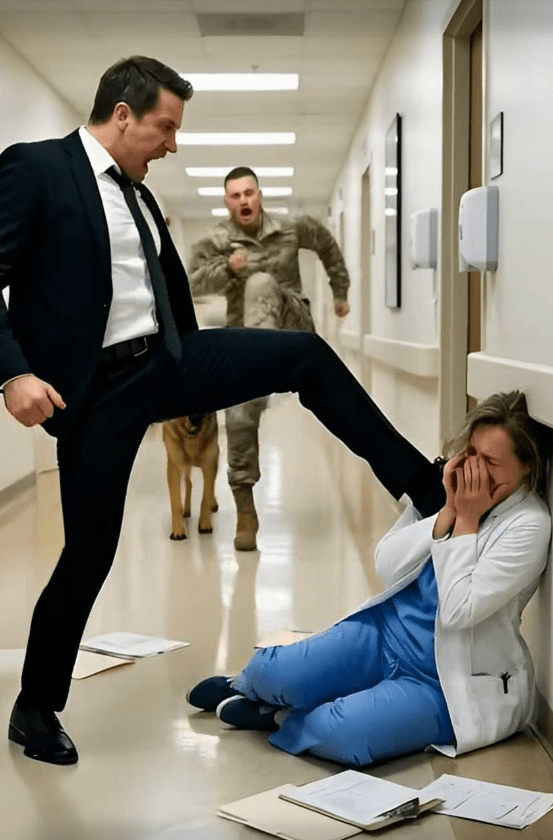
He moved slowly, deliberately, pushing a mop across the floor with a rhythm that felt almost too controlled to be casual. But he wasn’t just cleaning. He was observing.
Always observing.
Not the floor.
People.
Like he was reading something everyone else was too distracted to notice.
There was no time to think about it.
Leo’s monitor suddenly screamed—sharp, urgent alarms cutting through everything.
“Crash cart—now!” I shouted.
And the room changed instantly.
Chaos arrived with purpose.
Then the doors exploded open.
Not metaphorically.
Literally.
Julian Thorne Jr. stepped in.
Expensive suit. Expensive arrogance. The kind of presence that assumed the world would rearrange itself to accommodate him.
“Treat her immediately!” he barked, pointing like authority itself was enough to override medicine.
I didn’t look up.
“This is a critical care area. Wait outside.”
His voice snapped louder. “Do you know who I am?”
Yes.
People like him always made sure you knew.
“I don’t care who you are,” I said, focused entirely on Leo. “I’m treating a child who is actively dying.”
That was when Jax moved.
Not rushed.
Not dramatic.
Just forward.
He stepped between us like he had been there the entire time.
“Step back,” he said calmly.
Julian scoffed and shoved him.
That was his mistake.
In one fluid motion, Jax redirected him to the ground and controlled his arm with precise restraint. No violence beyond necessity—just absolute control.
“This is obstruction of emergency medical care,” Jax said evenly. “And it’s a criminal offense.”
His voice didn’t rise.
It didn’t need to.
From the hallway, a shape emerged.
A German shepherd.
Large. Scarred. Silent.
It didn’t bark.
It simply watched.
And suddenly, the room felt smaller.
More controlled.
More dangerous—for the right people.
Then the elevator doors opened again.
Hospital administration arrived.
Dr. Thorne Senior.
The kind of man who didn’t enter rooms—he occupied them.
“Dr. Miller,” he said coldly. “You are relieved of duty.”
“On what grounds?” I asked, still beside Leo.
“Gross insubordination. And collaboration with an unauthorized individual.”
The air tightened.
But Jax didn’t react.
Instead, he pulled out a device.
And the wall display changed.
Live footage.
Not just of the room.
But of everything.
Audio. Video. Data streams. Security overlays. External transmission indicators.
“This is being broadcast to the hospital’s safety compliance system,” Jax said. “And multiple external oversight channels.”
Thorne’s expression shifted—just slightly.
That small fracture of control.
Understanding.
“This includes your attempt to interfere with a critical care procedure,” Jax continued. “And your son’s aggressive disruption of emergency treatment.”
Julian started shouting again—but no one was listening to him anymore.
Because sirens were already on the way.
Real ones.
Law enforcement.
The consequences had already left the room before anyone fully accepted they had arrived.
By the time morning light entered the ER, Leo was stable.
Not because the night had been kind.
But because it had been fought through.
His heart now beat steadily—no longer panicked, no longer slipping away.
Just alive.
I sat beside him, the exhaustion finally settling into my bones like gravity catching up.
“You did well,” a nurse said softly.
I shook my head slightly. “He did.”
Jax stood near the doorway, the dog at his side.
Different now—no janitor uniform. Tactical jacket. Quiet authority that no longer pretended to be invisible.
“You held the line,” he said.
“I just did my job.”
A faint, almost tired smile crossed his face. “Most people stop before that point.”
Then he turned slightly toward the hallway.
“And that’s why people like me exist.”
“People like you?” I asked.
He nodded once.
“To make sure the ones who think they own everything… learn they don’t.”
He paused, then added:
“And to make sure kids like Leo get to keep their heartbeat.”
He left without ceremony.
Just footsteps fading into a hospital that suddenly felt less like chaos—and more like something that could be protected.
I looked at Leo again.
His chest rose.
Fell.
Rose again.
And for the first time that night, the sound of life didn’t feel fragile.
It felt real.