— Why should I be angry? — Serena asked calmly, as if she were discussing something trivial, while adding a pinch of salt to the boiling water.
— An apple thrown at a wall is nothing compared to what I’ve already survived. If you want to impress me… you’ll have to try much harder.
The kitchen froze.
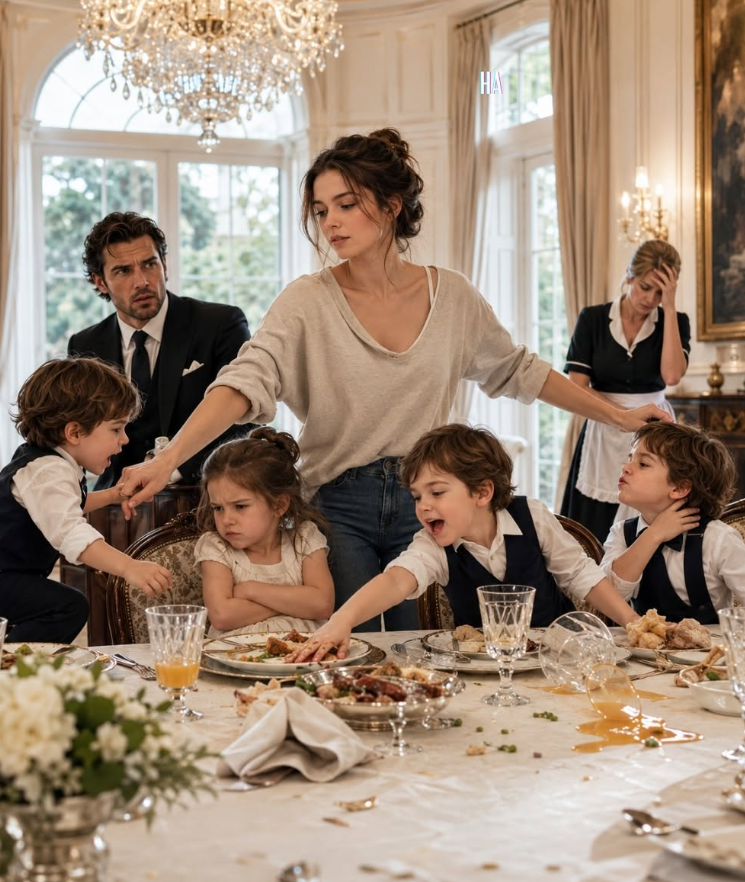
The four boys exchanged looks. This wasn’t what they were used to. Nannies usually cried, shouted, or quit within hours.
This woman, soaked, exhausted, in a cheap jacket clinging to her body, stood there as if she already belonged.
Marco, the self-appointed leader, stepped forward, fists clenched. He was only six, but he had learned to rule his world through chaos and fear. No one challenged him. No one… until now.
In the corner of the vast kitchen, Viktor Rinaldi watched in silence, his crystal glass held still in his hand. He had seen “experts,” tutors, and nannies collapse in front of his sons. But this woman was different.
She wasn’t trying to impress anyone. She wasn’t trying to win them over. She simply… existed without fear.
Serena turned on the stove. The oil heated, garlic began to sizzle, and pancetta released its rich aroma into the room. The tension didn’t disappear—it transformed. It became anticipation.
The boys, used to chaos and shouting, started to watch. Nico swallowed hard. Tommy took a half-step forward without realizing it.
— What are you making? — he asked quietly.
— Carbonara, — Serena replied without turning around. — The real kind. Eggs, parmesan, not cream and excuses.
She paused briefly, then continued:
— And the rules are simple. We eat at the table. Not on the floor. Not hiding. Anyone who wants food… sits like a person.
Marco let out a mocking laugh.
— You think pasta will buy us?
Serena slowly turned her head toward him.
— I’m not buying anyone. I’m offering a choice. Until eight o’clock.
Her eyes flicked to the clock.
— After that, the food is gone.
Her voice wasn’t a threat. It was certainty. Experience. Something final.
For a few seconds, no one spoke.
Then Tommy broke the silence.
He walked to the table, pulled out a heavy wooden chair, and sat down. Not dramatically. Not defiantly. Just hungry.
— Tommy! Get up! — Marco snapped.
But Tommy didn’t move.
— I’m hungry… — he said softly. — And it smells like when Mom used to cook.
The word “Mom” fell into the kitchen like a stone.
The air changed.
Nico lowered his gaze. Alessandro stiffened. Marco hesitated for the first time, something older than anger flickering behind his eyes.
Slowly, one by one, they sat down.
Serena didn’t smile. She didn’t celebrate. She simply continued cooking as if this outcome had always been inevitable.
She combined the pasta with eggs and parmesan. The sauce turned silky, warm, almost comforting—less like food and more like memory made tangible.
At 7:42, she placed four plates on the table.
And for the first time that evening, the house didn’t feel like a battlefield.
It felt like silence that didn’t hurt.
Only the sound of forks and spoons. And breathing that had finally slowed.
Viktor set down his glass and stepped closer.
— You did it… before eight, — he said quietly.
— It was never about the time, Mr. Rinaldi, — Serena replied without looking at him. — It was about hunger.
He studied her carefully.
— Why didn’t you shout at them? Everyone else does.
Serena finally turned to face him.
— Because the children who make the most noise… are usually the ones who haven’t been heard.
She paused.
— I learned to listen to silence.
Viktor didn’t respond right away. For the first time in years, his home didn’t feel like chaos.
It felt like something fragile beginning to become a home.